Holy God, Holy People–A Sermon for the Seventh Sunday after the Epiphany

Holy God, Holy People
Seventh Sunday after Epiphany
February 20, 2011

Well, it certainly has been an interesting week here in Madison, and events continue to unfold. Emotions are high—there’s the exhilaration of participating in protests and sitting-in at the capitol as some of our members could attest; there’s concern among many who are state workers about what the future holds; and there is the anger that can flare up when the exchange of ideas turn into shouted arguments, when ill-considered protest signs offend, and when people who want to go about their daily routine are thwarted. Continue reading →

Wisconsin and South Carolina

There are a couple of things going around the web that put my move in 2009 from Greenville, SC to Madison, WI in perspective. One of them is somewhat misleading, if memory serves me correctly.

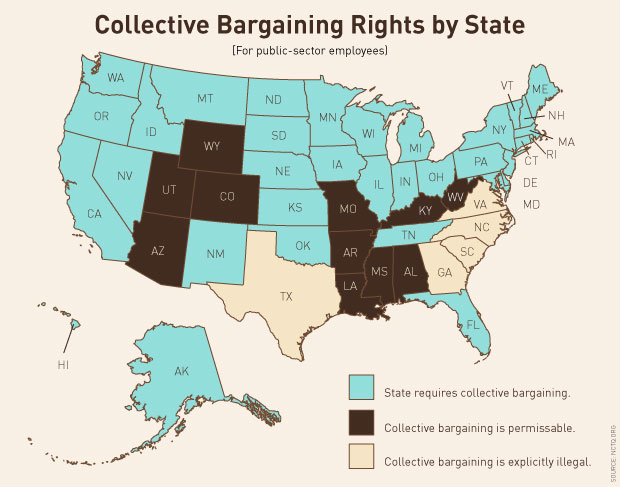
The first is the map that shows states allowing collective bargaining as opposed to those that don’t.

I’m grateful for the map because it confirmed what I had suspected. I recalled that there was some major conflict while we lived there when the state patrol attempted to organize, not even to begin a union, and were shut down.

The other is the statistic related to ACT/SAT scores which a number of sources have correlated to the collective bargaining map. It turns out, South Carolina ranks #50 on that list. This may be misleading because, if memory serves me correctly, the ACT is taken by all South Carolina High School students.

Whether or not the latter is true, what is true is that South Carolina schools are woefully underfunded and teachers underpaid. I was amazed to learn that universal public education didn’t exist in the state until the 1920s; that even then, transportation wasn’t provided. Much of that was due to racism and Jim Crow laws but it also reflected a different vision of the public good than that which was created in the old Northwest Territories by Thomas Jefferson, with the provision for a school in every township.

More surprising still was the revelation that as late as the early 1970s, school buses were driven, not by adults but by high school students who had demonstrated their maturity. Yes, that’s right (at least in Greenville County). I was sitting at a vestry dinner when I learned that. My jaw dropped. I was flabbergasted, but the Greenville County natives were shocked that I found this odd.

I know teachers and other public service workers in South Carolina who work incredibly hard for little pay and little respect. I also know that many of them struggle to make ends meet and struggle to maintain their self-respect. I am in awe of them. I am also in awe of all of those in Wisconsin and throughout the country who work hard to make our nation, our states, and our local communities better places.

One last thing. I can’t imagine protests like the ones taking place in Madison occurring in South Carolina. I remember all too well the vitriol which came about when Furman faculty members protested President Bush’s visit to commencement in 2008. But I hope that what is happening in Madison gives heart to public service workers across the country. You are patriots and we owe all of you a great deal.


A fascinating description of a recently discovered mosaic

G. W. Bowersock comments on a mosaic currently displayed at the Metropolitan Museum of Art. Discovered in Lod (ancient Lydda), the mosaic, dating from around 300 CE, depicts a number of animals, many of them exotic. Bowersock the mosaic as a whole in light of the image of a vase, with handles depicting panthers in the mosaic’s center. He argues it derives from the Dionysian cult, and that it is transmuted here in a Judeo-Christian context, with allusions to Isaiah’s prophecy of the peacable kingdom.

The full essay is here: The Lod Mosaic by G.W. Bowersock | NYRBlog | The New York Review of Books.

Nonviolence

Nonviolence has been very much in the news of late, with the uprisings in Tunisia and Egypt. The New York Times profiles one of the leading theorists of nonviolent direct action, Gene Sharp. I met Gene Sharp back in the 1980s when our non-violent efforts were directed at the proliferation of nuclear weapons and US actions in Central America. Nonviolence has been much on my mind this week, because of the gospel reading for this Sunday:

Jesus said, “You have heard that it was said, `An eye for an eye and a tooth for a tooth.’ But I say to you, Do not resist an evildoer. But if anyone strikes you on the right cheek, turn the other also; and if anyone wants to sue you and take your coat, give your cloak as well; and if anyone forces you to go one mile, go also the second mile. Give to everyone who begs from you, and do not refuse anyone who wants to borrow from you. (Matthew 5:38-42)

While it may seem on the surface that Jesus is advocating complete passivity, that is not the case. The Greek word translated here as “do not resist” could be translated more literally as “stand against.” The actions Jesus mentions, turning the other cheek, giving one’s cloak as well as coat, and going the second mile, are, as MLK and Gandhi pointed out, intended to transform the oppressor.

Here’s an interview with Gene Sharp, author of The Politics of Nonviolent Action. It focuses on events in Egypt and Tunisia, but is interesting in light of ongoing events here in Madison.

Here is the section of questions related to religion:

NS: While watching the coverage, many of us were struck by the images of Muslims and Christians protecting each other while praying. Do you think religion was a significant factor?

GS: Not from anything that I have found so far.

NS: Nonviolence and pacifism have often been historically associated with religions, like Jainism and Christian “peace churches”—

GS: Yes, that’s right.

NS: Is religion at all essential to motivating nonviolent movements, or can the ideas transcend their religious origins?

GS: It’s not even a question anymore. They have transcended religious boundaries. If people come from any particular religious group and are inspired to be nonviolent and to resist—not just to be nonviolent and passive—that’s fine. But don’t claim that they have to believe in a certain religion. Historically, for centuries and even millennia, that has not been true. Nonviolent struggle, as I understand it, is not based on what people believe. It’s what they do.

NS: But don’t cultural differences make some societies more likely to act nonviolently than others? Or is everybody equally equipped to do so, independently of their culture?

GS: Setting culture aside for the moment, not everybody is equally equipped to do anything. But when The Politics of Nonviolent Action was first published in 1973, the famous anthropologist Margaret Mead said in her review that what I was maintaining—without saying so, in so many words—was that this is a cross-cultural phenomenon.

NS: There have certainly been stereotypes suggesting that Muslims couldn’t do something like this, that they can only use violence.

GS: It’s utter nonsense. In the North-West Frontier Province of British India, the Muslim Pashtuns, who had a reputation for great violence, became even braver and more disciplined nonviolent soldiers than the Hindus, according to Gandhi. It’s a very important case. And when my essay “From Dictatorship to Democracy” was published in Indonesia, it carried an introduction by Abdurrahman Wahid, a Muslim leader who later became president.

Interfaith Event at Grace on Tuesday

Details are still being worked out, but an event organized by Madison Urban Ministries will take place at Grace Church beginning at 10:30 AM. I anticipate some sort of prayer vigil in conjunction with the Governor’s scheduled budget speech. Join us this Sunday for services! This week’s lectionary readings certainly speak to what’s happening on the streets outside of Grace.

Bishop Miller’s letter to the Diocese of Milwaukee

A Letter from Bishop Miller to the Diocese of Milwaukee


February 18, 2011


Dear Friends in Christ,

Over the last few days we have witnessed freedom and democracy at work both around the world. I am pleased to report to you that our friends in our former companion diocese of Egypt are safe and that the missionaries of The Episcopal Church serving in Egypt are continuing their ministry in that place. I know you will join me in continuing to hold the people of Egypt and the rest of the Middle East in your prayers.

This past week we have also seen democracy at work in Wisconsin as thousands gathered in Madison in response to the Governor’s Budget Bill. Regardless of our individual positions on the bill before the Legislature and what steps are necessary to build a stronger and better Wisconsin, I believe we can all agree that our baptismal vow to “respect the dignity of every human being” is not served by a majority simply pushing through legislation because they have the votes necessary to do so. As Christians, it is our duty and call to make sure that everyone has a place at the table and every voice has the opportunity to be heard. Respecting the dignity of every human being requires taking the time to have honest and faithful conversation that respects the rights and freedoms of all.

We also are called to speak on behalf of the sick, the poor, the elderly, orphans, widows, and all those who live in the margins of our society. Matthew in his Gospel reminds us that in serving these we are serving the Lord Jesus himself. It would be a sin to balance our state budget on the backs of those who have the least.

As your bishop I ask you to do two things. First, contact your representatives and invite them to true leadership by taking the time to listen to the voices of all and provide a guarantee that the voices of all will be heard on the future. Secondly, pray for elected officials daily, by name. Leading is a difficult task that requires the prayer support of many. I know that I could not lead this diocese without the prayers of each of you.

May God continue to bless us his people that we may be a witness to the world.

Yours in Christ,

The Rt. Rev. Steven A. Miller

Bishop

Reflections on the fourth day of protests

It certainly is strange to be in the middle of exciting events, and I mean, in the middle. Grace is at the corner of Carroll St. and W. Washington Avenue in Madison, directly opposite the State Capitol. Protests have been building all week but because our offices are on W. Wash., we’re not quite at the epicenter. On Tuesday, we could hear protesters coming up State St. to Capitol Square. Today, we decided to open the doors of the nave, inviting people into our space to take a break, catch their breath, pray, and relax. We will do it again tomorrow.

I walked all the way around Capitol  Square today. It’s a festive mood, not unlike Farmer’s Market–no vendors, except for the food carts. People seem to be in a good mood; they are determined, but there’s also a sense of pride in what’s taking place. Police and other security who are on the scene are in equally good moods. When fire trucks drive through the crowds on State St., the firefighters cheer the crowds. I’ve not been inside the Capitol, but am told it’s quite warm inside, packed, and that folks could use water.

Underneath the excitement are other emotions–fear and foreboding among them. The concern and stress has been building since November as those who would be most affected by the draconian cuts wonder what life will be like. It’s not just state employees who are concerned. While businesses, especially restaurants, around the square are doing a bang-up business (the line for Ian’s pizza was half-way down the block on State St. at noon), they know that they may lose many of their best customers if the worst happens.

The crowd itself was amazing. UW students, of course, teachers and other state workers. But there were demonstrators from the Teamsters and other trade unions. Bagpipers played “America the Beautiful.” Young and old, racially diverse, it was a cross section of Wisconsin’s populace.

Being in the middle of it all brings special opportunities and special responsibilities. We need to reach out to everyone, on both sides of the debate, to offer hope and healing. Making our church available as a place of prayer for everyone is one important step. But alongside that hope and healing, we also need to be clear on the biblical call for justice–especially for the widow and orphan, the oppressed and alien. Tough week to be writing a sermon, especially with this week’s Gospel reading.

Pray for me. Pray for all of us

The Gospel and the State of Wisconsin

How should communities of faith, and specifically churches, respond to the current political conflict in Wisconsin?

I’ve had as a motto, ever since Sojourners Magazine first introduced it, “God is not a Republican or a Democrat.” I believed it then, and I believe it now (just as I also don’t believe God cared who won the Super Bowl).

But God does care about justice and mercy: “But let justice roll down like waters, and righteousness like an ever-flowing stream” (Amos 5:24). To disenfranchise people, whether they are citizens of Egypt or of Wisconsin is wrong. To undo the rights of citizens, to fail to protect the needy, the poor, the widow and the orphan, is not just a political decision. It is an affront against the vision of society proclaimed by the Torah of Moses, the prophets, and Jesus.

I also know that people of good will and deep faith can disagree on matters of politics. We must be able to come together in prayer, confessing our sins, asking God’s forgiveness, and sharing in the Eucharist. To that end, we are making Grace Church available as a space of prayer and respite in these days of conflict, uncertainty, and turmoil. Many of us are worried about what is happening. We know our own perspective, the narrowness of our vision; we can also recognize the narrowness of our opponents’ vision; let us pray that God grant us the wisdom to enlarge our vision as well as that of those with whom we disagree, that together, we might create a more just and merciful society.

For another perspective, read this.

Reflecting on the lectionary with a demonstration in the background

The rally at the Capitol against Gov. Walker’s plans to balance the budget is well underway. It’s noisy, well-attended, and there’s no sign of the National Guard (lots of cops though).

Next Sunday’s reading from Leviticus 19 challenges us to think about what sort of society, what kind of justice we should envision. It demands care for the poor, equal justice for rich and poor, and love of one’s neighbor. Christians tend to personalize such demands, when they attend to them at all, turning them into a guide for interpersonal relationships rather than the vision of a just society imagined in Leviticus and elsewhere in both the Hebrew and Christian Scriptures.

We are also in the midst of the Sermon on the Mount, where Jesus reinterprets Torah, in many ways intensifying its demands, for example, turning the call to love one’s neighbor, into a call to love one’s enemy, as well. One might say that he is reimagining the just society to include not just the people of Israel, but all of humanity.

Such clear calls for justice and love challenge us to think clearly about the society in which we live and what God is calling us to be and do.

There’s another rally scheduled for tomorrow at noon, same time as our Wednesday service.

“The Rise and Fall of the Bible”: Rethinking the Good Book – Laura Miller – Salon.com

Laura Miller writes in Salon about Timothy Beal’s new book on the Bible in American culture.  Entitled The Rise and Fall of the Bible: The Unexpected History of an Accidental Book, Beal’s work describes “biblical consumerism,” a situation in which the average American household owns nine bibles, purchases one a year (so what happened to the others), and yet most Americans are biblically illiterate.

Some of the most interesting chapters in “The Rise and Fall of the Bible” explore the world of Bibles created for specific subcultures and needs: the manly Metal Bible and Duct Tape Bible, kicky handbag/Bible combos and special editions geared toward teenagers, African-American women and so on. These can contain as much as 50 percent “supplemental” material, “explaining” the scripture according to the taste of the intended audience. Then there are Biblezines, publications in which articles about how to grill steaks or talk to girls (in the case of a Biblezine for boys) share the page with biblical quotations. Well-meaning older relatives give this material to young Christians, hoping it will make the Bible itself seem more “readable.” Beal thinks the kids just wind up reading the articles and skipping the quotations. He compares Biblezines to the “sweeter and more colorful roll-ups, punches, sauces and squirtable foams that I buy for my kids’ lunches” in lieu of the unprocessed fresh fruit they refuse to eat. At least you can tell yourself you’re giving them fruit.

Beal bemoans biblical illiteracy and those who want to interpret scripture literally. In fact, he sees a direct relation between the proliferation of niche bibles and the end of a search for certainty in scripture. I’m not so sure, and while I find the marketing of bibles to small subgroups of the population both odd and somewhat amusing, I don’t know that contemporary “biblical consumerism” is all that much different from what happened in earlier generations.

Take the Gideons, for example. They provide bibles in hotel rooms, hospitals, and the like, and distribute them on college campuses and elsewhere. I can’t remember where I was teaching at the time, but I recall coming into class one day (a Bible class, no doubt) and the students were joking about the New Testaments that were being passed out on the sidewalk.

For those passing out the bibles, they are a symbol of their own faithfulness as well as a means of reaching out and converting people. In past generations, a bible had a pride of place in many homes–a lavishly illustrated and bound volume displayed on an end table or coffee table in a living room. I doubt whether that particular bible was opened and read but its presence sent a message to all who saw it.

My sense is that the consumerism Beal describes has much more to do with the commercialization of Christianity–companies trying to make a buck–than with profound changes in biblical interpretation in the culture. Need a gift for a graduate? Why not buy the college-student’s bible?

Yes, there is rampant and growing biblical illiteracy, even in the South, and even among conservative Christians. It always amused me when freshmen figured out in the second week of class that the Bible course they took because they were certain it would be easy, turned out to be much more difficult than they anticipated, because in spite of their deep faith and regular church-going, they only ever read bits and pieces, at most. Then there was the kid who after I made an aside in another class, asked who Adam and Eve were.