She Laughed: A Sermon for Proper 6A, 2026

What would you do if three strange men appeared at your front door this afternoon? Would you welcome them in, offer them a shower and a meal, and somewhere to rest? Or would you send them away with nothing? Today we heard the story of Abraham’s encounter with three men by the oaks of Mamre. It turned out that they weren’t any old ordinary men. Instead, it was God, Yahweh, appearing before Abraham. It was God to whom Abraham offered hospitality, and gave him the reputation in the later tradition that he had entertained angels unawares. 

It’s an ordinary scene, depicted with detail that allows our imagination free play. We imagine Abraham trying to find some cool spot in the midst of a heat wave, sitting in the shade of his tent, or of the oak trees, watching idly, perhaps dozing, as the three men approach. Sarah, as befits ancient near eastern custom, is probably well within the tent. But when the men approach, Abraham draws their attention to him—he runs to them, begs them to stay with him for awhile. Abraham has their feet washed, instructs Sarah to begin preparing a meal, and he himself throws the steaks on the grill.

Last week we heard the story of his call. Today’s reading takes place 25 years later. Abraham and Sarah have been in Canaan all of that time. God has promised Abraham that he will possess the land of Canaan and that he will be the father of a great nation. Just before today’s reading, God had again promised Abraham that he would father a son with Sara; when he heard this, Abraham laughed. In today’s reading, of course, Sarah laughs when she hears the same words. When their son is born, he is named “Isaac”—which can be translated “he laughs.”

The Bible presents Abraham and Sarah to us as the parents of the Hebrew people, the ancestors of Judaism, and as Paul would have at, the progenitors of our faith as well. But the stories themselves raise more questions than they answer. One of the most obvious is raised in the text by Sarah herself: Can an old woman give birth to a son? Her barrenness is a theme that will continue for the wives of Abraham’s son and grandson—Isaac’s wife Rebekah, and Jacob’s wives Leah and Rachel, all suffered, at various times, from barrenness. It is a theme that is meant to underscore the miraculous nature of these births—that they were not simply a product of nature, but of God’s acting on behalf of God’s servants.

But there is more to this story than a prediction of Isaac’s birth, and of Sarah’s laughter. There is another enigma. Why is it three men that appear to Abraham? It is only in the course of the story, after the meal, that it becomes clear one of the men is no man at all, it is God, Yahweh. God’s first unmistakable act in the story is to chastise Sarah for laughing at the prediction of Isaac’s birth. This is not the end of the story, however. The three men separate, two of them make their way to Sodom, where Abraham’s nephew Lot will encounter them, and just as his uncle did, will invite them into his home and offer them a meal. The third, who now is clearly God, tarries for a time with Abraham. God tells Abraham that he intends to destroy Sodom and Gomorrah, and Abraham bargains with him.

We have two acts of hospitality here—Abraham’s welcoming of the three men, and Lot’s welcoming of the two men, two acts of hospitality. In Abraham’s case, it is an opportunity for God to repeat the promise that Abraham will be the Father of a great nation and indeed, it seems from the text that it is during this visit that Sarah miraculously becomes pregnant.

That hospitality is at stake in the story of Sodom and Gomorrah is seldom noticed by most casual readers of the Bible. Other biblical texts, for example, Ezekiel 16:49 reads: “This was the guilt of your sister Sodom: she and her daughters had pride, excess of food, and prosperous ease but did not aid the poor and needy.” 

And indeed, even in today’s gospel, the connection between Sodom and hospitality, while not explicitly stated, is clearly at issue. Jesus tells his disciples that “If anyone will not welcome you, shake the dust from your feet as you leave that house or town” and then predicts that things will be worse for that town on the day of judgment than it was for Sodom and Gomorrah. God’s judgment on that town will be worse than God’s judgment of Sodom and Gomorrah—and the only offense, the refusal to welcome Jesus’ disciples.

Today’s gospel is a central passage from Matthew’s gospel. It recounts Jesus’ commissioning of the twelve for mission. The context within which Matthew places it and the way in which he tells it, reveals a great deal about how Matthew understands the role of the disciples. Jesus commissions them in response to his experiences in Galilee. He has been going about Galilee, teaching and healing. 

Matthew tells us that Jesus “had compassion” for the crowds; the Greek implies he felt it down in his gut. His commissioning of the disciples is an extension of his own ministry. It is a response to the need he perceives. The commissioning extends Jesus’ ministry and authority to the disciples. They are not going to be lone rangers, out doing their own thing. They are extensions of Jesus. And of course, the tasks Jesus gave them to do were clearly laid out, he told them what to wear, how to act, who to be.

In a nutshell, Jesus gives the twelve instructions for the journey on which they are embarking, his own journey that they are extending. The instructions may seem puzzling, even unimportant, why no bag, no sandals, no staff, only a single tunic? Over the centuries, some Christians have interpreted these words literally—they have been the basis for some powerful missionary movements, like the work of St. Francis of Assisi in the Middle Ages. But what’s important about them is the underlying message. There is an urgency in Jesus’ words: “the fields are white unto the harvest.” There is also a strong sense that the twelve should be traveling lightly; they should be equipped for the journey but be carrying nothing unnecessary.

I am intrigued by the three very different responses to the situation in these stories. When Abraham sees the three men approaching, he runs out to greet them and welcomes them in. Jesus sends the twelve out because he had compassion for the needs he saw around him. And then, Sarah laughed. The instructions given by Jesus seem utterly serious, and they are, because the need is so great and urgent.      

These texts challenge us to consider our response to the presence of God, and to God’s call. As Abraham ran out to meet the stranger, as the disciples went out to spread the good news, we are challenged to welcome the stranger, and to be the stranger. We are challenged to offer hospitality and to be willing to receive it. These lessons are a useful reminder to us. How is God challenging us right now? What are we supposed to do? Who are we supposed to be? 

With the needs in the surrounding community and in the world so great, and our own uncertainty about the future gripping us, we are probably tempted to maintain a holding pattern, to keep things as they are, to muddle through. But the example of Abraham and Jesus both confront us. By faith, Abraham left Haran for Canaan when he was 75 years old; he wandered around Palestine for 25 years after God had promised him the land and descendants. After all of that, and yes, Abraham did put God to the test once or twice, he welcomed the strangers in, and received another promise, that was fulfilled in nine months

As God calls us, individually and as a parish, to be God’s people in the world, we need to step forward boldly, and in deep faith that God is leading us forward, not looking back at the past, or worrying about the future, but confident of God’s presence in our midst. And, like Sarah, there may be times when we need to laugh, too.

The Calls of Abraham and Matthew: A Sermon for Proper 5A, June 7, 2026

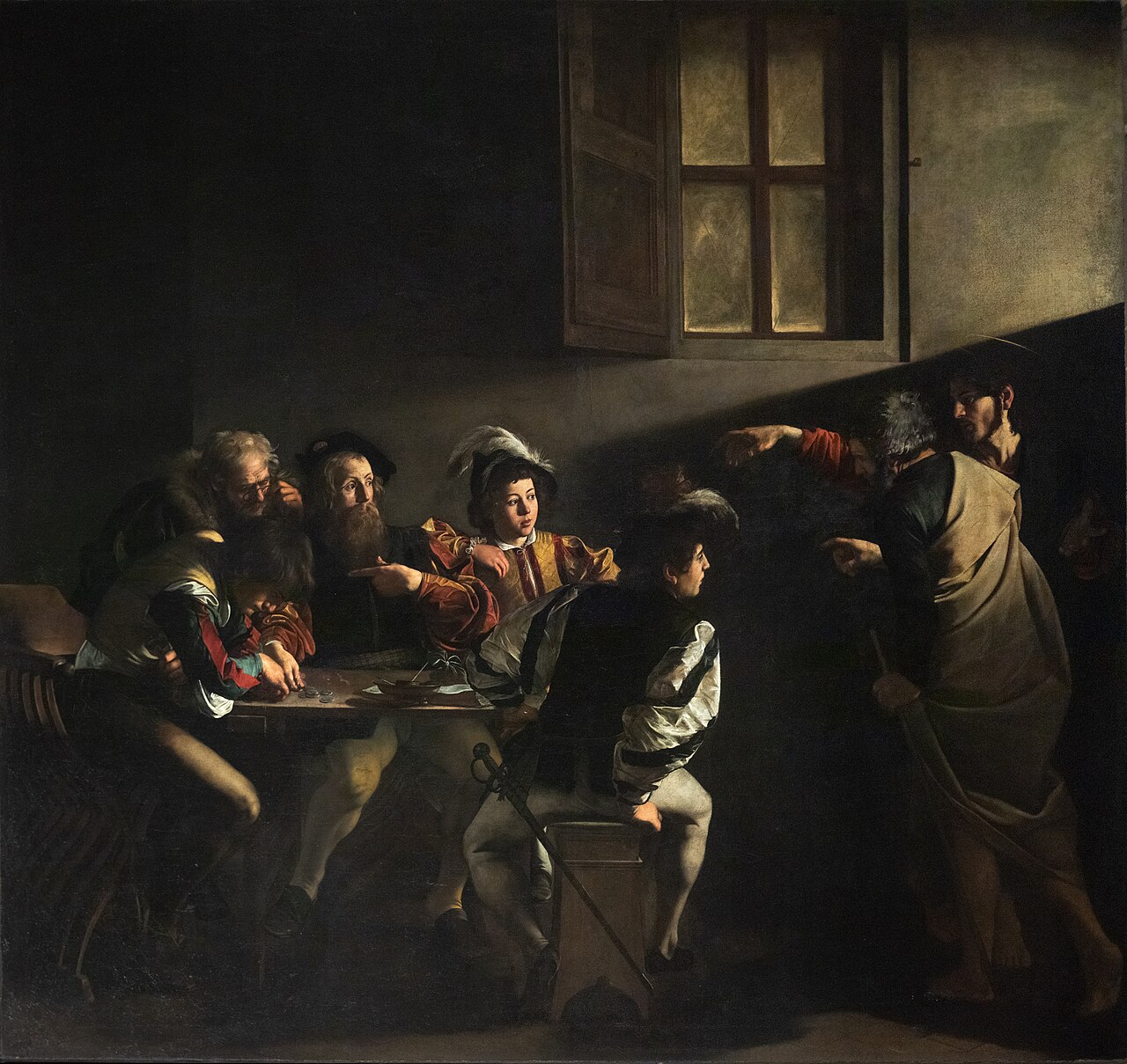
Caravaggio, The Call of St. Matthew 1599-1600, Wikimedia commons

Let me begin by providing some orientation for you. Today, we enter the long season after Pentecost, which continues right until November 29 which is the first Sunday in Advent and the beginning of the new liturgical year. In Roman Catholicism, this is called “Ordinary Time” not to distinguish it from the “special” time which precedes it, but because it is measured by ordinals—numbers. So we are on Proper 5, “propers” referring to the appointed collect and lessons for the day.

         In a sense, though, it is “ordinary” because we have just come out of that part of the calendar that focuses on the birth, baptism, crucifixion, resurrection and ascension of Christ. The great feast days of the liturgical year lie behind us and our gospel readings will focus on Jesus’ teachings and his miracles. We are settling in for the summer, with its slower pace and rhythms, and “ordinary time” seems an apt name for it.

         One more thing to which I would like to draw your attention. Since 2006 or so, the Episcopal Church has authorized the use of the Revised Common Lectionary for our Sunday readings. It is a lectionary shared by the mainline denominations and increasingly by other Christian denominations and churches. One of its innovations was to offer optional readings for the first or Old Testament reading during the Season after Pentecost. 

There are two tracks. Track 2 roughly conforms to the traditional Book of Common Prayer lectionary, which selected Old Testament readings that in some way reflected on the day’s gospel reading. The chief benefit of that approach is to provide some thematic unity to the readings. But it has two drawbacks in my view. The first is that it removes the Old Testament texts from their larger narrative contexts which can lead to confusion. The second, and in my view, more significant drawback is that it leads to a Christological, or even supersessionist interpretation of the OT text, reading it in light of our Christian faith, rather than taking it seriously on its own terms.

         Track 1, on the other hand, offers a semi-continuous reading of Hebrew Scripture. In this year, year A, we will be reading the stories of the patriarchs; year B focuses on the monarchy, and year C on the prophets. We will be following track 1 this summer, and as you heard, we begin with the story of the call of Abraham.

         As a final note before digging into the text, I would like to remind you of where this story comes in Genesis. Last week, on Trinity Sunday, we heard the story of creation as presented in Genesis 1. In the beginning when God created the world, the earth was a formless void and darkness covered the face of the earth. Then comes the creation of the man and the woman, later identified as Adam and Eve; the story of Cain and Abel, Noah, and the flood, and finally, in chapter 11 the Tower of Babel, and the dispersal of humanity throughout the world.

         Now, like one of those movie shots that begin with a panoramic view and slowly zoom into a detail, the narrator focuses in on a single family, a single man. Abram. It’s an archetypical story, perhaps the archetypical story for the related traditions of Judaism, Christianity, and Islam, because each of these traditions look to Abraham as the progenitor of their faith.

         In the brevity and simplicity of this story lies profundity, much of it unspoken but implied. God spoke to Abram: “Go from your country and your kindred and your father’s house to the land that I will show you. I will make of you a great nation, and I will bless you.” So Abram goes, taking with him his wife Sarai, his nephew Lot, all of his possessions and “the persons (ie., slaves) that they had acquired in Haran” and went to the land of Canaan.

         We’re not told why God chose Abram or why Abram obeyed. We’re not told whether his wife Sarai had anything to say about the decision. And of course, none of the slaves who were taken had any choice in the matter. There’s no mention of “faith” in the text, no matter how much St. Paul reads faith into it from the Romans lesson. 

         We might wonder, as the rabbis whose reflections were included in the Talmud, why God chose Abram. One of the most intriguing of their thoughts was that perhaps God had called many people before calling Abram, but Abram was the first to respond and follow God into the unknown.

         We might ask the same question about Matthew. The story of the calling of Matthew in Matthew’s gospel is as brief and puzzling as the story of Abraham’s call. Jesus sees him sitting at the tax booth, tells him to follow him, and Matthew gets up from the table and follows Jesus. He was clearly not qualified, not fit to be a disciple of Jesus, as the subsequent discussion of tax collectors and sinners reminds us, but nonetheless, Jesus called him, and he followed.

         Although it’s in black and white, and a relatively poor reproduction, the cover image on our service bulletin may be the most famous depiction of this story in all of Art History. Painted by Caravaggio around 1600, it is as enigmatic as the stories we’ve heard. The light seems to focus on the figure in the center of the image. But is that figure Matthew? At the end of the table is another figure, slumped down, his hands fingering the coins spread around. Is that Matthew, is that the one Jesus is calling? The ambiguity intrigues us; we wonder what the painter might have had in mind.

         Then there’s Caravaggio himself. One of the greatest of all painters in the European tradition; a figure of mystery himself. His biography raises all kinds of questions, not least the one many ask today; can bad people create great art? In Caravaggio’s case, the answer has to be yes. Convicted of murder and sentenced to death in Rome, fled to Naples, where eventually he would end up in another fight and a disfigured face. He died in uncertain circumstances, perhaps of illness, perhaps of lead poisoning, perhaps of murder.

         We hear lots of talk about “call” in church settings. Mostly, when we hear discussions of it, our focus is on call to ministry, discernment of a call to holy orders as Grace members Roger and Eileen have been undertaking. But call is much broader than that. Christianity is not chiefly about believing this or that doctrine, or attending services from time to time or even regularly. It is about discipleship—following Jesus. 

         We may resist such language, the image of call, because we don’t think we are worthy of it, that Jesus isn’t calling us, or couldn’t want us to follow him. It’s likely that many of us even think that if anyone is doing the call, it’s us who call Jesus when we need his presence or comfort in our lives. We want him to meet us here and now, and leave us alone when the crisis is over.

         But discipleship isn’t like that. Jesus calls us to follow him, into the future, into the unknown. He calls us where we are, and takes us new places and new directions. He encourages us to leave the past behind, with all of its suffering, brokenness, and sin, and open ourselves to his grace and mercy, as he re-creates us in his image and likeness. May we be open to Jesus’ call, receive his mercy and grace and be made into his disciples.   

God’s faithfulness and our faith: A Sermon for Proper 14C, 2019

The lectionary for the season after Pentecost gives us 2 options for the first reading, the Old or First Testament lesson. One option is called semi-continuous and provides an overview of the stories and texts of the Old Testament, so that, if you came to church every Sunday every summer, over the three years you would get something of a sense of the entire testament. The other option hews more closely to the lectionary of the 1979 Book of Common Prayer. In this option, texts from the Old Testament were selected for their relevance to the Gospel reading of the day. Continue reading

God tested Abraham: A Sermon for Proper8, Year A 2016

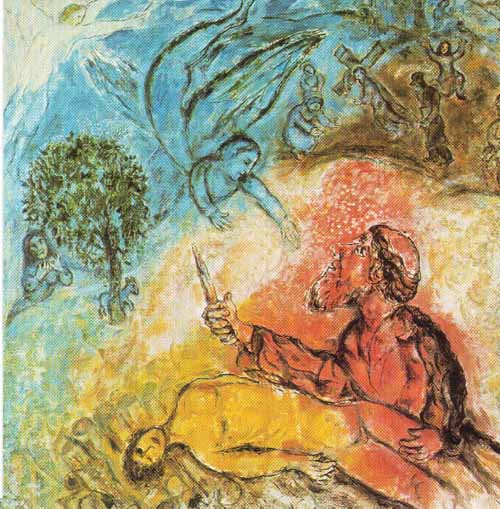
Marc Chagall, The Sacrifice of Isaac, 1966

We’ve been reading the story of Abraham these past few weeks, and today we hear the most dramatic episode in his story. Indeed, this may be one of the most dramatic stories in all of scripture. It confronts us with a horrific dilemma and its implications concerning God’s nature and the nature of the relationship between human beings and God, the nature of faith, are deeply unsettling. Continue reading

Hagar’s Tears: A Sermon for Proper 7, Year A 2016

When the water in the skin was gone, she cast the child under one of the bushes. Then she went and sat down opposite him a good way off, about the distance of a bowshot; for she said, “Do not let me look on the death of the child.” And as she sat opposite him, she lifted up her voice and wept.” Genesis 21: 15-16

These verses, from Genesis 21, our reading from the Hebrew Bible this morning, are terrifying and heartbreaking. They tell the story of a mother at wit’s end, facing the death of her beloved child, and her own death. She is hopeless and in despair. And in her situation, she is like so many others in our world, victims of violence and oppression abandoned by their families, their society, their fellow humans. Hagar is like all of the refugees in the world, looking for a safe place to live. She is like all the mothers in the world, searching for food and water for herself and her children. She is like the millions in our nation who are staring at a future with no safety net, no healthcare, no hope. Continue reading

Ordinary Time: A Sermon for Proper 6, Year A, 2017

Today marks an important transition in our liturgical calendar, marked by the change in colors. We are now in the long season of green, the season after Pentecost which will continue right through into the last Sundays of November. There’s a shift in emphasis as well. The liturgical year begins with the Season of Advent, a time of preparation and waiting the commemoration of the birth of Jesus, and from that point on, we follow, roughly, the life of Jesus, remembering his baptism, his death and resurrection. Now, we are focusing on Jesus’ teaching and ministry. We are finally returning to the Gospel of Matthew and for the next five months we will hear stories taken from Jesus’ preaching and miracles. The Roman Catholic Church calls this season “Ordinary Time.” In this case, ordinary doesn’t mean normal as opposed to special or extraordinary; rather it stands for ordered, or numbered, time. Still, it’s a term I love because there is a sense that the season in which we find ourselves now provides us an opportunity to reflect what it means to follow Jesus in our daily lives, rather than focusing on the events of Jesus’ life.

In that sense, our gospel reading is particularly important as we begin this season. It’s the story of Jesus sending out his disciples on his behalf. More about that in a bit. First, I would like to take some time to introduce the Hebrew Bible reading.

Today’s lesson from the Hebrew Bible is drawn from the stories of Abraham. You may remember that God called Abram to leave his parents and his home to go the land of Canaan, which God promised Abram would become his possession. Today’s reading takes place 25 years later. Abraham and Sarah have been in Canaan all of that time. God has promised Abraham that he will possess the land of Canaan and that he will be the father of a great nation. Just before today’s reading, God had again promised Abraham that he would father a son with Sara; when he heard this, Abraham laughed. In today’s reading, of course, Sarah laughs when she hears the same words.

There are profound mysteries in the stories of Abraham and Sarah in the Hebrew Bible. The Bible presents Abraham and Sarah to us as the parents of the Hebrew people, the ancestors of Judaism, and as Paul would have at, the progenitors of our faith as well. But the stories themselves raise more questions than they answer. One of the most obvious is raised in the text by Sarah herself: Can an old woman give birth to a son? Her barrenness is a theme that will continue for the wives of Abraham’s son and grandson—Isaac’s wife Rebekah, and Jacob’s wives Leah and Rachel, all suffered, at various times, from barrenness. It is a theme that is meant to underscore the miraculous nature of these births—that they were not simply a product of nature, but of God’s acting on behalf of God’s servants.

But there is more to this story than a prediction of Isaac’s birth, and of Sarah’s laughter. There is another enigma. Why is it three men that appear to Abraham? That the story begins in this way: “The Lord appeared to Abraham … he looked up and saw three men standing near him.” Christians have interpreted this to be a reference to the Trinity—we’ve reproduced Rublev’s famous icon of the trinity on the front page of the service bulletin. It’s a depiction of this very scene.

It is only in the course of the story, after the meal, that it becomes clear one of the men is no man at all, it is God, Yahweh. God’s first unmistakable act in the story is to chastise Sarah for laughing at the prediction of Isaac’s birth. This is not the end of the story, however. The three men separate, two of them make their way to Sodom, where Abraham’s nephew Lot will encounter them, and just as his uncle did, will invite them into his home and offer them a meal. The third, who now is clearly God, tarries for a time with Abraham. God tells Abraham that he intends to destroy Sodom and Gomorrah, and Abraham bargains with him.

These stories of the patriarchs—we’ll be reading them all summer and fall, are not primarily history. Scholars debate whether there are any historical figures or events underlying them and there are plenty of anachronisms and other problems with them to call them into question. They are first and foremost stories that the people of Israel told themselves to explain who they were and who their God is, stories of God’s faithfulness and God’s choosing them, and God’s blessing of them. But they are also stories that explain the character of Israel as a people. Abraham and Sarah both laughed when God promised them a son in their old age, and just a few verses later, we will see Abraham bargaining with God over the fate of Sodom and Gomorrah.

God’s call. We something of the same theme in the gospel story. As I said earlier, this is a good story to bring us back to the gospel of Matthew and to re-start our engagement with that gospel after the season of Easter. We are provided a summary of Jesus’ ministry, a recap, if you will:

Jesus went about all the cities and villages, teaching in their synagogues, and proclaiming the good news of the kingdom, and curing every disease and every sickness. When he saw the crowds, he had compassion for them, because they were harassed and helpless, like sheep without a shepherd

Matthew tells us that Jesus “had compassion” for the crowds; the Greek implies he felt it down in his gut. His commissioning of the disciples is an extension of his own ministry. It is a response to the need he perceives. The commissioning extends Jesus’ ministry and authority to the disciples. There’s something of an irony here. Jesus tells his disciples to pray for laborers to go out into the harvest, but then he sends the twelve out themselves. In other words, they themselves are the ones for whom they are praying. Jesus commands them to do exactly what Matthew has just told us he has done: proclaim the good news that the reign of God has come near; cure the sick, cleanse the lepers, raise the dead, cast out demons. The only difference is that Jesus told them to do their work only among fellow Jews (that is important for the gospel—at the very end of course, Jesus will command them to go into all the world, making disciples of every nation).

We are in ordinary time—this term has a particular resonance for me as this is my first Sunday back after four weeks of an extraordinary vacation, during which I thought little about the challenges facing our globe, our nation, our city, our church. But those challenges remain—gun violence, climate change, racism, and another reminder of the systemic oppression and violence faced by African-Americans with the acquittal of the police officer who shot Philando Castile.

Ordinary time—it is a time for us to hear God’s call to us, as God called to Abraham; a time for us to see the need in the world as Jesus did, to have the compassion Jesus had. It is a time to pray for laborers, to be those laborers. It is a time to accept his call to us, his sending us out, to proclaim the good news that God’s reign is near; to heal the sick and broken-hearted, to work for justice and peace.


Lectionary Reflections: The Season after Pentecost, Year A

This week’s readings are here.

I’m surprised this year by the abrupt changes in the lectionary in this season after Pentecost. As we move into Ordinary Time, there are almost no sign posts or markers to help us orient ourselves to the Sunday readings. The Gospel plops us back into the middle of Matthew, which apart from its appearance on Trinity Sunday (28:16-20), we’ve not encountered since Holy Week and Easter. And even that was something of an intrusion into our long sojourn with the Gospel of John (from the Second Sunday of Lent through all of the Sundays of Easter). The gospel reading includes sayings about discipleship that are quite challenging but consistent with Matthew’ overall depiction of Jesus.

Almost as disorienting is the reading from Genesis (we’ll be following Track I or the “semi-continuous” readings from Hebrew scripture). But again, we’re plopped into the middle of a much longer narrative arc. We hear the difficult and distressing story of Abraham casting Hagar and Ishmael out into the wilderness. This comes long after God’s call of Abraham in Genesis 12; long after the promise that Abraham and Sarah would give birth to a mighty nation; after Abraham’s two attempts to take matters into his own hand (first by naming Eliezer as his heir, then by impregnating his slave Hagar). The story of Abraham is a story of call and response, of the covenant God made with Abraham, a story of Abraham’s faith and God’s faithfulness, and a story of promises deferred. Abraham’s story ends with the only land he possesses the burial plot he purchased for Sarah, and his only offspring a son Isaac.

Even the lesson from Romans comes as a surprise with no back story. I’ll be writing about that separately in the next couple of days as part of my summer’s exploration of Paul’s letter to the Romans


Heroes, Faith, and God’s Promises: A Sermon for Proper 14, Year C

After 45 years, I can still rattle off the starting line-up for the Detroit Tigers World Series championship team of 1968. I listened to every game on the radio, read about them in the paper the next day. They were my heroes. I’m not much of a baseball fan anymore except if the Tigers are winning (which they are right now). It’s just not the same now. It’s become big business, entertainment and it’s hard to look at any of the players, any professional athlete of any sport, with any sort of adulation. And now this week with Brewers star Ryan Braun suspended and the Yankees’ Alex Rodriguez facing a ban through all of 2014, we know that every player’s stats are now tainted by the possibility that they have used performance enhancing drugs. But in other areas of life, it seems like people who we want to emulate, people who are held up as role models, inevitably have feet of clay. Continue reading

Entertaining Angels and Strangers: A Sermon for Proper 11, Year C, July 21, 2013

Proper 11, Year C

July 21, 2013

Take a minute. Look around the pews a minute. If you’re a visitor this morning, never been here before, were you welcomed? Did anyone greet you, ask your name, thank you for coming? If you’ve been coming a few months or even years, do you know the names of the people sitting next to you in the pews? If you’re a long time member, is there someone you’ve seen before, perhaps many times, but don’t know their names or anything about them? Well, here’s your opportunity. Take a few minutes—don’t start chatting with someone you know, start chatting with someone you don’t know. Continue reading