
What, me worry? A sermon for the Eighth Sunday after Epiphany

What? Me Worry?
Eighth Sunday after Epiphany
February 27, 2011

I took a call this week from someone who was totally frantic. He was facing homelessness for the first time, due to circumstances outside of his control, and he didn’t know what to do. The fear and anxiety came through as he spoke. I spent some time trying to calm him down, and then I walked him through the steps he could take to address the situation in which he now found himself. I was also able to help him with one of his immediate needs, as well provide a little orientation to the Men’s Drop-In Shelter here at Grace.

I’ve had several such conversations this winter with men who are in a completely new situation, often in a place that they know nothing about. They are completely disoriented, both geographically, and with regard to their lives. They don’t know what to do; they don’t know where to turn for help. By the time they come to me, they are often at wit’s end. All I can do is help get them oriented to the homeless shelter and hope that they can survive in a cold winter with no personal resources and few social services available to help them.

I’m increasingly aware of the anxiety that seems to be pervasive in our world these days. You can sense it when you walk around Capitol Square—police officers from out of town who aren’t sure what’s going on and why they’re here; protesters who are deeply frightened about what might happen; state workers who are concerned about what’s going to happen to them. Workers in the restaurants and other businesses that line the square are frazzled too. For many of them, every day brings another crowd of customers. They’re happy for the money and the tips, of course, but they also need a rest.

We may be feeling it more dramatically here than elsewhere in America, but there’s no question that we are an anxious people right now. We are worried about our own livelihoods, our personal family futures, and the future of our country. Many of us are also deeply concerned about the future of our planet. Worry seems to be a constant in our lives. We do all sorts of things to reduce our anxieties. We take medications, some of us self-medicate. We search for distractions. We may try to wall ourselves off from our neighbors and the world by turning off the tv.  We may seek to insulate ourselves with wealth, and luxury. In the end, nothing can secure us from our angst.

To hear today’s gospel with such a background is startling. The incongruities are piling on. In the last weeks, we have heard Jesus make radical statements like if you call your brother or sister a fool, you are liable for hellfire, someone who lusts in their heart has already committed adultery, and if someone hits you on your right cheek, turn your left and allow them to hit you on your left. These statements, commandments really, are so far away from our personal experience and perspectives that most of us cannot imagine living according them. When do see someone who lives in that way, people like Gandhi or MLK, we quickly are inclined to revere them as saints or something more than human.

Today’s gospel seems to be in the same vein. How can we not worry? How can we not plan for tomorrow? To do otherwise would seem to be irresponsible. All of the worries that swirl around in our minds, compounded by the events that occurring around us in Capitol Square, all of those worries are certainly legitimate. They are very human responses to the lives we are living and the situations in which we find ourselves.

But is there good news in these words from the gospel? Are there words that can help us get necessary perspectives on our lives and on our world and experience the grace of God? We might be tempted to say that “God will take care of everything” or just pray, or trust in God, and it will all work out. But many of us no all too well that such statements ring hollow and false in the face of the real challenges we face—whether it’s our economic well-being, our health, whatever.

To answer these questions, it might be helpful to look back to other texts we heard today, in particular, the reading from Isaiah and the Psalm. The reading from Isaiah clearly dates from the period of the exile, when the elites of Jerusalem and Judah had been forced into exile by a victorious Babylonian empire. It begins with the prophet promising deliverance to a disheartened people, assuring them that they will return to Jerusalem, and that God will take care of them on that difficult journey. Yahweh speech ends with a statement that God has comforted God’s people and had compassion on those who suffered.

These words rang hollow to the exiles as well, who replied to these promises by saying that God had forsaken them. To this, the prophet replied, using a surprising metaphor: “Can a woman forget her nursing child, or show no compassion for the child of her womb?” Comparing God to a nursing mother, the prophet reminds God’s people that a mother’s love is a powerful bond that unites her with her child.

That same image is picked up in the Psalm, which some scholars think was written by a woman who is describing her own experience. It begins with a stunning reversal of the sursum corda, the words we sing or say at the beginning of our celebration of the Eucharist. In the Instead of “We lift our hearts unto the Lord” the NRSV translation of the Psalm reads, “My heart is not lifted up.” For whatever reason, the Psalmist cannot praise God. But the psalm continues, saying that in spite of all the trouble that may be taking place:

I still my soul and make it quiet

Like a child upon its mother’s breast

My soul is quieted within me

We might think, from our translation, that the Psalmist is using precisely the same imagery here as the prophet did in Isaiah. That’s not the case. Where Isaiah likened God to a mother nursing her child, the force of the Hebrew in the Psalm implies the child has been weaned. No longer dependent on her mother for all nourishment and protection, we can imagine a toddler, eager to explore the world, yet often in need of comfort.

Two slightly different, yet equally comforting images of a God, who like a mother, loves and cares for her child. To remember those images, the notion that God is like a mother who loves, nourishes, and comforts her child, helps us put Jesus’ words about not worrying in proper perspective. Instead of hearing them as instructions on how to live our life, plan for tomorrow, or even plan for the rest of our lives, Jesus is reminding us that our lives are ultimately held within God’s loving embrace.

To hear those words, and to experience that embrace can give us the assurance that in the midst of a difficult and uncertain world, with all sorts of concerns and worries swirling around in our heads, our lives are in God’s hands. We may continue to struggle to find security in our lives by accumulating status and wealth, by grasping for security. Some of us may respond to our uncertainty, and our fears, by protesting. In the midst of all that, in the midst of the chaos, confusion, and conflict that surrounds us, let us remember God’s loving embrace, taking comfort in that love, and drawing strength for the journey that lies ahead.
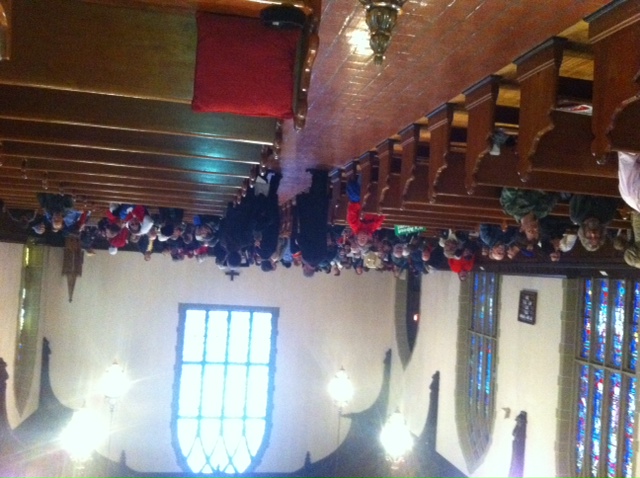
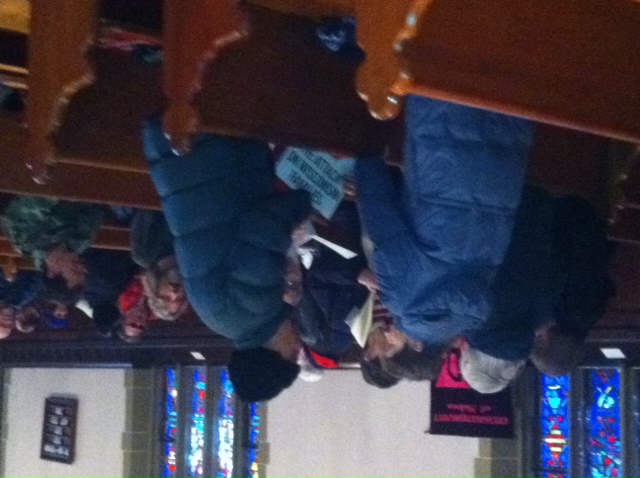
This is what Religion looks like, Part 3

Video of Bishop Miller at the rally today:

. Thanks to Shannon Kelly.

I didn’t see Bishop Miller today. I was in Grace as the clergy assembled and my guess is he was either outside the church or couldn’t make it through the crowd.

One amusing note: clergy and protesters behave like everyone else when they enter a church. They crowd the back and leave the front half of the church completely empty.

This is what religion looks like, part 2

I went up to the church this morning after learning that the steps of Grace Church would be a gathering point for another Interfaith rally. When Corrie and I got there, and realized how cold it was, we decided we had to open the church. I was there from 10 to 5. I made it out onto the steps of Grace for a few minutes to soak in the atmosphere. People came in to warm up all morning and early afternoon, but by 2:15, we had a crowd inside.

This is what religion looked like at 2:15:

Here a few Grace members:

Here’s what religion looked like at 4:00:

I didn’t follow the group as it went around the square. I stayed back at Grace, keeping our doors open for those who were looking for a warm space and somewhere to rest their feet.

We were a sanctuary. In the course of the day, I had interesting conversations with lots of people. It was a long, exciting, and rewarding day. Thanks to all of those Grace people who helped today.


More on the protests

From my colleague, David Simmons, Rector of St. Matthias Episcopal Church, in Waukesha, WI on why he participated in the interfaith rally on Tuesday.

Two evangelicals, Brian McLaren and Jim Wallis on the larger issue of Christianity, morality, and budgets.

Wallis writes:

As Sojourners said in the last big budget debate in 2005, “A budget is a moral document.” For a family, church, city, state, or nation, a budget reveals what your fundamental priorities are: who is important and who is not; what is important and what is not. It’s time to bring that slogan back, and build a coalition and campaign around it.

The Role of Religion in the Wisconsin Protests

The significance of Christianity in the actions of Governor Walker and among the protesters continues to be a matter of debate. Diana Butler Bass’s interprets Governor Walker’s actions in light of a talk he gave to Christian businessmen in which he said his motto was “Trust and Obey.” Walker is the son of a Baptist pastor and member of a non-denominationl church. Bass argues that absent the rich moral reasoning traditions of mainstream Christianity, Walker has developed a highly individualistic theology. To use her words:

His spiritual universe is that of 20th century fundamentalism, in its softer evangelical form, a vision that emphasizes “me and Jesus” and personal salvation.

From there, she jumps to a comparison of Walker’s position with that of President Bush whose certainty led the United States into wars in Iraq and Afghanistan. Her complete remarks are here. My guess is, she did what I did. She googled Scott Walker and religion and found this.

I find this analysis unhelpful and misleading. Granted, I’m a relative newcomer to Wisconsin; I live in Madison, which is very different from other parts of the state, and I’ve relocated from South Carolina, where religion (Christianity) does play a prominent role in politics. Plus, I watch relatively little local TV, and get my news and politics (even local) from alternative sources. So, my perspective is quite limited. Still, I haven’t noticed the foregrounding of religious language or religious arguments, either from Walker or from his supporters.

I went back to earlier coverage of Walker’s campaign in Isthmus. In an early piece on him, there was barely a mention of religion. In fact, it seems to me that religion, Christianity, has been a bit player in the drama that is unfolding and that it entered only in the second or third act. For example, last week Dan Schultz wondered where the religious voices were.

I rather doubt that Walker’s refusal to negotiate has anything to do with his religious beliefs or religious certainty. If anything, I would suspect that his religious certainty is a product of his personal and political certainty, not the other way around as Bass would have it.

Updated. Here’s The Washington Post’s Dana Milbank on Walker’s rigidity.

Theological and Faith Perspectives on the Protests in Wisconsin

I’m trying to collect links to blogs and other sites from outside Wisconsin that reflect theologically or religiously on the protests in Madison (and that don’t link back to me). So far, I’ve come up with these:

Here’s the Religion News Service report on the press event yesterday.

A blog post from Stephen Thorngate, former Wisconsin resident and currently Assistant Editor at The Christian Century.

Religion Dispatches has been following developments. Here’s commentary from Gary Laderman, Chair of the Religious Studies Department at Emory. Here’s Julie Ingersoll’s take.  (Hint: If I have time I will post my reflections on this essay and on the Ingersoll piece; I think they are both deeply flawed).

I want to meet Dan Schultz. He writes for Religion Dispatches, too. At least he’s in Wisconsin. He’s written a couple of things. One points out the relatively slow response by faith communities. He updates that post a couple of days later with info about those who have spoken out.

If you’ve got more, let me know. Yes, I will post thoughtful perspectives that challenge the progressive view.

Revolution U – Otpor, CANVAS, Burma, and the Egypt Revolution – By Tina Rosenberg | Foreign Policy

A few days ago, I posted a link to an interview with Gene Sharp, the theorist of nonviolent direct action. Here’s an article that details how the January 25 revolution in Egypt drew on his ideas, via a group in Serbia. It includes a fascinating look at work between the Serbian group CANVAS and activists in Burma. Here’s the link:

Revolution U – Otpor, CANVAS, Burma, and the Egypt Revolution – By Tina Rosenberg | Foreign Policy.

Reading it offers perspective into what’s happening in Wisconsin, too. I was particularly taken by the important role humor played both in the downfall of Milosevich and in the workshops the Serbians offered in Burma.

Ambassadors of Christ–Reflecting on another day of protests

On February 5, Wisconsin came together in a euphoric celebration of the Packers’ victory in the Super Bowl. In bringing back their fourth Lombardi Trophy to Titletown, we anointed a new Savior (Aaron Rogers) and finally laid to rest the ghost of Brett Favre. With a young quarterback and many important players who had been lost to injury, the future looked bright indeed.

The celebration that united all of Wisconsin a little over two weeks ago is not even a distant memory. The spontaneous community created by a major athletic championship has been shattered, deep divisions within our polity have appeared and the promising future of a new Packers dynasty has given way to fear and despair.

The small Midwestern town in which I was raised was profoundly shaped by the order imposed on it by Jefferson’s vision. The square-mile grid of townships, each with a one-room schoolhouse created both civic community and a sense of common purpose. There was relatively little disparity in wealth and what there was could often be blamed on the luck of the draw—the fertility of the land on which a family had homesteaded—or individual effort and talent. To be sure, there was poverty, but most of it was found either among the migrant workers who came each year to harvest vegetable crops, or in the city.

It wasn’t until I went south for the first time to meet my soon-to-be wife’s family that I encountered enormous disparity of wealth in small-town America. I remember vividly visiting one of my father-in-law’s farms and being greeted by the children who lived in the ramshackle house on the property. It seemed more like the Third World than America.

I remember vividly as well the “Poverty Tours” Deacon Steve MacDonald would lead in Greenville. A Vietnam Vet and recovering alcoholic, Steve was an ordained Episcopal deacon and worked for United Ministries. He was an in-your-face advocate for the poor and homeless. He knew where the homeless lived. He also took us to those areas of Greenville where walls divided neighborhoods. On side of the wall were houses that sold for upwards of $1,000,000. On the other side were hovels that lacked central heat, water, and often even electricity.

The Republican Party came to power in the South by using race to divide poor and working class whites from African-Americans, whose economic interests they shared. Politicians in the South continue to play off of division, competing with other states and regions of the country to attract manufacturing and other businesses.

Apart from everything else that is going on, it seems to me that what we are seeing in Wisconsin this week is a similar tactic of division. Instead of bringing people together as a community to come up with solutions and cooperate on solving our state’s problems, Governor Walker and other Republicans are seeking to consolidate power by creating division among our populace. Union members are vilified as freeloaders and undeserving of the wages and benefits they receive from their jobs in the public sector. The code words and rhetoric remind me very much of the language used in an earlier time to attack “welfare queens” and the like.

Among the calls in yesterday’s Interfaith press conference was a vision of shared sacrifice. As religious communities, it is our responsibility to hold up a vision of a common good, in which people of good will come together to solve society’s problems. Whatever our differences—class, race, even political views—we are all created in God’s image. As Christians, we need to do Jesus Christ’s work in the world, breaking down the barriers that divide us, being Christ’s ambassadors, offering reconciliation where others sow division.

This is what religion should look like

The protests continued today. As the Interfaith Press Conference took place on the steps of Grace Church, correctional workers, members of the IBEW, and others marched into the capitol. After representatives from various faith groups spoke about the need for justice and for society to care for the neediest and most vulnerable, many of us walked across to the Capitol as well. Among the speakers were Bishop Miller of the Episcopal Diocese of Milwaukee and Bishop Burnside of the ELCA Synod of Southern Wisconsin.

Here’s what it looked like when we entered the rotunda:

Thanks to Shannon Kelly for the video.

There does seem to be a much more visible and numerous police presence, many of them from out of town communities. That makes things seem a bit more tense on the square, but spirits still seemed high in the Capitol.

We need to continue to hold in our prayers all those involved–the politicians, the protesters, the public sector workers and all in Wisconsin who are concerned for the future of this state and the society that we are building.

Reflections on Day 8

Not as many people on the square today as there were last week, but the weather was awful. Didn’t catch sight of the Daily Show’s John Oliver, who was said to be interviewing people on the square around lunch time.

The response to us opening our doors has been overwhelming. As a gesture it seems to have struck a chord in the community, and to some degree, more widely. There are concerns about security but welcoming people in, giving them space to warm up, reflect, and pray, is being hospitable. There haven’t been all that many people who have taken advantage of our space. Yesterday, for example, when I walked through the sanctuary to check on things, there were three people sitting in pews. They all looked exhausted. Later, a cop used our restroom; when he didn’t come back upstairs after quite some time, we went looking for him. He was relaxing on a couch in the undercroft. He needed a break.

Some might say to open our doors in such a way is to take a political stand on one side or another. To me, it’s being church. Because of our location, anything we do or don’t do, could be interpreted as taking a stand. Keeping the place buttoned up while 30,000 people are protesting outside our doors, sends a powerful message about who and what Grace Church is, just as keeping our doors closed during the Dane County Farmer’s Market (when similar numbers inundate the square) sends an equally profound message.

We did Evening Prayer last night during a rally. Praying, reading scripture, psalms, and canticles while all that is going on is jarring, but a profound experience. I was deeply moved as we said the Magnificat:

He has cast down the mighty from their thrones,
and has lifted up the lowly.
He has filled the hungry with good things,
and the rich he has sent away empty.
He has come to the help of his servant Israel,
for he has remembered his promise of mercy,
The promise he made to our fathers,
to Abraham and his children for ever.

And as we prayed together:

Keep watch, dear Lord, with those who work, or watch, or weep this night, and give your angels charge over those who sleep. Tend the sick, Lord Christ, give rest to the weary, bless the dying, soothe the suffering, pity the afflicted, shield the joyous, and all for your love’s sake. Amen