Grace in the midst of it.

Another Saturday, another rally. There was a good deal of sunshine today, but it was cold and rather windy. I wasn’t sure what to expect when I got downtown this morning. After Wednesday and Thursday, I thought the mood might be somber. It wasn’t. There was a great deal of exuberance and laughter in spite of what had happened. Perhaps the tone was set by the tractor-cade:

Here’s the view of W. Washington from the courtyard this evening:

Here’s the view from Grace this afternoon:

We were helped by a great group of volunteers and many parishioners dropped by to see if they could help (and to warm up). We had hot cider on offer. That and our warm space were much appreciated as the rally wound down.

I am poured out like water

For some reason Psalm 22:14 has been running through my head since last evening. The full verse reads:

I am poured out like water;

all my bones are out of joint; *

my heart within my breast is melting wax.

Psalm 22 begins with “My God, my God, why have you forsaken me?” The Psalmist’s cry is repeated by Jesus on the cross in Matthew and Mark. The Psalm is a profound reflection on personal pain and suffering that ends in a triumphant expression of praise of God. It probably served as the template for the shaping of the passion narrative in Mark and is used liturgically by many churches during the Stripping of the Altar on Maundy Thursday and is designated for use on Good Friday.

No doubt, my memory called it up because of Ash Wednesday and thinking ahead to Lent. I find much of the imagery problematic when used as personal devotion, however powerful it is in the context of communal worship during Holy Week.

But v. 14 speaks to me, and for me, today.

Those who read my blog regularly may remember that I mentioned at some point in the last three weeks that I was caught completely unawares by both the protests and in thinking what role Grace might play because of its location as “the church on the square.” I’ve been reacting, often without the time for reflection that I want to take. It has also up-ended everything else at Grace. Our Lenten planning, begun in early February, came to a crashing halt and we’ve had to piece it together at the last minute.

This week was intense for reasons quite beyond events on the square. We had an elaborate and exquisite liturgical and musical celebration on Last Epiphany, with a Haydn Mass and string players. Monday was the first Monday of the month, so that meant we were feeding 150 people from the Men’s shelter and the community. Then came Shrove Tuesday, and Ash Wednesday. The Capitol Square, though, was quiet, and I felt like I was able to catch my breath and was hoping that after Ash Wednesday I could regroup and enter fully into the season of Lent.

Events at the Capitol overtook us. The protests that provided a backdrop and accompaniment for our service. It was surreal.

It was while driving home that the verse of the psalm first came to me. It remained with me as I talked with Corrie about the day, we followed events on the internet, and then watched a few minutes of local news.

It remained with me when she said, “We’ve got to do something. You have to organize volunteers to be in the church tomorrow.” I replied, “I can’t do anything. I can’t write an email right now.” In the back of my mind was, “I am poured out like water.” A few minutes later, I went to bed, reciting that verse to myself.

When I awoke in the morning, it was still with me. I managed the email; we got the volunteers. And I went off to Clergy Day which was a welcome reason to be away from Grace and Capitol Square, for at least most of the day. But still those words were on my lips and in my heart, “I am poured out like water.”

Being with Bishop Miller and with my brothers and sisters among the clergy today was restorative. Many expressed their good wishes, their support, and told me I and Grace were in their prayers.

As they spoke, shared, hugged me, and offered to help however they could, I was deeply moved and uplifted. But still, the tears were close all day, “I am poured out like water.”

When we talk about Lent, we often use language of desert and wilderness. As a community, a city, a state, we are in a very difficult place. Wherever we stand on the political debates, deep harm, perhaps irreparable, has been inflicted on our community and on our body politic.

I came home on the bus this afternoon, really the first time I’ve ridden the bus in the past few weeks. As I was waiting, a young man engaged me in conversation. I’m sure he was a student. He had been at the Capitol and asked where I was headed. As we talked, and as he learned that I was Rector of Grace, he began to open up about his fears. I was grateful to God when my bus came before we were able to enter to deeply into conversation and just as two other bystanders began to engage us.

“I am poured out like water.” I will stay away from Grace and Capitol Square tomorrow, but somehow I have to open myself up to God enough so that I can craft a sermon to preach on Sunday, the First Sunday of Lent.

While I was at Grace this afternoon, I took the time to pass through the nave and chat with the volunteers who were present. One of them said that, while she couldn’t carry a sign, walk around the Capitol, and protest, she could be in the church, sit, and pray. She said she was praying for me. My hope is that everyone who reads this blog prays for me, for Grace, and for Wisconsin.

“We are poured out like water.”

Ash Wednesday: The Changing Drama of a day

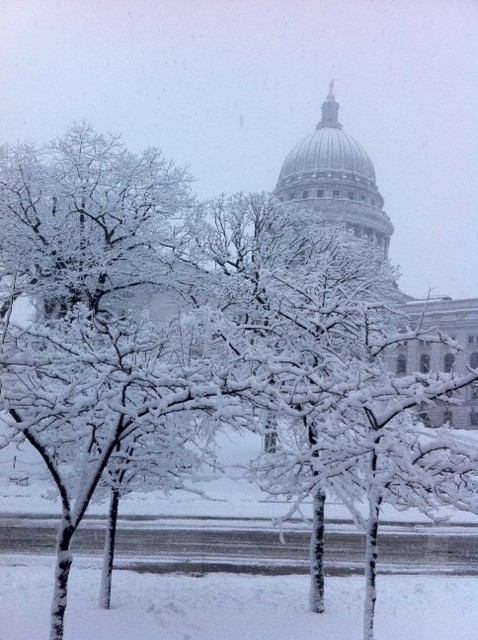
Earlier, I posted a photo showing what the Capitol looked like at 6:45 this morning. We received an unexpected snowfall. I wasn’t sure at 6:55 that anyone would make it to our 7:00 service, but a few hardy souls arrived. The beauty and silence of our surroundings made our worship meaningful, allowing us to reflect on the day, our human nature, and the God who created us. I had prepared a homily, but instead of preaching it, I reflected on our human nature, laid bare for us in the ashes of Ash Wednesday, and in the love of the God who created us.

What a difference eleven hours makes. It was obvious from the noise outside that as we prepared for our 6:00 pm service, things were heating up. As I mentioned in an earlier post, I hoped to use the Joel reading to think about the  significance of social and communal sin.

I’m not sure it worked, but the incongruity of it all struck home after the exhortation (“An Invitation to a Holy Lent”). There is an instruction in the prayer book for silence following the exhortation and before the imposition of ashes. We kept the rubric, but there was no silence. We could hear the chants from the capitol, but even more distracting were the horns of passing cars.

We could still hear the chants and the horns as we began the Litany and prayed:

We have not loved you with our whole heart, and mind, and strength. We have not loved our neighbors as ourselves. We have not forgiven others, as we have been forgiven.
Have mercy on us, Lord.

We have been deaf to your call to serve, as Christ served us. We have not been true to the mind of Christ. We have grieved your Holy Spirit.
Have mercy on us, Lord.

We confess to you, Lord, all our past unfaithfulness: the pride, hypocrisy, and impatience of our lives,
We confess to you, Lord.

Our self-indulgent appetites and ways, and our exploitation of other people,
We confess to you, Lord.

Our anger at our own frustration, and our envy of those more fortunate than ourselves,
We confess to you, Lord.

Our intemperate love of worldly goods and comforts, and our dishonesty in daily life and work,
We confess to you, Lord.

Our negligence in prayer and worship, and our failure to commend the faith that is in us,
We confess to you, Lord.

Accept our repentance, Lord, for the wrongs we have done: for our blindness to human need and suffering, and our indifference to injustice and cruelty,
Accept our repentance, Lord.

For all false judgments, for uncharitable thoughts toward our neighbors, and for our prejudice and contempt toward those who differ from us,
Accept our repentance, Lord.

For our waste and pollution of your creation, and our lack of concern for those who come after us,
Accept our repentance, Lord.

Restore us, good Lord, and let your anger depart from us;
Favorably hear us, for your mercy is great.

Accomplish in us the work of your salvation,
That we may show forth your glory in the world.

By the cross and passion of your Son our Lord,
Bring us with all your saints to the joy of his resurrection.

To put the debates over the budget and collective bargaining in the context of Ash Wednesday and Lent is no easy thing but knowing what is occurring outside our walls as we pray meant we were praying not only for ourselves but for our whole state.

The past weeks have been interesting, challenging, and incredibly stressful. Lent brings with it its own intensity. Given what happened tonight at the Capitol, the task of reconciliation will become even more difficult; our task as Christians, to respect the dignity of every human person, to love our neighbor as ourself (and our enemy as well), and in the midst of the cacophony, to trust in a God who is “gracious and merciful, slow to anger and abounding in steadfast love.”

Sanctify a Fast: A Homily for Ash Wednesday, 2011

March 9, 2011
Grace Episcopal Church

When I was a grad student at Harvard, one of my work-study jobs was helping to catalog a vast collection of what librarians and archivists call ephemera. In this case, it was material related to the history of religion in America in the first half of 19th century. Almost all of it was from New England, and in keeping with the historical roots of Harvard Divinity School, almost all of it was related to Unitarianism or Universalism. Continue reading →

Ash Wednesday on Capitol Square

Here’s what the Capitol looked like from Grace this morning:


Quiet and beautiful.

It’s hard not to think about the protests when preparing for Ash Wednesday and Lent, particularly when dealing with a text like Joel 2. I attempted in my homily to make a connection between the communal repentance advocated in Joel and our usual focus, on Ash Wednesday and Lent, on personal repentance. I’m not sure whether I pulled it off, but I’ll post the homily in any case, in a few minutes.

I spent some time before the 12:10 service offering ashes to passers-by. A couple of protesters saw me from across the street and ran over. They were clearly from out of town, for one said, “I hoped somebody would be doing this.” There wasn’t a lot of foot traffic on the square, the weather probably kept people inside today but my little gesture of bringing the ashes out onto the street met with smiles, laughter, and acceptance. A number of people thanked me, and as one woman passed by, I heard her say, “Oh, yeah, I forgot it was Ash Wednesday.” I hope my presence there didn’t make her feel guilty.


First Mondays at Grace

We’ve been calling it the Shelter Meal but that doesn’t describe what takes place at Grace. On the first Monday of each month. Grace takes its turn providing the evening meal for the guests of the Men’s Drop-In Shelter. This was something that began long before I arrived at Grace, but Corrie and I thought it had the potential of becoming something quite exciting. It has.

We try to create a great meal, and great community as well–among the shelter guests, and visitors from the community who might come in for a meal–community for our volunteers, too. We invite our guests to come in and take a seat, and our volunteers offer table service. While they eat, we have musical guests, sometimes from Grace, sometimes from the larger community. While the meal, service, and clean-up is staffed by Grace parishioners, there are also people from the community who come in and help out. For example, I met a guy tonight who works on Capitol Square but lives on the west side. He wanted to volunteer downtown, so he contated us. I’m sure he will be back.

Besides fellowship and entertainment, we also want to provide a delicious meal. Tonight in honor of Mardi Gras, we had chicken and sausage jambalaya, roasted sweet potatoes, and corn and black bean salad. For dessert, there was ice cream (Sassy Cow gave us an incredible deal on incredible ice cream! Thanks so much!), banana sauce and chocolate sauce. We all had a great time. Here are some photos:


The Midtown Jazz band warming up. They were hot!

The band likes to brag that they have over 300 years of experience playing jazz.

In the middle of all that’s going on around us on Capitol Square, it’s good to do something tangible that touches the lives of people and puts the gospel into action.

Facebook and the Church


The Episcopal Cafe continues to direct us toward debates on the relative merits of churches using social media, and the longer range implications of the growth in social media for religious institutions.

Most recently: Four questions on social networking. They are:

  1. What will happen to churches that are anchored in historic beliefs and hidebound in traditions, where hierarchy prevails over democracy and where expectations are that individuals will support the institution without question?
  2. How will clergy of all ranks respond now that church institutions are being peppered with demands for accountability from people in the pews?
  3. How will scholars debate online with integrity disciplines such as theology, ethics, and discipleship when the conversation opens up to those misled by the many irresponsible, unfounded myths, legends and outright lies passed along via the Internet?
  4. Can enthusiasm for various missions and ministries expressed via social networking be translated into real-life, feet-on-the-ground human effort and relationships?

They also comment on Ian Paul’s discussion of the benefits of facebook for ministry: Using facebook to build Christian community. I find his first two observations especially trenchant. Facebook connects me with people I don’t see except on Sunday, and people I don’t see at all regularly anymore. I think it strengthens community and it also nurtures the bonds of community and pastoral connection with people who have moved away.

Finally, they ask: Will Facebook kill the church? Picking up on an essay written a year ago.

We are in a rapidly changing culture with the decline of institutional religion and the rise of social media. What will happen is not at all clear, but what I am seeing is that social media, my blog, facebook, etc., are ways of reaching out to people who might not be closely connected to the church and finding ways of tightening those bonds.

I was struck on Saturday by comments from a number of people who walked past while I was standing outside of Grace, talking to people. Strangers came up to me and said that they had heard what we were doing, praised our hospitality, and thanked us. Had they learned of our open doors by seeing the sign? My guess is, most heard through the grapevine, facebook, or twitter. It has raised our profile in the community.

Now, we will we get new members or “pledging units” from this effort? Who knows? What I do know is that we are making a difference in people’s lives, in some small way.

St. Teresa of Avila

I mentioned her in my sermon. Andrew Sullivan posted the following poem today: “Teresa” by Richard Wilbur, who turned 90 this week.

After the sun’s eclipse
The brighter angel and the spear which drew
A bridal outcry from her open lips,
She could not prove it true,
Nor think at first of any means to test
By what she had been wedded or possessed.

Not all cries were the same;
There was an island in mythology
Called by the very vowels of her name
Where vagrants of the sea,
Changed by a word, were made to squeal and cry
As heavy captives in a witch’s sty.

The proof came soon and plain:
Visions were true which quickened her to run
God’s barefoot errands in the rocks of Spain
Beneath its beating sun,
And lock the O of ecstasy within
The tempered consonants of discipline.

via The Daily Dish | By Andrew Sullivan.

Teresa, as I said today, thought deeply and extensively about prayer, and wrote with great insight. She was especially concerned to distinguish between “true” visions and those which seemed to come from Satan or were self-induced. Jessa Crispin, in an essay devoted to the question about the relevance of philosophers’ lives for their thought, uses Teresa as an example of someone who “did not always live out their philosophy.” In fact, Teresa’s life was full of times when she lived far from the ecstatic experiences for which she was famous, when her attempts to come close to God were thwarted, either by herself or by God, and faced constant criticism from churchmen who thought her experiences were faked.

At the same time, she was well aware that such experiences could be faked, or products of self-delusion. In her autobiography, she writes with considerable sophistication about how to distinguish the “real” from the faked and shows herself a perceptive psychologist.

Do not be afraid: A Sermon for the Last Sunday after Epiphany

March 6, 2011

Today is the Last Sunday of Epiphany. It’s been a long season of Epiphany, almost two months. Christmas is nothing more than a faint memory and if we were in a different part of the country, spring would be well on its way. The season of Epiphany always begins with the story of Jesus’ baptism by John. It always ends here, with the story of the Transfiguration. In between those two, we hear stories of Jesus Christ’s appearances to his disciples and to us. This Sunday provides us with another opportunity to experience and try to understand the glory of Christ, even as we look forward to Lent with its very different emphasis.

Continue reading →

Doubt and Certainty

Mark Vernon writes in The Guardian today:

Doubt in relation to religion is almost mandatory in public life, whereas doubt in relation to politics is almost forbidden.

He is talking about the situation in the UK, of course, but what he says is of interest to me, especially given two issues I’ve been following in my blog–the debate over Rob Bell and universalism and the protests in Madison.

Vernon asks:

If God is not to be a tyrant, but is to allow us a degree of autonomy, must God not introduce a corresponding degree of doubt and uncertainty into human experience?

It’s an excellent question. Certainty, whether in politics or religion, tends to heighten conflict and cause suffering.