Freedom and Faith on the Fourth

some random thoughts and links. A sampling of stories from Religion Dispatches

Commentary on the US Catholic Bishops’ Fortnight for Freedom campaign

Silk points out the bishops’ selective use of history. They began their fortnight on the feast days of Thomas More and John Fisher, both of whom were executed by Henry VIII. Neither of the two were particularly interested in preserving the religious freedom of those who disagreed with them. More, as Henry VIII’s Lord Chancellor, oversaw the execution of many religious dissidents. John Fisher, as Bishop of London, oversaw book burnings and heresy trials. Their appeal to Becket is equally lame.

On American Civil Religion

The civil religion that’s not idolatrous is one that’s prophetic in the sense that it sees the American project as defined by a set of ideals, as opposed to being defined by a set of accomplishments. So if you imagine America as this great nation which has achieved all of these things, and you list all of the things that it’s achieved, in a way you’re already a little bit on the slippery slope toward idolatry. That always has to be held in balance with a recognition of how often and how much the US falls short of its central ideals that are part of the project.

If you asked my true religion, I would not answer anything practiced in a church, synagogue or mosque. My real religion is America, and I feel privileged that, among the world’s 7 billion people, I am one of the roughly 300 million lucky enough to be an American. This transcends mere patriotism. I believe in what this country stands for, even though I acknowledge its limits and failures. As individuals, we are no better than most(selfishness and prejudice having survived). As a society, we have often violated our loftiest ideals (starting with the acceptance of slavery in 1787). Our loud insistence of “exceptionalism” offends millions of non-Americans, who find us exceptional only in our relentless boasting.

Rhetorically, civil religion appears to be opposed to conflict and war; practically, though, it is deeply indebted to both.  For if civil religion is the appropriation of religion by politics, there is nothing more serious for politicians to do than to justify killing and dying, and nothing gets that job done better than coupling religion and war.  If we carry Hunter’s statement above to its conclusion we might note how the culture wars begat the Civil War which begat an American civil religion.

civility, incivility, and the common good

I’ve posted before about the “Season of Civility” efforts of the Wisconsin Council of Churches. There’s more about that available here. Press coverage here.

It’s not just an issue being raised in Wisconsin. There’s concern across the country.

Joe Klein is on the road again:

I traveled through North Carolina and Virginia, both in areas of deep blue and crimson red, and it was clear neither side trusted the other very much. For the conservatives, the country had changed beyond their imagining; not just civil rights but gay rights (a contentious referendum recently banned gay marriage in North Carolina), and new ethnic groups that seemed foreign–the South Asians who all of a sudden seemed to run half the convenience stores, the Latinos who didn’t seem to want to speak English. Why, even the President of the United States was something strange, neither black nor white. For liberals, it was all about intolerance. You couldn’t have a half-decent conversation with these Tea Party people, they said.

Pamela Haag writes about uncivility in America. She echoes Klein’s observations about the narrowing of our common life:

Incivility seems to me like collateral damage of our deeply niched lives, which make other Americans more unknown and unknowable to us. Sometimes it can feel as if we’re an ensemble of sub-cultures today, and no culture—no shared epistemology or point of view.

There are fewer spaces of social crossing and interaction that “humanize” the other and make them less available targets for our incivility. During the recall, Wisconsin residents reported that tensions were so high and implacable that the only safe topics of social kinship were the Packers and the weather.

Incivility thrives when social life is niched and anonymous. Online comments sections are the most depressing and extreme example of America’s collective hair-trigger temper (it’s as if the nation is suffering from a wicked, mood-destroying hangover that drives them to lash out). In the most basic sense, incivility is a social practice exercised against people whom we do not know, understand, care about, regard, or respect. These people simply aren’t accorded the same rich humanity—they don’t seem as “real” to us—as those who live in our particular niche, or share our ever more sequestered, cabalistic worldview.
Haag also points out that the increase in incivility has occurred simultaneous with the rise of women in the workplace and in prominence across culture.

Basil the Great, 379

“The bread which you do not use is the bread of the hungry; the garment hanging in your wardrobe is the garment of him who is naked; the shoes that you do not wear are the shoes of the one who is barefoot; the money that you keep locked away is the money of the poor; the acts of charity that you do not perform are so many injustices that you commit.”


A Prayer after Communion

We give Thee thanks, O Lord our God, for the Communion of Thy holy, pure, deathless and heavenly Mysteries, which thou hast given for the good, the hallowing, and the healing of our souls and bodies. Do Thou, O Sovereign of the world, cause this Communion in the Holy Body and blood of Thy Christ to nourish us in unashamed faith, sincere charity, ripe wisdom, health of soul and body, separation from all ills, observance of Thy Law, and justification before His awful Judgment Seat. O Christ our God, the Mystery of Thy Providence has been accomplished according to our ability. We have been reminded of Thy Death and we have seen a figure of Thy Resurrection; we have been filled with Thine Infinite Life, and we have tasted Thine inexhaustible joy; and we pray Thee to make us worthy of these things in the life to come, through the grace of Thine Eternal Father and of Thy holy, good, and life-giving Spirit, now and forever, eternally: Amen.

General Convention Update–Blogging the Blue Book

Not me, Scott Gunn. He’s writing a series of posts on the various reports and resolutions to be discussed at General Convention. They are all worth reading–thoughtful and challenging–and often addressing larger issues facing the church.

For example, he raises questions about the political resolutions proposed by various bodies here. Here’s the principle he proposes:

Let us tell the world what we are going to do about political problems, rather than telling the world what they should do about political problems.

So rather than tell corporations to mind the environment, let’s pledge to have environmentally sustainable congregations. Let’s stop killing so many trees (ahem, General Convention legislative binder. *cough*). Rather than tell President Obama to do this or that about various Middle Eastern crises, let’s divest or invest or travel or boycott or something. Let’s stop calling for an end to the boycott of Cuba and instead set up travel programs to take people there. You get the idea.

And, for the love of God, let’s stop telling other governments what to do. What possible business do we have telling the government of North Korea what to do? How are 800 deputies and 200 bishops going to monitor the use of drones in warfare? Why should we wade into the complexities of the US tax code (remember, we are an international church!)?

And remember, one of the few budget items to be increased for the the next triennium is the Governmental Affairs office, while other programs like formation were gutted.

Frederick Schmidt also ponders the relationship between the church and the political realm in “Winning the White House and losing our souls.” Some of what he says is quite pertinent to Scott’s analysis of the place of political resolutions at General Convention:

Three, political speech and theological speech are not one in the same. Yes, theology has collective and corporate implications and, therefore, political implications. But the church is called upon to think about those issues from a fundamentally different point of view. Methodists are fond of talking about the resources of Christian theology as lying in Scripture, tradition, reason, and experience. That list is inadvertently read as a list of two resources unique to the church (Scripture and tradition), alongside two resources shared in common with everyone else (what goes on inside our heads and what goes on in our lives). But when Christians talk about reason, we are talking about reasoning with the church, and when we talk about experience, we are talking about the experience of the church. When we use political language as if it were theological language, or when we use theology as if were a surrogate for politics, we fail to live and think as Christians were meant to live and think.

Conversations in the Church

We have been engaged in a series of conversation among Madison Episcopalians. Organized around the big issues facing us as a church and focused on upcoming General Convention, we have gathered each Tuesday night in May to talk about matters like the Anglican Communion and Covenant, proposed liturgies for the blessings of same-gender unions, and questions around the structure, budget, and mission of the Episcopal Church.

Tonight we met again and were joined by Bishop Miller and members of our diocesan deputation to GC 2012. We talked about many things, but perhaps most importantly, we talked about conversation itself.

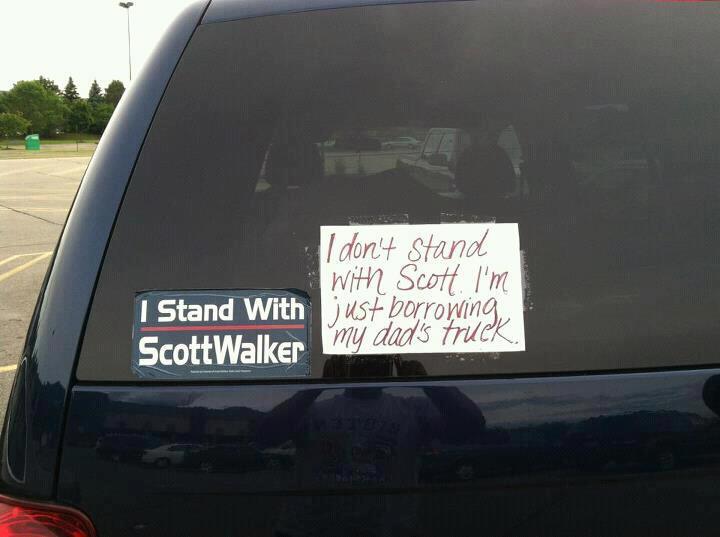
We live in a bitterly polarized society. Wisconsin may be ground zero for that polarization with the recall election for Governor Walker only two weeks away. Mention was made of Parker Palmer, his most recent book, and his efforts to foster conversation across the political divide.

Christianity is equally divided. There is the great divide over LGBT inclusion, which we are struggling over in the Episcopal Church as in other denominations. At the same time, in the larger culture, Christianity is fully identified with the forces of hate and intolerance, with video clips of Baptist pastors advocating that LGBT people be placed in concentration camps. Our internal struggles over full inclusion, and the nuances of our internal debates get drowned out.

We make halting steps toward having open conversations, toward allowing people the space, the freedom, to voice their opinions and their experience, without fear of retribution or punishment. Tonight we talked about our diocese’s history that made such open conversations difficult in past years, but might also mean that we are in a place now where we can speak freely, listen to another, and listen for the Holy Spirit’s leading.

Creating the space for such conversations requires a great deal of intentionality and groundwork. Often we don’t have any idea what they might look like, for our culture models only shouting and partisan soundbites. But such models do exist.

They exist even in the contested Anglican Communion. Recently, members of the Chicago Consultation, an organization dedicated to the full inclusion of LGBT persons in the life of the church, organized a consultation of some 25 African Anglicans with a dozen Episcopalians. A brief report on that meeting is here. Much more powerful is the brief video made of the meeting. It shows some of the conversation, the honesty and openness with which people participated. It also showed that relationships can be forged and nurtured through such conversations, even when disagreements are deep.

Here’s the video:

Think we’ve (Episcopalians) got it bad? Check out the Methodists

Tony Jones blogs a reflection on the United Methodist General Conference that took place a couple of weeks ago.

The eye-popping numbers: It cost $1500/minute!!! (I hope someone does the numbers for our own General Convention).

Will Willimon comments. Willimon’s warning applies to us as well:

My organizational guru Ron Heifetz speaks of the “myth of the broken system.”  Heifetz argues that all systems are “healthy” in that systems produce what those who profit from thesystemdesire.  Though the CGC can’t produce a complicated, large scale, two week convention, the CGC produces a General Conference that protects those in positions of power in our church.

Jones concludes:

All bureaucracies are good at one thing: self-perpetuation. They may be good at other things, too, but the propagation of the gospel is not one of those. Bureaucracy is good at distributing drivers licenses. But bureaucracies are bad for the gospel.

Culture Wars in Universities

Colleges and universities are in the news (It’s commencement time, I suppose). And some of the news is about commencement. A furor over Georgetown’s invitation to Secretary of Health and Human Services Kathleen Sibelius to speak. More here.

St. Francis University of Steubenville has announced it will no longer offer health insurance to its students, ostensibly because of the contraception provision in the ACA. But it turns out that the decision is largely financial, and they will continue to offer insurance to their employees.

At Shorter University in Georgia, a furor over the requirement of staff and faculty to sign a statement of moral behavior–. Inside Higher Ed’s coverage of the story; a story from Huffington Post on a librarian who has refused to sign, and the website that is spearheading opposition. Shorter is one of many institutions caught in the middle of the fundamentalist takeover of the Southern Baptist Convention in the 1980s and 1990s.

And, on a very different note–at another Christian college, the Biola Queer Underground.

And finally, my friend and mentor John O’Malley asks whether medieval universities were Catholic:

Were medieval universities Catholic universities? It is a question easier to ask than to answer. One thing, however, is certain: the contemporary grid for an “authentically Catholic” university does not neatly fit the medieval reality. There are even grounds for asserting that in their core values medieval universities more closely resemble the contemporary secular university than they do today’s Catholic model. If we are looking for historical precedents for that model, we do not find it clearly in the Middle Ages.

I still remember him saying in class some 25 years ago that the university was the one institution in the West that had never been reformed; it still functions in many ways today as it did in the Middle Ages. Shorter and St. Francis are both evidence that some modern universities are more benighted than medieval ones.