But I’ll bet they won’t be celebrating joint communion anytime soon

Lutherans and “Anglicans” have joint theological discussions. Sorry, not the ELCA and TEC, it’s the Missouri Synod and the Anglican Church in North America. I’m sure they agree on all of the hot button political issues; even perhaps, on the creeds.

But how did their comparison of the Augsburg Confession, the Book of Concord, and the 39 Articles go?

It turns out microwave ovens are the reason for same sex marriage

Fifty years later, homes across North America began to fit themselves out with a new technology that saved women more time than any technology that came before it – the microwave oven. Food producers responded quickly with prepackaged foods that were easily prepared in a microwave oven in a matter of minutes.

Before we knew it family dinners were appearing on the dining room table without having a mom at home cooking all afternoon.

The authors of the Bloomberg piece, University of Pennsylvania professors Betsey Stevenson and Justin Wolfers, are absolutely right when they argue that marriage changed as a result of these economic influences.

The traditional economic arrangement where women exercised their comparative advantage in home production while men exercised their comparative advantage in the labor force production has gone the way of the dinosaur, taking with it our view of what it means to work together as a couple.

Once society started to shift way from the “male bread winner” model of the family it was natural to start thinking about new ways to arrange families. Couples in which both partners are the same gender, after all, are not really so different from modern day heterosexual partnerships, at least not in terms of economic organization.

Here’s the article.

You never know what you might find in an old book

When I was a student at Harvard Divinity School, one of my work study jobs was cataloging ephemera, a vast array of sermons, pamphlets, and other printed material chronicling the religious history of New England in eighteenth and first half of the nineteenth centuries. There were sermons preached on Fast Days, sermons preached to the Ancient and Honourable Artillery Company, sermons preached on the death of Washington, and on the deaths, of well, pretty much anyone. We noted titles, joked about them from time to time, and occasionally were interested enough in a document to leaf through it or even read it.

There’s a charming story in the New York Times about a lowly minion working in the library of Brown University, who discovered a print by Paul Revere. The story is fun, and here’s the print:
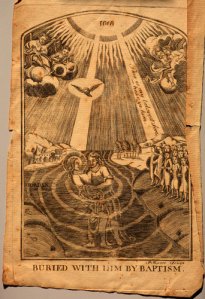
It had probably been in the book for two centuries, never noticed, because no one was interested in the book’s contents.

Speaking of libraries, and especially of rare book libraries, they’ve isolated the smell that collections of old books create. Perhaps they’ll come up with a cologne and market it to librarians, archivists, and historians.

Thinking can undermine religious faith

That’s the headline in the LA Times.

No doubt the study is in some sense accurate. But it reminds me of when I used to ride the T in Boston on Sunday mornings to my field ed site in downtown Boston. At the MIT stop, the train would fill with students on their way to services at one or another Evangelical Church in the downtown. Human beings are quite capable of compartmentalizing.

Obama on Faith, Doubt, and Gethsemane

“It is only because Jesus conquered his own anguish, conquered his fear, that we’re able to celebrate the resurrection,” Obama said.

“We all have experiences that shake our faith,” Obama said later. “There are times where we have questions for God’s plan relative to us, but that’s precisely when we should remember Christ’s own doubts and eventually his own triumph.”

More here.

But most Republicans think President Obama is a muslim. Sigh.

Inviting people to church

People who come to Grace for Sunday morning services know that I like to stand outside on the corner of W. Washington Ave. and N. Carroll before services, to welcome them in. Few probably know that I am also inclined to invite passers-by. Sometimes I make a joke about it, as I did a few weeks ago when a group of runners came by. I assured them there was no need to hurry, they were five minutes early.

Inviting friends, neighbors, coworkers, even relatives to church is not something most Episcopalians like to do. The very word evangelism strikes fear in our hearts. We worry that we might offend someone.

ECF’s Vital Posts has two interesting posts on inviting people to church:

Here’s Mary Parmer talking about how a simple invitation from a friend was life-transforming.

Here’s Richelle Thompson on an Episcopal Church that passed out gum to its members with the message: “It’s up to you to invite someone to church on Easter Sunday.”

And finally, advice from a visitor. It’s well worth reading.

So, anyone going to issue invitations to services this week? Have you ever invited someone to church?


Books, book graveyards, and top ten lists

I just read a blog post that I’d left unread for some time in google reader about a novelist’s ruminations after visiting a used bookstore: “The Beautiful Afterlife of Dead Books:”

Cue: Stephen Fowler, owner of The Monkey’s Paw. It was while chatting with Fowler in his beautiful shop that I had an epiphany. At any given time, his bookshop is packed with over 6,000 dead titles on everything ranging from terrestrial slugs to false hair. Rows of books rest in peaceful repose on tables: gorgeous idiosyncratic corpses that would excite any literary necrophile.

Then I came on Susan Russell’s blog entry Books, Books, and More Books. She begins by mentioning an encounter in a newcomer’s class with someone who had just encountered Urban T. (Terry) Holmes’ What is Anglicanism. She goes on to list her top ten list. Coincidentally, on Sunday, I was looking through my bookshelves for a copy of that very book, to share with two young people who have recently come to the Episcopal Church. My search was fruitless. I remembered then that I had lent a copy several years ago, at a former parish, and probably hadn’t got it back. I’ve got no qualms with her list of ten favorites. Mine would, of course, be much more heavily weighted to the theological and literary classics. No doubt Dante would make my list, even if an NGO wants it banned.

One of the books on her list is by Anne Lamott, who has a new book coming out soon: Some Assembly Required. An excerpt is available at Salon.

And speaking of lists, a Catholic church historian’s take on the ten top books in Church History.

Random web finds related to spirituality

Is Pope Benedict XVI going to canonize Hildegard of Bingen?

The Jesuit Style:

From his own experience, Ignatius deduced a series of methodological and pedagogical principles that will be characteristic in the way he acted when trying to assist men and women to find their way, in other words, helping them to achieve freedom and be responsible for their own lives. A major event was particularly important to the newly converted Ignatius, an enlightenment that transformed him during a stroll along the banks of the Cardoner, a river that flows in the neighborhood of Manresa. “The eyes of insight started to open. He didn’t have a vision, but he understood and learnt several things, spiritual as well as others concerning faith and words, and with such a huge enlightenment that all these things seemed to be new.”

A “one-nun show” on the life of Catherine of Siena, written and performed by Bill Murray’s sister (yes,that Bill Murray).

I suppose for all those despairing of the future of Christianity, and of Roman Catholicism, these three are witnesses to the rich streams of Christian spirituality that can’t be controlled or destroyed by hierarchies or institutions.