
The Book of Common Prayer

The Commemoration of the First Book of Common Prayer is observed on “a weekday after Pentecost.” In our calendar this year, that means it is observed today (Monday was the Venerable Bede, yesterday, Augustine of Canterbury. The collect for this day reads:

Almighty and everliving God, whose servant Thomas Cranmer, with others, restored the language of the people in the prayers of your Church: Make us always thankful for this heritage; and help us so to pray in the Spirit and with the understanding, that we may worthily magnify your holy Name; through Jesus Christ our Lord, who lives and reigns with you and the Holy Spirit, one God, for ever and ever. Amen.

From Alan Jacobs, The Book of Common Prayer, A Biography:

But a religious book is limited in its ability to learn because it is concerned to teach; and a prayer book especially wants its teaching to be enacted, not just to be absorbed. It cannot live unles we say its words in our voices. It can learn with us, but only if we consent to learn from it. There are relatively few, now, who give that consent to the Book of Common Prayer. Cranmer’s book, and its direct successors will always be acknowledged as historical documents of the first order, and masterpieces of English prose, but this is not what they want or mean to be. Their goal–now as in 1549–is to be living words in the mouths of those who have a living faith (p. 194)


I said this while reflecting on Jaobs’ book a couple of years ago:

As I was reading, I was reminded again of the role the Book of Common Prayer has played in my own spiritual journey. It was the means of my conversion to Anglicanism and it continues to shape my spirituality and my religious experience. Its language and prayers have become my own. In other words, if Cranmer’s goal in 1549 was to make the Book of Common Prayer “living words in the mouths of those who have a living faith,” it still holds that power. I see that same power in those among who I minister as well. I sometimes think that liturgical reformers and those who would do away with the BCP altogether lack faith in its transformational power and lack faith too, in the power of people to re-appropriate its language and imagery to meet their particular needs and contexts.

I’m struck by the last couple of sentences considering the rumblings going through the church right now about Prayer Book revision as well as the various resolutions the Standing Commission on Liturgy and Music have submitted to General Convention (You can read incisive commentary on those revisions from Scott Gunn here). It seems to me that before undertaking such changes, whether tinkering around the edges or full-scale revision, we need to think carefully and creatively about the role of the Book of Common Prayer in our common life in the twenty-first century.

On the one hand, there’s a tendency to fetishize the BCP (whether the 1662, the 1928, or I suppose, even the 1979), to regard a particular version as normative for all time. On the other hand, there’s another tendency to want to revise it regularly. At the same time, it’s important to recognize that as the institutional church collapses, the things that bind it together may lose their power as well. That is true of the Book of Common Prayer. Can its language, disciplines, and rituals continue to shape people when they no longer experience it as a “book?” And what might its demise mean for Anglicanism as a living tradition within Christianity?
 

Religious Identity, Religious Community: More Thoughts on the Pew Study and the Memorial to the Church

I’ve been thinking a great deal about my post last week and the conversations around both the Memorial to the Church and the Pew Survey. We’re in uncharted territory as the Episcopal Church (and Mainline Protestantism) collapse. All sorts of people from all over the theological spectrum will offer analyses of the reasons for this collapse but it will require historical distance to gain the necessary perspective from which to judge what happened and why. At the same time, with the rise of the percentage of people who no longer identify with particular denominations or traditions, one of the things the Pew Survey has made clear is that Americans are creating new ways of being religious. A number of commentators have made this case, among them Kaya Oakes and Peter Manseau. Something Oakes wrote is especially pertinent:

The new Pew Survey should not be giving people who are creating their own religions and communities something to think about. They’ve already thought about the role religions should play in their lives.

Manseau puts it like this:

Religion, however, is not a zero sum game. Just as any individual’s life might include periods of greater and lesser religious interest, every tradition is home to remarkable diversity of belief and practice. Church pews may hold nonbelievers; a chanter of mantras may still recall the bat mitzvah prayers of her youth. To claim one religious identity is not necessarily to forsake all others, no matter what a pollster’s multiple choice options might imply.

It is this development, individual creativity in response to America’s religious marketplace, that I consider the greatest challenge to those who want to create (or restructure) Christian community on the other side of Christianity’s collapse. With multiple commitments and engagements, people’s attention, interests, and desires have multiple claims on them—and each of those claims may be important and life-giving. I doubt very much that a Christian perspective that remains open to culture (in the Niebuhrian sense) can hope to claim the sole allegiance of many people in today’s world.

The problem is that we have few models on which to draw as we think about what Christian community (either local or national) might look like on the other side. Obviously, fundamentalism is a no-go and even the Anabaptist or Neo-Anabaptist models seem to draw too sharp a line between the community and “the world.” Over on the Catholic/Orthodox conservative side, there’s been considerable talk of adapting monasticism for the present moment. Rod Dreher calls it The Benedict Option:

This is the gist of the Benedict Option: creating the conditions and habits necessary for our faith to live on in an anti-Christian society in which the dominant culture is so overpowering. Going along to get along is not going to suffice. How do we do this? I don’t think there is one set way.

While such alternatives may be attractive to some, there must be other options. In essence, I’m asking what open and inclusive Christian community might look like in a post-Christian culture. I suspect we’re already seeing it coming into existence in congregations across America, with a core of significantly committed members and wider circles of people with lower levels of commitment and engagement. The congregational development gurus are all about increasing the engagement and commitment level of the people in those wider circles. But what would happen if we were to see this pattern as evidence of people fashioning their own religious identities rather than their lack of commitment to our community (congregation) and their resistance to accepting the identity we wish to impose on them? We would have to engage them on their terms, listen to their questions and needs, and respond to them where they are, rather than set preconditions on their involvement.

I suspect this is why I had such a negative response to the Memorial. While its calls to prayer, bible study, and evangelism are all laudable, the language it uses often sounds more like a manifesto for a nineteenth century missionary movement than a strategy for engaging the world in which we live. The movement in the document, for all the talk of decentralization, networks, and local initiative, is from center to periphery: “laborers into the harvest,” “learn to follow Jesus into all of our neighborhoods.” Do people in those neighborhoods understand themselves as fields readied to be harvested—commodities to be exploited, if not as pledging units, then as data points?

How do we proclaim a gospel that demands ultimate allegiance to people who cannot give their ultimate allegiance, who may not even be able to spare an hour a week? How do we share the Good News with people who want it, but on their terms, not ours? Do we abandon them and form our little communities, whether neo-Anabaptist or neo-Monastic, or do we continue to engage them and risk that in our encounters and life with them, we are transformed as they are?

I won’t be signing on…

I haven’t blogged Episcopal matters much in recent months for several reasons. First, I’ve been focused on other matters in my day-to-day ministry and as we prepare for renovations at Grace. Perhaps more importantly, there are urgent needs and issues in Madison and the nation that have demanded attention. And frankly, although the Triennial General Convention is a little more than a month away and the usual verbiage and posturing related to it are well underway, I haven’t found any of it particularly compelling. That’s surprising, because there are a number of important issues that will come before Convention—reports from the marriage task force, same sex blessings, restructuring, and the election of a new Presiding Bishop.

The level of my disengagement and disinterest was only slightly altered by the release yesterday of A Memorial to the Church: “Calling the 78th General Convention to Proclaim Resurrection.” Crafted by eight people and with a lengthy list of signatures from bishops, deputies, and others, the document is a plea for the transformation of the Episcopal Church:

 We, the undersigned, hold dear the Episcopal Church and believe passionately in the gift this church offers. Washed in the waters of Baptism and nourished from the deep springs of word and sacrament, we experience the power of God’s presence as we open the Scriptures and celebrate the Eucharist. We stand in awe of the mystery of the Holy Trinity and the power of the triune God to love, to forgive, to make whole. We know the joy of serving God through serving others. We long for a world with every unjust structure toppled. We love this church enough to yearn for it to be transformed.

The authors urge General Convention to take action:

Engage creatively, openly, and prayerfully in reading the signs of the times and discerning the particular ways God is speaking to the Episcopal Church now;


Pray, read the scriptures, and listen deeply for the Holy Spirit’s guidance in electing a new Presiding Bishop and other leaders, in entering into creative initiatives for the spread of the kingdom, and in restructuring the church for mission;


Fund evangelism initiatives extravagantly: training laborers to go into the harvest to revitalize existing congregations and plant new ones; forming networks and educational offerings to train and deploy church planters and revitalizers who will follow Jesus into all kinds of neighborhoods; and creating training opportunities for bilingual and bi-cultural ministry;


Release our hold on buildings, structures, comfortable habits, egos, and conflicts that do not serve the church well;


Remove obstacles embedded in current structures, however formerly useful or well-meaning, that hinder new and creative mission and evangelism initiatives;


Refocus our energies from building up a large, centralized, expensive, hierarchical church-wide structure, to networking and supporting mission at the local level, where we all may learn how to follow Jesus into all of our neighborhoods.

As I read, and although I am familiar with and respect many of the authors of the document, I wondered, “What world do they live in?”

That question reverberated as I read another document prepared for General Convention published the same day, “The Report on the Church.”

The four-year trend (2009-2013) shows an 8 percent decrease in active membership and a 9 percent decline in average Sunday attendance. The 10-year trend data provides a longer view of what has occurred in the life of the domestic dioceses of The Episcopal Church. In that period, the Church has seen an 18 percent decrease in active membership and a 24 percent decrease in Average Sunday Attendance. Communicants in Good Standing also declined by 18 percent during the last 10 years. It should be noted, however, that the severity of annual declines began to moderate somewhat in 2011, with domestic losses dropping from around 50,000 members per year to less than 29,000 per year for three consecutive years (2011-2013).

I began to wonder not only “What world do they live in?” but “What church do they live in?”

The Pew Survey that was released earlier this work shows a dramatic decline in religious affiliation in the US, a trend especially prominent among “millennials.” It’s not just about the decline of traditional mainline Christianity. It’s a transformation in the way people express and embody their religious lives. What might “discipleship” look like or mean in that context?

Don’t get me wrong. I think what the document advocates is spot on. My criticism is that it isn’t radical enough. Perhaps we need to be ready to “release our hold” on the Episcopal Church itself.

This past Tuesday, while I marched with other clergy through the streets of Madison in the wake of the DA’s decision not to prosecute in the shooting of Tony Robinson, I was struck both by the power and privilege of our symbols and buildings as well as by their relative irrelevance to the lives and issues facing our community. Clergy and lay people were present. We spoke, marched, prayed, and sang but most of the energy, passion, and message came from others. We contributed our prestige, privilege, and whatever moral authority we carry. And the final gathering on the steps of Grace was a great photo-op.

As we marched, I had a conversation with a retired Episcopal priest about the Pew Survey and what it meant for the Episcopal Church. I told him I thought that the Church would die but that the spirit of Anglicanism could live on in new forms of community and in new ways of being Anglican. But we must let that spirit blow where it will, and not try to divert it to rekindle the dying embers of old fires. I suspect the Episcopal Church lingers in those dying embers.

I want to spend my time and energy in following where the spirit is blowing, into new ways of being church, new ways of encountering Jesus, and new ways of connecting with those who are seeking spiritual meaning. If the institutional church can be transformed to do those things, fine, but I’m not going to be fighting that battle. There’s too much else at stake.


2 Poems for Christmas by R. S. Thomas

Carol

What is Christmas without
snow? We need it
as bread of a cold
climate, ermine to trim

our sins with, a brief
sleeve for charity’s
scarecrow to wear its heart
on, bold as a robin.”

from Later Poems (1983)

Hill Christmas

They came over the snow to the bread’s
purer snow, fumbled it in their huge
hands, put their lips to it
like beasts, stared into the dark chalice
where the wine shone, felt it sharp
on their tongue, shivered as at a sin
remembered, and heard love cry
momentarily in their hearts’ manger.

They rose and went back to their poor
holdings, naked in the bleak light
of December. Their horizon contracted
to the one small, stone-riddled field
with its tree, where the weather was nailing
the appalled body that had asked to be born.

–from “Laboratories of the Spirit” (1975)

Strike up “Nearer my God, to Thee:” The Titanic (aka Episcopal Church) is sinking

We’re done rearranging deckchairs; it’s all hands overboard. TREC (the Task Force on Reimagining the Episcopal Church, or maybe commission, I can’t remember) has issued its final report, available here.

I skimmed some of it but my eyes soon glazed over, I have four sermons to write in the next week or so, plus a vestry meeting tonight, so I waited for Crusty Old Dean to weigh in. And weigh in he did. I’m grateful to him because he knows the Constitutions and Canons, Episcopal history, and has extensive experience in the wider church as a long-time staff member and now as a Seminary dean. If you feel you must read the TREC report, be sure to have Crusty’s commentary open in another window.

Well, I’ll admit, I started reading the thing, but then I got to page 2 and to this paragraph:

The movement always precedes the institution, and practice always precedes structure. For this reason, we believe the most important thing we can do together in this moment is
return to three basic practices that helped to animate the early Christian movement. We believe that, rather than an anxious focus on how to preserve our institution, a joyful focus on the basic practices of the movement will hold the real key for moving us into God’s future. As in the past, the new future of The Episcopal Church will emerge from a focus on adapting and renewing the movement’s basic practices in our own various local contexts while adapting the current structures to enable and even encourage this movement to catch on.
I don’t know where this distinction between “movement” and “institution” comes from but I remember the former President of the House of Deputies use it in a talk and finding it remarkable that someone as deeply connected to the institutional church would find it a useful way of explaining the process of reform in the church. (I guess it derives ultimately from Troeltsch and or Weber, but I’m eager to be educated).
What bothers me about this distinction is that it’s artificial and utopian. We can posit the existence of a “Jesus movement” but the only sources we have for it were sanctioned by the institution (The Gospel of Jesus’ Wife notwithstanding). Jesus and his followers existed within and alongside an institutional Judaism which they were trying to reform and we know about Jesus only because of the institution that emerged from his death and resurrection.  Movement and institution are inseparable.
Something Crusty wrote in his closing paragraphs got me thinking, however. As he bemoaned the failure of TREC to capture the historical moment, he began to prognosticate:
and in the 2020s and 2030s our churchwide structures will collapse on their own.   There’s going to be lots of collapse in the church, after all.  A number of seminaries, about half our congregations, and maybe 40% of our dioceses will eventually no longer be viable.  Our churchwide organization will do the same.  Those surviving Episcopalians doing the mission of the Gospel will come together and create something.  Like the Popes declaring themselves infallible as their temporal power ended in 1870, like Episcopalians creating a new church only when their old one was destroyed in the Revolution, we can only create a new order when the old one has passed away.
I’m not sure why he mentioned those two particular historical moments but I began to think about other historical crises to which the church had to respond. The first that came to mind was the Protestant Reformation. It took decades (almost thirty years) for the Roman Catholic Church to respond institutionally to the challenge of Luther and the other Protestants. And the response itself took considerable time (the Council of Trent met sporadically from 1545 to 1563). But in the long run, Roman Catholicism was stronger and more vibrant, more stable too, than it had been in the preceding centuries.
An example closer to home (at least for Anglicans) is the Evangelical Revival of the late 17th and 18th centuries. A “movement” attempted reform; some elements of it remained within the institutional church; others left to form their own institutions. There are many other historical examples–the Franciscans (and Dominicans) in the 12th century; Vatican II; even Pope Francis, although it’s far too soon, decades too soon, to render any judgment there.
I suppose the point I’m trying to make is that if one looks at the History of Christianity, the impetus for reform almost never comes from the institutional center. In fact, the center almost always resists the reform. Occasionally, it will attempt to coopt it (as Innocent IV did with Francis), but usually even that fails.
Like Crusty, I had some hopes for TREC. I should have known better. Like Crusty, I have no doubt that the institutional structures that we have known, loved, profited from, and railed against, will not survive the next half-century. But I’m also quite confident that in the absence of planetary death or the parousia, in fifty years there will be new structures and institutions that will be the Body of Christ and participate in the Missio Dei, and that in less than a century, there will be new cries for reform in saecula saeculorum.

Anglicans and Reformation Day

#ReformationDay is trending on Twitter but probably not among Anglicans and Episcopalians. For the most part we downplay our tradition’s roots in the Protestant Reformation of the sixteenth century. When we blow our own horns (which we do rather too often) we usually mention something about the via media, seeking (or following) a middle road between Roman Catholicism and Protestantism. In fact, among contemporary US Episcopalians, the word “Protestant” may even be something of a negative. We want to distinguish ourselves from those low church folks who emphasize sola scriptura.

The fact of the matter is we are Protestants, even if we want to downplay it. Partly the problem is a matter of definition. What do we mean by the term? If we mean some central doctrinal tenets: justification by faith alone, sola scriptura, the priesthood of all believers, we have wandered rather far from our roots, which explains why the 39 Articles have been relegated to the “historical documents” section of the Book of Common Prayer. If by Protestant we mean worship styles and forms of devotion, again, most contemporary US Episcopalians are closer to Roman Catholics than were our ancestors one hundred fifty or two hundred years ago.

But Protestant means many things and has meant many things. In the sixteenth century, the very name Protestant came into existence as a result of a political act. Indeed, the most inclusive (and precise) definition of the term for the sixteenth century may simply be those who rejected papal supremacy.

I’ve written previously on Reformation Day here, here, here, and preached a sermon on it here. If you want some ideas on how to celebrate it, Mary Valle offered these tips a few years ago:

  •  Temporarily whitewash an unoccupied stone church—au style de Christo à la Jésus,
  •  Have a wine-into-juice station,
  •  Smash molded-sugar plaster saints,
  • Encourage everyone to bring various theses they might have boxed up in the basement—college, master’s, doctoral—and nail them to a selection of old, warped doors.
  • Rip off  “cassocks,” emerging in layman’s polyester suits.
  • Suggested soundtrack: Anything from the Jesus Music era, Bach, or Mendelssohn. Or no music if you want to go that far. You might!

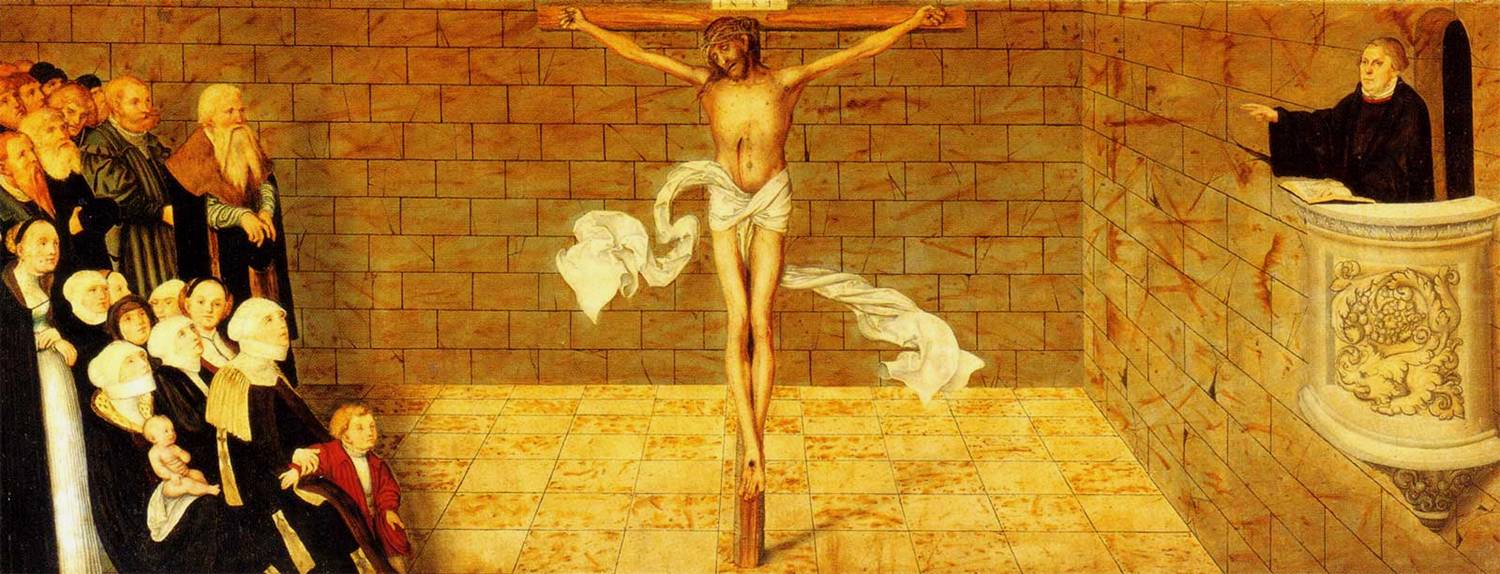
And an image that captures the heart of Martin Luther’s theology and self-understanding:

luther-preaching2

Well, that’s all right then

Apparently, the GTS faculty will return to work.

We accept your offer of reinstatement to our positions, and the salaries and benefits outlined in our contracts in effect prior to September 25, 2014. We look forward to being able to do this as soon as possible. Like any member of the Seminary’s faculty we agree to abide by the terms of the Seminary Constitution, Bylaws and policies. Given some of the confusion that has arisen about these texts in recent weeks, we will need you to provide us with copies of them: this would help us as we seek together to work within them. We are pleased to see that during the “cooling off period” all of the parties’ respective legal arguments and positions will be reserved.

A letter from the Rt. Rev’d Clifford Daniel 3d, a member of the Board of Trustees, may shed additional light

. I am hopeful that the Executive Committee and Board’s invitation to the Faculty to a return to the prior status through the remainder of this academic year will be received in a positive way and that the faculty assume their prior positions. I am encouraged by the decision of the Executive Committee to engage a skilled, qualified Christian mediator who will call the Dean, the Board, the Faculty, Students (and perhaps representatives of the Alumni/ae Association) together to engage in a prayerful, structured and disciplined process of mediation and reconciliation. Following graduation in May 2015, we as a community can come together to determine where we are and where we need to go. Part of the process must be mutual conversation, confession and repentance as necessary steps toward reconciliation.

The Shame of Being Episcopalian

On Friday evening, I received an email blast from Interfaith Worker Justice. It’s an email list I’d been on since 2011 and the protests at the State Capitol in Madison. Back then, I offered Grace’s hospitality to people of faith and somehow, my name was added to Interfaith Worker Justice email list. I’d always meant to unsubscribe because as important as the issues they raise are, my energy, time, and passion are focused in other directions.

On Friday, however, the issue wasn’t the minimum wage but the events at General Theological School that began with the firing of 8 faculty, a decision that was affirmed at the Board of Trustees meeting this past week. As I read the email I felt the shame rising in myself to know that once again the leadership of the Episcopal Church seemed to be acting immorally, unpastorally, and in ways antithetical to the Good News of Jesus Christ. In spite of my shame and embarrassment, I recognized the irony of the appeal to the Presiding Bishop in the petition that the email highlighted. The PB had been on campus in the days after the initial firing of the faculty (taught one of the classes as a “replacement) and is an ex officio board member.

Others, most notably Crusty Old Dean and AKM Adam have laid out the labor issues at stake and the offense that that the Board of Trustees is acting in ways that General Convention has denounced (or would denounce) if it were occurring in corporate America or perhaps in foreign lands. As a former academic myself, and as a former short-term faculty member of an Episcopal seminary, I was always uncomfortable with the effort to view relations between faculties and administrations in light of labor law. I always thought (and still do) that the labor model distorts what ought to be happening in colleges, universities, and seminaries, especially when those institutions claim to be church-related. I know the necessity of it, but I think it diminishes the mission, purpose, and quality of relationships all around.

In fact, what bothers me most about the situation at GTS is not so much the labor issues at stake. It is not even the claim made by many that the actions of the Board of Trustees go against church canons and the gospel (although they seem to). What bothers me most is that this seems to me to be an extension of a trend we have been witnessing for the last decade in the Episcopal Church–the insistence by the leadership to seek recourse to legal remedy, to defend prerogatives and property against every claim, to pursue a scorched-earth policy in protection of the institution, and to offer reconciliation after the trials are over (but while the wounds are still raw).

What’s happening at GTS is not unlike what has happened to bishops (remember the PB declaring that the Bishop of South Carolina had abandoned communion?), to dioceses, and now to a seminary. A petition that appeals the Presiding Bishop to take action?

It’s doubly ironic that all this is occurring as we’re still digesting the recent report from the Taskforce on Reimagining the Episcopal Church with its recommendations for a stronger “CEO” as Presiding Bishop, a smaller Executive Council, and contract workers as church-wide staff. We are eyewitnesses to the restructuring of General Theological Seminary with its evisceration of faculty governance and lasting damage to a community of formation. I have advocated strongly for the need to reform the structures of the church, but if what emerges is less shared governance and more centralized power, count me among the resistance.

What I fear most is that over the last decade we have sown the wind, and now we are reaping the whirlwind.

Bishop Dietsche of the Episcopal Diocese of New York (and a member of the GTS Board of Trustees) has issued this statement:

it is my hope that we may yet find a way to work within the structure provided by this resolution to continue to press forward toward that which we still believe must be done, and that is to reinstate the eight faculty in full, and to do that this week.

Bishop Breidenthal (Diocese of Southern Ohio) has also spoken publicly in defense of the fired GTS faculty.

IfIs the Anglican Communion whimpering to its end?

News reports today suggest that the Lambeth Conference, the meeting of Anglican Bishops from across the world that is scheduled to take place in 2018, has been postponed indefinitely. Although there’s no official word from the Archbishop of Canterbury or the Anglican Communion Office, Presiding Bishop Katharine Jefforts Schori of the Episcopal Church reported at the recent House of Bishops meeting in Taiwan that Archbishop Welby had informed her of the postponement.

The Lambeth Conference meets every ten years and has previously been postponed twice because of World Wars I and II. This time, the postponement is not due to world war but to conflict within the Communion itself. In fact, more than 200 of the 700-plus bishops boycotted the 2008 gathering.

Lambeth is understood to be one of the four “Instruments of Communion” that bind the Anglican Communion together (in addition to the Archbishop of Canterbury, the Primates Meetings, and the Anglican Consultative Council. Jefforts Schori was quoted to say that Archbishop Welby told her that the next Lambeth Conference would not to be preceded by a Primates’ Meeting at which “the vast majority of are present.” Whether such a meeting is possible in the current climate remains to be seen.

If true, this seems to me a very big deal indeed. I’m rather surprised PB Jefforts Schori’s comments were not picked up and explored earlier. The Anglican Communion is knit together by means of very weak threads and the postponement of Lambeth can only mean further disintegration. In the meantime, other bodies are being created that bring together like-minded groups intent on creating their own version of Anglicanism.

The Presiding Bishop will stand down

Katharine Jefforts Schori, Presiding Bishop of the Episcopal Church, has announced she will not seek reelection in 2015. Elected in 2006, PB Jefforts Schori is eligible for reelection according to the rather complicated rules laid out in the canons, and there had been considerable speculation that she might do so.

She writes:

I believe I can best serve this Church by opening the door for other bishops to more freely discern their own vocation to this ministry.  I also believe that I can offer this Church stronger and clearer leadership in the coming year as we move toward that election and a whole-hearted engagement with necessary structural reforms.  I will continue to engage us in becoming a more fully diverse Church, spreading the gospel among all sorts and conditions of people, and wholeheartedly devoted to God’s vision of a healed and restored Creation.

Previously, the Joint Nominating Committee for the Election of the Presiding Bishop had issued three essays laying out the nominating and election process, the current roles and responsibilities of the office, and how the office has changed over the centuries. Those essays are worth reading and available here:

Meanwhile, the Task Force on Reimagining the Church (TREC) has issued its own vision for changing the structure and governance of the Church. It envisions a vastly expanded set of powers for the Presiding Bishop while streamlining various governing bodies. That document has received criticism for reducing the participation of laity and democratic process.