
Touring Higher Ground St. Paul

On Monday, April 8, a group from Madison drove up to St. Paul to visit Catholic Charities’ Higher Ground shelterwhich opened in January 2017. Our group consisted of city and county staff as well as representatives from service providers and other interested parties like myself. It was an opportunity to visit a facility that had been designed for the purpose of providing overnight emergency shelter as we dream of a new shelter in Madison.

The scale of the project is breathtaking. The shelter itself provides 172 beds for men, sixty for women. In addition, on the second floor there are 48 pay-to-stay beds and ten medical respite beds. The upper floors provide193 additional SRO (single-room occupancy) beds. Opposite the shelter, another facility that will house daytime services as well as additional housing is under construction with completion scheduled for fall 2019. Overall the campus is the result of a public-private partnership and a successful $100 million capital campaign.

As we approached the shelter, we were greeted by homeless people who were hanging out on the broad plaza in front of the building. One shared a little bit about his life, another gathered us and offered a prayer. Inside, our formal greeting took place in the spacious intake area which is used for both the men’s and women’s sections of the shelter. We were given a brief history of the efforts to provide emergency shelter and then taken on a tour of part of the facility.

The stark difference between the Drop-In Men’s Shelter in Madison and Higher Ground was obvious at first glance. A spacious lobby accommodates guests at intake unlike the cramped hallway where intake occurs at Grace, requiring that men wait outside during cold and inclement weather. Inside the shelter is ample room for guests to sit. There are mats available for overflow. The bunks are efficiently and thoughtfully designed, offering electric outlets, USB ports, and storage lockers. Guests can reserve their bunk for the next night which gives them the opportunity to leave their belongings in the small lockable storage locker. The reservation policy means that there is relatively little turnover because the shelter operates at capacity year-round.

Preston Patterson, manager of the shelter at Grace, in the Higher Ground lobby
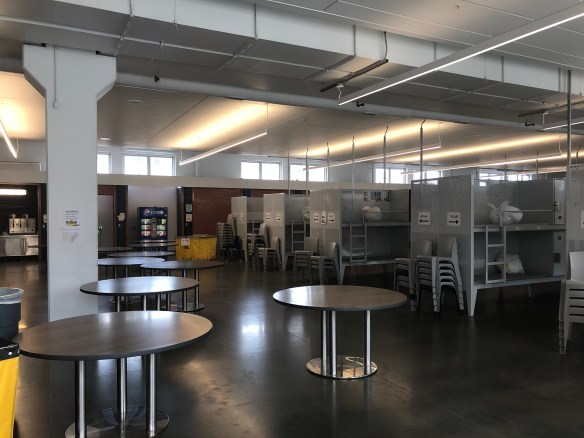
A shot of the men’s shelter area

The outdoor smoking area

a bunk showing storage locker and bedding

Our tour guides

The facility was light and airy. One of the features is an outdoor smoking area that is always accessible from the shelter. Benches and tables allow smoking guests to sit comfortably and engage in conversation.

The pay-to-stay area offers more seclusion and more storage space than the first-floor shelter. Guests pay a fee for each night, payable in advance. The money is held in escrow and as it accumulates up to $500 can be used toward permanent housing (first-month’s rent or security deposit).

a peek into the pay-to-stay area. The bunks are the same as below but there’s more storage and privacy

Because Higher Ground is not the only emergency shelter in St. Paul and there are facilities in nearby Minneapolis as well, policies and procedures can be both stricter as regards behavior and more flexible around limits on stay and the like. Some of them might not work in Madison.

One of the most difficult issues facing any discussion of building a new shelter in Madison is location. There is widespread consensus among government, service providers, and homeless advocates that any homeless shelter needs to be located downtown near transportation and other services. Higher Ground was built on property that was already owned by Catholic Charities. Initial attempts to locate it elsewhere faltered on neighborhood opposition.

I came away from the tour deeply impressed by facility’s design, by its operation, and by the commitment of the staff who led the tour. St. Paul can be proud of the facility that offers shelter and services to people experiencing homelessness, ensuring their dignity and offering them opportunities to move temporary to permanent housing as they seek to build lives of meaning and contribute to the greater good of the community.

It also reaffirmed my commitment to working with others in our city and county to create a purpose-built shelter adequate to the needs of our community and dedicated to helping those who seek shelter there to find permanent housing and to lead productive, meaningful lives.

The Future of the Men’s Drop-In Shelter at Grace Church

In an important article examining the mayoral candidates’ position on housing issues, there   was a line that threw me for a loop:

Porchlight’s men’s shelter at Grace Episcopal Church on Capitol Square will need to be moved due to redevelopment on the block…

This is not now true and will never be true. The Men’s Drop-In Shelter will move from Grace only when our community comes together to create a new purpose-built shelter designed according to best practices, and adequate to the needs of the guest who seek shelter there.

The Drop-In Shelter came to Grace on a one-year trial basis in 1984-1985. That it remains here 35 years later reflects Grace’s commitment to the most vulnerable members of our society, and that our community has lacked the political will to develop an alternative, more adequate, and permanent solution.

In fact, Grace’s leadership has begun a conversation on creating a new men’s shelter. We have met with homeless providers, city and county elected officials, and other community leaders. The counsel we have consistently received is that unless we set a deadline, we will never build enough momentum and urgency to create change. And that has been our dilemma. Our commitment to the men who sleep at Grace each night (and at the overflow shelters at St. John’s Lutheran and First United Methodist) is such that we could never issue an ultimatum. So we have slowly begun building support for our ultimate goal of a shelter that our city and county can be proud of.

Just last Sunday, we offered an update to our congregation on where we are with these efforts. In the coming weeks, we hope to contract with a consultant who will help us gauge community and governmental interest in such a project and solicit leadership from a broad representation of the community in our effort. If the climate seems favorable, we will move forward with the next steps: finding a location and beginning to seek funding. It’s a long-term project. Given my experience with Day Resource Center (the Beacon), I anticipate it taking anywhere from five to ten years.

A possible shelter move, while complicated by the development proposal for the new Wisconsin History Museum, is independent of any redevelopment plans. While Grace Church has been informed as the development proposal has moved forward, we are not currently involved in the project.

Ultimately, there are questions about the future use of our property, especially the west wing which houses the men’s shelter and our food pantry. Both of those entities provide essential services and are central to Grace’s response to the proclamation of Jesus Christ to feed the hungry and provide shelter for the homeless. Similarly, any development that  Grace undertakes on our property will have to support our mission and ministry and be consistent with the gospel mandate to preach good news to the poor and to proclaim justice in the heart of the city.

My hope is that our community comes together in support of our effort. I also hope that this issue will become a central element of the mayoral campaign. Whatever vision for Madison that the candidates have, a great city is great only to the extent that all of its residents are able to flourish.

Faithful Development: Stewardship of property for mission during a real estate boom.

News broke this week that Governor Evers’ proposed capital budget includes funds for a new state historical museum. There is a proposal on the table to redevelop much of the block on which Grace Church is located with a new museum as the anchor tenant. We’ve been in occasional conversation with the developers for almost five years, most recently before the election last fall. At that time, we were told that the project’s future would be determined after the election and its fate might depend on the election’s outcome. That Governor Evers has included it in his capital budget is one more step in a long process. Currently, construction is anticipated to begin in the Fall of 2021 with completion in 2023.

It’s not at all clear whether or how Grace Church might participate in this major development. Early on, it was thought that part of our property might be needed in order to assure adequate parking for the project but as plans have changed, that seems less likely. At the same time, our west wing which currently houses our homeless shelter and food pantry, is underutilized and may be ripe for development.

When I first learned of the proposed redevelopment of our block, I was excited because I saw the possibility of our participation in such development to be a way of securing long-term financial viability for Grace Church and its ministries in the midst of our rapidly changing culture and the decline of mainline Christianity in the US.

During my tenure at Grace, I have become increasingly interested in issues of urban planning, development, sustainability, and how Christian theology and Christian churches intersect with those issues. I spent my sabbatical in 2016 reading widely from Jane Jacobs to Richard Sennett to those few theologians who are thinking about such questions. I also visited cities from Richmond to Boston, as well as Seattle and Portland, to explore how congregations in urban settings were thinking about their property and using it to connect with their neighborhoods.

Recently, I have begun to see that questions of real estate development are not just about financial sustainability, more importantly they are questions that have at their heart theological and ethical dimensions. One reason for this is that this redevelopment is occurring in a city that is among the most segregated in the nation, in which racial inequities are among the highest in the nation. At the same time, our real estate boom is not creating affordable housing.

When I met with the mayor last April about the desperate need for a new men’s shelter, purpose-built and adequate to the needs of our community, he immediately turned the conversation to possible uses for a new development on our property. In a conversation with another elected official, I was asked what I thought the city of Madison’s core value was. My reply came immediately, “real estate development.”

I came across a book that will be published next week: Samuel Stein’s Capital City: Gentrification and the Real Estate State.

the growing centrality of urban real estate to capital’s global growth strategy. Through this process, the price of land becomes a central economic determinate and a dominant political issue. The clunky term “gentrification” becomes a household word and displacement an everyday fact of life. Housing becomes a globally traded financial asset, creating the conditions for synchronized bubbles and crashes. Government, particularly at the municipal level, becomes increasingly obsessed with raising property values and redistributing wealth upward through land and rents. Real estate developer Donald Trump becomes first a celebrity and ultimately a president. Taken together, we witness the rise of the real estate state, a political formation in which real estate capital has inordinate influence over the shape of our cities, the parameters of our politics and the lives we lead.

You can read an excerpt of the book here:

From what little I’ve read, Stein seems to be describing the situation in Madison well.

As property owners, churches participate in this “real estate state.” Diana Butler Bass points out that in many cities, the cumulative property owned by churches and religious organizations is significant, making them among the largest nonprofit landowners. As Christianity declines and demographic shifts take place, churches in urban cores are often seen more as financial assets than as ministry opportunities. Across the country we have seen numerous sales, property developments and the like, often with significant financial windfalls for congregations and denominations. We saw this happen here in Madison with the redevelopment of the St. Francis House Episcopal Campus Ministry. A private student housing development on a portion of the land funds not only UW Madison’s campus ministry, but also supports diocesan campus ministry elsewhere. And yes, I was actively involved in that project.

When Willie James Jennings spoke in Madison recently, he emphasized the importance of place for Christian theology, especially given the ways that our theology has not seen itself as grounded in local and spacial contexts. At one point he said, “planning and zoning meetings are the most important meetings for determining the futures of our communities. Churches and Christians should be present and engaged at these meetings.”

Our churches, especially older churches constructed in traditional religious architectural styles, are increasingly witnesses to an alternative to the glass-clad buildings of contemporary cities. While they are symbols of the sacred and gathering places for the faithful, their very presence in the heart of cities bear witness to an alternative to the neo-liberal, capitalist, and consumerist culture in which we live. When we sell our property, or redevelop it in order to maximize profit, we succumb to the idolatry of the market and abandon our allegiance to the Christ who died as a victim of the imperial system of domination.

Our churches are not only pieces of property, they are outposts of the reign of God. They should model the community and world Jesus proclaimed and that God is bringing forth. In our stewardship of our property, our primary concerns should be to create community, to support and nurture the flourishing of the residents of our neighborhoods. My hope is that as redevelopment plans for our block move forward, Grace Church can be an advocate for a project that values justice, diversity, and a vibrant neighborhood where all residents can flourish, as well as profit.

“The churches should do more” My response to those who say our response to need is inadequate

I’m told that elected officials and city staff have complained in connection with this week’s sub-zero temperatures, that churches should be doing more; for example, that they should open their doors 24/7 to people in need. Whether they mean we should offer temporary emergency shelter, or that our doors should literally be unlocked all of the time isn’t clear to me, and the comments have apparently been removed.

I suppose the logic runs something like this—we receive property tax exemptions as non-profits, we have facilities that can offer shelter, why don’t we do it? Well, we are doing it. Religious organizations provide the core of Madison and Dane County’s emergency shelter for the homeless: the Salvation Army, The Beacon, which though partially funded by city and county dollars, is operated by Catholic Charities. Then there is the Men’s Drop-In Shelter, operated by Porchlight, but housed at Grace Episcopal Church with overflow shelters at St. John’s Lutheran and First Methodist. Bethel Lutheran Church has also had a significant homeless ministry over the last years. This week, First Methodist and its Outreach Coordinator Karen Andro, received national media attention for offering their space as overflow shelter for families.

No doubt, any comments critical of churches would have excused the work of these downtown churches and religious organizations, aiming at other targets: the many neighborhood churches that dot the city, or perhaps, the megachurches that are mostly located in suburbs. But these churches also do their part, providing volunteer labor and funds, for example, helping to provide the meals at the Men’s Shelter 365 days a year, or supporting the Beacon, or by organizing food drives for food pantries and the like.

For many of these other churches, offering temporary shelter is unrealistic. I talked with one pastor on Friday who told me his church was 1 ½ miles from the nearest bus stop. Most of them are in unsuitable locations. But there are other problems. Temporary shelter, even on a short-term basis, requires incredible resources. Most churches lack the staff to operate such shelter. For example, our facilities are cleaned by a service that comes twice a week. We could not provide the necessary security. Our staff and volunteers are neither trained nor competent to deal with the issues raised by a large intergenerational group confined to a small space. Imagine a 75-year old volunteer trying to mediate and de-escalate a dispute between two men in their twenties, who might be mentally ill or high. In addition, volunteers would need to be vetted in advance. Our denomination requires, and quite rightly, that volunteers undergo training for the prevention of sexual abuse. We also carry out background checks, especially of volunteers working with children. We cannot accept the help of any random volunteer, and I’m sure the mayor and city staff understand why such measures are necessary.

This is the second Polar Vortex I’ve experienced since coming to Madison. I was reflecting this week how different it is in 2019 than it was the last time. Then, we scrambled day by day to make sure there were spaces for people to stay warm during the day. On MLK Day that year, with the libraries, and many churches closed in observance of the holiday and no day shelter, Grace Church opened its doors to more than 100 people who sought refuge with us. But we couldn’t have done it by ourselves. Karen Andro brought a group of volunteers from First Methodist to provide lunch and staff from the homeless ministry at Bethel as well as other volunteers and outreach workers offered their professional expertise. In 2019, the presence of the Beacon makes an enormous difference. And I’m so grateful for Catholic Charities, for Jackson Fonder, Executive Director, and the amazing staff and volunteers who help operate it.

I’m sure I speak for all other leaders of religious organizations throughout Madison who have met with people this week and throughout the year who are in need of food, shelter, or other services and who have seen the effects of these record-breaking temperatures on the most vulnerable of our neighbors. We are doing our part. Indeed, many of us are operating at or beyond our capacity in terms of our financial resources and our volunteer base.. The religious community will continue to do what we can, but to expect us to do more, in the midst of the long-term decline in American religion, changing demographics, and the amount of work we are already doing, comes across as nothing more than an attempt to shift blame and responsibility.  It is divisive, unhelpful, and counter-productive. In emergencies like this, the whole community needs to come together and cooperate on solutions.


So, rather than taking potshots or criticizing congregations and religious organizations for “not doing enough,” perhaps city officials ought to invite us into the conversation. I’m sure Dane County and the City of Madison have emergency plans in place for various natural disasters. Is there such a plan in place for another lengthy period of sub-zero temperatures? There certainly should be. Whether there is one or not, if city officials want congregations and religious organizations to “do their part,” they should invite us into the process, and work with us to develop a plan that will ensure no resident of Madison lacks shelter when temperatures hit -20.

Is Madison a “people” city or a “market” city?

Madison is gearing up for a mayoral election next year and it’s likely much of the campaign  will focus on the candidates’ vision for our city’s future. I came across this interview with one of the authors of Market Cities, People Cities and thought it offered insight into how we ought to think about Madison’s present and future:

When market cities are asked, “What’s the purpose of a city?” they say it’s to create jobs, to lure companies, to create regional wealth — and that is going to make a healthy, vibrant economy, and then life is good.

A people city will say the purpose of a city is to create a high quality of life for its citizens and to create equality between its citizens — to make life livable, healthy and sustainable.

That different assumption about what the city is for creates extremely different outcomes — from the city’s priorities to how it spends money to what it will decide when it’s forced to make decisions, which it always is.

[Residents] have a very different experience of living in these different kinds of cities.

Read the full interview here:


Update on the Beacon, Madison’s new day resource center

In around fifty days, the Beacon, Madison’s long-overdue day resource center for the homeless, is scheduled to open. It’s a project I’ve been involved in off and on for six years and I now serve on the Beacon’s Community Advisory Team. The Beacon is intended to provide a one-stop location for services for individuals and families, providing everything from showers and laundry facilities to lunch, employment and other services. Construction is nearing completion.

As with any project of this magnitude, there are bumps along the road. One of the most significant came to public attention this week when it was revealed that there is a significant gap in providing funding for ongoing operations. Details are here.

The community’s response has been disappointing. I read responses on social media from  homeless advocates that focused on the original process that resulted in granting Catholic Charities the contract to operate the Beacon. Advocates have also questioned the size of the annual operating budget. I would hope that advocates would focus their energies on the Beacon’s success.

The city is reluctant to provide additional funding. In the linked article, Jim O’Keefe suggested cutting the operating budget, even though it is based on in-depth study of best practices in such facilities across the country. And given the city’s track record with the Rethke Terrace Housing First project, where the operating budget didn’t initially cover the services necessary to succeed, its top priority should be providing adequate funding.

I’m optimistic that this problem will be solved and that the Beacon will open on schedule. It’s certainly the single most important development in our community’s response to homelessness since I arrived in Madison in 2009, and it may be the most important such development since the founding of the men’s drop-in shelter.

In the meantime, let’s encourage the stakeholders to sit down and figure out how to fund the Beacon in such a way that its mission to provide services to homeless people, to help them transition from the streets to permanent housing, and to flourish as human beings, is a success.


“Lord, Save Us!” A Sermon for the Sunday after Charlottesville

I am struggling. I am afraid.

As I’ve watched events unfold this week, I’ve struggled to make sense of it all. I’ve struggled to find a way from our world and our lives into the gospel. It’s not that the gospel doesn’t speak to our situation. It most certainly does. it’s that the situation keeps changing and each day brings new horrors, new fears, new challenges. In this week when we observed the 72nd anniversary of the bombings of Hiroshima and Nagasaki, we seem to be on the brink of nuclear war—closer to that catastrophe than at any time since the Cuban Missile Crisis of 1962. All week, I kept thinking back to what it was like for me as a student in West Germany in 1979-1980; where scars from World War II were still present, and all around were reminders of the threat of catastrophic, nuclear war.

By the end of the week, the president was threatening to go to war with Venezuela.

We learned this week that 2016 was the hottest year in the recorded history of our planet.

This weekend we have witnessed in Charlottesville the hatred and violence unleashed by white supremacists, emboldened by a national culture that seems unwilling to name and reject hate and white supremacy. We have seen a young woman murdered by one of the white supremacist protesters. Views that might have been unthinkable a decade ago have become mainstream, and people who hold those views are embedded at the heart of our political and civic culture. While I was heartened to see the Episcopal bishops of the Diocese of Virginia and other priests, among whom several I know personally, standing witness against that violence and hatred, the reality is that many, too many, white Christians equate Christianity with whiteness, white supremacy, and with American nationalism. These are sins we need to call out and name as evil. While it is easy to point fingers at others, it is important that we examine ourselves, to see where those views are embedded in our selves. Continue reading

Being Transfiguration in a time of violence: A Sermon for the Feast of the Transfiguration, 2017

Today, August 6, in the church’s calendar is the Feast of the Transfiguration. It’s one of the major feasts of the life of Christ and because of that, when it falls on a Sunday, it supersedes the regular lectionary readings for the day. That explains why we are reading lessons from Exodus, 1 Peter, and the Gospel of Luke, rather than the Gospel of Matthew and the readings from Genesis and Romans we’ve been having.

It creates something of a problem for the preacher because there’s another Sunday each year when we always hear the story of the Transfiguration, the Last Sunday after Epiphany (the Sunday before Ash Wednesday). So it was only a few months ago that we heard Matthew’s version of this story. That we read this story each year on the last Sunday before the beginning of Lent is appropriate because the themes of this story are a fitting transition between the season after Epiphany and the beginning of Lent and reflect the story’s position in each of the synoptic gospels. It comes immediately after Peter confesses Jesus to be the Christ, after Jesus’ first prediction that he will be crucified and his invitation to his disciples to take up their crosses and follow him. Luke deepens the connection between transfiguration by stating, just a few verses later, that Jesus “set his face to go to Jerusalem.” In other words, after this mountaintop experience, Jesus begins his final journey that will end on another mountaintop—Calvary—with his crucifixion.

There’s another detail in the story that points ahead to the crucifixion. There’s only one other time that Luke says the disciples fell asleep. On that later occasion, as he faced crucifixion, Jesus asked his disciples to stay and watch with him while he prayed. Luke tells us that after praying, Jesus came back to them and found them sleeping, “because of grief.” This time, the disciples were “weighed down with sleep but they stayed awake and saw his glory and the two men who stood with him.”

Whatever positive spin we might put on the disciples’ behavior here is likely negated by Peter’s response to seeing Jesus with Moses and Elijah. He says, “Master, it is good for us to be here. Let us make booths…” No doubt, you’ve heard sermons criticizing Peter’s response, his lack of understanding, his desire to prolong the experience. But there other ways to think about it. “Booths” is an allusion to the Jewish Feast of Sukkot or Tabernacles, which was in part a commemoration of the Hebrew experience of the Exodus.

And there are all sorts of echoes of Exodus here. Not just in the presence of Moses, the location on a mountaintop. There is also the presence of the cloud and the bright light, which were associated with experiences of divine revelation, including at Mt. Sinai. The word “Exodus” also appears, in Luke’s description of what Jesus talked about with Moses and Elijah—his “departure”—the same Greek word, eksodon is used. In the Hebrew Bible and the Jewish tradition, “exodus is one of the primary examples of God’s mighty acts on behalf of God’s chosen people, and it’s likely that Luke wants his readers to understand Jesus’ departure or exodus in similar terms, as God saving God’s people.

It may be, then, that Peter’s desire to erect booths is not an example of his misunderstanding, but that he wants to worship in this place, to be present with Jesus here, to learn from all three of these men. While the primary point of this story is about Jesus, a confirmation of his ministry, his calling, his identity as the Son of God, the Chosen One, this story may also be about discipleship, about following Jesus.

Jesus took his three favorite disciples, in Luke, the first three disciples he called, Peter, James, and John, up this mountain to pray. They had been with him all along his journey. They had seen his miracles, listened to his teaching, his first prediction of his suffering and death, and his call to them to take up their crosses and follow him. Now on top of this mountain, they saw his glory and wanted to prolong it. Whatever it meant, whatever they experienced, there was more to do; they could not tarry, but the four of them went back down the mountain and soon began that last, fateful trip to Jerusalem. And they kept silent about all that they had seen that day.

We, all of us, are called to follow Jesus. We are called to be his disciples. In our complicated world, with our complicated lives, it’s never quite clear what discipleship means. Is it enough to come to church from time to time and worship, to experience the beauty of God, to catch sight of God’s glory, if only momentarily and partially? I was speaking this week with an elderly couple who are unable, because of health issues to attend Grace. They expressed their deep sadness about missing services, for it was not just the community they lacked, it is the experience of awe and transcendence that they miss, and can find in no other place in their lives.

Worship, the experience of God’s glory is an important part of following Jesus but there is more to discipleship than that. When Jesus came down the mountain, he returned immediately to his ministry of teaching and healing, of proclaiming and bringing into being, the reign of God. And that is precisely what we are called to do as well. Our experience of God’s glory transforms us as well as we do those same things proclaiming the coming of God’s reign, and in our actions and lives, being agents and examples of God’s glory in the world.

The mount of Calvary looms over the mountain of Transfiguration; the cross casts its shadow on Christ’s transfigured face. Our observance of the Feast of Transfiguration occurs in a divided city that has experienced unprecedented violence in recent months. We have seen, as I’m sure you know, 10 homicides already this year, tying the record for the most murders in a year in Madison. Our city is more divided than ever. Our elected leadership is quarreling over what to do in response to this crisis and community leaders are frustrated and angry. Meanwhile, residents of the neighborhoods most affected by the violence are living in fear everyday and mourning the deaths of friends and family.

We, most of us, watch the news reports, read about them in the papers or on social media, but few of us have experienced the ripples of that violence ourselves. Oh, we may know where the events occurred, we may have stopped at the gas stations or convenience stores where incidents took place, we may even live within earshot. But most of us live in a completely different world. There’s a map on Madison.com that plots all of the significant incidents of gun violence in the city since May. Only one of the some 50 total occurred in the downtown, near westside or near eastside. It’s another piece of evidence showing how divided our city is.

As followers of Jesus, called to share the good news of the coming of God’s reign, called to break down the barriers that divide us, we are called to be agents of Christ’s reconciling love in this world. A group of us, the Creating More Just Community task force, has been engaging on issues of racism and inequality for the last several years. We are working on a new initiative to build relationships with our neighbors across the street at the Capitol, and shared information about that effort with you last week.

Now, I am calling us to engage in that reconciling work in our city. The violence we are witnessing is a symptom of something much deeper, of hopelessness and despair, of broken families, broken lives. In the coming weeks, I will be taking part in conversations with clergy and community leaders to see how we at Grace can work with others to heal our divisions, to bring an end to violence, and to spread the glory of Christ’s love in our city.


Murder City Madison–Follow up

I wrote on Wednesday about the rash of shootings and 10 homicides in Madison so far this year. For those interested in the story, I am providing here some updates and additional information.

First, there was another attempted homicide last night.The victim had “non-life threatening injuries.”

There’s a background piece in this week’s Isthmus about the violence and about the conflict among city elected officials and community leaders about how best and most effectively to respond.

Amid all the violence and rancor, there are also signs of hope and success. Selfless Ambition reports on the dramatic changes in one Madison neighborhood over the last few years. One of the city’s poorest communities, the Leopold neighborhood has begun a remarkable transformation. The number of police calls dropped by 25% between 2011 and 2015, thanks to the assignment of a community resource police officer, expanded community programming at the elementary school, and the creation of urban community gardens.

If you want to follow developments in this ongoing story and in the effort to overcome racial disparity in our community, I recommend visiting Madison365 and Selfless Ambition regularly. Both are doing great work!

Murder City Madison

We woke today to learn that overnight another man was shot to death in Madison, the tenth homicide in 2017, the third in the last week. That ties the record with 2007 for the most homicides in a year, on August 2. I took me a while to compile a list of all of the victims’ names (police haven’t released the name of the most recent victim). Here they are:

1 David Edwards March 1
2 Andrew Nesbitt March 27
3 Michael Mederds, May 30
4 Jameel Easter June 10
5 Gerald Moore  June 24
6 Christ Kneubuehl June 26
7 Kub Herr July 2
8 Riccardo C. Simms. July 26
9 Ciara Philumalee July 29

There were domestic incidents (Andrew Nesbitt was killed by his roommate) and Christ Kneubuehl died of a heart attack during and armed robbery at a Culver’s but the most recent killings have seemed frighteningly similar: people gunned down in public. As Police Chief Mike Koval said of the most recent homicide: “This was a brutal assassination.”

The increase in violence has increased tension between elected officials and leaders in the African-American community as they struggle to develop solutions to the immediate problems and the underlying issues. There’s also a knee jerk response that puts the blame on people coming from Chicago or Milwaukee.

Madison.com provides a map that shows all of the serious gun-related incidents in Madison since May. It’s quite revealing. There’s only been one incident in the downtown area, the near east side, or near west side. The remainder of the almost 40 charted on the map occurred in or near largely African-American neighborhoods, along the belt line or near the interstate.

Of course, many of them occurred in places, like a 7-11, where people of all races and classes might come together but Chief Koval has been careful to insist that the most recent killings have been targeted–victims and shooters are known to each other.

Koval has also warned that police will become more proactive, that they will be “rattling the cages” those “creating havoc.” Undoubtedly, this means closer surveillance of African-Americans, arresting people on parole or probation violations. Such tactics will only worsen the already strained relationship between law enforcement and the African-American community.

I’ve got no proposals to make, no great ideas, no possible solutions. I am surprised not only by the spiral of violence but also by the relative silence in the larger community. Perhaps we’re overwhelmed by all of the news coming out of Washington–the healthcare debate, the chaos in the White House, the international crises. The old tagline “if it bleeds, it leads” still seems to be valid. Headlines of the shootings on the home pages of local media, but there is a lot else grabbing our attention, not least the Foxconn deal that has brought the legislature back into special session.

I’ve got nothing to offer, except prayer and an invitation to conversation. We’ll be using a litany this Sunday that I’m adapting from one written by Bishop Stephen Lane of the Episcopal Diocese of Maine. We’ll name all ten victims of homicide in Madison this year in those prayers; we’ll remember their friends and family. We’ll pray for healing and hope and that our city will come together across the divisions of neighborhood, class, and race.

And today I’m praying that there are no more killings, tonight, or tomorrow, or next week, or for the rest of the year.