Jesus, Son of David, Have mercy on us: A Sermon for Proper 25B, 2018

 This is a week that has been filled with meetings—with downtown leaders, with the Outreach Committee, the Creating More Just Community group, the taskforce working on issues around the redevelopment of our block, with ecumenical colleagues across the state, with grieving family members, families preparing for baptisms, and couples about to be married. I was so busy that I barely had a chance to take in the excitement of Grace’s participation in the downtown trick-or-treating on Wednesday, when thousands were welcomed to Grace and heard the spooky playing of our own Mark Brampton Smith. I did get to see the photos and videos that Pat posted to our facebook page and show all of the fun and excitement that was taking place.

Accompanying all of that, all week, has been the sound of the bells, as the technicians completed their work in time for this afternoon’s evensong and bells rededication. Many of us are looking ahead to events here at Grace, making plans for the coming months, talking about new opportunities for ministry and mission, or opportunities for deepening relationships among members in the congregation. The excitement is palpable all over Grace and in the soundwaves above and beyond Grace.

This week has also been a week of hatred and violence, with bombs sent in the mail, the killings of African-Americans in Kentucky, and then yesterday the shocking murders of 11 people at the Tree of Life Synagogue in Pittsburgh. Whatever excitement and joy we may feel here at Grace as we gather this morning to celebrate a baptism and as we celebrate our newly refurbished bells is tempered by the grief, sadness, and anger we feel at the deep divisions in our nation, at the violence and hatred that surrounds us and threatens so many. Continue reading

Prayers in times of violence, hatred, and grief

A Prayer for Victims of Terrorism

Loving God, Welcome into your arms the victims of violence and terrorism. Comfort their families and all who grieve for them. Help us in our fear and uncertainty, And bless us with the knowledge that we are secure in your love. Strengthen all those who work for peace, And may the peace the world cannot give reign in our hearts. Amen.

A Prayer for Social Justice

Almighty God, who created us in your image: Grant us grace fearlessly to contend against evil and to make no peace with oppression; and, that we may reverently use our freedom, help us to employ it in the maintenance of justice in our communities and among the nations, to the glory of your holy Name; through Jesus Christ our Lord, who lives and reigns with you and the Holy Spirit, one God, now and for ever. Amen. (BCP, 260)

A Prayer for the Whole Human Family.

O God, you made us in your own image and redeemed us through Jesus your Son: Look with compassion on the whole human family; take away the arrogance and hatred which infect our hearts; break down the walls that separate us; unite us in bonds of love; and work through our struggle and confusion to accomplish your purposes on earth; that, in your good time, all nations and races may serve you in harmony around your heavenly throne; through Jesus Christ our Lord. Amen. (BCP, 815)

A Prayer for Social Justice.

Grant, O God, that your holy and life-giving Spirit may so move every human heart [and especially the hearts of the people of this land], that barriers which divide us may crumble, suspicions disappear, and hatreds cease; that our divisions being healed, we may live in justice and peace; through Jesus Christ our Lord. Amen. (BCP, 823)

A Prayer for First Responders

Blessed are you, Lord, God of mercy, who through your Son gave us a marvelous example of charity and the great commandment of love for one another. Send down your blessings on these your servants, who so generously devote themselves to helping others. Grant them courage when they are afraid, wisdom when they must make quick decisions, strength when they are weary, and compassion in all their work. When the alarm sounds and they are called to aid both friend and stranger, let them faithfully serve you in their neighbor. We ask this through Christ our Lord. Amen.– adapted from the Book of Blessings, #587, by Diana Macalintal

For the President of the United States and all in Civil Authority

O Lord our Governor, whose glory is in all the world: We commend this nation to your merciful care, that, being guided by your Providence, we may dwell secure in your peace. Grant to the President of the United States, the Governor of Massachusetts, and to all in authority, wisdom and strength to know and to do your will. Fill them with the love of truth and righteousness, and make them ever mindful of their calling to serve this people in your fear; through Jesus Christ our Lord, who lives and reigns with you and the Holy Spirit, one God, world without end. Amen.

For Peace

Eternal God, in whose perfect kingdom no sword is drawn but the sword of righteousness, no strength known but the strength of love: So mightily spread abroad your Spirit, that all peoples may be gathered under the banner of the Prince of Peace, as children of one Father; to whom be dominion and glory, now and for ever. Amen.

A Prayer Attributed to St. Francis

Lord, make us instruments of your peace. Where there is hatred, let us sow love; where there is injury, pardon; where there is discord, union; where there is doubt, faith; where there is despair, hope; where there is darkness, light; where there is sadness, joy. Grant that we may not so much seek to be consoled as to console; to be understood as to understand; to be loved as to love. For it is in giving that we receive; it is in pardoning that we are pardoned; and it is in dying that we are born to eternal life. Amen.

“The Brazen-Throated Monsters:” Madison’s newspapers’ reporting on Grace’s bells in 1874

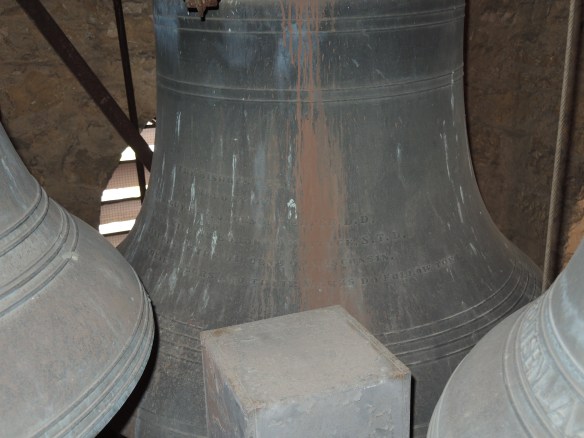
Workers from Lee Manufacturing Co. of Muskego, WI are putting the final touches on new strikers and state-of-the-art bell-ringing technology on the 23 bells that reside in Grace’s bell tower. The first nine were installed in 1874. Additions from the 1950s through the 1970s brought us to our current status. Along the way, all of the bells were made stationary and equipped with an electronic ringing system that has deteriorated over the decades so that in recent years, we’ve only been able to play a half-dozen or so of them. It seemed to me to be poor stewardship of the resources past generations gave Grace not to be able to use them in worship and celebration and after consultation with a number of vendors and a successful campaign to garner the congregation’s support, work began a few weeks ago. I’ve enjoyed learning more about the bells in the past few months.

Apparently, there had been something of a competition among Madison’s churches to have the largest bell. Apparently, with the installation of the “Bishop’s Bell,” weighing 2500 Lbs., Grace emerged victorious.

Madison’s newspapers, “The Daily Democrat” and the “Wisconsin State Journal” both reported on the installation of the bells. They arrived from Troy, NY on March 20, 1874. The total weight of the bells and platform was 14000 lbs. The Daily Democrat reported on March 31:

The nine chime bells were safely deposited in the tower of the Episcopal Church yesterday, and will be raised to their places as fast as possible. A large number visited the church to see them, and all will anxiously await the first peal from the “brazen throated” monsters.

After their installation and use throughout the day on Easter Sunday, 1874, the State Journal noted that:

the chimes were generally regarded as a success, and something on the possession of which the church and the city is to be congratulated, though they will sound better when experience will lead to more skilful ringing. Some tunes sounded beautifully, others, rather discordant. We have heard the opinion expressed that one or two of the smaller bells had not as good a tone as was desirable. This morning there was considerable experimenting on the bells by different parties, and a great deal of jangling. –State Journal April 6, 1874

A few days later, The Daily Democrat disclosed that action was being taken to address the intonation issues:

Slightly out of tune. – The third bell, key of G, in Grace Church tower, has been discovered to be slightly out of tune, and the services of a man were engaged through yesterday in chipping off a portion of the rim, by which means it is proposed to obtain the correct sound.–The Daily Democrat, April 10, 1874

However, as is often the case with contractors, Grace, and the whole city were assured that nothing was amiss:

Those bells are in perfect tune, so says a good judge of music; and Mr. Waters, the gentleman who came with them and superintended their erection, has received assurances that all is well; the money is paid down, and all the members of Grace Church are satisfied that the chime is superior to any in the State. –The Daily Democrat, April 16, 1874

The Bishop’s Bell, E-flat or Tenor Bell, 2500 lbs.from The Jones Company of Troy, NY), dedicated to the memory of Bishop Jackson Kemper, first Bishop of Wisconsin, and Bishop William Armitage.

The Third Time wasn’t the Charm: A Sermon for Proper 24B, 2018

We’re drawing near to the end of our reading of the Gospel of Mark this year. The past weeks, we have been accompanying Jesus and his disciples as they walk toward Jerusalem. They are now in Judea, the province where Jerusalem is located. As they near Jerusalem, the dangers and possibilities that await them come to dominate the narrative. It’s as if they can see the temple mount on the horizon as they walk.

We don’t know what the disciples were expecting. From Mark’s depiction of them, it seems likely that they thought they had signed up for a divine mission; that when Jesus arrived in Jerusalem and confronted Rome, God would intervene in history and restore the Kingdom of David and the Kingdom of God. Continue reading

Episcopal Dioceses and rising geographical inequality

October 13 was the date of the Episcopal Diocese of Milwaukee’s annual convention. It’s not an event I look forward to each year and the longer I serve in my current cure, the less I tend to focus my energies on larger Episcopal entities, whether dioceses or General Convention. Still, it’s an opportunity to connect with other clergy and laity and to hear a bit about what’s happening in other corners of the diocese.

Like so much of the US, Southern Wisconsin is seeing growing inequities among regions and races. Dane County, home of Madison, is in the midst of an economic boom and is home to a growing population. Other parts of the region are struggling economically and losing population. The economic boom affects races quite differently especially in Wisconsin, where racial inequities are among the worst in the nation.

Those inequities are not limited to the secular sphere. We see them in the Church as well. The Diocese of Milwaukee is neither large nor wealthy. Grace Church, with an average Sunday attendance of around 170 and an operating budget of approximately 550,000 is the second largest congregation in the Diocese. Many of our congregations are quite small and are served by part-time clergy. A number of congregations, both urban and small-town, have closed over the last years.

It was with this in mind that I read Richard Florida’s piece on City Lab entitled “America’s Worsening Geographic Inequality.” Drawing on a number of recent studies, Florida points out the disturbing trends:

  • the decline of middle-class neighborhoods and the separation of America into “areas of concentrated advantage juxtaposed with areas of concentrated disadvantage”
  • change in prosperity of neighborhoods (1980-2016); suburban neighborhoods most stable; among urban neighborhoods, more upwardly mobile than downwardly mobile; rural neighborhoods the most volatile
  • up to 1980, geographical inequities declined; since 1980; they have grown
  • Today, median household income for the top 20 percent of America’s counties is more than twice as high as the median household income of the bottom 20 percent, while poverty rates are roughly three times greater in the poorest 20 percent of counties, compared to the most affluent 20 percent.
  • America is not only economically unequal: Its inequality cuts sharply across geographic lines. We are becoming a country of have and have-nots that turns on where we were born or where we are able to live. And this worsening winner-take-all geography is bound up with, and reflects, our long running divides of race and class.  Increasingly, our neighborhood, and our zip code, is our economic destiny.

One sees evidence of such growing geographical inequality in the life of our diocese. It’s not just that a relatively small number of congregations account for much of diocesan revenue, it’s that the diocese in turn offers aid to a significant number of parishes. So, in a sense, there’s a redistribution of wealth taking place among parishes.

It seems to me that we don’t take these larger geographical inequalities into account when we think about our common life as a diocese. I doubt very much whether many dioceses do. We are accustomed to think in terms of racial inequality and regional (North and South; the coasts and flyover country) differences. But geographical inequality is also present within dioceses. Many of our struggling churches are in neighborhoods that are struggling as well. This is true of urban as well as rural or small-town communities.

The Episcopal Church with its geographically-shaped structure may be uniquely situated to address geographical inequities like those cited by Florida. To a degree, we already do this with our funding mechanisms. But I suspect we need to go further and nurture the bonds that tie us together as Episcopalians across the divides that separate us, whether those divisions be class, race, gender, or geography.

Jesus loved him: A Sermon for Proper 23, Year B, 2018

I’ve been thinking about gratitude a lot recently. It’s stewardship season at Grace, so there’s that of course, and we focused on stewardship and gratitude at recent diocesan clergy and leadership days last month. But it’s more than that. As we see growth in our congregation and new efforts to reach out into our community and to develop deeper relationships among our community and most importantly with Jesus Christ, I am overwhelmed with a sense of gratitude for the people here and our shared ministry and mission. I’m grateful to have been called to this congregation nine years ago; I’m grateful for our amazing staff and committed lay leadership, I’m grateful for the challenges presented us by an uncertain future in a changing world… Well, I could go on and on but I hope you see my point.

We have begun our stewardship campaign for 2019. We are in a strong and exciting place in our common life and our community and I pray that together we will develop the resources that will make possible new ministries and programs, and strengthen our current offerings and deepen relationships among us.

To mention stewardship on the Sunday when we hear this gospel reading is perhaps ironic, if not exactly offensive. This story is challenging on so many levels but it confronts with uncomfortable questions about our relationship to our financial assets, and the connection between our relationship with Jesus, discipleship, if you will, and money. And those challenges are also present when we think about how we will support Grace’s ministry and mission in the coming year.

Today’s gospel confronts us with two questions. The first question is asked by a rich man: “What must I do to inherit eternal life?” Jesus’ disciples ask the second question after hearing Jesus’ words: “Then who can be saved?”

Committed Christians reside in the interstices between these two questions, seeking salvation but profoundly challenged by Jesus’ words. Because Jesus’ words are so unsettling, because they amaze us, even as they amazed Jesus’ disciples, as Mark reports. Over the centuries Christians have done any number of things to soften the edge of his words: “It is easier for a camel to go pass through the eye of a needle than for a rich man to enter the kingdom of God.”

Those words are so difficult for us to hear, because, like the disciples, we wonder. These are hard words that Jesus says, words that put is in a hard place. If it is the case, if it is easier for a camel to go through the eye of a needle than for a rich person to enter the kingdom of God, then salvation is impossible. So we try to weasel out of the hardness of the place. We tell ourselves, we aren’t rich, not like the really rich, not like Bill Gates. So Jesus wasn’t talking to us.

Then we look for another escape route. There’s always the possibility that Jesus didn’t mean what he said or didn’t say what Mark has him say. Or my favorite interpretation, that there was a gate in Jerusalem, called the “eye of the needle” through which a camel could squeeze with difficulty. In other words, these difficult words aren’t meant for us, we’re middle class, not wealthy; and camels can get through the eye of the needle after all. So let’s all breathe a sigh of relief and go about our business.

It’s important to remember that the man did not come to Jesus in search of financial advice, or in response to Jesus hitting him up for a donation. He has come for help. He approaches Jesus because he wants to know how to attain eternal life, how to enter the kingdom of God, of which Jesus preaches. He addresses Jesus with humility, bowing down before him, calling him “Good teacher.”

Jesus’ response is challenging—not simply because he challenges the rich man, but because he challenges us as well. His response to the man is to remind him of his obligations under Jewish law. In a nutshell, Jesus is saying, keep the commandments. The man asserts that he maintains his obligations to the Jewish law.

From a traditional, twenty-first century Christian perspective, the whole of this interchange between Jesus and the man is jarring. Things don’t seem to make sense. Jesus’ response to the man ought to be, “accept Jesus Christ as your personal savior;” or “have faith in me,” or even “I am the way, the truth and the life.” Instead Jesus tells him, keep the law. Furthermore, when the man insists that he does keep the commandments, that, in essence, he is a good Jew, Jesus doesn’t respond with words to the effect that keeping the law is impossible, righteousness under the law doesn’t work. Instead, he gives him another command: “Go, sell all that you have, give it to the poor, and come, follow me.” Doing that will give the man treasures in heaven, it will bring him into the kingdom of God.

But of course, the man finds those commands much harder to follow than the 10 commandments. Now we learn something new about him. Mark tells us for the first time, that he has great possessions and he can’t give them up. So he leaves Jesus. His desire to share in the kingdom of God, his desire to walk with Jesus, to be a disciple was not as intense as his desire to continue living the life he had, to enjoy his possessions.

There’s another detail in the story that is very important. After Mark reports the man’s response to Jesus’initial statement, Mark tells us that “Jesus loved him.” At first hearing, we may find such a statement completely unremarkable, but in fact, it is almost unique. Only one other time in the gospel of Mark does the writer use the word “love”—that is when Jesus recites the two great commandments, to love God and to love neighbor. In other words, Mark never says elsewhere in the gospel, that Jesus loves someone.

Jesus loved him. So his challenge to the man “to go, sell all that you have and give it to the poor, then come follow me” is not a condition of Jesus’ relationship to the man, but a response to the possibility of such relationship. Jesus loved him, and because he loved him, he told him to sell all that he had and to follow him.

These simple words challenge us, and challenge every interpretation of this encounter that we might have. In the first place, Jesus doesn’t simply tell the man, follow me. No, he adds conditions. In Mark’s version of Jesus’ calling of the disciples, Jesus words are simply, follow me. But here, Jesus adds conditions, demands. Go, sell, give, come and follow me. For this man, it seems, it’s not enough to follow Jesus, he must also turn his back on all that he has, publicly renounce it.

But then, even though he turns away from Jesus, we are told that Jesus loves him. Does it mean simply that Jesus feels sorry for him, that he has compassion on him? But no, it isn’t because the man turned away in shock after Jesus’ words. Jesus loved him and then said to him, Go, sell what you own.” Jesus commands were in response to his love of the man.

The man stood on the edge of a great opportunity. Having asked Jesus a question of eternal significance, he received an answer of equal significance. But it wasn’t simply a matter of the man’s eternal fate. It was also about a relationship. To give up his possessions would have meant to accept, in radical and complete openness, the love of Jesus Christ.

Like the man, we kneel before Jesus, full of questions and uncertainty. We are drawn to him, to his words of love and hope, to the possibilities of forgiveness and healing, in gratitude for all we have received from God through Jesus Christ. Perhaps the little exercise at the beginning of the sermon opened your hearts in a new way to how you experience Christ’s love at Grace Church and through Grace Church.

May we in these weeks and months filled with planning for the next year, may we hold in our hearts and minds the awareness of Jesus’ love for us, that we are called to follow him, and to share that love with others. May our giving and commitment to Grace reflect that love and mission.



Creation, Relationship, Blessing: A sermon for Proper 22,Year B, 2018

Today is our Annual Blessing of the Animals. We do this on a Sunday close to October 4, which is the Feast of St. Francis, the anniversary of his death in 1226. Francis is of course among the most beloved and popular saints in the Christian tradition, as popular today as he was in his own lifetime. He is famous for his life of poverty, his simplicity, and his desire to imitate Christ. His imitation of Christ was so complete that he received the stigmata. For the last year or so of his life, he bore on his body the wounds Christ suffered on the cross, bleeding from his hands and feet. Continue reading

Grace and favor to God’s people in distress: A sermon for Proper 21A, 2018

 I don’t know how many hundreds of times I’ve sung our opening hymn “Praise my soul, the King of heaven.” But today was the first time I really noticed the first line of the second stanza “Praise Him for his grace and favor to his people in distress.” I don’t know about you, but I am distressed today. Distressed by events in our community and in our nation. I’m full of fear, anger, and despair and I struggle to find comfort in scripture or in the Good News of Jesus Christ, whether we can even hope or pray for, God’s grace and favor to us. Continue reading

Sometimes, crumbs are more than enough: A Sermon for Proper 18B, 2018

In addition to today being the Wisconsin Ironman Triathlon, it is in church parlance, the beginning of the program year. Our choir is back after its summer hiatus and Christian education for children and adults begins as well. This week, we are beginning something we’ve not done in quite some time at Grace, at least not on a regular, consistent basis. We will be offering two bible studies—one begins today, between the services; the other takes place on Thursday evening at 5:30. I hope some of you will take advantage of these opportunities, for engaging more deeply with scripture is essential to deepening your faith and your experience with Jesus Christ. Continue reading

Pure and Undefiled Religion: A Sermon for Proper 17, Year B, 2018

 Religion that is pure and undefiled before God, the Father, is this:


to care for orphans and widows in their distress, and to keep oneself unstained by the world. (James 1:27)

What is pure and undefiled religion? What is religion? You might be surprised to know that this latter question is one that is much debated among contemporary scholars of religion. There’s an overwhelming consensus that what we in the west call “religion” and which we distinguish from other areas of life and culture, is very much a modern western concept that has been imposed on other cultures and peoples. So, for example, there is no term for religion in the languages of India, and when the British Empire came to the subcontinent, it categorized a certain number of activities and practices as religious and defined Hinduism as a religion.

No doubt you find it odd that I might begin a sermon by questioning the term religion. It very likely is, but as many of you know I was a professor of Religious Studies for fifteen years before becoming a full-time parish priest, and as a teacher and scholar, I was very much interested in the way scholars and ordinary people thought about the material I was teaching and studying How we as a culture define religion has an enormous impact on how we organize society and its institutions, how we negotiate among competing claims and values (think “church and state” for example, and how we regulate individual and community behavior. As individuals, how we define religion for ourselves, shapes not only our self-understanding, but helps to shape our identity as individuals and members of larger groups, and where we place our ultimate trust and value.

When I taught Intro to Religion, I would usually begin the first day by distributing to the students a handout with around 15 definitions of religion, derived from theologians and scholars of religion, anthropology, and sociology. It was an exercise intended to get students thinking about this cultural activity we call religion, and to challenge the way they thought about it. So, for example, the image posted above, the scene outside the church today, where we have a shrine erected to Wisconsin’s true religion.

I know this sounds all terribly abstract, but let me point out something important. The word “religion” in the verse I quoted a few minutes ago actually means devotion or worship. That puts a rather different spin on things, doesn’t it? “Worship that is pure and undefiled before God is this: to care for widow and orphans, and to keep oneself unstained from the world.”

That translation may be more puzzling than clarifying, because to us in the 21stcentury, none of that, caring for widows and orphans, or maintaining purity from the world, sounds like worship to us. Ethics, morality, maybe, derived from prior religious beliefs, but certainly not worship. I’d wager that when most of you heard that verse the first time, you got all excited, because James confirms the views of most progressive Christians. What matters is justice, outreach, advocacy for the poor and the oppressed, challenging new immigration policies, all of that.

The terms pure and undefiled, even unstained strike us strangely in our contemporary world, even if in the case of their appearance in the Letter of James, we can easily interpret them in ways that make them less, indeed even support our own personal preferences and commitments. When we see the same English word in the verses from the gospel of Mark that we heard this morning, we may have a slightly different reaction.

After all these weeks, we’re back in the gospel of Mark, where we will remain for the rest of the liturgical year, until the end of November. To recap a bit, so far in Jesus’ public ministry, we have seen him heal a number of people of their diseases and infirmities, cast out demons, walk on water, calm storms, and feed five thousand people. We haven’t been introduced to much of his teaching or preaching, one or two parables and that’s about it. As fast-paced as Mark is, the gospel will pick up in speed and intensity as we move inexorably toward Jesus’ final confrontation with the Roman authorities and their Jewish sycophants in Jerusalem. And in today’s reading, we see another aspect of the conflict between Jesus and other Jewish communities and leaders.

What’s at stake here, as it almost always is when Jesus is in conflict with other Jews in the gospels, is the interpretation and authority of Torah, Jewish law. The Pharisees were a group within Judaism that sought to extend the role of Torah to the daily life of ordinary people. Their interpretation of Torah was intended to offer guidance in what to do so that the central precepts of Torah were maintained. They called this “building a wall around Torah.” Take the 10 commandments: “Remember the Sabbath Day and keep it holy.” Well, that’s great, but what does it mean to keep the Sabbath Day holy? The Pharisees explained that by offering guidance on what constituted work, and how much work one could do on the Sabbath.

In today’s gospel, the issue at hand is hand-washing. The Pharisees understood ritual hand-washing as keeping oneself ritually clean before eating; other Jewish groups saw things differently and Jesus’ disciples, apparently, couldn’t be bothered. It’s worth pointing out that the word translated as “defiled” here is a different word than the one used in James. Here, the word literally means “common” as distinguished from “sacred” or set apart.

Jesus’ answer, as it so often does, changes the terms of the debate. The issue is no longer whether or not to maintain ritual cleanliness, but the deeper meaning of defilement, or being “set apart.” Jesus points out that what matters is what is in the heart, not the particular ritual action, and here he lists all the ways in which we might defile ourselves by our thoughts.

And that may be where we come back to the letter of James and to our own context. In addition to the two funerals that played out in front of mass audiences over the last two days, religion has been very much in the news the past few weeks. There was the spectacle of a White House dinner for key evangelical supporters of the president early in the week; and the ongoing and deepening crisis in the Roman Catholic Church.

In the former case, many people question the political choices of many Evangelical leaders. In the latter case, that of the Roman Catholic Church, with the crisis and cover-up extending to the highest levels of the Church, the institution is shaking to its very foundations, and the faith of many ordinary Catholics is wavering.

We might think that none of this matters to us here. But it does. All of it affects the general perception of Christianity in America and attitudes toward the institutional church. And we in the Episcopal Church are not immune either from the sin of sexual misconduct and cover-up or the temptation to cozy up to power and privilege.

The world is watching. As we struggle to make sense of what’s happening in this nation and around the world, as we struggle to find our own way in these difficult times, James offers us some simple advice. He reminds us where our focus should be and what the pitfalls are. It’s easy to look in a mirror, he says, to focus on ourselves, instead of looking to God. We should avoid criticizing others. He says that unbridled speech is worthless religion: good advice in the face of the noise, hate, and anger all around us now, that too often escalates from rhetoric to hateful action.

And he reminds us of our duty to care for the marginalized: widows and orphans, yes; but also all those who our society despises, rejects, and leaves behind. And finally, he admonishes us to keep ourselves unstained by the world. It may be unfamiliar, troubling language, but it’s worth exploring whether even this might provide us with guidance. Can we, by our actions, our words, our disposition, bear witness to the love, grace, and mercy of Christ, to a world that too often sees Christians and Christianity in very different terms. Can we, by our actions and words, change our homes, neighborhoods, and workplaces for the better?