The Anointing at Bethany

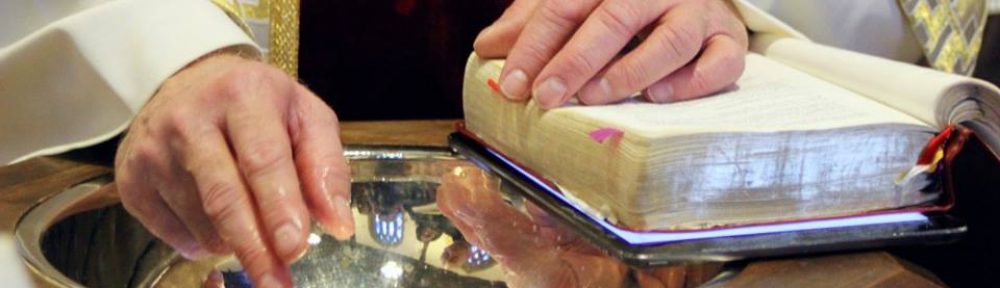
The gospel appointed for Monday in Holy Week is John 12:1-11–the story of the anointing of Jesus at Bethany by Mary. While all four gospels have versions of this story, the four diverge dramatically in details. John sees the significance of the anointing in light of the crucifixion. When challenged by Judas about the expensive perfume used, Jesus replies, “she has anointed me beforehand for my burial.

Monday in Holy Week is also the traditional day in our diocese for the annual reaffirmation of ordination vows and the chrism mass, when the bishop consecrates holy oil and distributes it to clergy for use in the coming year. I’ve never attended this service; it comes on a day when I teach, and besides, my ordination vows are still recent enough that they don’t need to be recharged.

Yesterday, I visited a parishioner who’s been in the hospital for over a month. She is probably in the last stages of her life. While I was there, I anointed her with oil for healing, but as I thought about it, and as I pondered the gospel in preparation for the evening service, I wondered whether I was also anointing her for burial. Perhaps I was doing both. As I put oil on her forehead, I thought of Mary’s anointing of Jesus, and I thought as well of Jesus suffering on the cross. It was one of those moments when the little things we do are powerful reminders of our connection with the stories in the gospel and with the whole church. The anointing at Bethany was also the anointing in Greenville, yesterday.

House of Bishops, and other things

A lot has been happening in Anglican-land, and perhaps an update is warranted. You may have heard in the news that Bishop Schofield and the Diocese of San Joaquin voted last December to leave the Episcopal Church and join the province of the Southern Cone (Latin America). That action, which is illegal under the Constitutions and Canons of the Episcopal Church led to Bishop Schofield’s deposition (removal) from the House of Bishops this week. In the meantime, the National Church is working hard to reconstitute the Diocese of San Joaquin with a new bishop. A diocesan convention will be held on March 29 to do the work of rebuilding the structures of the diocese.

Although lay and clergy delegates to the diocesan convention in December voted overwhelmingly in support of the action, surprisingly it seems that many parishes and more than 1/4 of the diocesan lay membership will remain Episcopal and participate in some form in this new convention and the new diocese.

The issue is the same as the issue with parishes. Individuals, lay and clergy, may leave the Episcopal Church, but neither parishes nor dioceses can. Parishes are created by dioceses, and dioceses are created by the General Convention.

There was also considerable discussion at the House of Bishops meeting concerning the Lambeth Conference coming up this summer.

For complete coverage of these stories in the blogsphere, check out

Home

http://episcopalchurch.typepad.com/episcope/

http://www.thinkinganglicans.org.uk/

The Pew Survey of the US Religious Landscape

Amidst all of the other news and noise, you may have heard something about the massive study of religious life in the US undertaken by the Pew Forum. Among the key findings: almost 30% of Americans have left the religion in which they were raised for another one, or for no affiliation. If one includes movement within Protestant denominations, that percentage increases to 44%. Almost 1/4 of young adults (18-29) claim no religious affiliation and although a third of American adults were raised as Catholic, only 1/4 of adult Americans are Catholic. This significant loss in numbers would be even greater if not for immigration. You can read more about the survey here.

Such surveys provide useful information for us as we think about St. James’ ministry in Greenville. While we live in an area that is more Protestant and more Evangelical than the rest of the country, Greenville is changing rapidly. The growing number of religiously unaffiliated people and the frequent movement between denominations and religions pose challenges to the Church. How can we reach out to those who are unaffiliated, especially those who have become disaffected from their religious upbringing? How can we make our worship, parish life, and ministries attractive to newcomers and visitors?

I haven’t read the report closely–my eyes often begin to glaze when dealing with too many statistics–but I am familiar with other surveys that focus on baby-boomers and post baby-boomers. Remarkably, these surveys have shown clearly that when following people over periods of time (longitudinal studies), many people move in and out of involvement in religious communities. We know that young families seek out the church, but these studies have shown that many young families disengage, and people later in life re-engage with the church. That’s partly why the Pew Survey found such a low affiliation among young adults.

We are living in a religious marketplace, and how the church responds to that reality will be key to its survival, both on the local and the global level.

Clerical Collars and Lenten Fasts

One of the reasons I enjoy wearing a clerical collar is that it leads to interesting conversations and interactions that otherwise would not take place. Today, it was Friday in the second week of Lent, I dropped by the Fresh Market to pick up some things for dinner. As I approached the check-out, the man in front of me turned and said, “Hello Father” in what was clearly a Northeastern accent (Pennsylvania, perhaps). After exchanging pleasantries, he began pointing out his purchases.

“I’ve got some prosciutto, here; some cappicola, a little salami.”

I couldn’t resist the temptation. “You’re obviously observing a Holy Lent,” I said.

He didn’t miss a beat. “It’s Lent?” he asked.

“You could have said that you were buying these things for tomorrow,” I replied. “But then you’d have another sin to confess.”

Quickly, he countered, “That’s right, we’re having fish sticks tonight.”

By then, we were both laughing and I said, “Don’t worry. I’m Episcopalian. We don’t take all that too seriously.” I didn’t mention that I avoid eating meat on Lenten Fridays. I will probably never see him again, but I’m sure I made a lasting impression on him and perhaps, he will wonder where the life of faith might be leading him.

Lenten Reading, Anyone?

During Lent, many people adopt a discipline of reading, selecting a book or books that either explore spirituality or deepen their understanding of the Bible or the Christian tradition. Among my favorite choices during Lent are classical Anglican authors like John Donne, George Herbert, or Jeremy Taylor. There are several good anthologies of Anglican spirituality available. I would also draw your attention to the following titles: 

Borg, Marcus and Dominic Crossan. The Last Week: What the Gospels Really Teach About Jesus’s Final Days in Jerusalem. Harper One. ISBN 0060872608 Available here. Borg and Crossan are two of the leading scholars of the New Testament and have collaborated closely over the years. This book is their reconstruction of the last week of Jesus’ life, from Palm Sunday to Easter, based on the Gospel of Mark. There is a great deal here of historical interest, but the authors also engage questions of contemporary faith and life.

Crafton, Barbara Cawthorne. Living Lent: Meditations for these Forty Days. Church Publishing. ISBN 0819217565 Available here: Crafton. Crafton, who visited St. James last year, wrote this book as a Lenten devotional, drawing on the Church’s hymnody. 

Kugel, James. How to Read the Bible: A Guide to Scripture Then and Now. Available here. I’m reading this wonderful book right now. James Kugel, an Orthodox Jew and Harvard professor writes here on two very different ways of interpreting scripture, especially the Hebrew Bible—the first is that of ancient readers, both Jewish and Christian, the second is that of contemporary scholarship. He lays out each approach to particular texts and demonstrates that both are interesting and instructive.

Williams, Rowan. Tokens of Trust: An Introduction to Christian Belief. Westminster John Knox Press. ISBN 0664232132 Available here. This book is drawn from a series of sermons the Archbishop of Canterbury gave during Holy Week 2005 and are based on the ancient creeds.

If your Lenten discipline includes financial restraint, at least the Borg/Crossan and Kugel volumes are available from the Greenville County Libraries, which is how I gained access to them.

An Exciting and Exhausting weekend

Months ago, when I invited Dr. Shelly Matthews to preach on January 27 I had no idea what else would be going on. Oh, I knew that there were two organ recitals scheduled, but it was only later that we decided to focus on Children’s Church at the 9:00 service. The senior EYC lock-in that was scheduled for the 19th and 20th was postponed until this weekend. I ended up spending about as much time at the church this weekend as I would from Good Friday to Easter.

But it was a wonderful weekend. The recital was beautiful, both times–in fact I heard it in full only on Sunday. I had to slip out early on Friday night to help with final preparations for the reception. I was especially taken with the Bruhns from the first half of the concert, and the Durufle at the end. It was also great to see Hal Gober again, and to meet his wife. Karen and the organ wow’ed all of those in attendance.

At 12:15 AM on Sunday, I celebrated the Eucharist with around 25 of our young people. It was a beautiful night as I drove up the mountain. The moon was shining brightly which gave me an idea for some comments on the gospel I made at the Eucharist. Yesterday’s readings were from Isaiah 9 and Matthew 4, which quotes the Isaiah passage “the people that walked in darkness have seen a great light.”

Then at 9:00, we worshiped with Children’s Church and gave our first and second graders prayer books to celebrate their completing the course on the meaning of the Eucharist. It was great fun to watch all of the kids participate in our worship so enthusiastically and I must say that several of them are almost ready to become readers for our regular services. The energy and excitement during the service was wonderful.

I would like to thank everyone who worked so hard to make this weekend the huge success it was. Karen of course; the members of the organ committee–especially Albert Blackwell; Corrie who put on the reception Friday night and Karen Hipp who did so much to help; the women of the ECW who did the reception on Sunday; Laura Lipscomb and Jennifer Jerina, who organize children’s church and organized as well the children’s participation; Shelly Matthews who preached a fine sermon, as always; Katie, who organized and survived the lock-in, and the staff of St. James, who worked so hard behind the scenes to make the weekend a success: Dena, Becky, and Mike. Great job, everyone!

Our Middle School EYC's hike to Raven Cliff Falls.

I’ve never been there in January, but Corrie and I have enjoyed the hike both in the spring and the fall. Some of our middle school youth made the hike January 13. They made the mistake of sharing the photos with me. As an aside, when the EYC ski trip was announced for Super Bowl Sunday this year, I mentioned that the last time I had been skiing was Super Bowl Sunday, 1979. Thanks be to God, no pictures exist of that event.

So here is the falls, the kids, and an emu.early-january-08-013.JPG

early-january-08-025.JPG

early-january-08-014.JPG

So what is sin?

Over the last months, I have been asked about sin by several parishioners. Today someone asked me, “What does Jesus save us from?” It’s a very good question. In my sermon on Sunday, I said that one important aspect of the incarnation is that in Christ we see the possibility of what humanity might be, what we were intended by God, and prevented by the fall from becoming. In fact, most traditional theology (the Fathers, St. Thomas Aquinas, et al.) argues that salvation offered by and through Jesus Christ goes beyond what we might have achieved on our own had we not sinned.

But what is sin? We tend to think of sin in terms of particular acts–going against the ten commandments, for example. But sin is more than that. As I understand it, sin is above all a way of describing the fact that as humans we are not as God created us to be. There is a fundamental brokenness in us that we experience in different ways: when our body betrays us, when we know what we ought to do, but cannot or will not do it, when we hurt others or ourselves out of sheer maliciousness or even ignorance. That brokenness we interpret as sin. God created us as good, but because of the fall, we are not whole beings.

I reject the notion of substitutionary atonement, that Jesus Christ had to die to save us from our sins, that “he paid the price” or that “there is power in the blood” to quote two familiar 19th century hymns. Rather in his life, in the cross, and in the resurrection, Jesus Christ shows us what humanity might be, could be, should be. In his self-giving love, he overcomes our brokenness and offers us a way that we, too, might overcome it.

The colors of Advent

Some of you may have noticed that mysteriously one of the blue candles on the advent wreath at St. James became pink last week, and that it was lit on Sunday with two of the blue candles. Some controversy ensued. Before the change was made all of the clergy were consulted and were comfortable with the change. Little did we expect passions to be aroused.

Fr. Tom said in conversation this afternoon that the advent wreath was a recent liturgical innovation, so I decided to do a little research. While one must approach information on the internet with considerable caution, wikipedia above all, I did find it interesting that according to that source, the modern advent wreath became a common custom in Germany only around 1900, and then only among Protestants. It probably arrived in the US in the 1930s or so.

The color of the candles is dependent on the liturgical color of Advent. Traditionally among Roman Catholics, because Advent was seen as a penitential season, the liturgical color was purple, the same as in the season of Lent. But like Lent, which had a Sunday “off”–Laetare Sunday–when the liturgical color was rose (pink), it became the custom to use pink on the third Sunday of Advent, known as Gaudete Sunday.

As a result of the liturgical changes in the twentieth century that sought to de-emphasize Advent’s penitential nature and to distinguish it clearly from Lent, blue became a popular liturgical color, especially among Protestants. Anglicans could appeal to the Medieval traditions of Salisbury (the “Sarum” rite) which used blue during Advent. In most Episcopal churches, whatever the color of the other candles on the wreath, there is one pink or rose candle, which is usually lit on the third Sunday (though according to some traditions on the fourth).

I suppose that the most “liturgically correct” thing to do would be to get a set of vestments to match the pink candle. But remember, the color of the candles doesn’t matter a great deal; what does matter is what the season of Advent is about, to help us prepare for the coming of Christ.

Meanwhile, back at the Communion …

Perhaps you have been following news reports concerning recent activities among Episcopalians in the US. The diocese of San Joaquin (parts of Southern California) has voted to leave the Episcopal Church and join up with the Province of the Southern Cone (parts of South America). More bishops have been consecrated by the Nigerian Church for work in the US. Yesterday (December 14), the Archbishop of Canterbury released an Advent letter to the Primates concerning events since the US House of Bishops meeting in New Orleans.

Like all of the Archbishop’s writing, it is densely written and at times difficult to interpret. But it does seem clear that he continues to criticize both sides. He is especially harsh on those who have intervened in the US and elsewhere by consecrating bishops and incorporating American parishes and now dioceses, “The challenge is not best addressed by a series of ad-hoc arrangements with individual provinces elsewhere…this is not doing anything to advance or assist local solutions that will have some theological and canonical solidity.”

Concretely, he says that he will not disinvite anyone from Lambeth; he will not invite either Bishop Robinson of New Hampshire, or any of those bishops who have been consecrated by African primates for work in the US. He proposes continued conversation, bringing leaders of the American church and their opponents together with professional facilitators to seek common ground, and another group of primates to craft proposals for Lambeth 2008.

There is much more here to think about. Part of the problem of this whole controversy is that the internet seduces us to respond quickly, before thinking carefully about what has been said, and what it means. Theological reflection is hard and painstaking work and it is best done in conversation with others. For example, I am uncomfortable about some of what the Archbishop says concerning bishops in the letter. There are significant ecclesiological issues raised in the letter and they require careful analysis. If you are interested in following the discussions about this letter, I refer you to several sites:

Thinking Anglicans This is a site from the UK.

Episcopal Cafe A wonderful blog that includes items on spirituality and commentary as well as discussion of news

Episcope From the national church office, provides links to all things Anglican in the news, all over the world.