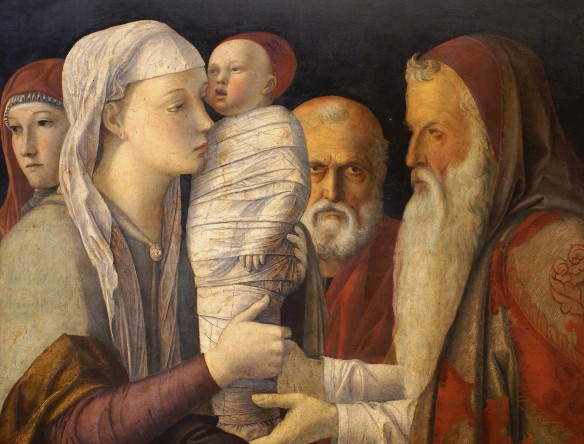
Dietrich Bonhoeffer on the Magnificat

The throne of God in the world is set not on the thrones of humankind but in humanity’s deepest abyss, in the manger. There are no flattering courtiers standing around his throne, just some rather dark, unknown, dubious-looking figures, who cannot get enough of looking at this miracle and are quite prepared to live entirely on the mercy of God.

For those who are great and powerful in this world, there are two places where their courage fails them, which terrify them to the very depths of their souls, and which they dearly avoid. These are the manger and the cross of Jesus Christ. No one who holds power dares to come near the manger; King Herod also did not dare. For here thrones begin to sway; the powerful fall down, and those who are high are brought low, because God is here with the lowly. Here the rich come to naught, because God is here with the poor and those who hunger. God gives there the hungry plenty to eat, but sends the rich and well-satisfied away empty. Before the maidservant Mary, before Christ’s manger, before God among the lowly, the strong find themselves falling; here they have no rights, no hope, but instead find judgment.

From a sermon preached in London, the Third Sunday of Advent, December 17, 1933

The Messiness of the Messiah: A Sermon for Advent 4A, 2019

As I grow older, it becomes increasingly difficult for me to make keep up with all the changes in popular culture.

That sentence could be the lede for an almost infinite number of examples..

In this case though, I’m thinking of the Hallmark Channel, of which I was only vaguely aware. I learned this fall that from approximately Halloween to New Year’s Day, there’s an endless stream of Christmas movies; and that on Friday nights throughout the year, Hallmark shows holiday-themed movies. Apparently other channels have followed suit. With good reason. Apparently Hallmark’s programming is so successful that for the fourth quarter last year, it was the most popular channel among women aged 19-54.

other channels have followed suit. Apparently, this programming is so successful that Hallmark wins the ratings war for the final quarter of the year with the key demographic of women 19-54. Continue reading

Are you the one? A sermon for Advent 3C, 2019

Last week we saw John the Baptizer at the height of his power and career. Crowds were coming to see him and to be baptized by him. Even the movers and shakers were coming—the Pharisees and the Sadducees. How do think he was feeling as he saw the response to his preaching, the adoring crowds and the changed lives. As evidence of his power, we hear him attacking the religious insiders with language of great drama and violence.

Now, some weeks or months have passed and John is in a very different position. Herod had arrested him because John had criticized him for marrying Herodias, his brother Phillip’s wife. Another important point to note is that in the synoptic gospels of Matthew, Mark, and Luke, Jesus begins his public ministry only after John is arrested. In other words, John doesn’t actually see Jesus’ preaching and healing ministry in action. He only hears about it second hand.

John is in prison, waiting. In the Roman world, prison was a place of waiting, not of punishment. Prisoners were waiting to find out what the judgment would be, whether they would be found innocent or guilty, and what their punishment would be. Execution, sentenced to the galleys or the mines? John was waiting.

John had been waiting for a long time, not to find out his fate. He, like Israel, had been waiting for the one who was to come; he was waiting for deliverance. And so, from prison, he asks that question, “Are you the one who is to come, or are we to wait for another?”

This probably seems like a very strange question for casual readers or hearers of the gospel. The story we know, if we know it, is a story in which John the Baptist knows who Jesus is. As Luke tells it in his gospel, John and Jesus were cousins, and John recognized the Messiah when both were still in their mothers’ wombs. Luke says John leapt in the Elizabeth’s womb when Mary came to visit her. The Gospel of John is even clearer. When John sees Jesus walking, he says to his disciples, “Behold the Lamb of God who takes away the sins of the world.”

So why would John want to know, “Are you the one who is to come?”

I think it’s simple, really. As we saw in last week’s gospel, John was looking forward to a great reckoning; the day when God’s justice would come down to vindicate the righteous and punish the wicked. John had prophesied, “Even now the ax is  lying at the root of the tree; every tree therefore that does not bear good fruit is cut down and thrown into the fire.”

John was now in prison, hardly evidence that God was making things right. And Jesus, the one whom John had baptized, the one in whom he had placed his hopes, had continued John’s preaching. He, like John, was proclaiming the coming of God’s reign. But there seemed to be no signs of its arrival.

So, John, lying in prison, wonders. He wondered whether everything he had been about had meant anything; whether his preaching had been worth it. So he sent two of his followers to ask the question. It’s an obvious question, but still it’s a very interesting and important one. And it is a profoundly “Advent” question. Advent is a time of already but not yet; it is a time when we recognize Christ’s presence among us, Christ’s having come among us as a human. But at the same time, we are looking ahead to that final reckoning. Like John, we are looking ahead for that time when God makes all things new; when God’s justice rolls down like water, and God’s righteousness like an ever-flowing stream.

John’s disciples asked Jesus the question, “Are you the one who is to come or are we to wait for another?”

Jesus’ reply is not a simple and unambiguous affirmative. Instead, he instructs John’s disciples to tell him what they have seen, “the blind receive their sight, the lame walk, the lepers are cleansed, the deaf hear, the dead are raised, and the poor have good news brought to them.”

As readers of the gospel, as people who know the story, this answer seems obvious and to the point. Jesus is alluding back to prophetic scripture, to the Book of Isaiah. It is language that is echoed in the gospel of Luke, in which Jesus’ public ministry begins with his reading from Isaiah: “He has sent me to bring good news to the poor, to proclaim release to the captives, and recovery of sight to the blind.”

As readers of the gospel, we know about Jesus’ healing ministry. Jesus had restored sight to the blind, healed a paralytic, and performed many other healings.

We hear this passage and we think it’s all so obvious and we may even wonder how John the Baptist could have had any question about who Jesus was.

But think about it a moment. Think about all of the suffering in the area where Jesus was preaching and healing. He may have performed some healings, but there were many other people who continued to suffer and the oppressive yoke of Roman occupation was as harsh as ever. Did Jesus’ answer convince John’s disciples? Did it convince John?

Like John, we are living in a time of already but not yet. We believe and proclaim that Christ has come into the world; that Christ has ushered in something quite new; that his death and resurrection have changed everything.

At the same time, we continue to see the suffering and injustice around us. Many of us experience great suffering and pain in our own lives. It may so overwhelm us that we despair.

Jesus’ answer to John’s disciples is his answer to us. In the midst of the world’s suffering, in the midst of our own pain, he challenges us to see signs of his coming; to look for signs of God’s coming reign; signs of his healing power. Those signs may be faint; they may be overwhelmed by the bright lights and glare of the world.

Like John, we want to see clear evidence; we want to see God coming in glory, destroying evil, beating down the devil. We want to see the carnage and a complete and total victory.

Instead, we are pointed toward this. A few people are healed; a few hear the good news and are transformed. God’s reign breaks in, tentatively, quietly, almost unnoticeably. So we have to pay attention.

There are signs, but we need eyes that will see them; ears that will hear them. I invite you to look for those signs, to imagine what such signs might be in our world today. In the midst of the suffering in the world, in the midst of all of our troubles, where do we see Christ’s healing power? Where do we see God’s justice rolling down? Where do we see God’s reign breaking in and transforming lives and the world?

In food offered from our pantry? Or the meal and music provided at our First Monday meal? In the shelter offered to a homeless man or to a family? In the compassionate service that moves a homeless person from the street to permanent housing? In the reconciling witness of MOSES and other organizations that help formerly incarcerate people rebuild their lives and relationships?

Look for those signs, in the world, in the lives around you. Become those signs, to the world, to the lives you encounter. God is here among us, healing us and the world. Christ will come again to make all things new. May we rejoice to see his coming; and may we see the signs of his coming in our faith and in our actions.


Advent is a wilderness: A Sermon for Advent 2A, 2019

Wilderness. It’s a word that conjures up images of danger, untamed nature; precarious human life facing the challenges of uncharted territory and unknown threats. For Americans, we almost immediately think of our national myth of pioneers setting out against great odds into a distant and forbidding land, in an attempt to make lives and livelihoods in uninhabited territory. That myth, as attractive as it may be, is a far cry from the reality that the places to which white settlers came usually already had human populations and were home to highly developed human communities. Continue reading

St. John of the Cross, December 14

Today is the commemoration of the sixteenth-century Carmelite mystic St. John of the Cross. He is best known in the contemporary world for the phrase “the dark night of the soul” although he never used it, and he doesn’t mean by “dark night” depression or atheism, which is often assumed. There’s a great essay on him by Lawrence Cunningham in America (2006).

Here is the beginning poem of the work that bears the title Dark Night of the Soul:

1. One dark night,
fired with love’s urgent longings
– ah, the sheer grace! –
I went out unseen,
my house being now all stilled.

2. In darkness, and secure,
by the secret ladder, disguised,
– ah, the sheer grace! –
in darkness and concealment,
my house being now all stilled.

3. On that glad night,
in secret, for no one saw me,
nor did I look at anything,
with no other light or guide
than the one that burned in my heart.

4. This guided me
more surely than the light of noon
to where he was awaiting me
– him I knew so well –
there in a place where no one appeared.

5. O guiding night!
O night more lovely than the dawn!
O night that has united
the Lover with his beloved,
transforming the beloved in her Lover.

6. Upon my flowering breast
which I kept wholly for him alone,
there he lay sleeping,
and I caressing him
there in a breeze from the fanning cedars.

7. When the breeze blew from the turret,
as I parted his hair,
it wounded my neck
with its gentle hand,
suspending all my senses.

8. I abandoned and forgot myself,
laying my face on my Beloved;
all things ceased; I went out from myself,
leaving my cares
forgotten among the lilies.

From: THE COLLECTED WORKS OF ST. JOHN OF THE CROSS, translated by Kieran Kavanaugh, OCD, and Otilio Rodriguez, OCD, revised edition (1991).

Copyright 1991 ICS Publications. Permission is hereby granted for any non-commercial use, if this copyright notice is included.

“Advent” by Christina Rosetti:

Advent

This Advent moon shines cold and clear,
These Advent nights are long;
Our lamps have burned year after year,
And still their flame is strong.
“Watchman, what of the night?” we cry,
Heart-sick with hope deferred:
“No speaking signs are in the sky,”
Is still the watchman’s word.

The Porter watches at the gate,
The servants watch within;
The watch is long betimes and late,
The prize is slow to win.
“Watchman, what of the night?” but still
His answer sounds the same:
“No daybreak tops the utmost hill,
Nor pale our lamps of flame.”

One to another hear them speak,
The patient virgins wise:
“Surely He is not far to seek,”–
“All night we watch and rise.”
“The days are evil looking back,
The coming days are dim;
Yet count we not His promise slack,
But watch and wait for Him.”

One with another, soul with soul,
They kindle fire from fire:
“Friends watch us who have touched the goal.”
“They urge us, come up higher.”
“With them shall rest our waysore feet,
With them is built our home,
With Christ.” “They sweet, but He most sweet,
Sweeter than honeycomb.”

There no more parting, no more pain,
The distant ones brought near,
The lost so long are found again,
Long lost but longer dear:
Eye hath not seen, ear hath not heard,
Nor heart conceived that rest,
With them our good things long deferred,
With Jesus Christ our Best.

We weep because the night is long,
We laugh, for day shall rise,
We sing a slow contented song
And knock at Paradise.
Weeping we hold Him fast Who wept
For us,–we hold Him fast;
And will not let Him go except
He bless us first or last.

Weeping we hold Him fast to-night;
We will not let Him go
Till daybreak smite our wearied sight,
And summer smite the snow:
Then figs shall bud, and dove with dove
Shall coo the livelong day;
Then He shall say, “Arise, My love,
My fair one, come away.”

Come, Lord Jesus: A Sermon for Advent 1C, 2019

Could the news get any worse? We are faced with a relentless cycle of stories that break our hearts and that bear witness to the brokenness of humanity and the brokenness of our world. What’s more, in the face of these crises—the global climate crisis, the crisis of political legitimacy that so many nations and peoples are confronting, beginning with our own, instead of coming together to work on solutions, we are growing more divided. Our differences seem to be widening even as things seem to be getting worse.

Among those divisions, one of the most interesting to me is the generational conflict that seems to be growing. Younger generations are becoming more resentful, more angry at their elders. And the target of much of that anger is my generation—the baby boomers. Well, we sure have messed things up, haven’t we? On our watch, warnings about global warming have become climate catastrophe; economic inequality has increased to levels not seen since the Gilded Age of the late 19th century; our political system, not just in this country, but worldwide, seems to be nearing total collapse with authoritarianism, nationalism, and racism on the rise. Continue reading

A Thanksgiving Prayer by Howard Thurman

Howard Thurman’s Thanksgiving Prayer

Today, I make my Sacrament of Thanksgiving.
I begin with the simple things of my days:
Fresh air to breathe,
Cool water to drink,
The taste of food,
The protection of houses and clothes,
The comforts of home.
For all these I make an act of Thanksgiving this day!

I bring to mind all the warmth of humankind that I have known:
My mother’s arms,
The strength of my father
The playmates of my childhood,
The wonderful stories brought to me from the lives
Of many who talked of days gone by when fairies
And giants and all kinds of magic held sway;
The tears I have shed, the tears I have seen;
The excitement of laughter and the twinkle in the
Eye with its reminder that life is good.
For all these I make an act of Thanksgiving this day

I finger one by one the messages of hope that awaited me at the crossroads:
The smile of approval from those who held in their hands the reins of my security;
The tightening of the grip in a simple handshake when I
Feared the step before me in darkness;
The whisper in my heart when the temptation was fiercest
And the claims of appetite were not to be denied;
The crucial word said, the simple sentence from an open
Page when my decision hung in the balance.
For all these I make an act of Thanksgiving this day.

I pass before me the main springs of my heritage:
The fruits of labors of countless generations who lived before me,
Without whom my own life would have no meaning;
The seers who saw visions and dreamed dreams;
The prophets who sensed a truth greater than the mind could grasp
And whose words would only find fulfillment
In the years which they would never see;
The workers whose sweat has watered the trees,
The leaves of which are for the healing of the nations;
The pilgrims who set their sails for lands beyond all horizons,
Whose courage made paths into new worlds and far off places;
The saviors whose blood was shed with a recklessness that only a dream
Could inspire and God could command.
For all this I make an act of Thanksgiving this day.

I linger over the meaning of my own life and the commitment
To which I give the loyalty of my heart and mind:
The little purposes in which I have shared my loves,
My desires, my gifts;
The restlessness which bottoms all I do with its stark insistence
That I have never done my best, I have never dared
To reach for the highest;

The big hope that never quite deserts me, that I and my kind
Will study war no more, that love and tenderness and all the
inner graces of Almighty affection will cover the life of the
children of God as the waters cover the sea.

All these and more than mind can think and heart can feel,
I make as my sacrament of Thanksgiving to Thee,
Our Father, in humbleness of mind and simplicity of heart. (source: http://blogs.bu.edu/sermons/2008/11/23/a-thanksgiving-prayer/comment-page-1/)

Howard Thurman (1899-1981) was an African-American theologian, preacher, and activist.  Author of Jesus and the Disinherited, he mentored Martin Luther King, Jr., and many other civil rights leaders.

Humiliated, Reigning, Reconciling: A sermon for the Reign of Christ, 2019

Today, the last Sunday of our liturgical year, is Christ the King or the Reign of Christ. It’s a recent addition to the church’s calendar, authorized by Pope Pius XI in 1925, only eight years after the end of World War I. It was a time when the church was on the defensive from the forces of modernity and secularism and coincided with the rise of Fascism in Italy.  Whatever political or theological statement was originally intended, The Reign of Christ invites us to pause and reflect on all of the themes that emerge as we make our way from Advent, through Lent and Easter, and now as the season after Pentecost draws to an end. We are asked to reflect on what it means to follow Jesus, to proclaim our faith in him, to confess that he is King of King and Lord of Lords. Continue reading

What salsa dancing has taught me about church in the 21st Century: Annual Report 2019

Another year of growth, with exciting new developments in our common life and ministry as we were reminded by the lovely slide show prepared by Arianna. Before going further, I would like to thank the staff—Christina, Ari, Pat, the folks in the kitchen, Berkley and Mark, Vikki, and especially Deacon Carol. And the outgoing wardens John and Greg, and vestry members Paula, Kabura, and John, who agreed to fill out the balance of Jarrod Irwin’s term.

It’s great that we are growing, especially because we are going against the trend of decline in the diocese, the Episcopal Church, and Christianity in the US. Growth brings challenges. As new members join us, and as visitors continue to explore connecting with us, we are reaching the limits of what we can do with our current staff and volunteer base. We began talking about the possibility of calling an Associate Rector, the budget that is being presented to the congregation today includes funding for such a position beginning on July 1, but our conversation should be driven not by financial worry but by our desires to deepen our relationships with each other, to reach out more effectively and creatively into our city and to respond faithfully and courageously to God’s call.

Bishop Search.

In the coming year, we will say good bye to Bishop Miller as he retires after 17 years as the Bishop of the Diocese of Milwaukee. We will also begin to make plans for our next bishop. Even now, that search process is taking shape. The Standing Committee of the Diocese, the entity with the responsibility for overseeing episcopal transitions, is in the process of selecting a search committee. It’s likely that the members of that body will be made public before the end of the year.

The search consultant, the Rev’d Dr. Anne Hallisey, will be in the Diocese in January, leading the clergy retreat from January 20-22, and then holding a retreat with the Search Committee January 24-25. It’s been a long time since we’ve had an episcopal search, so it’s worth reminding you of the process. There will be intensive study of the current state of the diocese. Members of the search committee will visit parishes, interview clergy and lay people. There will be a survey distributed that will solicit opinions about the state of the diocese, perceived needs, and what we might like to see in the next bishop. Eventually, a diocesan profile will be prepared, and the names of nominees solicited. The search committee will hold a retreat with select candidates, visit them in their contexts, do the necessary vetting process, and eventually publish the list of nominees. But even after that, there will be the possibility of additional nominees being brought forward. An election date will be set; the candidates will tour the diocese giving us the opportunity for us to get to know them. Finally, there will be an electing convention. The candidate who receives a majority of votes from both the clergy and the delegates elected by parishes, will be elected bishop; but their ordination will not take place until they receive a majority of consents from bishops and standing committees of the dioceses of the Episcopal Church. We don’t know the timeline for any of this, but it’s likely that the process of election will take most of the next year, and we won’t have a new bishop until some time in 2021.

Many of you may wonder what any of this has to Grace Church. We see the bishop only rarely; few of us are involved in any diocesan ministries or commissions, beyond the Haiti Project, Deacon Carol’s work with the Commission on Global Reconciliation, and our delegates’ attendance at diocesan convention. Still, we are not a stand-alone congregation. The search for a new bishop provides us an opportunity to intensify our engagement with the diocese, help shape its future, and allow other congregations and clergy learn from our experience in downtown Madison over the last decade.

I am completing my second term as a member of Diocesan Executive Council. In the last year, I was asked by the Bishop to participate in a subcommittee of that body whose task was to look at the relationship of the Diocesan Haiti Project with the diocese as a whole. As we worked, it became clear that the future viability of the Haiti Project would depend on a period of intense diocesan engagement with the Project, helping to develop new leadership, bring transparency and stability to its finances, and raise its visibility in the diocese. I volunteered to co-chair the Haiti Project Steering Committee for at least a year as we sought to build on its strengths and address some of its vulnerabilities. Our work is made more challenging by the difficult situation on the ground in Haiti. I expect to continue involvement in that work for the immediate future but hope that by the end of 2020, new leadership will be in place to work with a new bishop to shape the future relationship between the diocese and this crucial outreach ministry.

New Homeless Shelter.

As most of you know, for a number of years a group from Grace Church have been exploring a bundle of issues around the possible redevelopment of the West Wing and the future of the Men’s Drop-In Shelter that Grace has hosted since 1984. In addition, there have been questions about the impact of the proposed new historical museum on our property. Over the last year, we have taken a number of significant steps. As we continue to research future possibilities for the West Wing, we worked with a developer on the economic feasibility of a limited project that would add a floor and create a roofline that would match the nave. Unfortunately, that possibility while aesthetically pleasing is not feasible economically. We have not had significant conversations with the Museum project developers in the last year.

Much of our work has focused on exploring whether there is interest and energy in the wider community for a new, purpose-built shelter adequate to the needs of our unhoused neighbors. We contracted with Ms. Susan Schmitz, retired president of Downtown Madison, Inc, to help us discern whether a new shelter project might be welcomed by both the private and public sectors. Her initial contract is concluding and with her help we have decided to move forward with the formation of a steering committee that will continue our work and build coalitions with the ultimate goal of a purpose-built shelter. Along with her, we have met with city and county elected officials and staff, service providers, and other stakeholders. There seems to be significant interest and momentum building that over time could result in a new facility for people experiencing homelessness.

As that work proceeds, Grace Church will continue to be involved with representation on the steering committee and shepherding the process. It will undoubtedly take several years to reach completion and as we have watched the progress of the proposed Salvation Army redevelopment, we know that it will take a great deal of effort, political will, and careful listening.

With the new museum project and the potential shelter move, we will have to engage in simultaneous conversations about the future of our physical plant, especially the west wing, and how our ministry and mission might adapt to the changing needs of our neighborhood, and the changing built environment. As I have said many times over the years, the questions driving our conversations should begin with our careful attention to the movement of the Holy Spirit, and our faithfulness to Jesus’ call to us to share the good news. How can we be a blessing to our neighborhood, and how can our buildings be an agent of the church’s mission to reconcile humans with God?

I want to close with a story; it’s one I told the vestry a couple of months ago but I hope it will get you thinking as well. Corrie and I are ballroom dancers, and the demographics of ballroom dancing are pretty much like the demographics of the Episcopal Church; the vast majority of people at ballroom dances are over 50; except that is, for the young couples learning their wedding dance (sound familiar?). This summer, we decided to try something new—salsa and we went to a venue downtown that has an hour-long bachata or salsa lesson followed by live music. The demographics there were quite different—of the 100 or so who usually attend, no more than a handful were over 50, and in the group classes the same teacher offers at a studio, the difference is even more stark. We were usually more than 20 years older than anyone else in the room. But it’s not just about learning moves; the teacher has created community, making use of social media. They have regular social gatherings, they become friends and hang out together. My point is not that we need to start salsa classes or a jazz mass; my point is that community is being created in completely new ways now and often outside of traditional institutions like the church.

We have to take risks; we have to experiment; we have to continue to ask new questions and explore new approaches as we seek to deepen our relationships with each other and make connections with our neighbors who work and live in downtown Madison. In the last ten years, we have done that time and again, and while sometimes our efforts have faltered, we have also seen new life. My prayer for us as a congregation is that as we continue to discern God’s call, we have the courage to experiment, to take risks and to follow Jesus into the heart of the city, and into the heart of his love.