It Gets Better

In response to the recent suicides by gay teens, Dan Savage started a video project.

Here’s the pledge:

We are the kids who have been bullied for being gay, lesbian, bi or trans. We pledge to stay open and strong. We are also the friends, family members, teachers, mentors, and allies of anyone who’s ever felt like they didn’t fit in, gay or straight. We pledge to talk to the kids in our lives to put an end to the hate, violence, and tragedy — and to offer advice on coping, strategies to make it better, and to remind kids that It Gets Better.

Here’s the link to the videos.

And here’s the video from Bishop Gene Robinson of the Diocese of New Hampshire:


Sermon for Proper 23, Year C

Your faith has saved you
Proper 23, Year C
Grace Church
October 10, 2010

I have a confession to make. I hate talking about stewardship. I hate thinking about stewardship, I hate preaching about stewardship. OK? I hate doing it as your rector. I hated it when I was on your side of things and sat in the pews listening to sermons and stewardship appeals and the like. It’s one of those things that come around every year and makes us uncomfortable in so many ways. We feel guilty for not pledging, or not pledging enough. We may feel guilty because we think we ought to be tithing and we know in our hearts that’s never gonna happen because we live from paycheck to paycheck with never quite enough money for the necessities of life, let alone to give to those worthy organizations that need our support, and to give to our church. A pledge is one of those obligations, those duties, one of those things I think I need to do. So I tend to put my annual pledge in the basket with feelings of guilt and often resentment. Continue reading →

The Presiding Bishop’s visit to the Diocese of Milwaukee

This weekend was Annual Convention for the Episcopal Diocese of Milwaukee. The Presiding Bishop of the Episcopal Church, Katharine Jefforts Schori and her husband Richard Schori were in attendance. Yesterday morning, the PB spent two hours with diocesan clergy while her husband met with clergy spouses. She began her session with us by asking us to meditate on the words Jesus heard as he came out of the Jordan River after being baptized, “You are my Beloved. In you I am well pleased.” After meditation and conversation in small groups about what we heard during our time of meditation, and how we responded to those words, we had the opportunity to ask questions of her.

During that time, and later in the afternoon during an open conversation with clergy, lay delegates, and other interested people, the Presiding Bishop spoke about what she saw as she traveled around the church in the US and the world. One of the things she stressed repeatedly is that the Episcopal Church is a world-wide church. It is not just an American, or even North American denomination.

She was honest about all of the ways Episcopalians do mission, both here and abroad, and she had a lot of positive things to say about the impact of the emergent church on our denomination. But she was also honest about the challenges facing us. One of the greatest may be demographic. According to her, while the average age for Americans is 37, the average age for Episcopalians is 57. Another theme that came back both in her remarks and in questions from the floor was the challenge we face with our aging physical infrastructure. To one question, she answered bluntly that some buildings need to be abandoned, given over to other purposes, while others can be revitalized and can continue to be the focal point of ministry. She also stressed that we have to get out of our buildings to do ministry in new places and in new ways. “Those churches that thrive,” she said, “are more than a worship space; meaningful to the larger community; while some of them are albatrosses.”

There were questions concerning the Anglican Covenant, to which she pointed out that “covenant” can mean very different things in different cultural contexts. For the Maori of New Zealand, who were victimized by a treaty that the settlers labeled a “covenant,” the term is deeply painful.

It was a good visit, an opportunity to hear from someone who has a much wider perspective on the Episcopal Church and the Anglican Communion than we can have in the local parish. It was also a powerful reminder of the challenges that we face as well as the world of possibilities that lies before us.


Blessing of the Animals–Photos

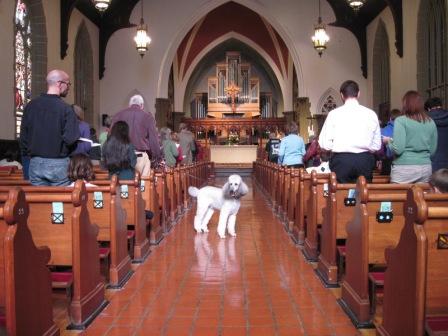
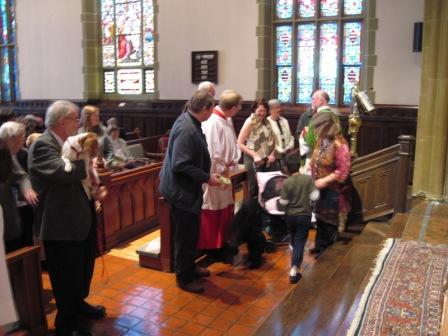
On Sunday, October 3, we had a Blessing of the Animals as part of our 10:00 service. Here are some pictures:


Figaro wanting to join the procession


That's "Prada" in the cage


The full gallery is available here:

To be honest, I decided to do the Blessing at the main Sunday service on the spur of the moment. I’ve usually done it on Saturdays or on the weekday, wherever the Feast of St. Francis falls. And I was regretting my decision when I woke up at 3:00 am on Sunday morning catastrophizing all of the possible things that could go wrong–from no one bringing their pets to the prospect of total chaos breaking out.

In the end, it went very well. The pets were very well behaved as were the people who accompanied them. We had a great time. Several people remarked on how wonderful the service was, so I suppose we’ll be doing this regularly from here on out.

“Glee” and Religion in America

There’s a lively comment thread  on the Episcopal Church’s Facebook page about last night’s episode. It was interesting, especially in light of several themes repeated on this blog–the relationship between religion and secularism, contemporary American spirituality, and the role of religious knowledge. Much of the show seemed sensitive and thoughtful–teens dealing with questions of faith, for example, and the struggle with loved ones who are suffering.

Well-done, too, was the debate about the role of religion in public schools. How far can teachers and students go in proselytizing? What religious themes or topics are valid for public school classrooms?

Still, I found it ironic that after the debate about what students could and couldn’t sing in the school room, when the scene shifted to church, instead of a straightforward gospel number, we heard a version of “Bridge over Troubled Water.” I’m just not sure what to make of that. It’s almost as if the show’s producers were as uncomfortable about an openly-religious song in their show as school administrators tend to be.

More on that Pew survey

I blogged on this last week, but there’s an interesting series of comments from scholars about the survey and what it reveals and doesn’t reveal. Perhaps the most interesting point, made by several of the scholars, had to do with religious knowledge itself. What constitutes religious knowledge? Is it being able to parrot doctrine in response to questions? Is it being able to recite the creed, or to know that Catholics believe the bread and wine become the body and blood of Jesus Christ?

To take the latter question, if someone has deep Eucharistic devotion and is wont to meditate or pray at the Reserved Sacrament, yet cannot articulate the doctrine of transsubstantiation, do they believe that bread and wine become the body and blood of Jesus Christ? Their actions certainly suggest they are encountering the divine in some way.

Certainly, religion is more than doctrine and faith more than assent to a series of propositions. One academic suggested that part of the problem is that preachers don’t preach what seem to be core doctrines to theologians. Thus mainline Presbyterians rarely mention the finer points of Calvinist theology from the pulpit.

Wearing the hat of a scholar of religious studies, I grant the point. As a pastor, I also know that people attend and belong to churches for all sorts of reasons. Still, it seems to me that it can’t hurt to pose the questions occasionally, to ask people both what they know and what they believe, and to try to determine whether there are discrepancies between faith, religious knowledge, and religious practice.

One of the scholars brought up the category of “Lived Religion,” briefly put religion as expressed through ritual, practice, and the like. In my experience, some of the most vocal believers could express their faith easily in words, but did not demonstrate it either in their ethical actions or in their religious practice.

Twenty years ago

Twenty years ago, on October 3, 1990, Germany celebrated reunification. In some respects, it was something of an anti-climax after the drama of the previous Autumn with the fall of the Berlin Wall. But we were there for the official reunification and it was only late yesterday that I realized where I was twenty years ago and what happened.

We were far from the center of things, living in Tuebingen in Baden-Wuerttemberg, in Germany’s southwest. Tuebingen is a university town. When we arrived in September of 1990, it was already bursting at the seams as a result of the changes taking place. Students from the east were eager to study in West German universities. Housing, always a problem in a college town, was impossible.

There were no parades, no speeches, no flags on October 3, 1990. All that we saw in the center of the city was a counter demonstration–people dressed in black symbolizing mourning and if I recall correctly, they were singing or playing somber music.

I remember the hope and excitement of 1989. I also remember the disappointment as reunification actually took place. The cutbacks forced in the west to pay for reunification were already taking their toll. West Germany’s Fulbright Foundation learned just a few days before our arrival that they would have to find money for the East German scholars from the budget that had already been appropriated for us. It was also the time of build-up to the first Gulf War.

Over the course of that year, we had occasion to visit Berlin, and Wittenberg, where some of the early demonstrations took place. We saw Soviet troops pulling out of East Germany. We saw the scars left by the Berlin Wall.

From the perspective of 2010, those events seem ancient history. The euphoria, the hope, and the important role Protestant Christians played in the demonstrations that led to the collapse of the DDR, opened up a future that no one could have imagined a year or a decade before. Twenty years later, that imagined future lays beneath the rubble of problems–from the reality of the hard work of reunification that still needs to take place, to September 11, the wars in Iraq and Afghanistan, the financial meltdown, the global environmental crisis. I wonder if there is any way to rekindle the hope of twenty years ago.

Homily for the Blessing of the Animals

Francis in the 21st Century

October 3, 2010

Tomorrow is the Feast of St. Francis, marking the saint’s death 784 years ago. St. Francis is among the most beloved and most familiar of all the saints of western Christianity. He is beloved today as he has been for nearly 800 years, In the contemporary world, St. Francis remains among the most beloved figures in the Christian tradition. His love of animals and of God’s creation have made him an icon of the environmental movement. His joy, playfulness, and child-like faith offer an alternative to a Christianity that often seems to take itself too seriously.

There was much more to St. Francis, though. He preached to human beings as well as to birds and he showed in his lifestyle a serious and radical commitment to the imitation of Christ. For him, following Christ meant trying to live exactly as Jesus and his disciples did. He demanded of his followers that they own no property whatsoever. One of his slogans was: “naked to follow the naked Christ.” He took that quite literally. One of the key moments in his story is that when he renounced his share of his family’s wealth and threw himself on the mercy of the church, he stripped nude in the city square of Assisi in front of his parents and the bishop.

Equally dramatic was his identification with Christ. Francis is attributed with setting up the first crèche (nativity scene). Near the end of his life, after he had given up control of the religious order he had founded and retreated into a life of solitude, he is believed to have received the stigmata—he bore on his hands and feet the wounds Jesus Christ received on the cross. It is the first recorded example of that phenomenon in the history of Christianity. His reception of the stigmata is evidence of his total identification with his Lord. It is also an example of another trend to which Francis gave impetus. Although the suffering of Christ was already an important focus of Christian piety by the time Francis came on the scene, his devotion to it helped make it wildly popular in the later Middle Ages.

Today offers us the opportunity to reflect on Francis, on his legacy, his faith, and his significance for today. It’s a curious thing that with all of what Francis meant, that the way we honor him most often in the twenty-first century is with the blessing of the animals. It’s curious because there’s little evidence that Francis related to animals in quite the way we tend to relate to our pets. Oh, he loved them, preached to them, and in the case of the wolf of Gubbio, he turned him into a pacifist and a vegetarian. But he certainly didn’t treat animals like family members, which is the way many of us treat our pets.

Indeed, one of the reasons I like the blessing of the animals is because it is one small way to acknowledge the important role our pets play in many of our lives. If you don’t have no, or never have had a pet, this may be hard to imagine, but for those of us who include animals among our household, they truly are often like members of the family. Indeed, it’s not an exaggeration to say that some people have closer and deeper relationships with their pets than they have with other humans.

That may sound shocking, but it shouldn’t be. Our pets are utterly dependent on us, –yes, that’s true even of cats, no matter what they might think, and whatever attitude they might have at the moment. And they share love and devotion with us. Now, I’m not about to say that all dogs go to heaven; that’s not my call, but I do know that for many of us, our spiritual lives are also experienced and deepened through our relationships with animals.

So it’s appropriate to bring our pets with us to church at least once a year, and on that day, to ask God’s blessing on them and on our relationships with them. Yes, it may be a little disruptive, and perhaps even a little unseemly. Nonetheless, to acknowledge the role our pets play in our lives is also to acknowledge our full humanity, in all of its messiness and unseemliness.

And if there’s anything that St. Francis was about, it was that. His ministry was among the poor and the downtrodden. He and his followers sought to help those who were sick and dying and he brought the gospel to places it was rarely heard or experienced. His life was preaching the gospel. As is often attributed to him, he said, preach the gospel, if you have to, use words.

Our culture, indeed, our religious sensibilities, often lead us to disparage the concrete and the real. We want our spiritual lives to exist in some nebulous ether up there, far from the down and dirty of daily life. But Francis was just the opposite. He sought to lead others, through the concrete and real to know Jesus Christ. That’s what led him to create the first nativity scene, for it is in the incarnation, when Jesus became human, that we see God most clearly.

Francis sought to embody the love of Christ. Following Christ for him did not mean the abstract, either, but the literal. Some of what Francis did we may find humorous, silly, or even offensive. But when he gathered a group of men around himself, and organized them, he took his model from Jesus’ sending his disciples out into the world two by two. So as Jesus said in Matthew, they were dressed in tunic and sandals with a rope for a belt. They had no money or possessions.

In the end, Francis’ identification with Christ became so complete that he received the stigmata—his body bore on it the wounds of the crucified Christ. If nothing more, that identification should remind us of what it means to follow Christ, to seek to form ourselves and our lives in the image of Christ.

We have been hearing a great deal about discipleship as we have been reading from the Gospel of Luke. The call to discipleship, to follow Jesus is clear. What Jesus means by following him also seems clear—hard sayings like “none of you can become my disciple if you do not give up all your possessions.” What doesn’t see clear is how to follow Jesus in the twenty-first century, in our world which is so very different than first-century Palestine, and in our lives, which are so very different from the lives of first-century peasants.

That’s one way the saints can be of help. In the Anglican tradition, we regard the saints primarily as models of faith. Their lives and their faith should inspire and challenge us to deepen our own faith and discipleship. They were human beings like us, with shortcomings and faults like ours, who received the grace to follow Christ more closely and to experience God more deeply than most of us. Francis followed Jesus in a way that was completely consistent with the gospel, and perfectly suited to the early twelfth century. It is our job as faithful Christians, to shape our lives similarly, consistent with the Gospel, adapted to the present.

In this present day, there may be no more urgent message we need to hear than the one carried by the presence of animals in our worship. For they remind us that our relationship with God is not just about us and God. It includes all of creation. Creation proclaims the glory and love of God and in an age of climate change and environmental degradation, to see our responsibility to the earth as part of what it means to follow Jesus, may be the most important thing of all.