Incomprehensible Theology

Michael Jinkins challenges the “dumbing-down of theology, taking off from the following research:

Last fall “The Economist” reported on new research by Daniel Oppenheimer, a Princeton University psychologist, which suggests that if you want people to learn something “make the text conveying the information harder to read.” “The Economist” comments that one of the perennial paradoxes of education “is that presenting information in a way that looks easy to learn often has the opposite effect. Numerous studies have demonstrated that when people are forced to think hard about what they are shown they remember it better.”

Money quote:

This is the great adventure of theological education. I’m talking about the kind of theological education we do in our congregations, in Sunday schools, and in our homes, and not only the kind we do in graduate theological schools. It invites us to comprehend that which cannot be comprehended, to interrogate that which provokes ever new questions, to engage with our whole hearts and minds the God who created us out of nothing, though of course we have no real conception of what it means to say “out of nothing.” There’s no way to appreciate the fact that God numbers every hair on our heads without appreciating the endless expanse of a universe that is a Tinker Toy to God.

It kind of reminds of one of the greatest compliments paid me by a student (though I doubt she meant it that way): “Dr. Grieser, your class makes my head hurt. I have to think too hard.” And that was at the end of an hour of Intro to Biblical Literature.

Anglican Eyes looking in the wrong direction?

There will be a lot of press in the coming days about the Primates Meeting in Dublin this week. Already there have been articles about which primates will attend and which won’t be there. Thinking Anglicans has the rundown. But perhaps this is better commentary: Google “bonobos” if you don’t get the reference.

Meanwhile work gets done even in Episcopal dioceses. A telling commentary from Julie Ingersoll on Religion Dispatches. Of course, there is pain. The article mentions those who went their separate way in the past decade. But the issue was never going to be resolve. There would always be contention, and in the midst of that contention, precious little good news gets proclaimed. We have gone our separate ways. Let’s get on with doing the Lord’s work in our own contexts and with our own perspectives. Perhaps the Primates are willing to do the same.

God chose what is weak in the world

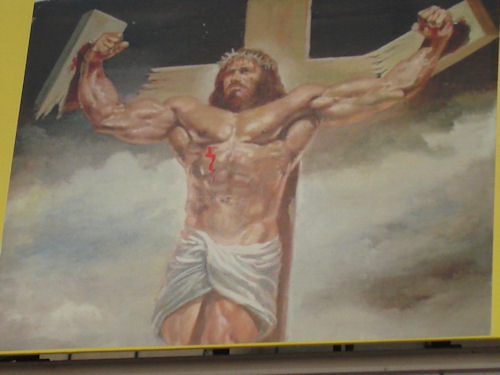
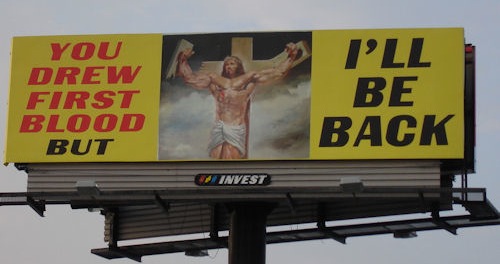
These images have been floating around on my desktop for a couple of months. It seems appropriate to post them now as an example of how Christians misinterpret the cross, in light of this week’s reading from I Corinthians. Here’s a billboard:

And a close-up:

Here’s Paul:

“For Jews demand signs and Greeks desire wisdom, but we proclaim Christ crucified, a stumbling block to Jews and foolishness to Gentiles, but to those who are the called, both Jews and Greeks, Christ the power of God and the wisdom of God. For God’s foolishness is wiser than human wisdom, and God’s weakness is stronger than human strength.
Consider your own call, brothers and sisters: not many of you were wise by human standards, not many were powerful, not many were of noble birth. But God chose what is foolish in the world to shame the wise; God chose what is weak in the world to shame the strong; God chose what is low and despised in the world, things that are not, to reduce to nothing things that are, so that no one might boast in the presence of God. He is the source of your life in Christ Jesus, who became for us wisdom from God, and righteousness and sanctification and redemption, in order that, as it is written, “Let the one who boasts, boast in the Lord.”

Nothing in that image of a God who is weak, is there?

New perspectives on the Atonement

I was interested to observe that during the Trinity Institute, both in the televised conversations, and in our discussions at Luther Memorial, the Atonement came under close scrutiny. Ben Myers points to Bruce McCormack’s 2011 Croall Lectures which set out a new typology of the Atonement. There’s reporting, with theological reflection here. When people ask me about the Atonement, and I’m always surprised when they do, I refer them to Gustav Aulen’s Christus Victor. I read it for the first time as an undergraduate; came back to it when I was preparing a course on the Theological Anthropology in the Christian Tradition. On second reading, I found it both interesting and troubling. I didn’t find it particularly helpful in understanding the perspectives of thinkers, either ancient, medieval, or early modern. That’s always the problem with typologies of course. Perhaps McCormack’s alternative will be more compelling, intellectually and theologically.

But what fascinates me most, as a theologian and as a pastor, is the continuing power of Atonement theory. Christians and seekers both struggle with the meaning of the cross for their lives. That came out in our conversations this week; I also encounter it in conversations with thoughtful parishioners. We still have work to do.


“Come, follow me” A Sermon for the Third Sunday after Epiphany

This past Thursday and Friday, I participated in the Trinity Institute Conference via a webcast at Luther Memorial Church. The topic was “Reading Scripture through other Eyes” and it brought together scholars from North America and Africa to explore the interpretation of scripture in various contexts. The conversations among the scholars were fascinating as were the discussions we had at Luther Memorial. I was struck once again by the centrality and importance of Christians wrestling together to understand scripture, and how Christians in different cultural contexts approach and learn scripture in different ways. Continue reading

Open Communion again

Or “Communion without Baptism.” A cogent three-part article by Derek Olsen that argues against the new custom on historical and theological grounds. I’ve talked about this before, but I agree with him that this practice constitutes so significant a change, that it needs careful and convincing theological formulation.

Part I

Part II

Part III

The comments are worth reading as well, because they offer insight into the depth of the disagreement and some of the strongest counter-arguments.

Trinity Institute: Day II

Today begin with Mary Gordon’s talk and a lively discussion, both on the panel at Trinity and among us in Madison. Gordon sad that there are three elements that pervade the stories of Jesus. First, that he has an intimate relationship with his Father; second that the gospels show Jesus was actively involved in people’s lives; and third that he suffered grotesquely and died, but that resurrection demonstrates that his suffering had meaning. On this third point, she quoted Simone Weil to the effect that the genius of Christianity is not that it offers a “supernatural cure for suffering, but that it offers a supernatural use for suffering.” Later, she said also that one cannot uncouple the readings or interpretations of the gospels from the actions those readings produce.

Gerald West led the group on-site and world-wide through the method of “contextual bible study” that he and his colleagues developed in South Africa and in conversation with people in Brazil and the Philippines.

I didn’t have particularly high hopes for the conference. I expected Brueggeman to entertain and provoke. He did so. I expected Gordon’s eloquence. Not knowing anything about the other two scholars and with a passing familiarity with liberation and post-colonial interpretations, I thought the conference would probably disappoint. But it didn’t. It was exciting.

There were two things that struck me. One was the level of discourse on the panel. It was clear that there were deep differences among the panelists. Perhaps the deepest were between the two Catholics. Sister Teresa Okure, who repeatedly appealed to the magisterium in positive ways, citing Vatican II documents as well as documents produced at the African Synod. Gordon spoke often and eloquently about the pain she and others suffer at the hands of the institutional church. But the conversation, in spite of those differences, was though-provoking and civil. The second thing was the stress by several of the speakers on the importance of the community coming together to read scripture.

Episcopalians aren’t very good at reading scripture together. In my experience, bible studies are poorly attended and often degenerate into individualistic reading into the text of one’s own issues and concerns, rather than allowing the text to speak to one’s situation. But time and again, the speakers urged us to find ways of reading and interpreting in community and in conversation between the trained and the less well trained or educated. But I wonder. Reading has become such a solitary activity and relatively uncommon at that. Is it possible to come together as a community to read and interpret together?

Trinity Institute: Reading Scripture through other eyes

I just got home from the first day of the Trinity Institute’s conference “Reading Scripture through other eyes.” Thanks to Brad Pohlman and Franklin Wilson of Luther Memorial who provided the downlink and invited my participation again this year.

The conference speakers today were Walter Brueggeman, emeritus professor of Old Testament at Columbia Theological Seminary in Decatur, GA and Sister Teresa Okure of the West African Catholic Institute. I enjoy the conference because it is one of the few opportunities I  have to engage theological scholarship in community, even if a large part of that community is virtual. Brueggeman and Okure both asked hard questions in their talks. Brueggeman gave an overview of the development of biblical interpretation in the last five hundred years, making use of Paul Ricoeur’s concepts of “pre-critical,” “critical,” and “post-critical” interpretations, the latter involving what Ricoeur called a “second naivete.”

He also stressed the important developments in biblical interpretation in the past thirty years, mentioning the rise of rhetorical criticism, ideology critique (including liberation theology, feminism, and post-colonialism), and the growing appreciation of Jewish approaches. He challenged us to ask questions of the text that let the text come close to people’s experience, and said in the panel discussion that truth claims have to be tested in the presence of pain. He pointed out Freud’s discovery that the self is “thick, layered, and conflicted,” making the connection between Freud’s use of image and story to help people understand themselves, with the traditional methods of Jewish interpreters who explained a story by telling another story. He extended Freud’s insight to the text and to God. The text of scripture is “thick, layered, and conflicted” and reveals a God who is “thick, layered, and conflicted.” Human beings, he observed, are created in the image of that God.

Okure sought to distinguish between the cultural contexts in which scripture was written and in which it is interpreted and the transcendent truth of the gospel. She spoke passionately both about her particular cultural context in Nigeria, and about her institutional context in the Roman Catholic Church.

Much of the discussion following the presentations, both in the panel conversation, and in our group at Luther Memorial, focused on questions of truth, including the truth of Jesus Christ. There’s an account of today’s proceedings here. More on the Trinity Institute here.

Although we were a relatively small group today, our conversation was lively and deep. To hear scholars struggling with important issues like the cultural contexts of reading scripture, and trying to articulate the relationship between the truths in scripture and the limitations of the human cultures in which scripture was written is exhilarating. There was also a provocative discussion about the role of the preacher/pastor and the community as a hermeneutical community, a community that interprets scripture.

We also heard Steed Davidson’s wonderful sermon on “Reading out loud.” He was working with Acts 8, the story of the Ethiopian eunuch. He pointed the importance of Philip as guide, not as teacher, and asked who was more transformed by the experience, who was baptized, since the Greek isn’t clear.

One of the things I want to do at Grace in the coming months and years is some serious bible study and this conference gave me more impetus to do that.

 

The Church of Apple

I’ve been a devotee for a long time. You can blame it on Sewanee. When we arrived there in 1994, just after Windows came out, Sewanee was an all Mac campus. I never recovered. I never got used to Windows and found keyboard commands and functionality on Macs more user-friendly, intuitive, and quicker.

But that’s as far as my brainwashing went. Others are more deeply inducted into the cult. There’s Andy Crouch, who argues Steve Jobs has offered hope in an increasingly despairing world. The Ipod appeared in October 2001, just after 9-11 and the Ipad was introduced in January of 2010, in the depths of the recession and in a month when unemployment hit 10%.

On Jobs, Crouch writes:

But the genius of Steve Jobs has been to persuade us, at least for a little while, that cold comfort is enough. The world—at least the part of the world in our laptop bags and our pockets, the devices that display our unique lives to others and reflect them to ourselves—will get better. This is the sense in which the tired old cliché of “the Apple faithful” and the “cult of the Mac” is true. It is a religion of hope in a hopeless world, hope that your ordinary and mortal life can be elegant and meaningful, even if it will soon be dated, dusty, and discarded like a 2001 iPod.

But Andrew Sullivan goes even further:

This is certainly why my own conversion to Apple, and my deep loyalty to the company and its products, somehow felt comforting in the last decade. Their style elevates me, their power and reliability I have come to take for granted. Their stores have the innovation and beauty that a renewed Christianity would muster in its churches, if it hadn’t collapsed in a welter of dogma and politics.

While I appreciate the convenience of the Apple Store and am deeply indepted to their knowledgeable staff, entering one gives me the willies. It’s especially scary at the tables set up for little children where you can see kids barely able to walk punching buttons, mesmerized by video screens. There may be innovation there, but I see no beauty, and nothing of the sacred.

Martin Luther King

I came across the astounding story that a Pentagon official declared during an MLK event at the Pentagon last week that Martin Luther King, Jr. would have supported the wars in Iraq and Afghanistan. MLK denounced the war in Viet Nam, in part because he was a pacifist but also because he thought it would detract resources and energy from the war on poverty. Here’s a link to a story that talks about the controversy. The full remarks suggest a more nuanced understanding than the early blogosphere outrage suggested.

Apparently, the official in question is a graduate of Morehouse College and was a classmate of one of King’s children. One might forgive him for trying to make a connection between King and the current conflicts. But I find it hard to stomach the notion that King would have “recognized that we live in a complicated world.” King knew that the 1960s were complicated as well. The final sentence of the speech does put it all in a larger perspective:

The irony of next Monday is that Mrs. King’s dream of a national holiday for her husband has become a reality; Dr. King’s dream of a world at peace with itself has not.

This is not the only way in which King’s legacy is being shaped to fit a contemporary narrative. The focus of the celebration tends to be on racial equality and cooperation. But as several people have pointed out today, King was assassinated while he was in Memphis helping organize a sanitation workers’ strike and he was also heavily involved in planning for the “Poor People’s Campaign. The historian Al Raboteau points out the central role of poverty in King’s thinking and efforts. (h/t Jim Naughton at Episcopal Cafe).

It is important to remember the fullness of his witness to the Gospel of Jesus Christ.

The collect for the commemoration of Martin Luther King, Jr., from Lesser Feasts and Fasts. He is remembered in our liturgical calendar on April 4, the day of his assassination.

Almighty God, by the hand of Moses your servant you led your people out of slavery, and made them free at last; Grant that your Church, following the example of your prophet Martin Luther King, may resist oppression in the name of your love, and may secure for all your children the blessed liberty of the Gospel of Jesus Christ; who lives and reigns with you and the Holy Spirit, one God, now and for ever. Amen.