Some random links on reading scripture

Mark Vernon exploring the interpretation of scripture by comparing it to interpreting Plato’s Symposium. Of the latter he writes:

It’s impossible finally to decide. There is no one reading of the Symposium that’s definitive. Love, like life, is both of us and beyond us. And this is why the Symposium is a living text, and worthy of comparison with the real Good Book. Ultimately, it’s not rational or even ethical, is not a distillation of wisdom or a consolatory read. Rather, it’s a living text – and hence, like the Bible, has inspired art and further literature, architecture and generations of human beings. It forces us to read between its lines to glimpse something of the mystery of life, and thereby to want to make something of this most tremendous energy in life.

Or, of course, to draw back and flee in the opposite direction.

David Lose, professor of homiletics at Luther Seminary at St. Paul, whose work I regularly engage when preparing my sermons, on the truth of scripture:

the Bible is filled with testimony, witness, confession and even propaganda. Does it contain some reliable historical information? Of that there is little doubt. Yet, whenever we stumble upon “verifiable facts” — a notion largely foreign to ancient writers — we should keep in mind that the biblical authors deployed them not to make a logical argument but rather to persuade their audiences of a larger “truth” that cannot be proved in a laboratory but is finally accepted or not accepted based on its ability to offer a compelling story about the meaning and purpose of the world, God, humanity and everything in between. To attempt to determine whether the Bible is “true” based only on its factual accuracy is therefore to make a profound category mistake, judging its contents by standards its authors were neither cognizant of nor interested in.

And David Steinmetz on the process behind the compilation of the King James Bible.

Mortal, Can these bones live? A Sermon for the Fifth Sunday of Lent

April 10, 2011

There are many dramatic stories in the scriptures; many stories that grab our imagination and won’t let go. There are stories that are far-fetched and unbelievable. There are stories of people who, quite literally, wrestle with God. But for sheer dramatic power and shocking imagery, there may be no story quite like the story of the dry bones in Ezekiel.

It has come down to us as a spiritual that became something of a children’s song: “Dem bones, dem bones, dem dry bones.” But however familiar we might be with the song, the biblical story in itself presents an even eerier picture, like something out of a horror flick. Ezekiel is brought by God to a valley that is filled with bones. God asks him, “Mortal, can these bones live?” Ezekiel’s response might be a statement of faith but it could also be a sign of his futility, that he thinks the question is unanswerable. In any case, the bones begin to come back together, bone on bone, sinew on sinew. But they do not live. It is only when God’s breath or spirit comes upon them that they come to life. Continue reading

Dietrich Bonhoeffer, Theologian and Martyr 1945

Today marks the 66th anniversary of the martyrdom of Dietrich Bonhoeffer. There’s a brief bio on the Holy Women, Holy Men blog. Bonhoeffer was both a powerful witness and martyr to the faith, and a challenging theologian.

A recent book by Martin Marty explores the history of his Letters and Papers from Prison, which his close friend, confidant, and biographer Eberhard Bethge edited and published. Here’s an excerpt. Here’s more on the series “The Lives of Great Religious Books” to which Marty’s book belongs.

Included in the Letters and Papers is the poem “Who am I.” Here’s an English translation that first appeared in the March 4, 1946 issue of Christianity and Crisis:

Who am I? They often tell me

I stepped from my cell’s confinement

Calmly, cheerfully, firmly,

Like a squire from his country-house.

Who am I? They often tell me

I used to speak to my warders

Freely and friendly and clearly,

As though it were mine to command.

Who am I? They also tell me

I bore the days of misfortune

Equally, smilingly, proudly,

Like one accustomed to win.

Am I then really all that which other men tell of?

Or am I only what I myself know of myself?

Restless and longing and sick, like a bird in a cage,

Struggling for breath, as though hands were

compressing my throat,

Yearning for colors, for flowers, for the voices of birds,

Thirsting for words of kindness, for neighborliness,

Tossing in expectation of great events,

Powerlessly trembling for friends at an infinite distance,

Weary and empty at praying, at thinking, at making,

Faint, and ready to say farewell to it all?

Who am I? This or the other?

Am I one person today and tomorrow another?

Am I both at once? A hypocrite before others,

And before myself a contemptibly woebegone weakling?

Or is something within me still like a beaten army,

Fleeing in disorder from victory already achieved?

Who am I? They mock me, these lonely questions of mine.

Whoever I am, Thou knowest, 0 God, I am Thine!

From Religion Online.

About those lead codices …

You may have seen the sensationalized reports last week of the discovery of lead codices in Jordan that seemed to contain early Christian writings, perhaps the earliest ever discovered. There’s already a fairly complete wikipedia article that details the press coverage, the back story and some of the significant questions regarding their authenticity.

Peter Thoneman, who teaches Ancient History at Wadham College, Oxford, was shown photos of one of them several years ago and concluded it was a forgery, making use of a tomb inscription published decades ago. Here’s his article: The messiah codex decoded.

There’s much more complete coverage of the issues at Tom Verenna’s blog.

Short version? We’re coming up toward Easter; it’s time to round up another story about early Christian origins. Remember the Gospel of Judas?

Why College Students Are Losing Their Religion – Conor Friedersdorf – Politics – The Atlantic

Conor Friedersdorf writes in response to an essay by Dennis Prager that includes the line: “the agenda of Western universities is to produce (left-wing) secularists.” It’s a silly piece, for Prager probably hasn’t talked to a lot of undergrads since he left college. If he spent any time on a college campus, he would realize that students’ values are largely shaped by eighteen years of immersion in American consumer culture, and if they “lose their religion” in college, it is only because they have left family, home, and community, and encountered in college new avenues for consumerism such as alcohol.

Friedersdorf wants to be charitable to Prager; he labels him “as thoughtful a voice as you’ll find on talk radio.” For Friedersdorf, the chief culprit in the losing of religion is the fact that college students leave home, family, and community, and learn that their religious commitments were largely the product of family and social pressure, and the desire for community. I think he’s right to place much of the blame on churches themselves:

If you’re someone who wants to see organized religion do a better job of holding on to young people – I have no strong preference either way, having friends for whom religion is the best thing in life and others for whom it’s been a terrible burden – the most problematic part of Mr. Prager’s argument is the lack of agency he gives to religions and their congregations. They’re cast as powerless in the face of university influence that is somehow made out to be irresistible.

But if four years of college undo 18 years of parenting and religious affiliation, perhaps the faith community’s tenuous hold is the problem, not the particular place outside its bubble where that hold evaporates.

I think Friedersdorf is exactly right. But I also think that there is a more subtle dynamic at work, too. For many young people, college is a rite of passage, a way of disengaging from their childhood and family and make themselves anew as young adults. If religion can’t help them make that transition, but instead seems to impede it, then religion must also be jettisoned along with other childhood values. Friedersdorf’s essay is here: Why College Students Are Losing Their Religion.

First Monday at Grace (April)

Last night marked a major seasonal change for our first Mondays. The shelter switched to summer hours on March 20 and restrictions on the number of nights guests could stay also began to be enforced (Although because of the unseasonably cold weather the last couple of weeks of March, several nights continued to see numbers more typical of winter).

What that means for us is that we had fewer guests join us, probably about 100, including a large contingent of people who weren’t staying in the shelter last night. We served a little bit later, but we had just as much fun.

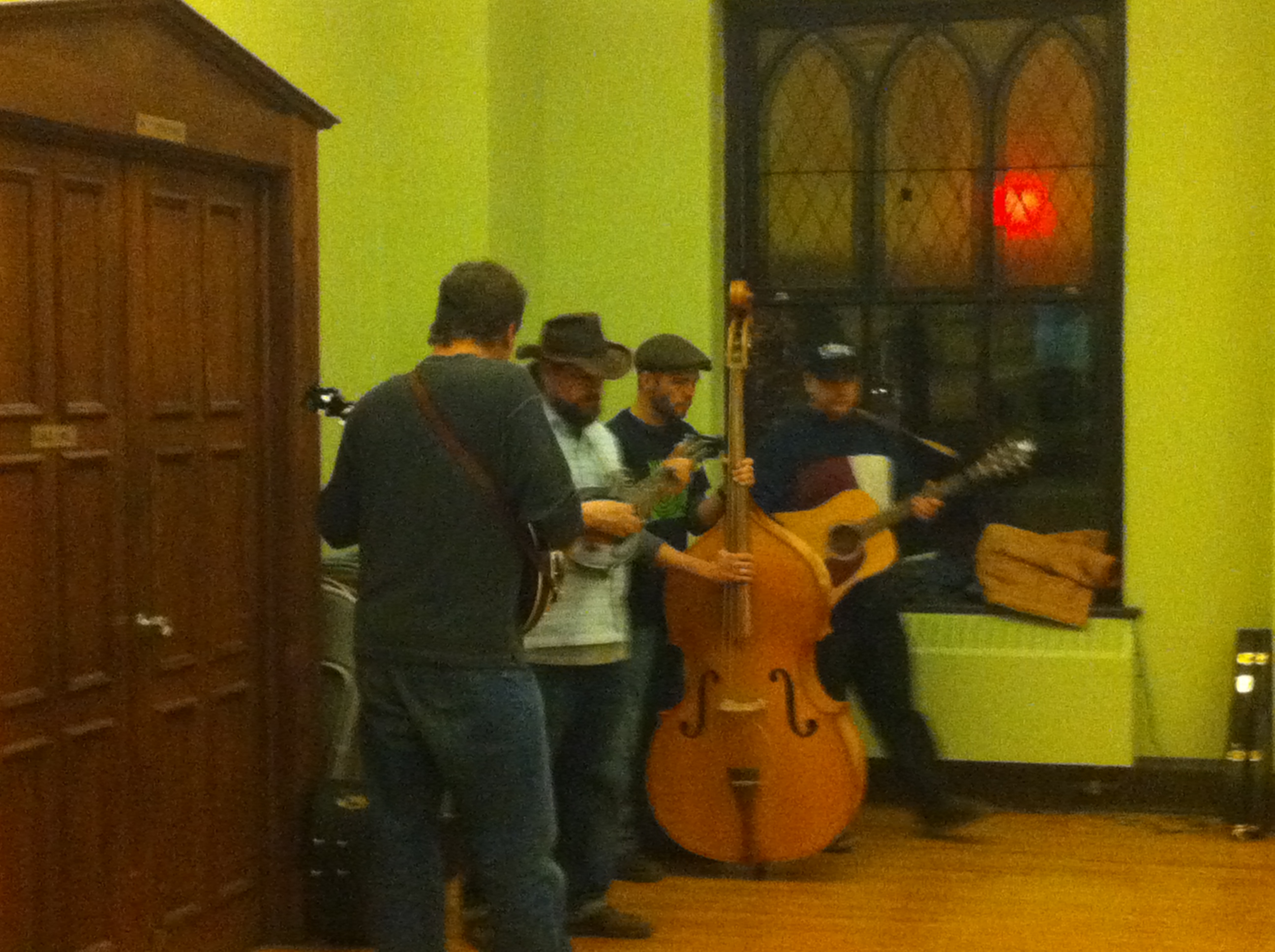
The food was Italian and the music was bluegrass.

The music was provided by members of the Oak Street Ramblers:

Even though it was late, and the NCAA finals were on, a couple of guys stayed to listen to the music. One was heard to say, “That’s hillbilly music, and I’m a hillbilly.”

As a follow-up to the  post about medical care, one guest came in wearing a surgical mask, and as he left, he told me that he had pneumonia.

As we prepared the meal, we could hear sounds from the rally going on at the Capitol. I popped out a couple of times to see the action. Several thousand people were there to hear Jesse Jackson speak on the anniversary of MLK’s assassination in 1968.

Special thanks to the Oak Street Ramblers for providing the music, to some students from St. Francis House (the Episcopal Chaplaincy at UW) who volunteered, and a happy birthday to Emma, who shared a birthday cake with volunteers after we were done serving.

See everyone next month!

Medical and Dental care for the homeless

Two articles on today’s Madison.com featuring doctors and dentists who provide free health and dental care for the homeless. One features Grace member Ben Farrow. If you can pay for dental care, Ben practices at Monroe St. Family Dental.

The other article introduces us to HEALTH, brainchild of Drs. Cate and Erik Ranheim. This group offers free clinics at various places, including once a month at Grace Church.

They aren’t the only ones offering medical care at Grace. Every week, students from the University of Wisconsin Medical School offer a clinic.

I’m surprised again and again in my encounters with homeless people and others seeking help, by the serious medical conditions that many of them are dealing with. I’m told repeatedly by people that it was a medical catastrophe that landed them on the street. Others have chronic conditions that require medications. The efforts of these doctors and dentists, as praiseworthy as they are, can do little to respond to the enormous needs on the street.


Who sinned? A Sermon for the Fourth Sunday of Lent

Who Sinned?
4 Lent
April 3, 2011

We’ve all asked the question—sometimes for ourselves, but often on behalf suffering people we know and love. What did I do wrong, that God is punishing me? What did he, or she, do to deserve this? It’s a natural, human response to pain or misfortune. There must be some reason for it, and when we begin looking for a reason, we often seek the reason in a moral failing or weakness. This tendency, or temptation to blame someone’s misfortune on some personal failure is even more pronounced when it comes to people whom we don’t know. Continue reading