
On the Visitation of a Bishop

One of the fun things for me about having a doctorate in the History of Christianity and being an Episcopal priest is musing over the historical background of particular customs or even canons. Bishop Miller’s visit to Grace has been the occasion for some not-so-serious reflection on the history of Episcopal visitations.

The visitation was introduced in the late middle ages as an effort at reform. First targeting monastic houses, reform-minded bishops and church organizations began visitations of parishes as well. One of the early, and most famous, visitations was that of Electoral Saxony (Luther’s home) in 1528. Eventually, the requirement for regular visitations was enshrined for Roman Catholics at the Council of Trent. When I was working on my doctorate, visitation records were all the rage. Visitors (not bishops, but state or church bureaucrats) would go to all of the parishes and inquire about the religious life and faith of the community, asking as well about the priest or minister. From these records, we gain insight into the level of religious commitment, religious practice, and other things like magic, witchcraft, heresy, and clerical malfeasance. The visitors often had a set of very detailed questions to ask, and they also demanded that people do things like say the 10 Commandments or creed.

In the Episcopal Church, the Bishop’s visit is usually the occasion for confirmation. Such was the case for us, but unlike visitors of yore, Bishop Miller did not query confirmands on their catechism (good thing!). After confirmation, as is the custom in many places, we had a reception. Here are some photos:

Thy table now is spread
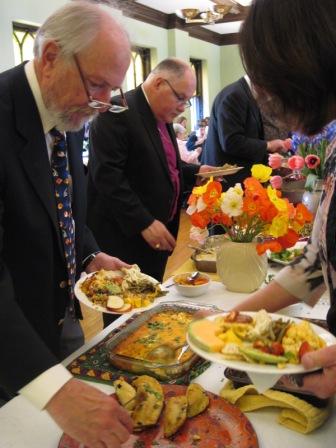
The Bishop and the Senior Warden analyzing the situation

There was music as well:

From the children:

And from Los Soles:

In addition to celebrating the confirmands and all of our mothers, we belatedly celebrated the Rev. Pat Size’s ministry among us. She retired at the end of 2010.

Mary Ray Worley gives Pat a scrapbook of her ministry with the Hispanic community
Participants or Spectators? Consumers or producers?

Bishop Miller made his biennial visitation to Grace Church yesterday. In his sermon, he referred to a college course he once took on the history of sport in America. The professor’s thesis was that Americans’ involvement in sports was the movement from participation to being fans. He compared that to the church and proclaimed that Christianity is not a spectator sport.

I found a connection between his sermon and a blog entry that asked whether worshipers are consumers or producers. The author began with music–the difference between consuming (turning on the radio, listening to one’s ipod) and producing, whether as a musician or as a songwriter. She then turns to worship, asking whether we perceive worship leaders (clergy, choir, professionals) as producers, and those who sit in the pew as consumers of worship. She concludes that to some degree the notion of the lay consumer of worship is an accurate representation:

It’s true that we consume the Word which is given to us, something we did not produce ourselves.  But as we chew and swallow and ponder what we freely receive, we do go out to produce, to create, to produce fruit, to create community, to do justice and to love kindness.

One could have deepened the comparison by pointing out that people’s “consumption” of music has changed since the nineteenth century, with the selling of sheet music giving way to the selling of recordings, and the important value that educated, cultured persons could play an instrument, or that popular entertainment for many among the poorer classes, was self-created. In these cases, music also created community.

The problem with the consumer/producer model is not just that tends towards passivity; it also tends towards isolation. I think that’s true of much of worship as well, even in the Anglican tradition.

In honor of the 300th Anniversary of the Birth of David Hume

The 300th anniversary of David Hume’s birth was yesterday. An appreciation by Morgan Meis that concludes with this paragraph:

Dialogues Concerning Natural Religion is a discussion between an all-around skeptic, Philo; a religious dogmatist and believer in abstract reason named Demea; and a moderate empiricist, Cleanthes. The three characters debate the existence of God and other light topics. Scholars have long debated the question as to which of the interlocutors represents Hume’s true position. The answer is that none of them do, and all of them do. Hume was fully reconciled to being bifurcated, trifurcated even, if we can put it that way. He tried to love the war that was always raging inside. In this, he was an honest philosopher, and an honest man.

I didn’t read Hume with any care until I began teaching, and I quickly realized what all the fuss was about. His attack on rational religion of the 18th century is devastating and continues to resonate across the centuries. I used to include in my lecture on 18th century religion the following quotation:

So that upon the whole, we may conclude that the Christian religion not only was at first attended with miracles, but even at this day cannot be believed by any reasonable person without one. Mere reason is insufficient to convince us of its veracity: and whoever is moved by faith to assent to it, is conscious of a continued miracle in his own person, which subverts all the principles of his understanding, and gives him a determination to believe what is most contrary to custom and experience. David Hume, Essay on Miracles

Hume was also partly responsible for one of my great memories of teaching. When teaching Bible to students from conservative religious backgrounds, there inevitably came the moment when students would ask how one could believe in God if the Bible was not God’s inerrant Word. My response was usually to ask them from where their assurance and certainty of faith came. On probing, they usually agreed that such certainty came from experience, from their relationship with Jesus Christ. On one occasion, however, a student responded with, “the argument from design.”

I tried to suppress a guffaw and urged the student to go read Hume’s  Dialogues on Natural Religion.

Civil Religion, Monarchy, Establishment, and the Church of England

still reflecting on the royal wedding and what it says about the role of religion in the UK.

Jonathan Chaplin and Religion, Royalty, and the Media. He concludes with the following:

But it surely is primarily responsible for how far the liturgical offerings it seems so eager to supply to what is a largely inattentive and uncomprehending nation are actually consistent with its own theological integrity, even its self-respect.

For many defenders of establishment, the royal wedding will no doubt provide glorious confirmation of their claim that the church remains the spiritual hub of the nation, sending out signals of transcendence from the heart of a unifying national celebration. For many opponents, it will raise the question whether the meaning of even a robustly orthodox wedding liturgy – for such it certainly was, as Martin Bashir so tactlessly pointed out – is effectively neutered when placed in service of a survival strategy for a political institution with an uncertain future. They will interpret the day’s events as yet further evidence of church’s captivity to civil religion, and will ask whether on April 29th the church really “served” the nation or rather was “used” by it. Will the church dare to have a serious discussion about that question?

The situation is quite different in the US than in the UK because of establishment. Still, there is an American civil religion, and the Episcopal Church has very often provided the setting as well as the content for the exercise of it. Witness the prominence of the “National Cathedral.” Sometimes, civil religion is relatively innocuous, such as the requirement that presidents end their speeches with “God Bless America.” It easily shades into the dangerous, however, when civil religion and Christianity are equated, as they so often are, by politicians, people, and pseudo-historians like David Barton.

Still, I’m not sure the appropriate response for concerned theologians is to adopt a neo-Anabaptist position like Simon Barrow and Nick Knisely seem to advocate. Nick Kniseley asks “Co-opting the Church?”  In response to an essay by Simon Barrow. It’s not that I’m not sympathetic to their position; it was difficult to distinguish the worship of God from the worship of the royal family during the wedding, and the prominence of the nation-state in the form of dress uniforms was especially disconcerting. Still, the Anabaptist, and neo-Anabaptist response of withdrawing, figuratively or literally, from engagement with the spiritual concerns of the larger society is troubling to me. Our sacred spaces and rituals need to be available to those who turn to them for support and meaning at times of crisis or transition. The task is to use that tentative engagement as a step to deeper involvement, all the while recognizing that such deeper commitment might not be forthcoming.

And Frederick Schmidt  on the inadequacies of our traditional-language liturgy seems to have struck precisely the wrong note a few days before the use of traditional language in the royal wedding. One of the great powers of ritual is that it can invest with great power, language that seems meaningless or dead in other contexts.

This in the context on continuing doom and gloom concerning the future of Anglicanism in the UK.

Archbishop Barry Morgan of Wales chimes in: “the Church in Wales must adapt to cope with the decline in clergy, waning investments and falling congregations.”

I do think it is time for the Church of England to be disestablished; this would free it up to have precisely the sort of theological conversation that Jonathan Chaplin advocates.

Forgiving Bin Laden

All week, we have been thinking about bin Laden’s death and our reactions to the news. Emotions have ranged from joy to outrage; there have been celebrations as well as concerns about the legality of the action. Andrew Sullivan and the readers of his blog have been struggling to understand their responses to the death of Osama bin Laden.

This, from a reader, may be the most moving of all. But following the whole conversation, beginning with Sullivan’s original statements is testimony to the complexity of the question.

Eric Reitan, a Christian universalist, explores our need for cosmic retribution and concludes:

So, is Osama bin Laden in hell? Yes, absolutely. But I will not be at peace, I will not believe that justice has been done, until he is redeemed.

His essay puts me in mind of the piece by Jonathan Jones I read this morning. It’s an appreciation of Dante’s Divine Comedy.

On Sam Harris

Allen Orr on Sam Harris in the New York Review of Books:

Harris’s view that morality concerns the maximization of well-being of conscious creatures doesn’t follow from science. What experiment or body of scientific theory yielded such a conclusion? Clearly, none. Harris’s view of the good is undeniably appealing but it has nothing whatever to do with science.

Orr concludes the essay:

In the end, it’s odd that one can share so many of Harris’s views and yet find his project largely unsuccessful. I certainly share his vision of the well-being of conscious creatures as a sensible end for ethics. And I agree that science can and should help us to attain this end. And I certainly agree that religion has no monopoly on morals. The problem—and it’s one that Harris never faces up to—is that one can agree with all these things and yet not think that morality should be “considered an undeveloped branch of science.”

Even more brilliant is Jackson Lears’ article on Sam Harris: Same Old New Atheism: On Sam Harris | The Nation. In addition to providing historical perspective to Harris’ position, and pointing out his historical ignorance, Lears connects Harris’ project with the Bush war on terror:

Hitchens and Harris, in particular, wasted no time enlisting in Bush’s crusade, which made their critique of religion selective. It may have targeted Christianity and occasionally Judaism, but hatred and fear of Islam was its animating force. Despite their disdain for public piety, the New Atheists provided little in their critique to disturb the architects and proselytizers of American empire: indeed, Hitchens and Harris asserted a fervent rationale for it. Since 9/11, both men have made careers of posing as heroic outsiders while serving the interests of the powerful.

The essay is brilliant and the final two paragraphs a scathing indictment of Harris’ optimism:

Moral progress is unmistakable, he believes, at least in “the developed world.” His chief example is how far “we” have moved beyond racism. Even if one accepts this flimsy assertion, the inconvenient historical fact is that, intellectually at least, racism was undone not by positivistic science, which underwrote it, but by the cultural relativism Harris despises. Ultimately his claims for moral progress range more widely, as he reports that “we” in “the developed world” are increasingly “disturbed by our capacity to do one another harm.” What planet does this man live on? Besides our wars in Afghanistan and Iraq, “we” in the United States are engaged in a massive retreat from the welfare state and from any notion that we have a responsibility to one another or to a larger public good that transcends private gain. This retreat has little to do with Islamic radicalism or the militant piety of the Christian right, though the latter does remain a major obstacle to informed debate. The problem in this case is not religion. Despite the fundamental (or perhaps even innate) decency of most people, our political and popular culture does little to encourage altruism. The dominant religion of our time is the worship of money, and the dominant ethic is “To hell with you and hooray for me.”

Harris is oblivious to this moral crisis. His self-confidence is surpassed only by his ignorance, and his writings are the best argument against a scientific morality—or at least one based on his positivist version of science and ex cathedra pronouncements on politics, ethics and the future of humanity. In The Moral Landscape he observes that people (presumably including scientists) often acquire beliefs about the world for emotional and social rather than cognitive reasons: “It is also true that the less competent a person is in a given domain, the more he will tend to overestimate his abilities. This often produces an ugly marriage of confidence and ignorance that is very difficult to correct for.” The description fits Harris all too aptly, as he wanders from neuroscience into ethics and politics. He may well be a fine neuroscientist. He might consider spending more time in his lab.

Bad History, Bad Religion

I’m surprised there’s so little chatter in the blogosphere about the article in the NYTimes profiling David Barton, who argues that most of the Founding Fathers were “evangelical Christians,” cherry-picking quotations and sources to argue against the separation of church and state.

A complete smackdown of him and his pseudo-history by People for the American Way.

May 4: Monnica

Today is the commemoration of Monnica, the mother of St. Augustine of Hippo. I can’t let the day pass without some comment.

I used her commemoration at today’s Eucharist. It was difficult for me to say the collect without snickering, having internalized the Confessions through teaching it yearly for some 15 years, “love and prayers and tears” hardly describes Augustine’s depiction of her. She was a woman of deep faith: among those who sang with Ambrose in the Milan basilica while surrounded by imperial troops demanding it be given over to the Arians; her deep piety to the martyrs that Augustine (and Ambrose were uncomfortable with) and as mentioned in an earlier comment, her status in the Cassaciacum Dialogues as the model of theological wisdom gained through faith that could instruct young intellectuals. She did pray for Augustine’s conversion, but she also acted to make it more likely, by pleading with him and by encouraging him to listen to Ambrose’s sermons, and to talk with the great Bishop.
The beautiful scene that Augustine describes in Ostia when together, in conversation, they ascended from earthly love and conversation, to the beatific vision, is one of the great moments in Christian spiritual writing, and presumably in Christian spiritual experience. It continues to give me chills every time I read it (30? 40? times) as it did during today’s Eucharist, in spite of the suppressed snicker during the collect.

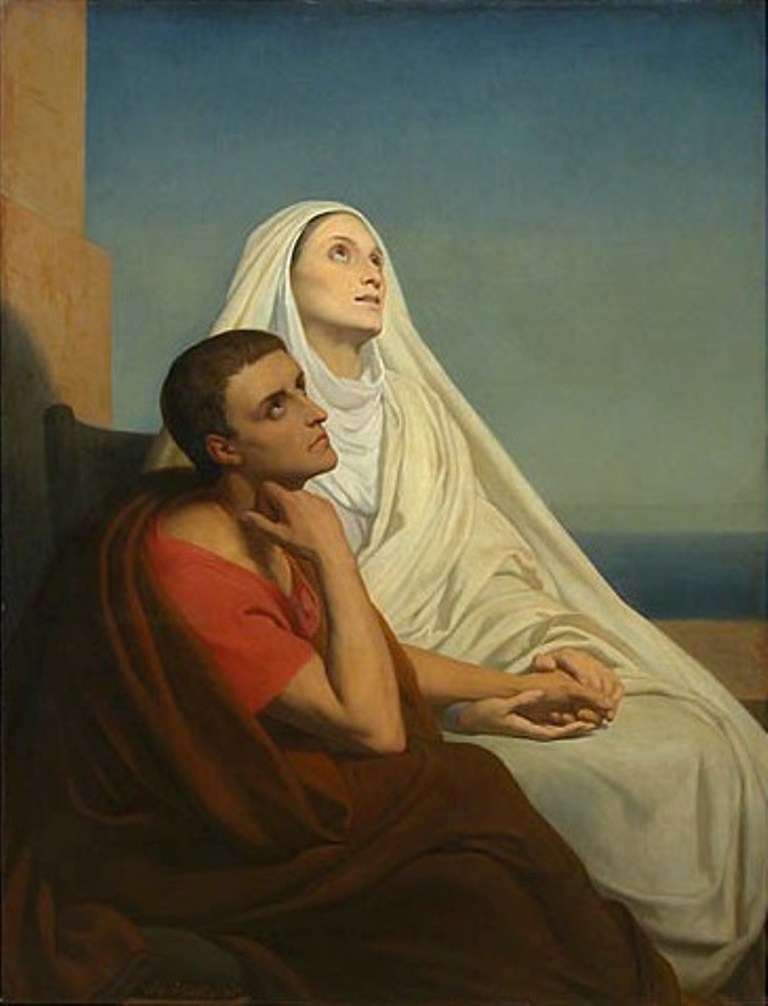
A print of this painting hangs on the wall of my office–it is intended as a depiction of that experience in Ostia:

I doubt whether either of them looked anything like that. She certainly wasn’t clad in a nun’s habit and it’s all a little bit precious, but still…

First Monday at Grace–May

The menu was ham (again from Weber’s Meats in Cuba City–They’re the best!) and macaroni and cheese (one guy said it was the world’s best, another said it was better than his momma made), biscuits, green beans, and pound cake with strawberries. Music was provided by the Kat trio. They were great!

We served about ninety last night. The total number of shelter guests is down because of summer hours, but we had a line of people waiting for dinner who weren’t staying in the shelter. Many of them had eaten with us in previous months and remembered the good food and the good times.

What’s especially exciting to see is the emergence of real community among the volunteers. We’ve got a core of folks who come every week, some of them from Grace, some of them from the community, and as we work together, we are developing camaraderie and deepening relationships. That’s picked up on by newcomer volunteers who want to come back after their first time.

Here are a couple of photos:

That’s the Kat Trio

The joy of last night was tempered this afternoon when a guy came by the church looking for me. I don’t remember if he was at the meal last night, but I know he was at last month’s, because he was drunk and maudlin and asked to talk with me privately for a time. Today, he was drunk again, and he wanted me to help him get to detox. He said he hadn’t eaten in two days. I called the cops to transport him and off he went. I hope it goes well for him.