Visiting the day center for the first time

Today, I made the long journey around Capitol Square to the new day center that’s been open for two weeks. I probably wouldn’t have done it if I hadn’t had been given a task.

I attended the Annual Meeting of the Wisconsin Council of Churches today in Waunakee. The keynote speaker was Palker Palmer and I will write about what he said in the next couple of days. This post is about something else.

We had lunch–sandwich fixings, soup, and dessert. There was a lot of bread and coldcuts left over and as we were finishing lunch one of the WCC staff members came over to me and asked if we could use the leftovers.

There’s a backstory here. People are bringing food, donations of clothing, and the like to us all of the time. These donations are intended for the men’s shelter that is housed at Grace and operated by Porchlight. Often the donations come when there is no Porchlight staff on the premises and our staff have to deliberate about what to do with the items. We have limited storage space and a lot of groups that use our kitchen and other facilities, so we can’t really accommodate large quantities of donations. But we also don’t want to turn people away when they bring things to us, or tell them to go somewhere else. So when I was asked about the food, I immediately began thinking about all of the issues related to receiving a donation of this sort. After a lengthy pause, I agreed to take the food.

By the time I moved my car to make it easier to move the donated food, I had lit on a solution. The Day Center on E. Washington needs food for the people who use its facility during the day. I knew there would be staff on hand who would tell me immediately if they could use what I brought. And it also gave me a reason to drop in and see how things were going.

So I made my way over to E. Washington Ave. this afternoon with several pounds of turkey, roast beef, and cheese, as well as lots of bread. It’s amazing. There are people in the courtyard, smoking and chatting and when you go in the door, you’re overwhelmed by the number of people in the space, talking, visiting, hanging out. The check-in desk is manned by two volunteers, who this afternoon were probably homeless people. I found Sarah Gillmore in a backroom talking with someone. I asked her about the food, and she immediately accepted it, saying “that’ll be lunch, tomorrow.” She asked if I needed help. I saw someone I knew, called him by name, and asked him to come out to the car to help me. We brought the food into the kitchen, where another volunteer, another guest, was clearly running the kitchen.

Sarah and I chatted briefly. I asked how things were going. It’s obvious that the shelter is filling an important need. I hope that politicians, media, and others will drop by and check it out. I’m sure there will be problems–any time you get that many people in a confined space for a long period of time, there will be conflict. But what struck me was the conviviality, the community that was developing. People greeted me as I came in, engaged me in conversation. They were talking together as well. Sarah seems to have things under control. One of the great things she’s doing is involving guests in the operation of the facility.

Oh, and about those donations? We’ll be directing them to the Day Center and to Feeding the State Street Family. And I hope you will send items that way, too.

The Songs of Advent: A Homily for the 2nd Sunday of Advent, 2012

At the 10:00 service today, we will have our annual service of Advent lessons and carols. If you’ve never attended, it brings together readings from Hebrew Scripture, primarily from the prophets, and the New Testament, to help us focus our attention on some of Advent’s major themes. It is intended to help us prepare for Christmas. The songs of Advent draw on prophetic imagery; they are filled with expectation and hope, they express the promises of Hebrew Scripture that Christians believe are fulfilled in the person of Jesus Christ. Continue reading

A New Era? Changing attitudes and approaches to homelessness in Madison

There seems to be a revolution taking place in Madison and Dane County. Thanks to a number of factors and the efforts of a remarkable group of people, new initiatives are beginning and there is evidence of changing attitudes among our political leadership and wider community. I’m excited to be a witness and in a small way a participant in these changes.

One change, the Warming Center, which finally opened a couple of weeks ago on E. Washington Ave. The first day it opened, 57 people made use of it. It’s a temporary solution with a permanent facility funded by Dane County in the works. I received a plea from Scott McDonnell (chair of the County Board of Supervisors) in which he lists the shelter’s needs. You can download that letter here: McDonnell_letter.

Some of my excitement is due to the work of Tami Miller and her group “Feeding the State Street Family.” The Cap Times recently profiled Miller who began volunteering on her own a couple of years ago. Miller and her group reach out to homeless people where they are instead of expecting homeless people to seek them out. They provide meals, make midnight drop-offs of food and supplies. She is also experimenting with new programs, like a one-on-one mentoring program that may begin as early as January. She and I had a great conversation on Tuesday about how Grace can support her efforts. We also talked about some of the unmet needs in the city and the county.

One impact she and others have had is to shift the approach of the politicians. Mayor Soglin who has come off as very heavy-handed and tone deaf about homelessness over the last months, has been much more conciliatory in the last weeks. And County Executive Joe Parisi, who has made several mis-steps himself, is making similar efforts to reach out. Here’s an article about that.

The focus now from the City of Madison is on figuring out where the gaps in services are. It’s interesting that the 2011 annual report on homelessness in Dane County has finally appeared, just a few weeks before the end of 2012. That document is here: 2011 Annual Report revised

It makes for interesting reading. The statistics come primarily from social service agencies and shelters. It’s interesting to note that for all demographic groups, most people in the shelters were residents of Madison or Dane County before becoming homeless. What it doesn’t seem to track is the number of people who are homeless but don’t use the shelter system. Tami Miller puts that number at 400. On Monday, I talked to a couple of guys who are regulars at our First Monday meal. They sleep outside. One of them said he’ll go in the shelter when it’s really cold, another said he never uses the shelter. When I asked them about it, they brought up the usual issues and complaints I hear. The reality is that the shelter isn’t appropriate for everyone, and with shelter as with almost every other issue facing homeless people, it’s important to develop solutions based on the particular needs of individuals. Of course that takes more financial and human resources, but if the goal is to get someone into a stable living situation, those resources are necessary and produce results.

A video about the plight of homeless teens in Madison is here:

In short, these are interesting and exciting times and I look forward to future developments.

What a Mess!

Mark Lawrence responds to yesterday’s developments. Money quote:

“Quite simply I have not renounced my orders as a deacon, priest or bishop any more than I have abandoned the Church of Jesus Christ — But as I am sure you are aware, the Diocese of South Carolina has canonically and legally disassociated from The Episcopal Church,” Lawrence said in a letter posted on the diocese’s website after the presiding bishop’s announcement. “We took this action long before today’s attempt at renunciation of orders, therein making it superfluous.”

Some circular reasoning here, I think, in that he claims his actions make the declaration of renunciation “superfluous.”

Other commentary on the spiraling crisis. From Mark Harris:

I have sometimes wondered what would have happened if one of the first dioceses to undergo the stress of division had come to the General Convention and petitioned to leave the General Convention, gave the grounds, showed that a large majority of the people and clergy were for it, and made suggestions as to how all could be responsible to the trust or common ownershop concerns. Could General Convention have said, go with our blessings, but know that we will continue in the area where you are to keep and Episcopal Church presence. I don’t know. But no diocese has to my knowledge ever petitioned General Convention on any level to a parting of the ways.  Instead leaders have gone with their followers, called themselves the Diocese and generally ended up in a spitting contest with The Episcopal Church leadership.

From Anthony Clavier:

When it comes to the essential morality of what has happened -I’m not using morality as in sex – few on either side have much to boast about. We’ve hurled insults as readily as we’ve sought to make theological justification for our positions. We look like our political parties. That’s no accident. We live in two worlds and as we spend more time in society and ‘culture’ as we do in the Kingdom: the world seems to triumph.


Is it too late?  It’s never too late. If those who manage the Episcopal Church don’t believe in conscience that they can make room for conscientious dissent, isn’t it their duty to make caring space for dissenters? If those of us who cannot square our consciences with the new canonical provisions, should we not do all we can to respond to any initiatives by the Episcopal Church to give us room.

Update on the Episcopal Church in South Carolina

I had some trouble figuring out what to title this post, since everything, including what to call the various parties involved in the dispute, is being contested.

Whatever.

At least I’m not being as tendentious as the the Episcopal Church’s Office of Public Affairs, which entitled its press release today “Presiding Bishop accepts Lawrence’s renunciation.” It’s not at all clear to me that what Bishop Lawrence did or said in his convention address of November 17 constitutes renunciation of his ordination vows. The Episcopal Cafe story is here.

The article goes on to say that the PB’s actions were fully supported by members of her Council of Advice.

I grant that this is a difficult situation but I fail to see what is being accomplished in these actions or in earlier ones, such as the PB’s “pastoral letter” that read more like a legal document than attempt to listen, mend fences, or pray for reconciliation.

Tobias Haller wonders whether the PB is jumping the gun. He points out that the canons require a written declaration of renunciation:

While I believe that Mark Lawrence has abandoned the communion of The Episcopal Church, I do not think he has renounced his ministry, at least in the manner laid out by Canon III.12.7, which requires a written declaration to the Presiding Bishop expressing a “desire to be removed.”

If there is a way forward, or a Christ-like presence in this controversy, it seems to me the statements of the Diocese of Upper South Carolina are bearing witness to Christ’s reconciling love. Here’s a resolution passed by that Diocese’s Standing Committee on the situation: SC Ltr Res

Bishop Waldo wrote a pastoral letter. In it he writes:

Looking to the future, we do not know how things will unfold across the state. We do not know what individuals and congregations within the Diocese of South Carolina will do. We do not know how the leadership of The Episcopal Church will proceed.

We do know that friendships and relationships across the state will persist. I do know that I will stay in contact with my brother, Mark Lawrence, and those within this diocese who have appreciated and agreed with his theological perspective. I will also stay in contact and dialogue with those who have felt that The Episcopal Church has moved courageously in its theological developments. And, I offer my support to those within the Diocese of South Carolina who wish remain within The Episcopal Church. Both Bishop Mark Lawrence and Presiding Bishop Katherine Jefferts Schori are aware of my offer.

My deepest hope is that in the long-term we, in our brokenness, will steadfastly hold on to the possibility of reconciliation and restoration, even if it takes us a generation. This is precisely the kind of dialogue to which our diocesan strategic visioning process calls us. I will continue to foster such dialogue and to be the bishop of all in this diocese, regardless of where members are on the theological or political continuum.

Therefore we must continue to pray for those whom we love and for those whom we struggle to love, whether they live within or beyond this diocese.

The complete text is here: Advent 2012 – for posting


First Monday: Food, socks, and fun

It’s become a tradition at Grace. The First Monday in December, our regularly scheduled dinner with entertainment for guests of the Drop-In shelter and community, is St. Nick’s Day. We make sure there’s great food; Christmas carols and Holiday songs sung by our Sunday School kids and adult choir and St. Nick himself appears to hand out new warm winter socks for our guests.

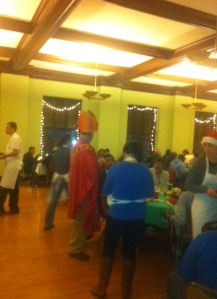
The menu was ham, macaroni and cheese, green beans, and cupcakes. Helping us serve were youth from Grace and St. Andrew’s as well as many of our regulars. We planned for 150 but probably had somewhere around 110 or so. It was 64 outside when we began to serve and I suspect many of those who might have joined us if the temps were more seasonal decided to stay outside for the night and forage for food. A couple of pics:

photo(2)photo(1)photo


As always, the guys were very appreciative of both the food and fellowship. Because of the relatively leisurely pace of the evening, there were lots of opportunities to sit down and visit with the guests, hear their stories and make a human connection with some of them. It was especially neat to see the intergenerational interactions and to watch how newcomers to volunteering with us jumped in both to help serve and to take the time to listen to those they were serving.


The Tender Compassion of our God: Lectionary Reflections for Advent 2, Year C

This week’s readings are here.

The Psalm this week comes from Luke’s Gospel (1:68-79). It is one of several songs or hymns that Luke records in his nativity scene (among the others are the Song of Simeon and Mary’s Magnificat). New Testament scholars suppose that Luke was drawing on hymns being sung by early Christians in his community when he wrote the gospel but in their current form they reflect his literary genius and overarching theological concerns.

Although we say, sing, or hear a psalm in every Eucharist, it probably doesn’t dawn on most of us that the Psalter is a hymnal; that when we say the psalms we are joining our voices with those of Christians from the two millennia before us as well as with the Jewish community of today and previous generations.

The Song of Zechariah is replete with the language and imagery of the Hebrew Bible and the Psalms. In fact, like the other Lucan canticles, one can find in Hebrew scripture parallels for almost every word, phrase, or image. But it goes beyond a simple parroting of earlier language and imagery. In its current form, the canticle connects earlier scripture and prophecy with the current moment. The first section refers to David and thus draws our attention to the prophetic books of the Hebrew Bible. The second section refers to Abraham and thus refers us to Torah, the Law. Here we have the Law and the Prophets pointing the way forward to the present moment and the coming of the Messiah. The same thing is true in Luke’s description of Zechariah and Elizabeth which resonates powerfully with both Abraham and Sarah and Elkanah and Hannah. Both were barren couples.

To sing, say, or reflect on this hymn in Advent is to place ourselves in the middle of the season’s expectant hope. Our words echo the words of ancient Hebrews and first-century Jewish Christians. With them, we proclaim our faith in God’s promises; we look forward to our salvation. And we can sing from the position of Zechariah, who with the birth of his son knows that “in the tender compassion of our God, the dawn from on high shalll break upon us.”

One of the miracles of Advent is that for a few brief weeks, all of salvation history, the story of God’s reaching out to us, is collapsed into our lives, into the darkening days of December. Through our prayers and worship, we unite with the voices, the hopes and faith of countless generations, in awaiting the coming of the Savior. God’s tender compassion comes to us as it has to the generations before us and will continue to come for generations to come.

Of course, Luke was writing his gospel decades after the events he was describing. He may have been writing decades after the destruction of the temple in 70 CE (some scholars think Luke was written in the 120s). He, his readers, and the community of Christians among whom he worshiped were singing hymns of hope and faith that were not reflected by the reality in which they lived. The Savior in whom they believed had not materially changed their situation. They were as poor and oppressed as ever. But still they could sing that God had raised up a mighty Savior; promised forgiveness of sins, and guided their feet into the way of peace. And this Sunday, so will we. I pray we believe it.

Rowan Williams: “Advent Calendar”

Rowan Williams, “Advent Calendar”

He will come like last leaf’s fall.
One night when the November wind
has flayed the trees to the bone, and earth
wakes choking on the mould,
the soft shroud’s folding.

He will come like frost.
One morning when the shrinking earth
opens on mist, to find itself
arrested in the net
of alien, sword-set beauty.

He will come like dark.
One evening when the bursting red
December sun draws up the sheet
and penny-masks its eye to yield
the star-snowed fields of sky.

He will come, will come,
will come like crying in the night,
like blood, like breaking,
as the earth writhes to toss him free.
He will come like child.

h/t Wesley Hill

Be on Guard! Be alert! A sermon for the First Sunday of Advent, Year C

December 2, 2012

I’m tired of the end of the world. I’m tired of having to think about what might be the fate of our planet and human existence in the decades to come. I’m tired of worrying about Global Warming, and about politicians and our whole society’s unwillingness to face and deal with the reality of climate change. And it’s real.

I’m also tired of apocalyptic—of the worldview that sees the world coming to a cataclysmic end in a fire of God’s judgment and the return of Jesus Christ. I’m tired of Mayan calendars, Harold Campings, Left Behind. I’m tired of Hollywood movies premised on the end of the world.

I’m tired also after more than a decade of Advent sermons, of preaching apocalyptic, judgment and the Second Coming during what for everyone outside Christian Churches (and for many within) is the Christmas or Holiday season, a season that begins with Thanksgiving, and ends on December 26, when we take down all the decorations and beginning planning for the next holiday.

Let’s be honest with ourselves. Advent is no longer a penitential season. It’s not a time when we prepare for the coming of Christ at Christmas by fasting and repentance. The idea that somehow in this month when we are preparing for festivities, going to parties, some of them lame and boring, some of them lots of fun, a season when we are buying gifts for friends and loved ones and splurging with special foods and drink we don’t enjoy the rest of the year, the idea that in the midst of all that we fast, is absurd.

I’m not even sure hearing the gospels being read this season—today’s being about the second coming, the gospels for the next two weeks focusing on John the Baptist, I’m not sure that there’s any point of connection, any way to draw meaning from those gospels for what’s going on in our world or in our personal lives. I’m not sure there’s any connection at all. And I’m not going to try. I’m not going to chide you for preparing for Christmas in the season of Advent, for saying Merry Christmas to me, although Christmas is still 22 days away. I’m not going to chide you for ignoring the church’s calendar as we all look forward, plan, prepare, and enjoy what the season of Christmas has become in 21st-century America. Do it! Have fun! Deck the Halls! Have a holly, jolly Christmas!

But what’s it all for? Why do we do it? There are lots of reasons. We enjoy it; our culture embraces it; we don’t want to get a reputation for being Scrooge. And somewhere in all of it, in all of the preparation, the parties, the buzz, the songs and the decorations, somewhere in it is our deep yearning for meaning and connection, our desire for relationship, and for God. And if there’s any meaning at all in Jesus’ instructions to be on guard, to be alert, that meaning comes from the promise that God’s reign is drawing near; the promise that God is near.

This morning’s gospel comes from Luke’s version of Jesus’ apocalyptic warnings to his followers. Present in all three synoptic gospels, though with significant differences among them, this speech is located in the last week of Jesus’ life, when he is preaching and teaching in the temple, and confronted by his opponents. In fact, it comes from Luke’s version of the story we heard from Mark just two weeks ago. To set the context a little more clearly, the chapter began with Jesus’ prediction of the destruction of the temple, followed by the disciples asking him when all this would take place. Then Jesus gives lists of things to look for, warnings of what will happen to those who are his followers—arrest and persecution.

Now, here, Jesus gives his followers advice. Be on guard! Be alert! Stand up and raise your heads! But there’s another piece of advice that seems to contradict what else he says. Jesus refers to the fig tree. He points out something every gardener knows, that when a plant begins to show signs of growth in the spring, the summer is on its way. On one level, that’s obvious and might be interpreted as another sign of what is to come. But as every gardener knows, a tree that leafs out and blossoms in the spring, may not bear fruit until the late summer or fall. In other words, the new growth may be a sign of things to come. But there is also a lot of time to pass and probably some hard work to do.

The Reign of God is near. There’s a sense in which all that we do in this season of Advent, all that we do in the run-up to Christmas, is about the nearness of God’s reign. The promise we hear in the words of the prophet Jeremiah, that God will keep God’s promise and restore justice and righteousness,–that promise beckons still. We hear its fulfillment in the words Mary sings, words we will sing on the 4th Sunday of Advent:

My soul proclaims the greatness of the Lord,
my spirit rejoices in God my Savior; *
for he has looked with favor on his lowly servant.

But the reality is rather different. God’s reign draws near but the world knows it not. God’s reign draws near but the shoots of new life are only that, faint signs in the midst of a turbulent and difficult world. God’s reign draws near but it is easy to miss those signs and to fall into despair and disappointment.

We shouldn’t interpret Jesus’ instructions to be alert, stay awake, as warnings. We shouldn’t lapse into fear and foreboding. Instead, we should look for the signs that God’s reign draws near, signs of promise and hope, signs of new life in the midst of our troubled world. Advent is a time when we should look for such signs, cultivate and nurture the signs we discover, and be signs of the coming of God’s reign to the world around us.

Where might we see such signs? In the joy and pleasure of friends and family gathered together? In the joy and pleasure of a delightful meal prepared and served to homeless people, with fun music, and the small tokens of warm socks shared with them? In Advent candles lit by families, symbolizing the hope and love of the season?

Where might we see such signs of the nearness of God’s reign? How might we be such signs for others? What might we do? How might we be in such a way that the light of the season shines forth from us and is a beacon of God’s reign to others?

And how might we nurture the signs of the nearness of God’s reign in ourselves? Be on guard! Be alert! In all of our preparations, our shopping, cooking, decorating, the hustle and bustle of the season, how are we paying attention to the nearness of God’s reign in ourselves, in our souls? It’s easy to allow the season and our day-to-day responsibilities of work and family to fill up our lives so the deep yearnings of our hearts, the desires of our souls to welcome Christ’s coming are left unmet, unnoticed. Be alert, stay awake! Nurture those shoots, that new growth so that God’s reign may blossom forth in your hearts and this season of Advent might be a season of transformation for you and for all of us.

There will be signs: Lectionary Reflections for the First Sunday of Advent, Year C

This week’s readings are here.

The first verses of this week’s gospel are full of foreboding:

“There will be signs in the sun, the moon, and the stars, and on the earth distress among nations confused by the roaring of the sea and the waves. People will faint from fear and foreboding of what is coming upon the world, for the powers of the heavens will be shaken.

How many Christians over the centuries have seen in the world around them signs of Jesus’ imminent return? How many times have Christians declared the day and hour of the Lord’s coming, only to be disappointed? The image in that first verse, the “roaring of the sea and the waves,” may sound particularly familiar and ominous to those who lived through Hurricane Sandy and are still suffering in its aftermath.

In this passage, Jesus calls us to be vigilant, to be alert, to look for signs of his coming. The problem is that signs are often open to interpretation. Some aren’t of course–a stop sign offers a pretty clear meaning; but when a traffic light turns to yellow? Is a massive hurricane like Sandy a sign of God’s judgment, Jesus’ Second Coming, perhaps evidence of Global Warming, or just a random event?

Interpreting signs requires careful attention, something that may be difficult in the month of December, during the season of Advent. We are busy with our preparations for the season. Academics, whether students or professors, are focused on the hard work of the end of semester. It’s often the case that our lives are so busy we can’t find time or energy to look around us and pay attention to the signs of Christ’s coming. Of course, on one level, it’s impossible to avoid those signs. Christmas decorations and holiday music have been around for a couple of weeks already. But what about signs of Christ’s coming in our lives? Signs of Christ’s coming in the lives of those we love? Signs of Christ’s coming in our daily life? Do we have time to pause and pay attention to that? To pay attention to Christ coming among us at work or school? To pay attention to the ways we might be a sign of Christ’s coming to those we encounter and those we love?