
Prayers in this time of violence, grief, and fear

Almighty God, who created us in your image: Grant us grace fearlessly to contend against evil and to make no peace with oppression; and, that we may reverently use our freedom, help us to employ it in the maintenance of justice in our communities and among the nations, to the glory of your holy Name; through Jesus Christ our Lord, who lives and reigns with you and the Holy Spirit, one God, now and for ever. Amen. (BCP, 260)

A Prayer for the Whole Human Family.

O God, you made us in your own image and redeemed us through Jesus your Son: Look with compassion on the whole human family; take away the arrogance and hatred which infect our hearts; break down the walls that separate us; unite us in bonds of love; and work through our struggle and confusion to accomplish your purposes on earth; that, in your good time, all nations and races may serve you in harmony around your heavenly throne; through Jesus Christ our Lord. Amen. (BCP, 815)

A Prayer for Social Justice.

Grant, O God, that your holy and life-giving Spirit may so move every human heart [and especially the hearts of the people of this land], that barriers which divide us may crumble, suspicions disappear, and hatreds cease; that our divisions being healed, we may live in justice and peace; through Jesus Christ our Lord. Amen. (BCP, 823)

Prayer for Victims of Terrorism

Loving God, Welcome into your arms the victims of violence and terrorism. Comfort their families and all who grieve for them. Help us in our fear and uncertainty, And bless us with the knowledge that we are secure in your love. Strengthen all those who work for peace, And may the peace the world cannot give reign in our hearts. Amen.

A Prayer for First Responders

Blessed are you, Lord, God of mercy, who through your Son gave us a marvelous example of charity and the great commandment of love for one another. Send down your blessings on these your servants, who so generously devote themselves to helping others. Grant them courage when they are afraid, wisdom when they must make quick decisions, strength when they are weary, and compassion in all their work. When the alarm sounds and they are called to aid both friend and stranger, let them faithfully serve you in their neighbor. We ask this through Christ our Lord. Amen.– adapted from the Book of Blessings, #587, by Diana Macalintal

For the President of the United States and all in Civil Authority

O Lord our Governor, whose glory is in all the world: We commend this nation to your merciful care, that, being guided by your Providence, we may dwell secure in your peace. Grant to the President of the United States, the Governor of Massachusetts, and to all in authority, wisdom and strength to know and to do your will. Fill them with the love of truth and righteousness, and make them ever mindful of their calling to serve this people in your fear; through Jesus Christ our Lord, who lives and reigns with you and the Holy Spirit, one God, world without end. Amen.

For Peace

Eternal God, in whose perfect kingdom no sword is drawn but the sword of righteousness, no strength known but the strength of love: So mightily spread abroad your Spirit, that all peoples may be gathered under the banner of the Prince of Peace, as children of one Father; to whom be dominion and glory, now and for ever. Amen.

A Prayer Attributed to St. Francis

Lord, make us instruments of your peace. Where there is hatred, let us sow love; where there is injury, pardon; where there is discord, union; where there is doubt, faith; where there is despair, hope; where there is darkness, light; where there is sadness, joy. Grant that we may not so much seek to be consoled as to console; to be understood as to understand; to be loved as to love. For it is in giving that we receive; it is in pardoning that we are pardoned; and it is in dying that we are born to eternal life. Amen.
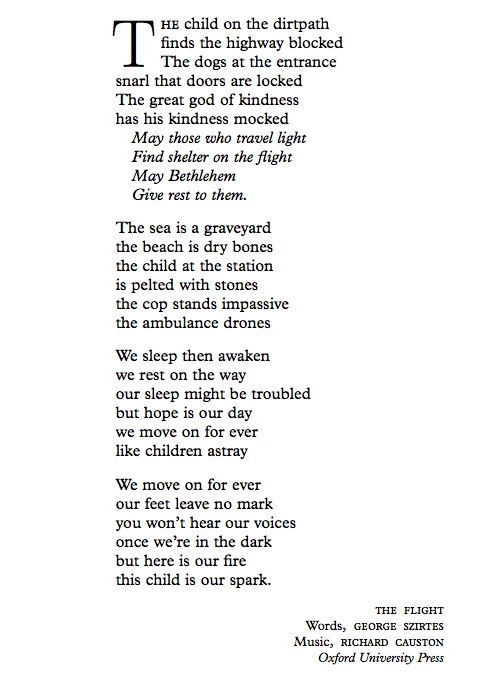
“This week has become a grotesque object lesson in gun culture”

This week has become a grotesque object lesson in gun culture, one that points to a conclusion that we could have and should have drawn long ago—that the surfeit of weapons at our disposal and the corresponding fears that they induce create new hazards. There is no telling how any of these specific horrors will be resolved. But here is what we do know: we live in an age of open-source terrorism. Our inability to respond to mass shootings has meant that, eventually, even law enforcement would fall victim to one. The context of the conversation about police accountability has been irrevocably changed. Black lives matter, but reports that those words were uttered by a gunman in Dallas mean that any movement under that banner may well have met its end. And realism, in the face of tragedy, tells us that there is more ugliness in the offing.

Jelani Cobb, Three Terrible Days of Violence.

Elie Wiesel has died.

One of the most profound and powerful voices of our time is silent; though his words and witness will challenge humanity for the rest of history.

His prayer for “The Days of Awe” is available at the New York Times:

Where were you, God of kindness, in Auschwitz? What was going on in heaven, at the celestial tribunal, while your children were marked for humiliation, isolation and death only because they were Jewish?

These questions have been haunting me for more than five decades. You have vocal defenders, you know. Many theological answers were given me, such as: ”God is God. He alone knows what He is doing. One has no right to question Him or His ways.” Or: ”Auschwitz was a punishment for European Jewry’s sins of assimilation and/or Zionism.” And: ”Isn’t Israel the solution? Without Auschwitz, there would have been no Israel.”

I reject all these answers. Auschwitz must and will forever remain a question mark only: it can be conceived neither with God nor without God. At one point, I began wondering whether I was not unfair with you. After all, Auschwitz was not something that came down ready-made from heaven. It was conceived by men, implemented by men, staffed by men. And their aim was to destroy not only us but you as well. Ought we not to think of your pain, too? Watching your children suffer at the hands of your other children, haven’t you also suffered?

Bishop Miller (Episcopal Diocese of Milwaukee) urges clergy and laity to support Senate action on gun control

Here”s his letter to the Diocese:

June 17, 2016

Dear Friends in Christ,

Yesterday the members of Bishops United had our monthly phone conference. Our discussion had a renewed sense of urgency because of the Orlando Shootings and renewed efforts to pass common sense gun legislation by member of the Senate.

If you haven’t had a chance to keep up with recent developments, including Senator Christopher Murphy’s 15-hour filibuster that stretched until about 2 am and produced an agreement to get gun violence prevention legislation onto the floor of the Senate, here’s an New York Times story with details: http://www.nytimes.com/2016/06/17/us/politics/senate-filibuster-gun-control.html?hp&action=click&pgtype=Homepage&clickSource=story-heading&module=photo-spot-region&region=top-news&WT.nav=top-news

This is perhaps the best opportunity we have had since the defeat of Mancin-Toomey to move gun violence prevention legislation forward a peg or two on the federal level. The horrific massacre in Orlando has changed the climate in which this legislation will be considered.

Today, I write you to ask to contact Senators Ron Johnson and Tammy Baldwin before Monday at noon asking them to support legislation that will

  • Make it illegal for people convicted of violent hate crimes to buy or possess guns
  • Make it illegal for suspected terrorists to legally buy guns
  • Require a background check for every gun sale, no matter where you buy a gun or who you buy it from

In particular what we are asking is for Congress to pass what is being referred to as Brady Bill 2.0, (S 2934) which would require a background check for any gun purchase and S 551, which would prohibit individuals on the FBI’s terror watch list from buying weapons. (The shorthand here is No Fly, No Buy.)

There are a number of ways to find your senators’ contact information. Here, for instance, is a directory of phone numbers and links to email forms: http://www.senate.gov/senators/contact/ However, probably the best way to be in touch with senators is through the website of one of the large gun violence prevention groups such as the Brady Campaign: http://www.bradycampaign.org/close-the-terror-gap-tell-senate-to-vote-yes-on-brady-bill-20-terror-gap-bill or Everytown: http://act.everytown.org/sign/orlando-congress-petition/?source=etno_ETHomepage&utm_source=et_n_&utm_medium=_o&utm_campaign=ETHomepage.

Both of these pages provide a little coaching instructions for those who would find that helpful. One of the advantages of placing the call with the assistance of the Brady Campaign or Everytown websites is that they are able to estimate the volume of calls they have generated, and those numbers, if they are large enough, can help to change wavering senators’  minds. Additionally, you can sign up for text alerts so you know when it might be helpful to make another call.

If you find that a senator’s voice mail or inbox is full, you can fax them at:  https://faxzero.com/fax_senate.php.  You can call one of the senator’s offices in your state during office hours.

One important point: it doesn’t matter whether you already know how your senator is going to vote on these bills. Volume is important. So please be in touch with those who are co-sponsoring the bills (to thank them) and those who will never vote for it (just so they will know you are out there).

Thank you for joining me in this important work.

Yours in Christ,

The Rt. Rev. Steven A. Miller

Bishop of Milwaukee


“And God is gay”: A new poem by Carol Duffy in the wake of Orlando

This writer is gay,
and the priest, in the old love of his church,
kneeling to pray.
The farmer is gay, baling the gold hay
out in the fields,
and the teacher, cycling to school each day.
The politician is gay,
though he fears to say,
knotting his tongue, his tie;
and the doctor is gay,
taking your human pulse in her calm way.
The scientist is gay,
folding the origami of DNA,
and the judge, in his grey wig, is gay.
The actress is gay,
spotlit in the smash-hit play;
the butcher, the baker, the candlestick-maker,
our children, are gay.
And God is gay.

source: The Guardian

Praying for America in a time of hate and fear

I’m on vacation this week but I’ve been horrified by the Orlando massacre and felt helpless and impotent. That a deeply troubled young man, suspected of sympathizing with terrorism, can easily purchase weapons and express his anger by killing dozens, is beyond my comprehension. That his actions will contribute to the spiral of hate, fear and violence in which we’ve found ourselves over the last fifteen years leads me to despair and lament.

What can I as a religious leader do? The ritualized response of politicians, clergy, and ordinary people expressing their “thoughts and prayers” is vacuous in the face of collective belief in the redemptive power of violence and our national worship of guns.  

When I heard that Franklin Graham was coming to Madison, I wanted to offer an alternative witness to his vision for America and Christianity. Bearing witness to that alternative is even more important now in the wake of Orlando, in the context of the presidential campaign, and the hatred and fear that consume us.

 
Tomorrow, Franklin Graham will bring his “Decision America” tour to Madison, the latest stop on his tour of all 50 state capitals in 2016. He will lead a rally on Capitol Square to urge Christians to pray for the United States to return to Christian values. Graham is the son of renowned Evangelist Billy Graham but his tour is much more similar to the tactics and message of the late Jerry Falwell than of his father. In recent months, Franklin Graham has advocated a ban on Muslims traveling to the US as well as the internment of Muslim citizens. He has gone further to suggest stopping all immigration to the US. He is a vocal supporter of North Carolina’s HB 2, the so-called “bathroom bill,” which forces transgendered persons to use the restrooms of their birth gender.  

Graham claims his tour is non-partisan (he resigned from the Republican Party last year) but most of his political positions conform to the positions of the most conservative of Republicans. Graham also asserts that his goal is to bring America back to the Christian values on which it was founded. There is no evidence to support his claim that America was founded as a Christian nation, and even if that were the case, we live now in a multi-cultural, multi-religious society. Christians must welcome members of other religions and no religion into the public square. Sadly, in the so-called Christian values that Graham advocates, there is klittle that is in keeping with the biblical tradition, the teachings of Jesus or the ethical perspectives of traditional Christianity. 

I do agree with Graham on one matter. Our nation needs our prayers. We live in a deeply divided culture with a fractured political system. We face significant problems as a nation, a state, and city that require creativity, hard work, cooperation, and sacrifice to address. I hope to join with my Hindu, Muslim, Buddhist, and Jewish brothers and sisters to pray for a nation in which all are welcome, all religious traditions are allowed free expression, and where all people, of every national origin, whether heterosexual or LGBTQ, of every religion or no religion, can find a home, a welcome community, and an opportunity to flourish as human beings. I am praying for that vision of America to become a reality and I pledge to join with others who share that vision, of any religion or no religion, to work for its realization. 

Racism, the university, and the “progressive” city.

Sis Robinson, Associate Professor at UW-Madison’s School of Journalism and Mass Communication, has written an essay about her research on five “hyper-liberal” cities: Madison, Evanston, IL, Cambridge, Chapel Hill, and Ann Arbor. Her conclusions:

My research shows that one reason is white people’s separation from the lives of people of color.  White professionals in these cities can go entire days without seeing any black or brown people. As a result, they don’t see or hear overt racism in their own daily lives, and it becomes easy to believe that it isn’t actually happening anywhere.

Also, many of us white, liberal-minded people consider ourselves “post-racial,” and accept no responsibility for racism in our community.  We understand racial disparity as a systemic issue, but feel powerless to do anything about it.

Indeed, we have also staked our identities on the belief that we live in communities that are open and fair to all. The idea that we need to change the very systems we have been invested in nurturing threatens our very sense of self.

I look forward to reading her book: Networked Voices: Race, Journalism, and Progressive Voices.

Descending Theology: The Resurrection by Mary Karr: Poetry for Easter

Descending Theology: The Resurrection

BY MARY KARR

From the far star points of his pinned extremities,
cold inched in—black ice and squid ink—
till the hung flesh was empty.
Lonely in that void even for pain,
he missed his splintered feet,
the human stare buried in his face.
He ached for two hands made of meat
he could reach to the end of.
In the corpse’s core, the stone fist
of his heart began to bang
on the stiff chest’s door, and breath spilled
back into that battered shape. Now
it’s your limbs he comes to fill, as warm water
shatters at birth, rivering every way.

Poetry for Easter: Seven Stanzas for Easter by John Updike

Make no mistake: if He rose at all
it was as His body;
if the cells’ dissolution did not reverse, the molecules
reknit, the amino acids rekindle,
the Church will fall.

It was not as the flowers,
each soft Spring recurrent;
it was not as His Spirit in the mouths and fuddled
eyes of the eleven apostles;
it was as His flesh: ours.

The same hinged thumbs and toes,
the same valved heart
that–pierced–died, withered, paused, and then
regathered out of enduring Might
new strength to enclose.

Let us not mock God with metaphor,
analogy, sidestepping, transcendence;
making of the event a parable, a sign painted in the
faded credulity of earlier ages:
let us walk through the door.

The stone is rolled back, not papier-mâché,
not a stone in a story,
but the vast rock of materiality that in the slow
grinding of time will eclipse for each of us
the wide light of day.

And if we will have an angel at the tomb,
make it a real angel,
weighty with Max Planck’s quanta, vivid with hair,
opaque in the dawn light, robed in real linen
spun on a definite loom.

Let us not seek to make it less monstrous,
for our own convenience, our own sense of beauty,
lest, awakened in one unthinkable hour, we are
embarrassed by the miracle,
and crushed by remonstrance.

John Updike, 1960.