Volunteering at the Food Pantry

I volunteered at Grace’s Food Pantry for the first time today. It was quite interesting. I’ve not even spent much time in it before, although it has taken up its share of my time. We’ve been awarded three grants this year–from the diocese and the Madison Community Foundation. Most of the money will go to much-needed upgrades and replacement of our food storage capacity (new coolers, freezers, shelving).

I’ve certainly seen pantry guests frequently. They line up outside the pantry before hours; often they linger in our courtyard before and after receiving food, and occasionally seek me out to ask for financial assistance. But for the most part, I’ve not dealt directly with them. I suppose I had the typical assumptions about who makes use of pantries. And certainly there were what might be regarded as stereotypes. What surprised me more were the numbers of young people, single men and women, and some who had jobs. One man told me he was working now for the first time in a while, but he wouldn’t get his first pay check till Wednesday. We gave him things that he could take for lunch. There were others who had come back to the pantry for the first time in four or five years. I was curious about the turns their lives had taken to bring them back to this place.

One of the surprising things was how health-conscious many of our guests were. They wanted to know the salt content of processed foods. They asked for low-fat alternatives. They also were concerned that they not take things that they had in supply. If they had rice, they didn’t ask for more.

There were two ironies I noticed. First was the most obvious, that a few hundred feet away from us was the Dane County Farmer’s Market filled with fresh spring vegetables, meats, cheese and other local food products. We benefited from it this morning. A bakery shared left over scones with us. But that in the midst of all of that agricultural bounty, there are those who go hungry is sobering.

The second irony came from the church itself. We open our doors to the public on Saturday mornings. We invite people in to look at the space, to enjoy the beauty, to sense the sacred. It may be that someone who comes to the pantry might also visit the church. It’s happened once or twice, but usually only because they are new to the pantry and don’t know where to go.

We’ve been trying hard to make a connection between what we do liturgically with our eating and our hospitality. It’s a difficult connection for most people to make even though our central liturgical act, the Eucharist involves eating and drinking. We say we welcome everyone to our table; we talk about the sacred act of eating. We call ourselves a friendly and welcoming parish.

But the pantry reflects those values only very dimly. It is not a welcoming place. There are steps leading up to the door, making it difficult for the disabled and elderly to come in. The entrance itself is dingy, dark, and dirty, and once inside, people line up, as they usually do at social service agencies, taking a number, waiting in line.

Sara Miles in Take This Bread, describes a very different sort of pantry–where there is little distinction between volunteer and guest, with a joyous atmosphere and a marvelous meal for the volunteers, and where the food is distributed, not out of some side room or back door, but from the altar of the church’s sanctuary. That makes clear the connection between liturgy and outreach, the eucharistic feast and the feeding of the hungry.

I’m eager to find ways of making the pantry a more welcoming place, or to make the physical space correspond to the values and attitudes of the church and volunteers. I’m eager also to find ways of making connections between the Farmer’s Market and the pantry. And I hope to broaden the group of those who volunteer–to bring in young people, for example. The pantry should reflect our values as a community of God’s people. It is not a social service agency or branch of the federal government.
John and Charles Wesley, March 3

The Wesleys might well be the two most influential figures in the history of English-speaking Christianity. I suppose that’s debatable, but certainly the shape of Christianity would be dramatically different without them. Sons of an Anglican priest and educated at Oxford, after travels to colonial America, they became leaders of the Evangelical Revival in England. John was the elder and more responsible for the theological and structural basis of what would become Methodism; but it might be that Charles, through his thousands of hymns, had the greater impact on the religious lives of English-speaking Christians over the past two and a half centuries. His hymns are probably in the hymnals of every Protestant Church, and generations of people undoubtedly knew many of them by heart.

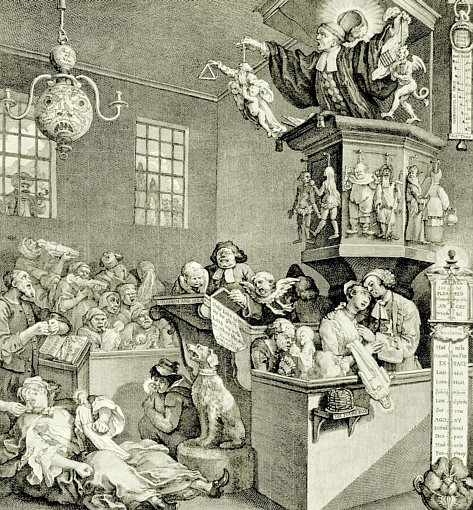
They were often criticized in their own time for the kind of emotional responses evoked by their sermons and in Methodist prayer meetings. Hogarth’s engraving captures anti-Methodist sentiment:

Much of the opposition could be attributed to class issues–the Methodists target working and middle class people–and to their tactics. They adopted George Whitefield’s practice of preaching in the open air, held meetings outside of regular church hours and in places other than churches, and they licensed lay people to preach.

From a twenty-first century perspective shaped by contemporary Christianity, what may be most surprising is the social justice emphasis of the Methodist revival. John Wesley opposed slavery and one of the last letters he wrote before dying was to William Wilberforce who was leading the campaign for abolition in Parliament, urging him to persevere in his efforts.

I can’t think about the Wesleys, though, without thinking of their hymns and beginning to sing them: “O For a Thousand Tongues to Sing” or “Love Divine, All Loves’ Excelling.

Night – The New York Review of Books

There’s a deeply moving, brief essay by Tony Judt in the New York Review of Books. Judt is a historian whose work I respect immensely. I began reading him during 1989 when the Iron Curtain was coming down and Corrie and I were making plans to live in Germany. I have followed his work ever since. He is an astute and perceptive commentator on current events, especially in Europe. His deep knowledge of European history allows him to see things that go unnoticed by others.

He was diagnosed with ALS (Lou Gherig’s disease) in 2008 and is now paralyzed from the neck down. This meditation focuses on his experiences during the night. It’s available here: Night – The New York Review of Books.

He describes an existence that most of us find unfathomable–an active mind trapped in body that can’t move, but through which he continues to have feeling. He will continue to write these brief essays for the NYRB and they promise to give insight into this disease but I feel somewhat voyeuristic as I read.

His essay does raise questions about the relationship of body and mind that have long intrigued me and about which I may write more substantively some day.

New Bishop for the Diocese of Upper South Carolina

Having left the diocese only four months ago, I followed the election closely. I will admit that I was deeply concerned when the slate of candidates was announced. The addition of a petition candidate did not assuage my fears. Part of my concern stemmed from my knowledge of the diocese and of the state after living there for ten years. I had spent enough time with lay people from across the diocese and knew the general tenor of religiosity and of politics.

I also have enormous respect and deep affection for Bishop Henderson. He navigated an incredibly difficult situation after 2003 with grace and skill and he was a gifted pastor to his clergy. I hoped that his legacy would be a strong diocese, moderate theologically, and diverse in its churchmanship. The slate of candidates seemed not to reflect his wisdom and perspective.

There are those who regard Bishop Henderson as a heretic or as spineless. He is neither. The same people regard at least three of the candidates for the next bishop as “revisionist,” whatever that means.

The election is a clear repudiation of the theology and politics of marginalization and polarization. I found it interesting that Waldo+received a clear majority from the lay delegates from the very first ballot, while the clergy were more divided amongst themselves. What I learned of him from a distance suggested to me that he would be an unlikely fit for the diocese I know so well. That he prevailed so quickly and easily suggests to me that he wa eloquent and charismatic in the walk-abouts, and that he connected very quickly with lay people.

I continue to pray for the people and clergy of the diocese. I count many among my friends. They have done good work under the guidance of the Holy Spirit. And I pray that they will continue to do such good work. Thanks be to God.

more on the election of bishops

I’ve never voted in the election of a bishop, and as time passes, I’m increasingly grateful for that, and hopeful that I will never be burdened with that responsibility. Seeing the firestorm that was ignited by last week’s elections in the Diocese of LA, I can’t imagine what it would be like to be casting a ballot with the knowledge that all of the Anglican Communion, and perhaps the world-wide press, would be taking an interest.

I almost did vote in the election of a bishop, and even more onerously, I was nominated to serve on the Search Committee for the next Bishop of Upper South Carolina (thankfully, wiser heads prevailed and I was not selected). My prayers are with all of those people who will be casting ballots on Saturday in Columbia. I’m wondering what effect last week’s elections is having on this week’s. How are events in the wider church having an impact on the decision-making by those who will be voting?

I’ve not followed the discussions closely and know only two of the candidates at all. I’m curious to see how the clergy and the laity, after more than ten years of Bishop Henderson, go about choosing his successor.

Biblical surprises

I’m always fascinated when I encounter surprises in the biblical text. Today was one such occasion. As I began preparing for the noon Eucharist, I turned to Lesser Feasts and Fasts. November 25 is the commemoration of James Huntington.

As is often the case, when I encounter a figure with whom I am not familiar, I look for alternatives. Tomorrow being Thanksgiving, I checked out the propers for Thanksgiving in Year C. The gospel was immediately approachable: Matthew 6:25-33 which include those wonderful words: Consider the lilies of the field; they neither toil nor spin…” Given the anxiety I was experiencing, trying to make final preparations for Sunday, after having been out of the office all day yesterday, they were words I needed to hear.

But the lesson from Joel was even more fascinating: “Do not fear, O soil; be glad and rejoice, for the LORD has done great things! Do not fear, you animals of the field, for the pastures of the wilderness are green; the tree bears its fruit, the fig tree and vine give their full yield” (Joel 2:21-22). Remarkable words given the overall attitude toward the land and its non-human inhabitants in the Hebrew Bible.

I had to drive to Whitewater yesterday. As I did, I saw fields that had been harvested, cornfields that remained untouched, and farmers here and there picking corn. Our culture has tended to view the land as something to exploit, but Joel’s words suggest a more difficult and complex relationship. Thanksgiving is traditionally a time to enjoy the fruits of one’s labors, the fruits of harvest. We live in a world that is very much divorced from the struggles of farmers, and their work in the fields. But much of our wealth is created on the backs of the poor, and on the backs of those who toil in fields to harvest vegetables and fruits for our tables. We also benefit from a system that exploits animals horribly. Thanksgiving is a hollow holiday indeed if we do not recognize the sacrifices of others (human beings and animals) to make our table full of food.

“Ancient of Days”

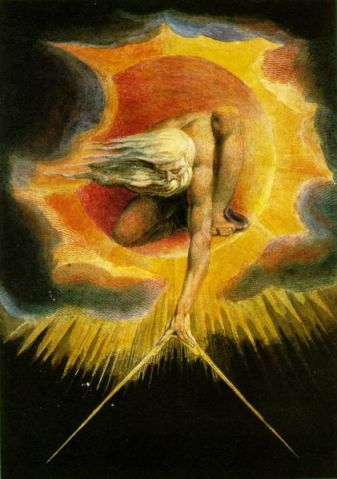
Here’s the Blake image I referred to in my Sunday sermon

I mentioned that the shafts of light emanating from the fingers are reminiscent of a compass, which calls to mind Milton’s description in Paradise Lost of God creating the universe:

Then stay’d the fervid Wheels, and in his hand
He took the golden Compasses, prepar’d
In God’s Eternal store, to circumscribe
This Universe, and all created things:
One foot he centred and the other turn’d
Round through the vast profundity obscure,
And said, Thus far extend, thus far thy bounds,
This be thy just Circumference, O World. Paradise Lost VII.224-231

The image of the golden compass has itself become quite familiar in contemporary culture, most prominently in Phillip Pullman’s novel of that name, recently made into a movie.

Reflections on "Meditation"

Wow! I don’t think I’ve ever had as busy a Christmas as this year was. In addition to the usual press of the holiday season, the staff of St. James bid our Interim Rector, Fr. Tom Davis good-bye on Christmas Eve, and then we had to make preparations for the arrival of our new Rector, Fr. Geoff Taylor. But it wasn’t all work. Corrie and I celebrated her birthday by seeing the Met’s performance of Massenet’s Thais on December 20, and we ended the holiday season at the Peace Center last Thursday for a performance by violinist Joshua Bell. For his encore, Bell played the Meditation from Thais. So our Christmas began and ended with that lovely and profound violin piece.

Thais is the story of an Egyptian monk from the early centuries of Christianity who takes it upon himself to attempt the conversion of Thais, the most famous and beautiful courtesan in the cosmopolitan city of Alexandria. Of course he falls in love with her, and of course she converts to Christianity. In fact the Meditation is the moment in the opera when she converts. Thomas Hampson and Renee Fleming were superb in their roles, but David Chang, concertmaster of the Met Orchestra was amazing in his interpretation of the Meditation (I won’t even try to use words to describe Bell’s performance).

What I love most about the live HD Met broadcasts in movie theaters are the intermissions. The performers are often interviewed just as they come off stage and you get to watch amazing scene changes. Chang was charming in the interview. He connected his playing with his Christian faith, and humbly but forthrightly spoke of what the piece meant to him.

The gift of music was one of my greatest joys these past few weeks–the organ and choir of St. James, but also performances I was barely able to hear, before services for example. I was stopped cold more than once, in the midst of last-minute preparations, by the beautiful sounds of the violin playing of St. James’ parishioners. I hope to hear more of it in the new year!

Priests (and others) in the news

There’s been something of a run of negative stories about Episcopal priests of late. There was the priest in Seattle who converted to Islam but was still functioning as a priest (her bishop has since put her on a year’s leave). There are of course stories of sexual and financial misconduct. But the icing on the cake was the story in Sunday’s NY Times about the ex-porn star who wants to be ordained. The article claimed he was in the ordination process. It turns out there were a number of errors in the article. If you want to get the real story, go here. By the way, that link takes you to Episcope which does a great job of tracking Anglican and Episcopal news and also works very hard to get the facts of the stories correct.

Today, the Times redeemed itself, somewhat, with an article on an Episcopalian Chaplain at St. Luke’s Presbyterian Hospital in New York. The article is here (You may need to register to access it).