Faith and unbelief: some links

I’ve gathered some beautiful and challenging writing on faith and doubt and the struggles many have with identifying as “Christian” in the twentieth century

First, Christian Wiman, raised Southern Baptist, estranged from the church, now exploring that complex relationship between faith and doubt in our contemporary world:

I do feel that some people may be called to unbelief—or what looks like unbelief—in order that faith may take new forms. Emily Dickinson is a good example of this, or Albert Camus. But I also believe that God requires every last cell of yourself to bow down. Or perhaps that verb, requires, is wrong, or that it’s God doing the requiring: It’s more like your nature requires, in order to be your nature, that every last cell of yourself bow down. There is still some satanic pride in me, for which I pay a high price.

Casey Cep on the spiritual journey of Reynolds Price (part I, part II):

It pains me to know that Price considered himself “a literal outlaw” of Christian churches because of his homosexuality. In one of his final books, A Serious Way of Wondering: The Ethics of Jesus Imagined (2003), Price confessed “though I’m not a churchgoer, for more than sixty years I’ve read widely in the life and teachings of Jesus; and since at least the age of nine, I’ve thought of myself as a Christian.”

Like the mystic Simone Weil, who resigned herself to “the conclusion that my vocation is to be a Christian outside the Church,” Price found his community with Christ beyond the sanctuary.

I never met Reynolds Price, but I carry his meeting with Christ in my consciousness, hold the words of his translations in my heart. Here was a writer, who many assumed would appeal to me for all his imaginary worlds, but who I only ever understood as a brother in the faith.

Pained as I am that he felt himself an outlaw of Christianity, I cherish the knowledge that he and I meet forever in the communion of saints.

Justin Erik Haldor Schmidt writes beautifully of “coming out of the closet” as a Christian, and the difficulties he has in confessing his faith publicly:

Those who know me or have read me will probably know that I have often claimed that I am an atheist. I would like to stop doing this, but if I had to justify myself, I would say that it is for fear of being confused with that blowhard with the ‘John 3:16’ banner that I am unforthcoming about what I actually believe. I am infinitely closer, in the condition of my soul, to the people who feel God’s absence– the reasons for this feeling are a profound theological problem, and one might say that it is only smugness that enables people, atheists and dogmatists alike, to avoid grappling with this problem. I am with the people who detect God’s hand, perhaps without even realizing it, where the smug banner-holder sees only sin: in jungle music, dirty jokes, seduction, and swearing. I am with the preacher who puts out a gospel album, then goes to prison on fraud and drug charges for a while, then puts out a hip-grinding soul album, and then another gospel album. I am with the animals, who can’t even read, but can still talk to the saints of divine things. I am sooner an atheist, if what we understand by Christianity is a sort of supernatural monarchism; if we understand by it that God is love, though, then, I say, I am a Christian.

The food stamp challenge and the faces of the hungry in Madison

I participated in a press event organized by Wisconsin Faith Voices for Justice. They are encouraging faith communities to participate in the Food Stamp Challenge. I was invited because Grace Church has had a pantry since 1979.

Here’s what I had to say:

In 1979, visionary members of Grace responded to the growing need in our community by starting a food pantry. Those founders aren’t around anymore but I’ll bet if they were, they would tell me that they had no idea that the pantry they founded would still be in operation nearly 35 years later.

I see them every afternoon lining up before our pantry opens its doors. White, African-American, Hispanic, Asian; old and young, parents or grandparents with children, occasionally even college students. I see the diversity that is twenty-first century America, the diversity that is hunger and poverty in our great nation on display within sight of the State Capitol. Their stories are as diverse as their ages and the color of their skin—the elderly or disabled on fixed incomes who are trying to scrape by until the next check comes, unemployed or underemployed people trying to supplement the pay from a job that doesn’t provide a living wage; college students who can’t afford to pay tuition, room and board; homeless people, too. On Saturday mornings, our guests are mostly employed, but their low-pay jobs don’t pay them enough to make ends meet. I’ve handed food out to people who had absolutely nothing to feed their children that afternoon; I’ve given formula to a grandmother whose baby grandchild had been abandoned by her mother and she had come to us in desperation.

These are the faces of the hungry in America. The SNAP program, what we used to call food stamps is intended to supplement, not provide, food for people who have nowhere else to turn except to food pantries and meal programs, people who are supposed to be able to feed themselves. And the amount that’s provided is barely enough to ensure adequate nutrition—the equivalent of $29 and change every week per person.

Those of us with homes, jobs, adequate clothing, and adequate food have no idea what it’s like to live without those things. As the gap between rich and poor continues to widen in our country, and we’ve learned that the US has the greatest income disparity of any of the world’s developed nations, the gap of comprehension of what it’s like to live without is growing as well. Most of us never see those lines waiting outside the pantry, or later in the evening, the line of men waiting to enter the Men’s Shelter at Grace. If by chance we encounter it, we avert our eyes or cross to the other side of the street. To experience that world, the world of want and deprivation is a greater shock than traveling to another country. To experience it, even in something so simple as the Food Stamp Challenge, is to begin to comprehend the struggles faced by so many in our society, struggles faced day after day, year after year.

As we approach the Christian season of Lent, traditionally a season of fasting and repentance in preparation for the remembrance of Jesus Christ’s death and resurrection, it’s appropriate for us to imitate the one who we believe became like us, by walking in the footsteps of our brothers and sisters who live in poverty and want.


A little cold water to throw on Obama’s speech yesterday

From Tom Junod: The War Obama Forgot:

I am not speaking, of course, of the wars that the president spoke of yesterday, in his second inaugural speech — the ground wars in Iraq and Afghanistan that he spoke of without naming. I am speaking of the war that is currently being prosecuted in countries where we are not supposed to be at war, like Pakistan, Yemen, and Somalia. I am speaking of the perpetual war, the shadow war, the invisible war against invisible enemies, the war whose latest manifestation came just two days ago, when three men identified as militants, names unknown, were killed by an American drone. I am speaking of the war that the president did not speak about, even though his Administration has never called it anything but a war, and it has killed thousands of people.

Read every word of it.
But here is the difficulty: the technology is so good that the criteria for using it are likely to be steadily relaxed. That’s what seems to have happened with the U.S. Army or with the CIA in Pakistan and Yemen. The overuse of drones and the costs they impose upon the civilian population have been carefully and persuasively documented in the Stanford/NYU Clinics’ report, Living Under Drones. I will focus on only one striking example of how the moral criteria have been relaxed in order to justify the overuse and the costs. According to an article in the New York Times by Jo Becker and Scott Shane, President Obama has adopted “a disputed method for counting civilian casualties” that makes it much easier to call drone attacks “proportionate.” In effect, it “counts all military age males in a strike zone as combatants.” If the targeted insurgent or terrorist leader is surrounded by, or simply in the vicinity of, a group of men who are, say, between the ages of fifteen and sixty (and even drone surveillance can’t be precise about that), an attack is permitted, and everyone who is killed is counted as a legitimate target. But this isn’t targeted killing.

Some links on prayer

I mentioned that I read Anne LaMott’s Help, Thanks, Wow. It’s a quick read about her life of prayer. LaMott writes with humor, honesty, and insight.

The Other Journal has been focusing on prayer, including this interview with Sarah Coakley.  There are two parts, both of them worth reading. She talks about asceticism, silent prayer, and the erotic (among a number of other things). Part I is here. Part II.

A very different take from Cathy Warner, who writes about her life of prayer:

When I was ten and composed my first prayer, I wasn’t trained or qualified. I didn’t know the right words. Once I joined a church, I tried to replace my primitive prayer with a better one. I thought if I invoked the precise and proper words, suffering would pass me by. I was wrong.

From Everyday Liturgy, five spiritual practices to cultivate in 2013.

Ann Hood writes poignantly about her search for a church with open doors in which to pray: A Prayer at Christmas – NYTimes.com. It’s one of those things I hate myself, that we can’t keep Grace open to the public as a place of prayer. Occasionally I’ll encounter someone who asks if they might come in to pray. I always invite them in to the church.

Where is the Church in Downton Abbey?

I asked this very question in a brief blogpost last year. There were several moments of pious devotion and an obligatory teatime visit of the Vicar to the Dowager Countess, but in last night’s episode, the careful omission of anything overtly religious was especially apparent. There was a scene of the wedding rehearsal, with the Archbishop (unidentified) berating the vicar’s handling of the rehearsal. And we saw the walk down the aisle at the wedding, the couple approach the altar, and then a cut. Not one word of the marriage service was uttered, not a single prayer.

On this side of the pond, at least judging by my twitter feed, Downton Abbey is a big hit with Episcopalians (although there is also considerable snark from many of the usual suspects). It appeals to our anglophilia which may be why some of us became Episcopalian in the first place but I think we ought to recognize how marginalized the institutional church and personal faith are in the overall series, and how that reflects twenty-first century sensibilities and probably distorts historical reality. The absence of religion is especially curious considering its creator Julian Fellowes’ own Catholicism, explored in a podcast featuring James Martin, SJ and Tim Reidy of America Magazine.

From Christianity Today: Why is God still absent from Downton Abbey?

Margery Kempe 1995-2013

We came home last night after a wonderful dinner with friends to find Margery had died. She was in her bed in front of the gas stove where she had spent much of her time over the last couple of months. She seemed to have had a peaceful end after a very difficult few days. As I mentioned in a previous post, Margery was a wonderful and feisty cat, very affectionate who loved life and persevered through a great deal.

A few more pictures of her:

as a kitten (she spent over a month in isolation in a spare bedroom after coming to us for fear that she might infect Maggie Pie). We would go in and spend time with her and she loved to play as most kittens do:

margeryplayingAfter she emerged permanently from her isolation chamber, she shared living quarters with us and for nearly eight years with the “magnificent” Maggie Pie. The two never really got along. This picture sums up their relationship:

20130102142416_00001

But my favorite photo of Margery may be this one. It’s probably from her second Christmas with us:

20130102142302_00001

And special thanks to the vets that cared for her over the years, especially the staff at Lakeview Veterinary Clinic who accompanied us on her final journey.

Let light perpetual shine upon her and may she be warm and have lots of good things to eat and embraced by love.

My year in blogging …

Total number of pageviews: 32000; busiest day: February 6

The most popular posts on my site in 2012

Thanks to all who visited, read, commented, and gave feedback in other ways.

Happy New Year!


Anne LaMott on the death of her beloved cat

As we prepare for Margery’s death, some words from Anne Lamott (from Help, Thanks, Wow)

Now it turns out that my cat is going to die later today. She is struggling to breathe. I had hoped and prayed that she would slip off in the night and that I would not have to have the bet come by to put her down. I said, Help. Also, I gave her a lot of morphine, what had to have been an overdose, which she just slept off. All I wanted was for her not to die miserable and afraid. That’s all.

It is nighttime now, and Jeanie passed an hour ago, miserable and afraid.

When the vet came, we tried to gently get her out from under the futon, and she went crazy, and the next ten minutes were so awful that I won’t describe them. Suffice it to say that she did not go gently into that good night. It broke my heart. But she had been suffering, and is suffering no more. She had an amazing run of love with my family. She was a proud little union cat, and also a model of queenly disdain with a bit of grudging affection for most people, and pure adoration for me.

Was my prayer answered? Yes, although I didn’t get what I’d hoped and prayed for, what I’d selected from the menu. Am I sick with anxiety, that I did the wrong thing? Of course. Sad? Heartbroken. But Jeanie hit the lottery when she got me as her person for thirteen years, and the bad death was only ten minutes. So let me get back to you on this.

Certainly the same could be said of Margery. Had we not noticed her that afternoon in Sewanee, or had we accepted the first vet’s opinion, Margery would have died as a kitten. She’s had a good life. She’s been loved and loved us and she’s endured all of the other cats we’ve brought into her life. She’s brought us joy and she’s enjoyed shrimp and calamari, and all manner of other things, including a nap on a sunny day on a screened-in porch in Madison.

Renovating and Rethinking Sacred Space

An article in today’s New York Times entitled “Building Congregations around Art Galleries and Cafes as Spirituality Wanes” explores the latest innovations in church planting among Evangelicals. Several things to note.

1) that the number of new evangelical churches has gone up every year since 2006 (despite the fact that attendance at services is on the decline

2) a quotation from Warren Bird of the Leadership Network:

For new leaders coming out of seminary, “the cool thing is church planting,” Mr. Bird said. “The uncool thing is to go into the established church. Why that has taken over may speak to the entrepreneurialism and innovation that today’s generation represents.”

3. An interesting detail in the description of the National Community Church in Washington. It has 3000 members and yearly turnover of 40%.

Readers of this blog know that I am very interested in some of the new forms that are emerging in Christianity, in outreach to young adults and millennials, and in the role of sacred space in mission and ministry. One of the important things about sacred space is that it roots us in the tradition and connects us with the divine. There’s a sense of permanence there that runs counter to the ideas expressed in all three of the points I numbered above.

The articles below offer several different approaches to sacred space; the renovation of space to fit in with current liturgical principles, the creation of new sacred space, and appreciation of sacred space that has been around a very long time.

An Episcopal Church in Allentown, PA won an award from Faith & Form, the quarterly journal of the Interfaith Forum on Religion, Art and Architecture (IFRAA), part of The American Institute of Architects, for his leadership of the award-winning liturgical renovation of Grace Church in Allentown, PA. IFRAA will bestow the 2012 Religious Art & Architecture award next June in Denver, Colorado.

Designed by its Rector Patrick Malloy who is now Dean of General Theological Seminary, it is intended to reflect the liturgical principles of the 1979 Book of Common Prayer. In classes on worship and architecture, Dean Malloy:

invites students to explore the intersection of architecture, art, and liturgy, and how they meet to shape the experience of sacred space. “I wished to provide a context in which students could consider how space and the liturgies we celebrate in those spaces interact. How might liturgical spaces be designed to inspire a community’s ways of celebrating? Those who plan liturgy, too, must conceive of the liturgy spatially: how it will inhabit the space.”

There’s an article on the church’s renovation available from the Diocese of Bethlehem. And more about the awards, including information on all the winners, is available here.

On a very different note, Notre Dame (Paris) is celebrating its 850th anniversary this year

Design for the new Roman Catholic Cathedral in Port-au-Prince, Haiti.

Kenan Malik writes about St. Etheldreda Church, perhaps the oldest Catholic Church in England. As he says, “An ecclesiastical gem soaked in blood and history.”

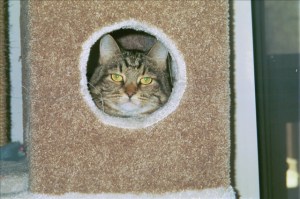
Cat-Blogging: Margery Kempe

Margery Kempe came to us in the fall of 1995. It was Parents’ Weekend at Sewanee and we suspected that she was dropped off by people who had come up to the Mountain for the weekend. We found her running from the general direction of St. Luke’s Chapel towards All Saints’ Chapel, crying with all of her might (Hence the name Margery Kempe). She was an itty-bitty little thing. When we took her to the vet for the first time to have her checked out, he told us she tested positive for Feline Leukemia and needed to be put down. We disagreed.

Another vet, vitamins and interferon, plus a couple of months of isolation away from our Maggie Pie, Margery was retested and came up negative. She was a feisty thing. She had a dear friend in Sewanee for a couple of years, Tigger, who would come and visit every day after his girls went off to school. And we’ll never forget the summer Reginald Fuller and his wife lived next door, and when a dead cat appeared on the street below us, Mrs. Fuller worried that it was Margery, or the “little fat one” as she called her. In Sewanee, our cleaners named her “Large Marge.” Although she was small-bodied, she ate her fill.

When we moved to South Carolina, Corrie wanted to get her a new playmate to replace Tigger. That explains Merton but they never really got on. Perhaps the most poignant moment ever for me and Margery came upon Maggie Pie’s death. For the last couple of years of her life, Maggie always slept up next to my head. It was the spot where she felt protected from Merton’s onslaughts. Margery never slept in the bed. She had grown accustomed to sleeping on her own, probably because of her early months in isolation.

Maggie’s last night, I knew she something was wrong. She couldn’t get comfortable next to me and in the morning, we took her to the vet and he discovered a huge tumor in her lungs. That night, for the first time, Margery came in the bed and settled down next to my head.

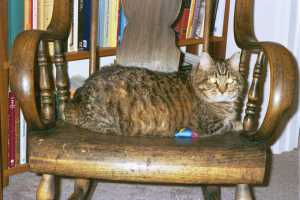
A couple of photos from Margery in her prime:

1(3) copyMargery copy

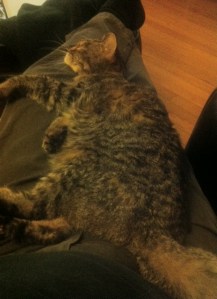
As I wrote this a couple of nights ago, Margery was sleeping on my lap. She barely moved her limbs in an hour. Her breath at times seemed forced; at other times it came easily. She’s on pain medication, blood pressure medication, subcutaneous fluids. But she’s still eating and especially enjoyed bites of shrimp cocktail on Christmas Eve.

photo