
On dying with dignity and our baptismal vow to “respect the dignity of every human person.”

I’ve been surprised by my personal response to the spectacle that’s recently played out in our media over Brittany Maynard’s widely publicized decision to move to Oregon to take advantage of that state’s assisted suicide law. On the one hand, I find the notion of terminally-ill people having the option of choosing when to die and the assistance of medical professionals appealing. On the other hand, making such a decision public in the interest of bringing attention to the death-with-dignity movement seems, well, less than dignified. End of life issues are deeply personal and gut-wrenching.

Part of my concern with the whole movement and the debate is how it is couched in term of individual rights and dignity. Many of those in favor of assisted suicide or death with dignity say things like, “I don’t want to be a burden to my family” or this (from Sarah Kliff):

Eric Holland, a brain cancer specialist at the University of Washington, calls glioblastoma multiforme “the terminator” of cancers. “It’s like the movie where there is this a killer that you can’t stop, no matter what you do,” he says.

I’ve spent a lot of time over the past few days reading about what it’s like to die from glioblastoma multiforme. Median survival for patients is 14.6 months. Death often happens with little dignity. There’s an essay that Stacey Burling, a Philadelphia Inquirer reporter, wrote in 2011 about her husband’s death, that I can’t get out of my mind. She describes the cognitive decline as “Alzheimer’s on steroids”:

He mistook the kitchen trash can for a toilet. He couldn’t figure out how to use a phone. I had to pull him with both hands through unfamiliar buildings because he could no longer walk normally or navigate. I bought Depends, just in case. Two days after we started using them, he asked, “What do you figure our last name is?”

Candace Mondello, who lost her brother Kim to the same tumor, describes the experience similarly. “Kim lost his ability to walk, talk, feed himself or use the bathroom,” she wrote in a 2012 essay. “He lost all dignity at this point. He had to be fed, wear diapers and was bed-ridden.”

Yes, it’s a horrific disease and if I were suffering from it I would likely want to end my life as well. Still, as I read these paragraphs, our baptismal vow came to mind: Will you strive for justice and peace among all people, and respect the dignity of every human being?

What is “dignity”? Well, the word comes from the Latin word dignus, which can be translated as “value” or “worth.” We are tempted to see ourselves in purely instrumental terms. Our value or worth is tied up in what we have or what we do, not who we are, God’s beloved children. Archbishop of Canterbury Justin Welby emphasized the potential of the proposed assisted dying law in the UK on the elderly and disabled.

No doubt, I’m in a shrinking minority in my church, but I fear for our culture if “death with dignity” is embraced. More importantly, I think we are called as Christians to be present in the midst of suffering; to be present with those who suffer, and to witness to the dignity of all human beings in the midst of their suffering.

Jason Welle, SJ wrote powerfully about his brother’s death (I linked to it earlier):

But his dying was never without dignity. I asked Tony to let us love him through his sufferings, and we were able to love him all the way through to the end. And in letting us do that, he showed us courage and heroism, and embodied real dignity. Tony’s journey through his own illness, suffering and death was nothing short of courageous; but that he did all this and cared for my dad in his illness and death is simply heroic. Courage and heroism aren’t born in complacency or contentment, nor are they the hallmarks of fearlessness and ordinary strength. They are created in response to trials and suffering, and they’re evidence of the triumph of hope over despair. Dignity too is made possible through courage and heroism, but love makes all of these possible; love in time of affliction is the condition that makes dignity a reality.

No, dignity isn’t opposed to suffering; sometimes in suffering dignity reveals its truest face.

Yes, it’s gut-wrenching, but as gut-wrenching issues usually are, there are hard questions and strong arguments on all sides.
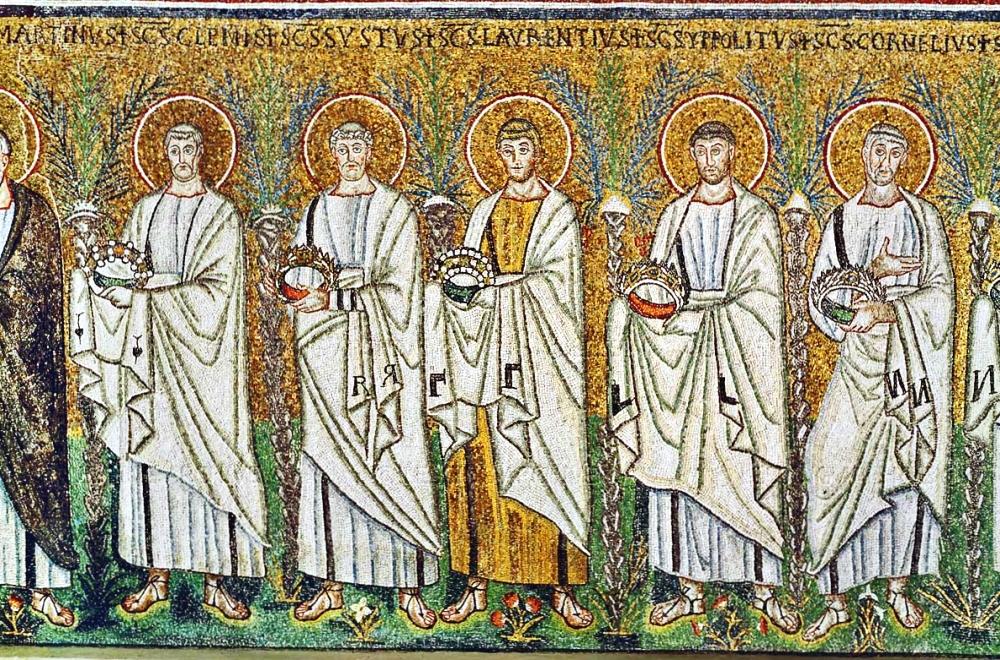
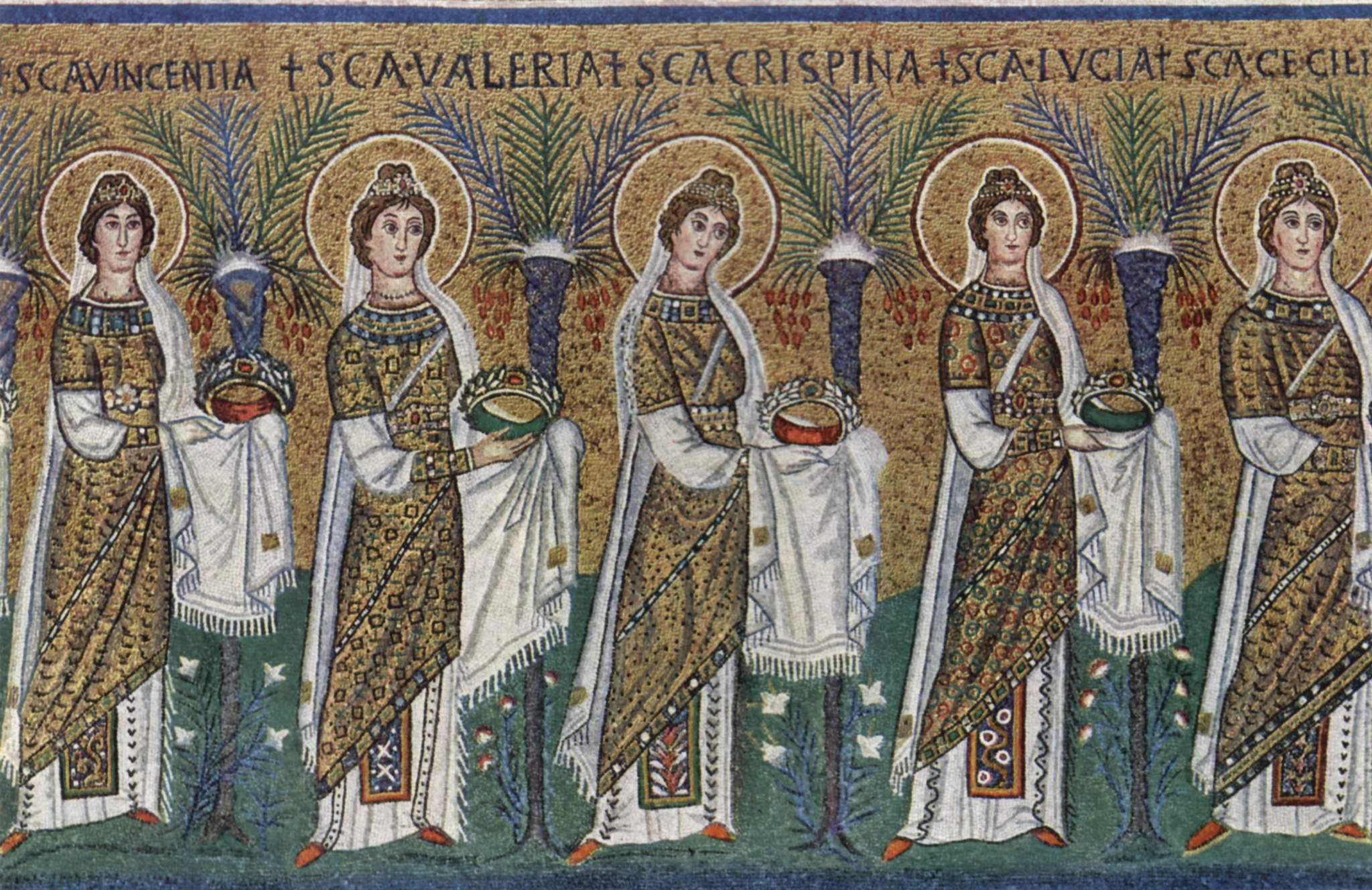
The Feast of All Saints

Almighty God, you have knit together your elect in one communion and fellowship in the mystical body of your Son Christ our Lord: Give us grace so to follow your blessed saints in all virtuous and godly living, that we may come to those ineffable joys that you have prepared for those who truly love you; through Jesus Christ our Lord, who with you and the Holy Spirit lives and reigns, one God, in glory everlasting. Amen.

Three of the images that are at the forefront of my mind today:

The marvelous and awe-inspiring procession of martyrs that grace the walls of S. Apollinare Nuovo in Ravenna:

???????????????????????????????????????????????????????????????????????????????????????????????????????????????????????????????????????????????????????????????????Meister_von_San_Apollinare_Nuovo_in_Ravenna_002And from a very different historical period, and a radically different expression of the communion of saints (the 16th century Anabaptist Dirk Willems, who after breaking free from his captors, went back to save one who had fallen through the ice. Willems was executed):

Dirk+Willems+small

Reflecting on the Recent Synod on the Family

There’s been a great deal of discussion and media attention to the recent Synod on the Family held at the Vatican. Western media and progressives were agog at the prospect of a welcome for LGBT people and for divorced and remarried Catholics. Then a few days later, they were outraged when it appeared the Synod reversed course. As one example, the Episcopal Cafe announced: “Catholic Bishops fail to welcome gay, divorced Christians.”

One can understand the wider culture’s inability to understand what precisely is going on in the Synod (I use the present participle because there will be a follow-up next year at which a final report will be issued). What’s more surprising is that even Catholics don’t get the dynamics at play. Witness Ross Douthat, who in his Sunday column in the New York Times seemed to be threatening schism (there’s another living pope, after all), and the absolute immutability of church doctrine over time. Douthat reasserts the importance of the latter to his own Catholicism in a blog post yesterday.

The greatest living American Catholic historian, John S. O’Malley, SJ responds to Douthat and provides background to the synod here. He writes:

Change is in the air at the synod. To that extent Mr. Douthat is right. Moreover, change is problematic for an institution whose very reason for existence is to preserve and proclaim unchanged a message received long ago. Yet, given our human condition, change is inevitable. Sometimes change is required precisely in order to remain faithful to the tradition. It has in that way been operative in the church from the beginning.

Every council in the history of the church has been an instrument of change, and the synod is in effect a mini-council. Pope Francis convoked it for an examination of conscience about a range of questions directly or indirectly affecting the Sacrament of Matrimony. What will result from this examination? We don’t know. Will it be a declaration, a decree, a simple report? We don’t know. No matter what the form, what will it say? We don’t know.

O’Malley knows councils, having written on the Council of Trent and Vatican II. His new book on the history of the Jesuits came out last week and I can’t wait to read it.

O’Malley was one of my teachers and it is to him that I owe my deep appreciation for Roman Catholicism as well as my knowledge of Early Modern Catholicism.

I’ll be interested to see what ultimately emerges from the Synod. As someone who regularly encounters Catholics who have been deeply wounded by the church’s practices around divorce and remarriage, I am hopeful that the Synod will find a way to embrace the lives, faith and journeys of divorced and remarried Catholics.


Thinking about All Saints’


To those who know a little of christian history probably the most moving of all the reflections it brings is not the thought of the great events and the well-remembered saints, but of those innumerable millions of entirely obscure faithful men and women, every one with his or her own individual hopes and fears and joys and sorrows and loves — and sins and temptations and prayers — once every whit as vivid and alive as mine are now. They have left no slightest trace in this world, not even a name, but have passed to God utterly forgotten by men. Yet each one of them once believed and prayed as I believe and pray, and found it hard and grew slack and sinned and repented and fell again. Each of them worshipped at the eucharist, and found their thoughts wandering and tried again, and felt heavy and unresponsive and yet knew — just as really and pathetically as I do these things. There is a little ill-spelled ill-carved rustic epitaph of the fourth century from Asia Minor: — ‘Here sleeps the blessed Chione, who has found Jerusalem for she prayed much’. Not another word is known of Chione, some peasant woman who lived in that vanished world of christian Anatolia. But how lovely if all that should survive after sixteen centuries were that one had prayed much, so that the neighbours who saw all one’s life were sure one must have found Jerusalem! What did the Sunday eucharist in her village church every week for a life-time mean to the blessed Chione — and to the millions like her then, and every year since then? The sheer stupendous quantity of the love of God which this ever-repeated action has drawn from the obscure Christian multitudes through the centuries is in itself an overwhelming thought.

Dom Gregory Dix, The Shape of the Liturgy (1945).

h/t Wesley Hill

Requiem for a seminary? Requiem for a church

Once again, Crusty Old Dean tells the hard truth:

Requiem for a seminary? Requiem for a church which calls white black and black white, and calls things resignations which are not resignations. Shall we be a church where petty oligarchies can run roughshod, whether in seminaries, or dioceses, or parishes, divorced from their constituencies?

What if my sermons got subpoenaed? Reflections on Religious Liberty in post-Christian America

When I first came across the story from Houston about lawyers for the city subpoenaing communications from clergy in connection with the ongoing conflict over Houston’s equal-rights ordinance, I was amazed. A facebook friend who is of a more conservative bent posted it on his timeline. I had come to expect such outrageous stories from him that didn’t hold up under closer scrutiny. So I succumbed to the click-temptation, read about it, and still wondered.

On the one hand, I suspected that all of the subpoenaed pastors provided public versions of their sermons (either text, or more likely, video), so lawyers ought not need subpoenas to read them. On the other hand, I immediately wondered what might happen if this practice became widespread. I could readily imagine mayors using subpoenas to suppress the prophetic voices of clergy speaking out on racism, police brutality, or presidential administrations using similar tactics against clergy who speak out against their military adventures overseas.

What has surprised me is the response from the mainstream (progressive?) press. Media Matters for America (a progressive media watchdog) assures us: “No, The City Of Houston Isn’t Bullying Anti-Gay Pastors – This Is Basic Lawyering.” Eugene Volokh takes a somewhat more nuanced approach at the Washington Post. He provides some hypothetical situations when a subpoena might be appropriate and legal, but argues that this effort is far too broad.

On one level, this dispute seems to me another example of the contested territory of religion in contemporary America. When is a pastor or an imam, or a rabbi, or whoever, communicating religious convictions or engaging in political advocacy? And when might she be doing both at the same time? Is it wrong for a pastor to express his opposition to a city ordinance from the pulpit and to urge his congregation to oppose it?

We may find the pastors’ arguments, political opinions, and theology wrong, even repugnant, but do they have the right to hold those opinions and to share them with their flocks? And who has the right to be the arbiter of such questions? Local governments? An attorney general? The Supreme Court?

One of my discomforts with the Hobby Lobby case was precisely that issue. Supporters of the contraception mandate were critical of the position taken by the owners of Hobby Lobby arguing in essence that their arguments about religious conscience weren’t valid. But who is to judge whether a position is religiously valid? As Queen Elizabeth I famously said, “I have no desires to make windows into men’s souls.”

I’m also uncomfortable with efforts to force small businesses to, for example, make wedding cakes for same-sex couples. Aside from wondering why such couples would want their cakes made by people opposed to their marriages, I think it really does impinge on religious freedom, just as in an earlier age, the US court-martialed those who refused in conscience to serve in the military. Does the state have the right and power to force a photographer to take pictures at a same sex wedding if his religious beliefs oppose such rites?

I suspect that the initial subpoenas were a fantastic and misguided over-reach. I suspect also that the mayor and her attorneys were playing to their base, just as the pastors play to theirs. Whatever the case, this is so hamfisted an attempt that it will likely end in utter failure and probably contribute to the ultimate revocation of the ordinance in question.

Still, it should put a chill down the spine of every religious leader.  Undoubtedly there will come other cases that have universal popular appeal and more skillful lawyers and politicians who will find a way of limiting the speech of clergy, if not conservative Christian pastors, then progressive ones, or more likely, Muslims.

Fortunately, the backlash is coming not just from conservative demagogues. It is also coming from Houston clergy who are supporters of the ordinance at issue. Chris Seay of the Ecclesia community in Houston has written an eloquent open letter to the mayor:

I see you as a friend, so I choose to speak to you in the context of friendship. You lead the city that I love, and I want my church, Ecclesia, to continue working alongside you to make our city better. I’m a native Houstonian and a self proclaimed Houston Geek. I love our diversity, food, sports teams, history, entrepreneurial spirit, and most of all I love the people. I know we agree that all Houstonians are made equal in God’s eyes.

Despite our common aim to better this city, your administration’s actions over the last 30 days confirm that we are now formally at odds. It doesn’t have to be this way, but your decision to subpoena the sermons and communications coming from Christian churches in our city requires a clear and unequivocal response. These actions impede on the historic religious freedoms of America’s churches, mosques, synagogues, and temples, while equally being a breach of the relationship we share as citizens of this city. These efforts will only create further division and mistrust, bringing harm to the greater good of Houston.

Oh, and it seems the mayor’s actions have resulted in a miracle: unity among Texas Baptists

On love and dignity and dying

In the end, we couldn’t take away Tony’s suffering, or my dad’s. The sadness
and grief still weigh heavily on me and my mom. I’m not sure I can say that Tony’s suffering and death were beautiful. In fact, it was messy sometimes. Yes, there was pain; it was painful for him even though we did our best to manage it, and it was painful for us who loved him.

But his dying was never without dignity. I asked Tony to let us love him through his sufferings, and we were able to love him all the way through to the end. And in letting us do that, he showed us courage and heroism, and embodied real dignity. Tony’s journey through his own illness, suffering and death was nothing short of courageous; but that he did all this and cared for my dad in his illness and death is simply heroic. Courage and heroism aren’t born in complacency or contentment, nor are they the hallmarks of fearlessness and ordinary strength. They are created in response to trials and suffering, and they’re evidence of the triumph of hope over despair. Dignity too is made possible through courage and heroism, but love makes all of these possible; love in time of affliction is the condition that makes dignity a reality.

No, dignity isn’t opposed to suffering; sometimes in suffering dignity reveals its truest face.

By Jason Welle, SJ

The Feast of St. Francis

jesus-san-damiano-cross


The brothers shall appropriate nothing to themselves, neither a house nor place nor anything. And as pilgrims and strangers 1 in this world, serving the Lord in poverty and humility, let them go confidently in quest of alms, nor ought they to be ashamed, because the Lord made Himself poor for us in this world. This, my dearest brothers, is the height of the most sublime poverty which has made you heirs and kings of the kingdom of heaven: poor in goods, but exalted in virtue. Let that be your portion, for it leads to the land of the living; 2 cleaving to it unreservedly, my best beloved brothers, for the Name of our Lord Jesus Christ, never desire to possess anything else under heaven.

And wheresoever the brothers are and may find themselves, let them mutually show among themselves that they are of one household. And let one make known his needs with confidence to the other, for, if a mother nourishes and loves her carnal son, how much more earnestly ought one to love and nourish his spiritual brother! And if any of them should fall into illness, the other brothers must serve him as they would wish to be served themselves.

–From the Second Rule of St. Francis (read it all here)

It’s all about grace: Marilynne Robinson’s Lila

Early reviews and essays are coming out.

Leslie Jamison in The Atlantic:

Robinson’s grace is all the things we don’t have names for: the immortal souls we may or may not have, a doll with rag limbs loved to tatters. It’s sweet wild berries eaten in a field after a man baptizes the woman he will someday marry. Grace is money for a boy who may have killed his father; it’s one wife restoring the roses on the grave of another. Grace here isn’t a refutation of loss but a way of granting sorrow and joy their respective deeds of title. It offers itself to the doomed and the blessed among us, which is to say all of us. “Pity us, yes, but we are brave,” Lila realizes, “and wild, more life in us than we can bear, the fire infolding itself in us.”

Ron Charles writes in The Washington Post:

In a way that few novelists have attempted and at which fewer have succeeded, Robinson writes about Christian ministers and faith and even theology, and yet her books demand no orthodoxy except a willingness to think deeply about the inscrutable problem of being. Her characters anticipate the glory beyond, but they also know the valley of the shadow of death (and they can name that Psalm, too).

Michelle Orange in The Book Forum:

Robinson’s genius is for making indistinguishable the highest ends of faith and fiction, evoking in her characters and her readers the paradox by which an individual, enlarged by the grace of God, or art, acquires selfhood in acquiring a sense of the world beyond the self—the sublime apprehension that other people exist.

Which is to say that Robinson’s animating theme—grace—is also central to her genius. Described as “a sort of ecstatic fire that takes things down to essentials,” grace is evidenced in both the particular and the abstract: as laughter, a beloved face or voice, or as “playing catch in a hot street . . . leaping after a high throw and that wonderful collaboration of the whole body with itself”; but also in forgetting “all the tedious particulars,” in feeling the presence of a “mortal and immortal being.” “A character is really the sense of a character,” Robinson has written, and hers suggest, above the particulars, how the mysteries of grace persist in human beings, those wanting creatures who move Ames with their incandescence, the presence “shaped around ‘I’ like a flame on a wick, emanating itself in grief and guilt and joy and whatever else.”

Wyatt Mason offers a compelling profile of Robinson in the New York Times Magazine

Making Sense of the Mess at General Seminary

I’ve got no wisdom on this awful, heartbreaking, embarrassing situation, knowing almost nothing about GTS except being acquainted with several alums. But I’ve been asked about it by some folks, so I thought it might help to point people to pieces that have helped me understand something of the situation. The first, most important, and perhaps only necessary thing to read is Crusty Old Dean’s ruminations.

Crusty reminds us of several important facts: 1) That even in the seemingly stable and everlasting Episcopal Church, institutions come and go, including seminaries. It may be that General is simply not going to survive. 2) That this conflict comes at the nexus of two significant transformations in our society–the changing role of religion, especially mainline Christianity and the transformation of higher education. Seminaries are caught up in both of these larger cultural forces.

3) (Although Crusty doesn’t explicitly say this)That this conflict, and the quick escalation to “firings” or “resignations” reflects the corporatization of the church and the academy (see the discussion of the Task Force on Reimagining the Episcopal Church for more of the former). In the place of conversation, prayer, and discernment, we have lawyers (on both sides).

I agree with Crusty’s assessment that General may not survive this and that there will be repercussions throughout US theological education for years to come.

Derek Olsen discusses the significance of the changes in corporate worship and daily prayer for the overall life of the seminary and the formation of the students.

The faculty have put up a website that offers some of their perspective.

And The New York Times has an article providing background, including the news that the Seminary Board of Trustees will meet with the faculty.

Oh, and by the way, according to the GTS website, Bishop Miller of the Diocese of Milwaukee is a member of the Board of Trustees.