
The oddness of ashes: A Homily for Ash Wednesday, 2015

Yesterday, as I burned last year’s leftover palms from Palm Sunday and ground them into ashes, I reflected on the strangeness of my actions and the strangeness of Ash Wednesday. I thought about ashes.

There was a time in human history and culture when ashes were ubiquitous. Indeed, from the very beginning of human civilization, ashes have been present. Ever since humans discovered how to make fire, our lives, our homes, our culture, has been surrounded by ashes. There are many places in the world where that is still the case, but not in twenty-first century America. Ever since the arrival of electricity and central heating, ashes have increasingly vanished from our ordinary experience. Think about it. How often have you encountered, touched, ashes in the last year? If you have a woodburning fireplace or wood stove, if you use a charcoal grill, if you go camping and build a campfire, you have to deal with ashes. But otherwise, they simply don’t enter into our daily lives and consciousness.

How different that is from what lives must have been like 150 years ago, or still are, in less-developed countries. For nineteenth century American housewives, ashes were probably one of the great enemies, threatening chaos and dirt throughout the house and yard. London used to have the nickname “The Smoke” because of the blanket of soot and ash that covered the city. Ashes were everywhere.

As a priest, in addition to preparing ashes for Ash Wednesday and making the sign of the cross on your forehead in ash, there is one other way in which I encounter and experience ashes. That is when I place the ashes of a deceased person in an urn before placing it in our columbarium, or when I pour someone’s ashes directly into the ground. For me there is no more intimate, no more holy, no more priestly act than that. And it probably explains why I took the time last week to drive down to Chicago to inter the ashes of one of our members in a Chicago cemetery.

As we placed her urn in the ground, I said,

Thou only art immortal, the creator and maker of manknd; and we are mortal, formed of the earth, and unto earth shall we return. For so thou didst ordain when thou created me, saying, “Dust thou art, and unto dust shalt thou return.”

When I attend to the ashes of a dead person, I am caring for her as Christians have cared for the dead for two thousand years. I am ministering to the body of someone who lived, loved, had all of the emotions and experiences humans do, suffered and struggled, wept and rejoiced. I am preparing her body for the next stage of her journey, a stage that will end when she is raised from the dead, body and soul reunited, and she becomes a new creation, a new being fully alive in the presence of God.

I know, too, how powerful the words, “Remember you are dust, and to dust you will return.” I had a chance conversation with a parishioner yesterday who told me about the first Ash Wednesday service he attended, when he was in boot camp and the Catholic Chaplain, aided by an enlisted assistant, imposed ashes on the recruits. I remember as a layperson, hearing those words and receiving the ashes on my forehead. I remember the power of the words, as well as the awkwardness of that smudge of ash.

I know, too, how powerful and intimate it is to put my thumb on your foreheads, brushing aside your hair, and saying, “Remember that you are dust, and to dust you will return.”

I know the temptation to make Ash Wednesday all about us, about our humanity and mortality, about our sin. There is something powerfully individualistic about it all, something that turns us in on ourselves, to focus on our sin, our venality, our failures, our brokenness; to think about God’s judgment on us. There’s a temptation even to wallow in it, to beat our breasts.

What makes it worse is that our lessons, especially the reading from Isaiah and the gospel, call into question our motives and actions today. “Beware of practicing your piety before others, to be seen by them…” We’re told to fast and pray in private, not to let our left hand know what our right hand is doing, then we come forward, have ashes smeared on our foreheads and go from this place about our daily business. What’s more ostentatious, more obviously pious than to walk around all day with a smudge of ashes on our foreheads? Isn’t that sort of behavior just what Jesus seems to be criticizing here?

Some of us might want to wipe the ashes off of our foreheads as soon as we leave the church; some of us might struggle with our motives for receiving and wearing ashes. How you respond to these issues has a great deal to do with how this day and this rite have affected you in the past, how comfortable you are with odd stares from passers-by, and whether you imagine that wearing an ashen cross is more about you than it is about God.

For all the self-reflection and self-examination of this day and the season of Lent, for all the focus on our sins and shortcomings, however appropriate such things might be, appropriate, and necessary. Ash Wednesday and Lent are not just about us; they are also, and primarily, about God.

I don’t know if you noticed the verses in the psalm we just read that gets at this point and puts everything we do today in proper perspective:

For as the heavens are high above the earth, *
so is his mercy great upon those who fear him.

As far as the east is from the west, *
so far has he removed our sins from us.

As a father cares for his children, *
so does the LORD care for those who fear him.

For he himself knows whereof we are made; *
he remembers that we are but dust.

He himself knows whereof we are made; he remembers we are dust. What comforting, what gracious words! They take us back to the very act of creation. We are told in Genesis 2 that God fashioned us from the dust of the ground. God knows what we are and who we are. God knows us more intimately and more completely than we know ourselves. And what’s most remarkable, the fact that God knows this is evidence of God’s love and care for us. The ashes are a sign to us and to the world of God’s care and love for us and for all human beings.

For it’s not just a smudge of ash on our foreheads. I mark your foreheads with my thumb, using the very same gesture I use when I make the sign of the cross with oil during baptism. Then I say, “You are sealed with the Holy Spirit in baptism and marked as Christ’s own forever.”

You carry that sign of the cross on your forehead every day of your life, even if it is invisible. For one day a year, perhaps only for a few minutes, you have on your forehead a visible sign of the cross, marked in ash. It’s a reminder of our humanity and morality. It’s also a reminder of our origins, in God’s creative love. It’s a reminder to us, of God’s love for us and for the world and an opportunity to share the knowledge of that love with everyone we meet. Thanks be to God!
 

Listen to Him! A Sermon for the Last Sunday after the Epiphany

Have you ever had an experience where in the middle of it, while you were enjoying it, you thought to yourself, Wow, if only this could last forever! What was happening then? Were you out in the middle of some adventure, climbing a mountain, or watching a glorious sunset? Were you laying on the beach, enjoying the beautiful weather as you escaped a Wisconsin February? Were you sitting around with family and friends, in a moment of intimacy and joy? Were you eating the meal of a lifetime, savoring combinations of tastes and exquisite preparation? Were you at a concert or visiting a cathedral or art museum? Continue reading →

We sure could use some eagles’ wings right about now: A Sermon For the Fifth Sunday after the Epiphany, Year B

I’m conscious of the pain and anxiety many of us have brought with us to church this morning. Some of you are to mourn and support a grieving family.  I know that many of us are struggling right now to make sense of what’s going on in our city, our state, our world. Some of us have seen our lives and livelihoods attacked in the last couple of weeks and we’re worried about the future of our jobs and the future of the university. We’re angry, afraid, demoralized. We have seen horrific images of executions of innocent people by the Islamic State and of terrorist attacks and wonder about the spiral of violence and hate that encompasses the globe. I attended the mayoral candidate forum on Wednesday held at Fountain of Life and listened as the candidates struggled to come up with solutions to the shocking racial disparities in our community. Wherever we look, the problems we face seem insurmountable, the future seems increasingly bleak. The bright light of hope has waned into ash and dust. Continue reading →

Let’s talk about Jonah: A Sermon for the Third Sunday after the Epiphany

I don’t know how many of you read the article in Newsweek last month about the Bible. It was subtitled “So misunderstood it’s a sin.” It was an attack on literalist and fundamentalist readings of scriptures and of those who cite verses of scripture in political debates without paying close attention to the context of those verses. My guess is that if you at all heard about it, it was because of others’ talking about it—either conservative Christians up in arms about this attack on the Word of God, or secularists using it to debunk and deflate our reverence for it. Continue reading →

Torn-Apart Heavens: A Sermon for the Baptism of Our Lord, 2015

Today is an exciting day in the one hundred and seventy five year history of Grace Church. It is also a day tinged with just a little bit of sadness and regret. We are celebrating the success of our Giving Light Giving Hope capital campaign that has raised nearly a million dollars and laid the foundation for renovations to our spaces that will equip us to engage in mission and ministry in the coming decades of our rapidly changing world. Continue reading →

The Pilgrim Way: A Sermon for the Second Sunday after Christmas

Corrie and I watched much of the PBS series Sacred Journeys  that aired recently. Hosted by Bruce Feiler who has written several books chronicling his own spiritual journey and exploring relationships among the Abrahamic religions, the series followed American devotees and seekers as they made their way to famous pilgrimage sites of the world’s religions. Feiler accompanied American veterans of the Iraq and Afghanistan wars as they sought physical and spiritual healing at Lourdes in Southern France. He went to Jerusalem, where he spoke with Christians, Muslims, and Jews. He also followed Buddhist pilgrims as they visited a series of temples in Japan and his cameras were taken by Muslims from the Boston area as they made the Hajj. Continue reading →

Babies, Tents, and the Incarnation: A Sermon for Christmas Day, 2014

“In the beginning was the Word and the Word was with God and the Word was God.” These majestic words, the beginning of John’s gospel capture the profundity and the mystery of our faith. For two thousand years, Christians have read these verses, wrestled with them, pondered their meaning. We do that today as we celebrate the miracle of God becoming flesh and living among us.

One of my great joys as a priest is to visit parents of newborn babies in the hospital. Each time I enter the room, I am overwhelmed with the joy, excitement, and love that a new mother and father have for their child. There is also awe and wonder, and usually, especially when it’s a first child, looks of amazement and bewilderment. As I sat with one couple recently, we talked about the life this baby would have, what he would see and experience, who he would become.

I’m awed by the responsibility parents take on. I’m also awed by the vulnerability, weakness, and dependence of newborns. This year, as I’ve reflected on Christmas and thought about what it means that God became flesh in a manger, in a stable, in Bethlehem, I have pondered the mystery that God comes to us, that God became human by being born as a baby, vulnerable, weak, utterly dependent on others for life.

For all the mystery and wonder about the first verses of John’s gospel, “In the beginning was the Word, and the Word was with God, and the Word was God” I think that in some ways, it’s easier for us to get our heads around what John is trying to say here than it is for us to comprehend the fact that God became incarnate in a baby in Bethlehem.

Even if it may be difficult to believe that God created the universe and that the Word was present at creation, such notions at least conform to the idea of God that we have. If there is a God, certainly God created the universe. That’s the sort of thing philosophers debate and a notion that is worthy of an adequate concept of God. But for such a God, as the philosophers argue, all-knowing, all-present, all-powerful, for a God like that to be born as a baby, that just doesn’t make a whole lot of sense.

Immediately, all sorts of questions come up that curious people might wonder. If God is all those things, all powerful, all-knowing, what was God like as a baby? How could a weak, vulnerable infant contain a being of infinite possibility and infinite nature? How do we make sense of these two ways of understanding the way in which God became incarnate—the story Luke tells of Mary and Joseph, of a manger and stable, of shepherds and the story, or poetry of John: In the beginning was the word and the word was with God and the word was God.

Well, John himself makes the connection a few verses into the gospel: “And the Word became flesh and lived among us.” More literally, “the Word became flesh and tabernacled (or tented) among us.”

That’s such an evocative image both for our present context and for the biblical story. Tents are something we’re familiar with. They provide shelter, yes, but they are also relatively insubstantial. They might protect us from rain, but they aren’t much use in a heavy storm with strong winds and few of us would want to have to live through a Wisconsin winter with only a tent for shelter. The image of the tent seems to capture something of the frailty of human nature.

But in the biblical context, the idea of tent or tabernacle takes on even greater significance. For it was in a tabernacle, a tent, that God was present with the Hebrews as they wandered in the desert for forty years. And in the tabernacle, God revealed God’s glory to the Israelites.

John uses that imagery as he seeks to help us understand the nature of God in Christ. For, he says, “we have seen his glory, … full of grace and truth.” Just as God revealed God’s glory to the Israelites in a tabernacle made from the skins of animals, so we see God’s glory in the frail flesh of a new-born baby.

That is the mystery of our faith, that we encounter God in a newborn baby born in Bethlehem. St. Paul articulates this fundamental paradox in the phrase: “power made perfect in weakness” because of course it is not just that we see God in the manger in Bethlehem. We also see God dying on the cross.

In John’s gospel, the paradox of the incarnation is also the paradox of the cross. John loves to use that word “glory” or “glorification” when speaking of the cross. Like Paul, John is telling us that in these moments of weakness, we see God’s majesty and power.

Manger, cross; God’s weakness, God’s vulnerability; God’s power. That is the mystery of the incarnation. That is the mystery and the bedrock of our faith. We may not understand, we may not comprehend it, but we can see it and experience it with our very eyes. We have the reality of the incarnation before us in the God who became flesh and tented among us, the God who died on the cross and was raised again.

But we have the reality of that incarnation before us in many ways. We see it, we taste it in the bread and wine of the eucharist, when we receive the body and blood of Christ. We see it in the very imperfect Church, both our local community, and the worldwide communion, bodies filled with flaws and imperfections, but also, mysteriously, the body of Christ. And finally, we may see it in ourselves, imperfect human beings though we are, but by the grace of God filled with the presence of Christ. May this Christmas rekindle in all of us the knowledge of Christ’s presence, of Christ’s glory, in ourselves, in our church and community, and in all the world. May we experience the reality of the incarnation for ourselves, and share it with the world!


Mary–Perplexed, Pondering, Prophetic: A Sermon for Advent 4, Year A

What comes to mind for you when you think of Mary, the mother of Jesus Christ? Do you think of a painting of her, perhaps a masterpiece from the Renaissance depicting her as a young woman, clothed in a beautiful blue dress, sitting demurely as the angel announces to her, “Hail Mary, full of grace!” Do you think of her at the foot of the cross, or holding the dead body of her son? Do you think of the theological and doctrinal debates surrounding her virginity or immaculate conception? Continue reading →

Pointing to Christ: A Sermon for Advent 3, Year B

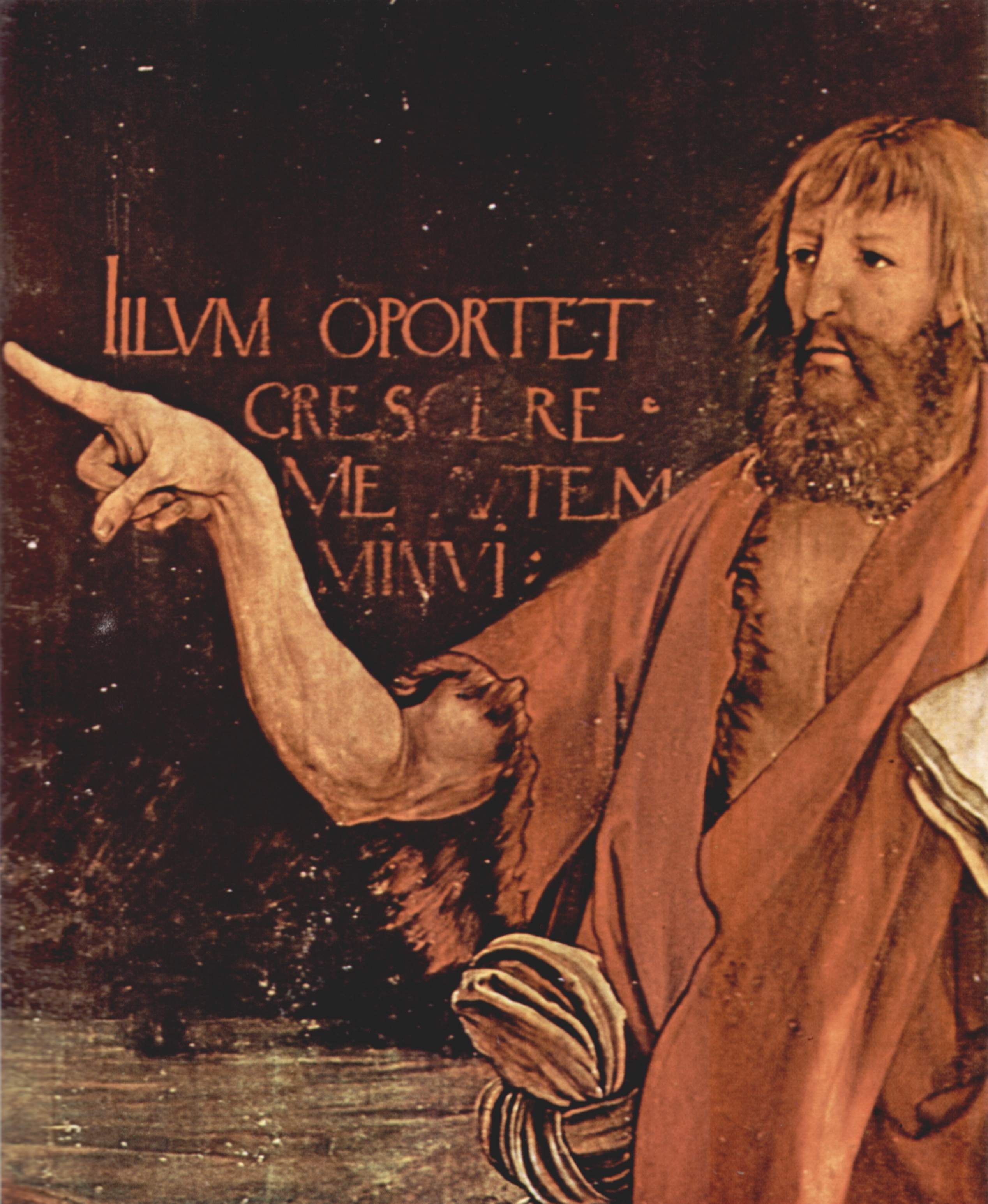
Mathis_Gothart_Grünewald_024The cover art on today’s service bulletin is a detail from one of the great works of art-Matthias Gruenewald’s Isenheim altarpiece. Created for a hospital and designed so that the patients could see the altarpiece from their beds, the center panel of the altarpiece depicts the crucifixion. Standing beneath the cross is the image of John the Baptist, with the lamb of God, a small lamb carrying a cross, by his side. Gruenewald was a master of perspective and artistic technique, so what stands out to me in this image is John’s index finger, pointing at the crucified Christ, which is all out of proportion with his hand. Continue reading →

What shall we cry? A Sermon for Advent 2, Year B

Whenever I read today’s reading from Isaiah 11:1-11, I find myself reading it in the cadences of Handel’s Messiah, the beautiful Tenor aria that begins that oratorio. I have no idea how many times I have heard that music; it was an annual accompaniment to Christmas throughout my childhood and youth. Although it’s been years since I’ve attended or sung in a performance of it, the music remains in my memory.

I’m fascinated by the different ways in which we encounter and interpret scripture. Take Messiah, for example. If you’re familiar with it, it’s very hard not to hear it when you read, or listen to, the scriptures that Handel set to music. There’s a sense in which the music has shaped our experience and interpretation of the texts. By the way, that’s one of the wonderful things about the Lessons and Carols service we’ll have at 10:00—our experience of scripture is enhanced and deepened by the music. Continue reading →