
Reflections on a decade of shared ministry, 3: Homelessness, part 2

The long quest for a day resource center for people experiencing homelessness could serve as a case study of how Madison’s political system, social service providers, and activists have failed the most vulnerable people in our community. It also provides lessons to anyone interested in developing new institutions or services in our city.

Back in 2011, I attended the first of a series of meetings of local political and civic leaders, service providers, and advocates that were convened to seek solutions to the lack of daytime resources for people experiencing homelessness. The problem became apparent because that the two places where many homeless people spent the days while the overnight shelters were closed were no longer available. The Capitol basement had been declared off-limits to homeless people during the protests in February and March, 2011, and the Central Library was about to close for two years of renovations. I was astounded when the meeting began with many of those present complaining about the then governor’s decision to close the Capitol—seemingly oblivious to the fact that the Capitol was a wholly inadequate space for a vulnerable population in need of many services. In other words, the urgency and extent of the need had gone unaddressed for decades. The stop-gap solutions that were in place were judged by many in the community to be perfectly adequate.

I’ve chronicled much of the story and my involvement in the efforts on this blog. Click on the Homelessness link and scroll down. Temporary shelters were funded for the winters of 2011-2012 and 2012-2013. The County put money its operating budget to fund operations of a shelter and secured capital funds to purchase and build out a property. There were a number of locations proposed over the years but all of them fell through because of various reasons, including poor planning and community engagement by county staff and elected officials, neighborhood opposition, and simply unsuitable locations. Many of us who were most actively involved in these efforts over the years grew angry, frustrated, and finally abandoned the quest. Fortunately others persisted and other agencies stepped, most notably Catholic Charities, who received the contract to operate the Day Resource Center. Finally, the Beacon opened in 2018 and is currently welcoming as many as 250 people daily for meals, showers, laundry, and to help them connect with services.

I say this is a case study in how Madison has thought about and responded to homelessness over the decades because there was no effort to examine the adequacy of our response to the community’s needs and no effort to seek better solutions. And there’s also the blame game, seeking to deflect responsibility for the problems we face from ourselves to others—whether it be the former governor, Chicago, or some other entity or individual. It was only when the stop-gap solution collapsed that we admitted the problem and began to seek new solutions and better alternatives.

In some respects, we are at the very same place with regard to the overnight shelters. The Salvation Army is developing plans for new facilities at their E. Washington Ave. property that would more adequately address the needs of the groups they serve there: single women and families. It is also becoming more clear by the day that the current Drop-In Shelter housed at Grace with additional space at St. John’s Lutheran Church and First United Methodist Church is inadequate to serve the number of homeless men in our community and to address their needs, providing assistance to help them find housing and connect them with services they need. For example, we lack the facilities to offer comfortable space for the one-on-one conversations with outreach workers and the building is only minimally accessible to people who lack mobility. It lacks air conditioning.

As we think about next steps in our response to the needs of our community, it is clear that the experience with the Day Resource Center will offer us important lessons as we seek to build community-wide support for significant changes in our system of emergency shelter. I, for one, look forward to this process.
Reflections on a decade of shared ministry 2: Homelessness, Part 1

Among the things that attracted me to Grace Church was the presence of the men’s shelter and the possibility of re-engaging with ministry and advocacy around homelessness. Back in the 1980s when I was studying for the MDiv, I did my field education at First Baptist Church of Boston (this was long before I became Episcopalian). Part of my work there was to help the congregation think about how it might engage the growing homeless population in Boston’s Back Bay and to make connections with other churches and social service agencies who were responding to people experiencing homelessness. As my journey took me away from ministry and toward academics, and as we moved away from urban Boston, those experiences faded into the background and I was interested in seeing how things had changed in the 25 years that had passed since my time at First Baptist.

A couple of months after arriving at Grace and after learning about policies and procedures at the shelter and beginning to explore the larger context of homelessness, service providers, and advocacy in Madison, I made a phone call to an old friend back in Boston. Jim had been a classmate of mine at Harvard Divinity School and with another classmate had founded a shelter in the basement of a Harvard Square church while students. 25 years later, he was still running a shelter, this one in another church on the other side of Cambridge Common. I described to him what I had learned and said that it seemed like Madison was in a time-warp, that service providers, government, and advocates were doing and saying the sorts of things that we saw in Boston in the early 80s. Jim confirmed my suspicions and shared with me what he was doing in the shelter he operated and what a more humane system, focused on the dignity and improving the lives of the guests might look like.

In February 2010, 6 months after I arrived at Grace, an article describing conditions in the shelter at Grace was published in Isthmus.It unleashed a storm of controversy at Grace and among supporters and staff of Porchlight and homeless advocates. It caught the eye of people at Epic Software and eventually Epic funded a long-overdue and much-needed renovation of the facility.  They upgraded the kitchen, showers, repainted, replaced the flooring, provided new bunks and storage lockers. It was an transformation.

What it couldn’t was solve the underlying problems of the shelter space. It was and remains a church basement. It is minimally accessible for disabled people (a jerry-rigged system allows access via wheelchair). It isn’t large enough to accommodate the number of men seeking shelter there, so every night, a group walk from there several blocks to St. John’s Lutheran Church on E. Washington Ave., where they sleep on mats on the floor. In the winter, First Methodist Church also serves as an overflow shelter on weeknights. All guests pass through Grace for intake and the evening meal, returning for breakfast as well. When the doors of the shelter open in the evening, the men line up in Grace’s courtyard, where they wait unprotected from the weather.

The shelter came to Grace in the early 1980s on a one-year, temporary basis and has remained there because of complacency and the difficulty of developing alternative solutions. Over the years of my ministry, I have struggled with my own and Grace’s role in all of this. I have made mistakes as I seek to advocate for improved facilities while supporting the important work that takes place here. I have been the target of neighbors’ and community members’ ire because of the presence of the shelter at Grace and also the target of advocates’ anger and criticism because of the conditions in the shelter and the treatment of its guests by Porchlight staff.

But what has been most heartbreaking for me are the memories of the tragedies. One Christmas Eve early on in my ministry, I came out of the early service to find churchgoers standing around a homeless man who had been dropped off from a hospital stay. He was immobile, having seizures on the sidewalk. Shelter staff refused to help because he wasn’t ambulatory. We called 911 and when the ambulance and police came, they told us that while they would take him to the ER, it was very likely he would be brought back here that night.

Then there was the Polar Vortex of 2014, when a man died on the steps of Grace’s tower entry. He had come in to the shelter in -20 temperatures, and with a companion was walking over to one of the overflow shelters. He collapsed and died of heart failure. His death was a tragedy, but it also should have demonstrated to everyone the inadequacy of a system in which necessary and permanent shelters were labeled “overflow.”

You can read all of my blog posts on homelessness by clicking here. They are in reverse chronological order. If you’re interested in how my views have changed (if they have changed, you should start at the very beginning). I will continue my reflections on the last ten years in later posts, including the long struggle for a day resource center and what the future may hold.

Reflecting on a decade of shared ministry 1

As I approach the tenth anniversary of my shared ministry with and at Grace Episcopal Church, I am amazed by what we have accomplished and by how much I have changed and learned over the years. I remember the fear and excitement I felt when I walked through the doors of Grace for the first time as its rector. I remember the challenges we faced, all of the uncertainty, all of the rebuilding of trust that needed to take place in the wake of the previous years’ trauma and conflict. I remember also those leaders who are no longer there, who have moved or passed on to the larger life, such as Sally Phelps who was Senior Warden for the first months of my tenure.

I like to tell people this. When I was working through the ordination process in the Diocese of Upper South Carolina from 2002-2005, if someone had asked me about my dream job, I would have replied, “a downtown historic church with an active homeless ministry in a city with a major university.” On August 1, 2009 I began working in my dream job. Ten years later, it still is. There are constantly new challenges, new people to meet, new opportunities for learning, new opportunities to share the good news of Jesus Christ. Days like today remind me of that.

It began with a meeting of the Community Advisory Team of the Beacon, the Day Resource Center operated by Catholic Charities. The effort to site and operate such a facility was a focus of my work for a couple of years as the lack of such a facility put enormous stress on downtown churches and put the lives of people experiencing homelessness at risk. At some point, I finally gave up as it seemed such a facility would never materialize, and then out of the blue, the miracle happened. A site was located, Catholic Charities received the contract to operate it, and now, nearly two years after it opened, it is seeing an average of over 200 guests a day. Supporting it, even if only by attending quarterly meetings of this group, is a blessing. Hearing about its successes and helping in some small to address challenges is incredibly rewarding.

In the office later, as I was working through the email accumulated over the weekend, I received a phone call from my friend and colleague, the chaplain at Capitol Lakes, who requested I come to administer last rites to an Episcopal resident. I walked the two blocks, administered the rite, and returned to the office and to that email inbox that had continued to grow.

Lunch was a lovely conversation with my downtown (Protestant) clergy colleagues. When I arrived in 2009, while I was warmly welcomed by my Episcopal colleagues, I had no contact with my neighbor clergy, except that I initiated. I resolved that I would reach out when new clergy came. Now, I’m the veteran. Of the other three at the table, one is in his fourth year; one started just a few weeks ago. In addition to the simple joy of getting to know each and spending some time together, we talked about the issues that we all share, most significantly, the challenges of ministry with and among people experiencing homelessness.

I’m writing this from a coffee shop on Monroe St., where I am holding open office hours on Tuesday afternoons throughout the summer. One of the emails I sent earlier in the day was to the chair of the Personnel Committee to let her know that I would be working on staff ministry reviews if I was undisturbed by visitors. Fortunately, for that task, I was able to finish the ones I was working on. By the way, the office hours experiment has been a success. Not only have I had visitors and conversations I would not otherwise have had, last week the presence of two newcomers to Madison and Grace, both recently retired, was an opportunity for them to connect with each other as well as with me. And in between visits, I’ve been able to get a lot of work done without the distractions of the office.

One of the things I did before beginning this post was to go back to my blog archives from 2009. I was curious whether I wrote much about the beginning of my ministry. The answer is no, except for in my sermons. The transition to full-time parish ministry wasn’t particularly difficult. What was challenging and unexpected was simply the level of administrative detail, the constant new challenges of ministry in an urban environment. Nothing could have prepared me for that or for the ways in which those challenges, and the changing city itself would affect my ministry.

In some essays over the next few weeks, I hope to reflect on some of the themes I detect in my and Grace’s shared ministry over the last decade: homelessness, our relationship with the political life of city, state, and nation, racism, and the transformation of American Christianity. All of these are themes I’ve preached and written about over the years, but I think it would be helpful for myself and others to reflect on them in light of our past experience as we think about the future.

The last ten years have been exciting and challenging. They have been difficult at times, and there were periods where we weren’t certain that Grace and I were a good fit. I have caused pain to others and have suffered some pain as well. But through it all I have sensed God’s presence in my life and in our common life, ministries, and outreach. We have sought to be faithful followers of Jesus Christ, to be his body in this place, and to be a place of healing, hope and witness to Christ’s redemptive love. I pray that we continue to do all of this in the years to come, with God’s help.

The Future of the Men’s Drop-In Shelter at Grace, updated

Yesterday I wrote:

In an important article examining the mayoral candidates’ position on housing issues, there   was a line that threw me for a loop:

Porchlight’s men’s shelter at Grace Episcopal Church on Capitol Square will need to be moved due to redevelopment on the block…

After expressing my dismay to the author of the article, he added this sentence:

The current shelter is inadequate, and should be replaced, but won’t be displaced unless a replacement facility is created, said Rev. D. Jonathan Grieser, rector at Grace Episcopal.

I’m grateful for the conversation and for the clarification. A new shelter is needed, not to ease the way for another downtown development but because the current shelter is not adequate to serve the needs of our community.

The Future of the Men’s Drop-In Shelter at Grace Church

In an important article examining the mayoral candidates’ position on housing issues, there   was a line that threw me for a loop:

Porchlight’s men’s shelter at Grace Episcopal Church on Capitol Square will need to be moved due to redevelopment on the block…

This is not now true and will never be true. The Men’s Drop-In Shelter will move from Grace only when our community comes together to create a new purpose-built shelter designed according to best practices, and adequate to the needs of the guest who seek shelter there.

The Drop-In Shelter came to Grace on a one-year trial basis in 1984-1985. That it remains here 35 years later reflects Grace’s commitment to the most vulnerable members of our society, and that our community has lacked the political will to develop an alternative, more adequate, and permanent solution.

In fact, Grace’s leadership has begun a conversation on creating a new men’s shelter. We have met with homeless providers, city and county elected officials, and other community leaders. The counsel we have consistently received is that unless we set a deadline, we will never build enough momentum and urgency to create change. And that has been our dilemma. Our commitment to the men who sleep at Grace each night (and at the overflow shelters at St. John’s Lutheran and First United Methodist) is such that we could never issue an ultimatum. So we have slowly begun building support for our ultimate goal of a shelter that our city and county can be proud of.

Just last Sunday, we offered an update to our congregation on where we are with these efforts. In the coming weeks, we hope to contract with a consultant who will help us gauge community and governmental interest in such a project and solicit leadership from a broad representation of the community in our effort. If the climate seems favorable, we will move forward with the next steps: finding a location and beginning to seek funding. It’s a long-term project. Given my experience with Day Resource Center (the Beacon), I anticipate it taking anywhere from five to ten years.

A possible shelter move, while complicated by the development proposal for the new Wisconsin History Museum, is independent of any redevelopment plans. While Grace Church has been informed as the development proposal has moved forward, we are not currently involved in the project.

Ultimately, there are questions about the future use of our property, especially the west wing which houses the men’s shelter and our food pantry. Both of those entities provide essential services and are central to Grace’s response to the proclamation of Jesus Christ to feed the hungry and provide shelter for the homeless. Similarly, any development that  Grace undertakes on our property will have to support our mission and ministry and be consistent with the gospel mandate to preach good news to the poor and to proclaim justice in the heart of the city.

My hope is that our community comes together in support of our effort. I also hope that this issue will become a central element of the mayoral campaign. Whatever vision for Madison that the candidates have, a great city is great only to the extent that all of its residents are able to flourish.

Faithful Development: Stewardship of property for mission during a real estate boom.

News broke this week that Governor Evers’ proposed capital budget includes funds for a new state historical museum. There is a proposal on the table to redevelop much of the block on which Grace Church is located with a new museum as the anchor tenant. We’ve been in occasional conversation with the developers for almost five years, most recently before the election last fall. At that time, we were told that the project’s future would be determined after the election and its fate might depend on the election’s outcome. That Governor Evers has included it in his capital budget is one more step in a long process. Currently, construction is anticipated to begin in the Fall of 2021 with completion in 2023.

It’s not at all clear whether or how Grace Church might participate in this major development. Early on, it was thought that part of our property might be needed in order to assure adequate parking for the project but as plans have changed, that seems less likely. At the same time, our west wing which currently houses our homeless shelter and food pantry, is underutilized and may be ripe for development.

When I first learned of the proposed redevelopment of our block, I was excited because I saw the possibility of our participation in such development to be a way of securing long-term financial viability for Grace Church and its ministries in the midst of our rapidly changing culture and the decline of mainline Christianity in the US.

During my tenure at Grace, I have become increasingly interested in issues of urban planning, development, sustainability, and how Christian theology and Christian churches intersect with those issues. I spent my sabbatical in 2016 reading widely from Jane Jacobs to Richard Sennett to those few theologians who are thinking about such questions. I also visited cities from Richmond to Boston, as well as Seattle and Portland, to explore how congregations in urban settings were thinking about their property and using it to connect with their neighborhoods.

Recently, I have begun to see that questions of real estate development are not just about financial sustainability, more importantly they are questions that have at their heart theological and ethical dimensions. One reason for this is that this redevelopment is occurring in a city that is among the most segregated in the nation, in which racial inequities are among the highest in the nation. At the same time, our real estate boom is not creating affordable housing.

When I met with the mayor last April about the desperate need for a new men’s shelter, purpose-built and adequate to the needs of our community, he immediately turned the conversation to possible uses for a new development on our property. In a conversation with another elected official, I was asked what I thought the city of Madison’s core value was. My reply came immediately, “real estate development.”

I came across a book that will be published next week: Samuel Stein’s Capital City: Gentrification and the Real Estate State.

the growing centrality of urban real estate to capital’s global growth strategy. Through this process, the price of land becomes a central economic determinate and a dominant political issue. The clunky term “gentrification” becomes a household word and displacement an everyday fact of life. Housing becomes a globally traded financial asset, creating the conditions for synchronized bubbles and crashes. Government, particularly at the municipal level, becomes increasingly obsessed with raising property values and redistributing wealth upward through land and rents. Real estate developer Donald Trump becomes first a celebrity and ultimately a president. Taken together, we witness the rise of the real estate state, a political formation in which real estate capital has inordinate influence over the shape of our cities, the parameters of our politics and the lives we lead.

You can read an excerpt of the book here:

From what little I’ve read, Stein seems to be describing the situation in Madison well.

As property owners, churches participate in this “real estate state.” Diana Butler Bass points out that in many cities, the cumulative property owned by churches and religious organizations is significant, making them among the largest nonprofit landowners. As Christianity declines and demographic shifts take place, churches in urban cores are often seen more as financial assets than as ministry opportunities. Across the country we have seen numerous sales, property developments and the like, often with significant financial windfalls for congregations and denominations. We saw this happen here in Madison with the redevelopment of the St. Francis House Episcopal Campus Ministry. A private student housing development on a portion of the land funds not only UW Madison’s campus ministry, but also supports diocesan campus ministry elsewhere. And yes, I was actively involved in that project.

When Willie James Jennings spoke in Madison recently, he emphasized the importance of place for Christian theology, especially given the ways that our theology has not seen itself as grounded in local and spacial contexts. At one point he said, “planning and zoning meetings are the most important meetings for determining the futures of our communities. Churches and Christians should be present and engaged at these meetings.”

Our churches, especially older churches constructed in traditional religious architectural styles, are increasingly witnesses to an alternative to the glass-clad buildings of contemporary cities. While they are symbols of the sacred and gathering places for the faithful, their very presence in the heart of cities bear witness to an alternative to the neo-liberal, capitalist, and consumerist culture in which we live. When we sell our property, or redevelop it in order to maximize profit, we succumb to the idolatry of the market and abandon our allegiance to the Christ who died as a victim of the imperial system of domination.

Our churches are not only pieces of property, they are outposts of the reign of God. They should model the community and world Jesus proclaimed and that God is bringing forth. In our stewardship of our property, our primary concerns should be to create community, to support and nurture the flourishing of the residents of our neighborhoods. My hope is that as redevelopment plans for our block move forward, Grace Church can be an advocate for a project that values justice, diversity, and a vibrant neighborhood where all residents can flourish, as well as profit.

Annual Meeting, 2018


Portions of my annual report:


Earlier this year, many of us read Dwight Zscheile’s The Agile Church, in which he argued that in order to thrive, in order to do the work of mission we are called by God to do in the world, we need to take bigger risks, be willing to experiment, and yes, fail, and listen carefully to our own stories as well as the stories of our neighbors as we seek to find ways of connecting with them, and helping our selves and our neighbors, connect with God.

That work has borne fruit in a number of ways: in a Welcoming Committee led by Rob Lemanske that has brought new energy and new ideas on how to connect better with newcomers and visitors. The Development Fund Trust is distributing almost $15000 to fund initiatives to build relationships within our congregation, with our neighbors, and with Diocesan ministry partners in the Diocese of Haiti.

This week, the Creating More Just Community task force gathered for a retreat to reflect on the work it has done since its inception in 2014 and to begin planning for its next steps. Their most recent effort, organizing a series of conversations based on a civil discourse curriculum published by the Episcopal Church, drew more than 20 people, including a number of attendees from the broader community, over the last four weeks. It has also hosted a number of community events, including a governors’ candidate forum focused on criminal justice reform, early in 2018.

As the group reflected on its work over the past years, the urgency of the tasks that lie ahead, and imagined what it might do in the future, it highlighted several areas that will receive special attention. First, building on the civil discourse conversations, members hope to share their experience with other congregations, both locally and statewide. Second, we will encourage discussions about racial healing across the congregation, beginning appropriately on the weekend of MLK Day. We also hope to engage more deeply in ministry with our neighbors at the Dane County Jail, both through our connections with Madison Jail Ministry, and with new opportunities that are emerging from conversations with other downtown churches. Finally, we want to continue to develop our efforts to engage elected officials and policy makers with issues of importance to people of faith. To that end, we hope to organize and host a forum for mayor candidates on issues of importance to us: homelessness, racial and economic inequality, relations between police and members of the community.

All of these are exciting developments and all are evidence of our response to God’s call to us. We should be proud of the work we have done and are doing, and grateful for those among us who are taking leadership in all of these areas.

There are significant challenges in our future. As most of you know, the proposal for a new State Historical Museum on the corner of N. Carroll and State St. has been made public and the State Historical Society is actively fundraising for that project under the bipartisan leadership of former Governors Tommy Thompson and Jim Doyle. Hovde Properties, who along with Fred Mohs own much of this block except for Grace Church are proposing redevelopment that would include all of the block except for Grace and the adjacent Hovde Building. We have been in conversations with them since 2014 about our participation in that project and the effects that redevelopment might have on us. We have also spoken with real estate consultants, architects, and developers about the value of our property and what possibilities there are for development of the West Wing. All of these discussions are ongoing and have made little progress since our last public gatherings in June and September.

At the same time, we have been speaking with community leaders, politicians and city and county staff about the future of the Men’s Drop-In Shelter that has been located at Grace since 1984. We are committed to the important role the shelter plays in our community and to the fact that addressing homelessness is at the heart of who we are as a congregation. Still, the possibility that our efforts, combined with a community-wide engagement of the public and private sector might lead to a new shelter in a new location, designed for its purpose and adequate to the scope of the needs in our community, is a dream worth pursuing. Those conversations are bearing fruit and we will share all developments with the congregation as they occur and involve all of you in the process as we move forward.

These are complex, challenging issues that are accompanied by strong feelings and opinions and elicit powerful emotions. Still, we should not fear having these conversations or ignore the possibility that change might be coming to this block of W. Wash. and N. Carroll. I would hope that our engagement in these conversations would be governed by two important and inter-related questions: 1) How can we be the best stewards of the property and location that past generations have bestowed, preserved, and enhanced? 2) What is God calling us to be and to do as the People of God in this very location where we have gathered for more than 160 years? We may not make the right decisions, but if we ask these questions honestly and answer them to the best of our ability and with the best resources and wisdom we can muster, we will be faithful both to those who have come before us, and to those who might come after us, as well as to the God who has called us together and placed us here.

Not one stone will be left: A Sermon for Proper 28, Year B (Annual Meeting) 2018

 We are nearing the end of the liturgical year. In the church, the new year begins on the first Sunday of Advent, which this year falls on December 2. But there’s a sense in which our gospel readings in the weeks leading up to that day help us prepare for Advent. Indeed some preachers and liturgists extend the season of Advent back three Sundays and advocate for a seven-week season of Advent.

There are at least two reasons for this move. The first reason for this extension of Advent is, I suspect, largely cultural. Since retailers replace their Halloween merchandise with their Holiday merchandise, and radio stations and satellite services have already started playing holiday music, extending Advent to the beginning of November is a way of offering a counter narrative to the excesses and consumerism of the Holiday season. The second reason for this longer Advent is that our gospel readings for these three Sundays are drawn from Jesus’ teachings concerning his return. They are what we call Apocalyptic literature.

Apocalyptic, which derives from a Greek word meaning revealing, emerged in the second century BCE during a period of crisis among the Jewish people. The central chapters of the book of Daniel are the earliest example of this type of literature. It is symbolic, full of strange beings. It presumes a cosmic battle between the forces of good and evil, in which ultimately, the good will prevail. While it seems to be describing events that will take place at a future time, in fact, it is describing in highly symbolic terms what is happening in the world right now. So, from time to time, after describing some event or some figure, a beast with seven horns, for example, the author will provide a clue, or a hint, and say, “let the reader understand.” Apocalyptic was also the context in which the idea of the resurrection of the dead first became popular, among the earliest clear references to the idea is in fact in the verses from Daniel in today’s first reading.

As I said, the world of apocalyptic is full of fear and danger, and we live in a context which is full of such imagery and events. Whether it’s mass shootings, terrorism, the continuous wars, or the wildfires that have transformed the landscape of California, taken lives, and changed the lives of so many people, our world seems to be collapsing around us. In such a context, Jesus’ words sound ominous indeed.

Today’s gospel, though written about two millennia ago, comes from a time and a community that were experiencing some of the same fear and uncertainty that we face as a world. As I’ve said before, it’s likely that Mark was written during the Jewish revolt against Roman occupation, and either shortly before, or after the destruction of the Jerusalem Temple. We date the gospel to this particular historical moment in part because of the very verses we heard today—the disciples marveling at the size and grandeur of the temple, and Jesus’ prediction of its destruction.

The Jewish Rebellion and the destruction of the temple constituted a cataclysmic change for Judaism. It was also of enormous significance for the tiny community of Jesus’ followers, who were caught in the midst of the conflict. As they looked around at what was happening around them, as they probably fled the violence, they were also reflecting back on Jesus himself, the hopes and faith he had instilled in them. As we have seen throughout this year, Jesus proclaimed the coming of God’s reign. It’s quite likely that many of those in this tiny community forty years later saw in the Jewish revolt and the Roman response, signs of Jesus’ imminent return.

You can almost hear the conversations of that community in Jesus’ words. He warns against false prophets—those who claim to be Jesus, those who claim to know when Jesus will return. All of the catastrophes, the wars, rumors of wars, earthquakes, and the like. There were people wondering whether these things were signs of Jesus’ return, signs of the end times. Of course, as we imagine first-century Christians wondering about these things, we know all too well that many contemporary Christians, and many in secular society, too, are fascinated with predictions of the end times.

Jesus’ words concerning his return are elicited by an observation of one of his disciples. Let me give you some background. In Mark’s chronology, this takes place of Tuesday in Holy. On Sunday, Jesus and his disciples made the triumphal entry into Jerusalem, which we reenact on Palm Sunday. After that, Jesus went to the temple and looked around.. Then he and his disciples left the city and spent the night in Bethlehem. On Monday, they returned to the temple, and overturned the moneychangers’ tables, after which they returned to Bethany. They came back to the temple on Tuesday where Jesus had a number of encounters with groups of Jews, the chief priests and scribes, some Pharisees and Herodians, some Sadducees. After the story of the widow’s mite which we heard last Sunday, they left the temple again, which is when this story takes place.

Once again, it’s as if the disciples are completely oblivious to what Jesus has just said, or has been saying all along. It’s the sort of remark we make as tourists, “Look at how big the stones are!” It’s the sort of remark I often hear when visitors come to Grace: “Wow, what a beautiful church!” Jesus’ retort may have been intended by Mark to reflect the reality that after Rome destroyed the temple, not a single stone was left standing but it’s an important reminder to us as well.

It’s not about the stones, even if it is our responsibility to make sure the stones of this building remain intact. The Jewish temple, Grace Church, are supposed to be places where people encounter God, where they experience the love of Christ and are transformed by that encounter. The beauty of our spaces, both inside and out, are meant to offer such opportunities, to invite people into relationship with God.

One way of thinking about all those encounters Jesus had with Jewish groups in the temple before this, from the moneychangers to the chief priests, Pharisees, and Sadducees, is to see them as challenges to the immediacy and accessibility of people to God. Spaces create barriers; institutions establish and maintain boundaries, communities dictate who’s in and who’s out. Jesus challenged all of those efforts to limit accessibility to God, to set boundaries. The threat he posed was part of what led to his arrest and execution.

2000 years later, those tendencies remain. We focus on the stones, not on God. Sometimes, instead of being a means of access to God, the building becomes our God, and we worship it or focus all of our energies and attention on it rather than on what it is supposed to be. Sometimes, a building can also be seen as an impediment, that it requires resources that might better be expended in other ways, in outreach to the community, for example. Striking the right balance is always a challenge, but I believe we at Grace do that.

I was reminded of the power and possibility of our spaces to connect us with God on Friday evening of this week. Corrie and I were walking on the square just as our bells began to ring at 6:00 pm. Hearing them from the other side of the square wasn’t just a distraction or noise. The sound of the bells reminded me of all that they represent: the faithful people who installed and now maintained them, their sound reminding me of God’s presence in this city, even on a Friday evening.

That is what our spaces should do—our building, our bells, our gardens, all should remind passersby of God’s presence in the world, and invite people to experience and enter into that presence more deeply, whether here at Grace or in other places or other ways in their personal lives.

We don’t know how long Grace Church will remain standing, whether for fifty, or a hundred, or five hundred years. But there will come a time, I suspect, when stone will no longer stand on stone, when there will only be rubble. But until that time comes, in God’s time, it is our responsibility, our mission, to ensure that our buildings and our congregation, are places where people encounter, experience, and share God’s love.

Make a joyful noise! A homily for Choral Evensong and the Rededication of the Bells

I wanted to say a few words as part of our evensong and service of rededication of Grace’s bells because it’s important to mark such occasions; to offer some words to put what we’ve done in larger perspective.

It’s easy for us to forget what we have here on this corner of N. Carroll and W. Washington. Sure, Grace is on the national register of historic places. It’s a landmark both literally and by designation, among the oldest churches in Dane County; among the oldest surviving buildings in Downtown Madison. But that’s only part of the story for behind that landmark, behind the stone and mortar are all of the people over the past more than century and half, who have worshiped here—who have been baptized, married, been buried from here. It’s easy to forget the legacy we have inherited from them—the presidents like Grover Cleveland and Harry Truman who worshiped here; senators, governors, and yes, regular people many of them.

It’s easy to forget all that they’ve given us; to ignore it or simply let them and their gifts pass into oblivion. That’s kind of what we did with the bells. Oh, we knew they were up there. We could even play some of them; but no one really remembered their stories. When I went digging in the files to try to figure out exactly what pitches, what sizes they were, there were at least 3 that were unrecorded (and the records we had, after the first nine were very incomplete, written by hand on note pads or lined paper). I myself had never even been up in the tower before this week.

But now, thanks to the persistence of a number of people, among them Conrad Bauman, Greg Rogers, and most recently Peter Schultz-Burkel, as well as Senior Warden John Wood, and all of those who donated to the effort, whose names are listed on the insert, thanks to all of you, we can enjoy Grace’s bells in all their glory.

No doubt part of the reluctance to assess let alone reinstate the bells was due to a lack of knowledge of how much it might cost, and a sense that it might be irresponsible, somehow even unfaithful to God to spend a significant amount of money on a rather frivolous project like this. But what we are doing by preserving and enhancing the bells is being good stewards of the legacy we’ve received. In many respects, we chose to worship here; to be members of and leaders of this congregation in this place, and part of what that means is to take care of, maintain, preserve, and enhance our facilities. It was an offense to that legacy and to those generations of donors, that too many of the bells sat silent for so long. We are honoring the memories of all of those people, from the Proudfits and the anonymous donors of the first 9 bells, right down to Bob and Betty Kurtenacker, who gave one of the last bells, and who many of us remember.

But it’s not just about that legacy. Ultimately the bells are about the worship and presence of God in our congregation and in our community. As I wrote in some of the materials describing the history of Grace’s bells, bells provide people with a sense of God’s presence in the world and in their lives. This was pointed out to me one day this week when I was stopped by someone on the sidewalk in front of the church he told me how the bells ringing reminded him of growing up in Goa India and hearing the bells call the faithful to prayer and rang out at the moment of consecration during the Eucharist.

Bells help us celebrate the great festivals of the church year, and sacraments like weddings; they toll at funerals, as ours did on Friday for Bob Kurtenacker, the funeral boll tolled 100 times to mark the years of his life, and at 6 seconds between each ringing, it took a total of ten minutes.

We worship in many ways, in the privacy of our homes, in silence and meditation, and in joyful song. Our bells fill the air with music and fill the nooks and crannies of the streets and alleys around capitol square. May their sound bring the city joy and remind us all of God’s beauty and presence in our world!


“The Brazen-Throated Monsters:” Madison’s newspapers’ reporting on Grace’s bells in 1874

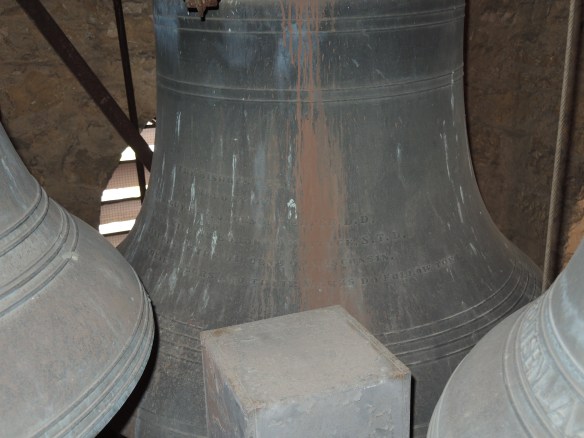
Workers from Lee Manufacturing Co. of Muskego, WI are putting the final touches on new strikers and state-of-the-art bell-ringing technology on the 23 bells that reside in Grace’s bell tower. The first nine were installed in 1874. Additions from the 1950s through the 1970s brought us to our current status. Along the way, all of the bells were made stationary and equipped with an electronic ringing system that has deteriorated over the decades so that in recent years, we’ve only been able to play a half-dozen or so of them. It seemed to me to be poor stewardship of the resources past generations gave Grace not to be able to use them in worship and celebration and after consultation with a number of vendors and a successful campaign to garner the congregation’s support, work began a few weeks ago. I’ve enjoyed learning more about the bells in the past few months.

Apparently, there had been something of a competition among Madison’s churches to have the largest bell. Apparently, with the installation of the “Bishop’s Bell,” weighing 2500 Lbs., Grace emerged victorious.

Madison’s newspapers, “The Daily Democrat” and the “Wisconsin State Journal” both reported on the installation of the bells. They arrived from Troy, NY on March 20, 1874. The total weight of the bells and platform was 14000 lbs. The Daily Democrat reported on March 31:

The nine chime bells were safely deposited in the tower of the Episcopal Church yesterday, and will be raised to their places as fast as possible. A large number visited the church to see them, and all will anxiously await the first peal from the “brazen throated” monsters.

After their installation and use throughout the day on Easter Sunday, 1874, the State Journal noted that:

the chimes were generally regarded as a success, and something on the possession of which the church and the city is to be congratulated, though they will sound better when experience will lead to more skilful ringing. Some tunes sounded beautifully, others, rather discordant. We have heard the opinion expressed that one or two of the smaller bells had not as good a tone as was desirable. This morning there was considerable experimenting on the bells by different parties, and a great deal of jangling. –State Journal April 6, 1874

A few days later, The Daily Democrat disclosed that action was being taken to address the intonation issues:

Slightly out of tune. – The third bell, key of G, in Grace Church tower, has been discovered to be slightly out of tune, and the services of a man were engaged through yesterday in chipping off a portion of the rim, by which means it is proposed to obtain the correct sound.–The Daily Democrat, April 10, 1874

However, as is often the case with contractors, Grace, and the whole city were assured that nothing was amiss:

Those bells are in perfect tune, so says a good judge of music; and Mr. Waters, the gentleman who came with them and superintended their erection, has received assurances that all is well; the money is paid down, and all the members of Grace Church are satisfied that the chime is superior to any in the State. –The Daily Democrat, April 16, 1874

The Bishop’s Bell, E-flat or Tenor Bell, 2500 lbs.from The Jones Company of Troy, NY), dedicated to the memory of Bishop Jackson Kemper, first Bishop of Wisconsin, and Bishop William Armitage.