Update on St. Francis House


In response to concerns from the neighbors of St. Francis House, the developers have revised their proposal to include an 8-story rather than 14-story tower. The proposal is now working its way back through the approval process. This week, the Urban Design Commission gave its go ahead subject to some minor alterations. The next important meetings are the Plan Commission on September 19 and the Common Council meeting on September 20. Bishop Miller has written a letter to all of the Madison-area Episcopal parishes, urging members to write letters to members of the Plan Commission and City Alders.

As I have said before, this project is an important step in the revitalization of Episcopal Campus Ministry for the 21st century.  The development itself will provide the revenue stream necessary to fund that ministry. But this is not just about money. I am most excited about plans for the ministry and especially for the future of St. Francis House itself. The developers’ architects will be using the original plans for the chapel as they design a renovation of the original chapel for worship. This will restore the chapel’s aesthetic integrity and create (or re-create) a beautiful worship space for the use of the ministry.. More information about the proposed development is available on the St. Andrew’s website.

Earlier discussion of the development is here.

Gay Straight Episcopalians at the Madison Pride Parade

Thanks to some initial organizational efforts by Michael Ramsey-Mulshof, the Madison rectors, and a team of lay people, a group began talking about ways of making Madison’s parishes more inclusive and supportive of LGBT people, and especially of LGBT teens. The group chose Gay Straight Episcopalians as its name, and decided to “go public” at the Madison Pride Parade today. At the end of the parade, while others were attending a rally just a block away, 30-40 of us, marchers and supporters gathered at Grace for a Eucharist. It was a wonderful experience. Here are pictures of GSE marchers:


I remember two years ago, coming out of church early Sunday afternoon and encountering the Pride Parade. It was my third Sunday at Grace and I was surprised that there was no visible Episcopalian presence among the marchers. Thanks to all those who organized and those who marched in witness to our inclusivity.


Ominous signs for the homeless in Madison

An article in Isthmus points out the implications for the homeless population of the ongoing restrictions in the State Capitol, and the closure for renovation of the Central Library beginning in November. One person estimated as many as 150 people have sought shelter in one or the other place on winter days.

One option that has been available when the library is closed on Sundays is also slated for elimination. The Salvation Army has offered a community breakfast on Sundays that will end this August. I’m accustomed to encounter as many as twenty shelter guests waiting for a shuttle bus that will take them there when I arrive at the church on Sunday mornings. They lack the funding to continue the program.

On the other hand, it’s estimated that the total number of homeless people in Dane County decreased from 2009 to 2010, according to the most recent summary issued by the City of Madison.


The St. Francis house brouhaha

I’ve had several inquiries from parishioners about what’s happening with St. Francis House, the Episcopal Chaplaincy at UW Madison, and decided it was time to offer my perspective. I’ve been a member of the board since early 2010. When I joined, discussions about the future of the chaplaincy were well underway. The chaplaincy had been funded by an endowment that over the last decade or more has been depleted in order to meet expenses. The building itself is in need of several hundred thousand dollars of deferred maintenance. Clearly, we were approaching a crisis.

At the end of its visioning process, the board concluded that the chaplaincy’s physical presence on UW’s campus was of vital importance and that we should do whatever we could to ensure that presence. We are also convinced of the importance of college chaplaincy to the future of the Episcopal Church. Such programs have served as the incubator for the church’s future leadership, and St. Francis House is no exception. We believe Anglicanism is a unique and powerful witness to the Christian faith that resonates with young people in an academic setting.

The chaplaincy’s greatest asset is its property, located on the heart of UW Madison’s campus. A number of options for moving forward were considered, including some sort of joint-venture development with our Lutheran neighbors. After exploring the possibility of an outright sale of the property, the board decided to move forward with a public/private partnership with a private developer. The plan is to demolish the 1964 chapel, move the historic building to the corner of the lot, and build an L-shaped student apartment complex on the remainder of the property. This portion of the property would return to the property tax rolls, and income from the project would place the Episcopal Chaplaincy on firm financial ground.

There has been lively debate on the board about the importance of having a physical presence on campus; in the end, the option to sell the property seemed shortsighted. It is also the case that an outright sale would not generate enough income to pay for the sort of chaplaincy envisioned by the board.

Bishop Miller wrote a letter on May 15 that captures the board’s reasoning and also speaks eloquently to the importance of campus ministry. He wrote:

Strengthening Campus ministry and the funding for it has been one of my priorities as bishop because it was through the Episcopal Ministry at Michigan State University I discovered The Episcopal Church and found a spiritual home. Over the last few years I have worked with our chaplains, the St. Francis House Board, and our diocesan convention to strengthen and restore this ministry. Each week a faithful community gathers for prayer, fellowship, and study at our home at 1001 University Avenue. Over the past eight years the ministry at St. Francis House has produced some great future leaders of our church including one candidate for ordination, and two others who are now exploring the possibility of ordained ministry while serving as missioner of the Episcopal Service Corps.

The full letter is here: bishopsletter.

The City Planning Commission rejected the proposal at its meeting this week. There has been vocal opposition from our neighbors at Luther Memorial Church. It is unfortunate that this conflict has arisen. Bishop Miller, the board, and the developers have worked hard to assuage any concerns our neighbors might have. In the end, however, our primary obligation is  to strengthen the mission and ministry of the Episcopal Chaplaincy at UW.

Who knows what will happen next but the board remains committed to this project and the promise it holds for empowering Episcopal campus ministry in the coming decades.

For background reading here are relevant articles from the Madison State Journal

One way to respond to the demonization of political opponents

I took a phone call from a reporter for a Madison media outlet a couple of weeks ago. He had recently returned to Madison after several years abroad and was shocked by the breakdown of community in Madison since he had left. Because of the developments in state government and the protests, deep fissures have arisen in Madison. Debate has given way to name-calling, and as he put it, everything seems black or white. I could do no more than concur with his assessment, having experienced myself that any attempt at nuance is often perceived as betrayal or attack.

For this, both sides share responsibility. The effects on our civic life will be felt for a very long time and our community may never be the same. But in the midst of this polarized and polarizing situation, there are signs of an alternative.

During the height of the protest, talk show hosts and others were quick to spew forth epithets. When one radio personality called police and firefighters who were protesting, “lousy, rotten people,” who used violence and intimidation, Lt. Laura Laurenzi of the Madison Fire Department challenged her to provide video proof of such behavior, or to make a substantial donation to a local charity. No proof was forthcoming.

Lt. Laurenzi wanted to make something good out of this, so she challenged members of Firefighters Local 311 to make a donation and promised that she would match their generosity. The firefighters donated $1000 to Porchlight. In return, Lt. Laurenzi wrote a check for $1000 to Grace’s Food Pantry. Her donation will help purchase food and other supplies for people suffering during these difficult economic times.

Lt. Laurenzi did something quite interesting. She demanded that her opponent examine the language she used; she attempted to open up a conversation with her opponent, and she demanded that she be treated as a human being. That her opponent didn’t respond is not suprising. What is surprising is that Lt. Laurenzi made something good out of a dehumanizing situation.

As the dust has settled on the budget, and the protests have diminished, we are left in a community and in a state that seems to be at war with itself. The hard work of reconciliation lies ahead. I wonder who will take the lead.

Religious Institutions and the Property-tax exemption

The property-tax exemption for religious institutions has been in the news of late. In Wisconsin, the legislature passed a measure that revoked the exemption granted to Presbyterian House at the University of Wisconsin for the student rental complex they constructed several years ago. Gov. Walker vetoed the measure. St. Francis House, the Episcopal Chaplaincy at UW is also proposing a housing development on its site, although plans there are for the project to return to the property tax rolls. From the comments on these stories, it’s clear that the property tax exemption strikes raw nerves.

Meanwhile, city officials in Palmer, Massachusetts, have asked several non-profits, from the Chamber of Commerce, to churches, to make payments to the city in lieu of taxes (this idea is not new; Harvard University has been making substantial payments to the cities of Cambridge and Boston for many years).

Matt Yglesias has posted on this issue. He argues that:

Urban land is a scarce commodity, and structures are valuable fixed assets. If you tax land and structures that are operated as homes and business, but don’t tax land and structures that are operated as churches, you end up with more land being used for churches and less being used for homes and businesses than would otherwise be the case.

This is silly. Take Grace Church for example. Grace is on the National Register of Historical Places; it is also landmarked by the city. As such, the property has no value except to members of Grace Church. If we were to abandon the property, as so many churches have been abandoned in America’s cities due to population shifts and declining attendance, the property would probably remain vacant. No other church would purchase it. The space is ill-suited for the needs of contemporary worship: there’s no parking, the space is not airconditioned, and barely handicapped accessible. No other other entity would be interested in it, either, except a themed restaurant-nightclub, perhaps.

At the same time, we provide valuable services to the city and the community: housing a homeless shelter that would be incredibly difficult to relocate, a food pantry, space for AA and other community meetings. Yglesias himself often argues about the importance of balance in urban planning, and we offer that as well, a courtyard garden that is much appreciated by local residents and tourists, a beautiful space that beckons even non-churchgoers who sense the sacred when they enter it.

I suspect that at some point in the future, the property tax exemption will be challenged, if not in Madison, the home of the Freedom from Religion Foundation, then in another part of the country. When that happens, some religious institutions will be forced to close their doors, and my guess would be that many of the endangered congregations would be located in old buildings in towns and cities that are already struggling to make ends meet, impoverishing the cultural and historical landscape of our communities.

The calm before the storm?

Here’s what was going on at Grace this morning during the Farmer’s Market. Members of the Camerata String Quartet played to pitch for the upcoming Bach Dancing and Dynamite Society (if you’re in Madison, their season is not to be missed).

Here is a photo:

We’ll see what the sidewalk outside our doors looks like tomorrow.

Oh, and by the way, apparently the city of Madison does value a church as much as an empty storefront; it turns out both of the other locations where 24-hour tents are permitted are in front of vacant commercial space.

A hearty welcome to our new neighbors

Here’s what we know now:

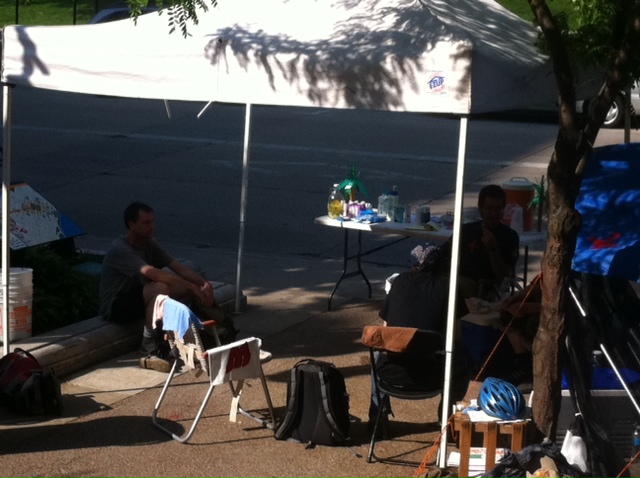
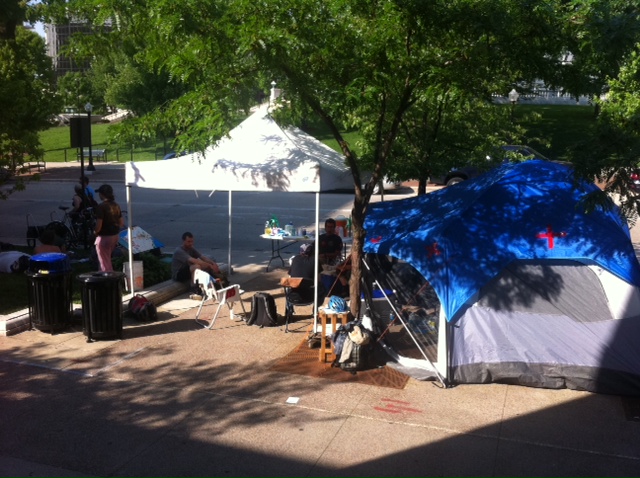
-Overnight tent camping areas:  They were allowed three areas where they could set up 24-hour tents:  On N. Carroll St. in front of Grace Church; in front of 14 W. Mifflin (they will try to keep to unoccupied storefront) and in front of 2 E. Mifflin St.  All tents must be attended at all times.

There are other details as well. Hopefully the disruption to us will be minimal. We shall see. I would make a comment about Grace being equivalent in the city’s understanding to an unoccupied storefront, but the third location, 2 E. Mifflin, is a multi-story office building.

I’m looking forward to meeting our new neighbors, inviting them to services, and to volunteer in their free time at our food pantry.


Walkerville is a go, with restrictions

Word is coming out that the permit for Walkerville has been approved, but there are restrictions. For one thing, tents will be allowed only overnight (from 9:00 pm-7:00 am, with an earlier departure on Saturday to accommodate the Farmers’ Market). There are other restrictions related to the placement of food, medical supplies, and information. Although the permit was approved, an additional campground permit will be required.

I’m disappointed in these results–disappointed for the city, for downtown residents and businesses, and for the ministry and mission of Grace Church. We’ve been placed in a very difficult position by the organizers of the protest, who didn’t take the time or deem it necessary to discuss their plans with us or with the others who would be most affected by it. We opened our doors to the protesters repeatedly in February and March and occasionally our hospitality was abused.