Unknown's avatar

About djgrieser

I have been Rector of Grace Episcopal Church in Madison, WI since 2009. I'm passionate about Jesus Christ and about connecting our faith and tradition with 21st century culture. I'm also very active in advocating for our homeless neighbors.

Resources for online worship, March 15, 2020

A link to our facebook page: You may also search for it on Facebook: @gracemadisonwi

A link to First United Methodist Church’s livestream (I’ll be joining their clergy for informal worship at 9:00 am).

our service bulletin for this Sunday.

A link to the online Book of Common Prayer.

We will begin with the Penitential Order Rite II, followed by the Eucharist

Prayers for Spiritual Communion (from Forward Movement Publications and St. Augustine’s Prayerbook), intended for use when it’s impossible to receive the sacrament. You may pray them while I’m consecrating the elements today:

National Cathedral’s streamed worship (Presiding Bishop Michael Curry is preaching

A little background about our efforts toward a new shelter

I didn’t sleep well last night. I rarely do on Saturday nights because I’m always a bit worried about Sunday. I worry whether my sermon will proclaim the Gospel and feed the souls of the people who gather at Grace. I fret about the logistics of worship. I wonder whether there will be people missing from the pews or whether I will learn of serious illness or the death of a member.

Last night, I was worried about something else. I knew Dean Mosiman’s article on our nascent efforts toward a new men’s shelter was going to be published today and I was worried about what would appear in it and what the public’s, and Grace members’ reaction would be. He had spent an hour interviewing me for the piece a couple of weeks ago; and we spent around a half hour on the phone on Thursday as he talked through the article, checked facts, and whether I was comfortable with the quotes from me he was using.

We’ve been working toward this for over five years. Back when we first began conversations at Grace about long-overdue renovations, we included some tweaks to the shelter facilities in our early plans. We ended not including that work in our capital campaign and renovations for a complicated set of reasons, including the prospects of a major redevelopment of much of the block. At the same time, we continued internal conversations and had some exploratory conversions about the possibility of a new shelter with some stakeholders in the community.

We started those conversations because our concerns about conditions and adequacy of the facility. The basement that is used as shelter is severely overcrowded at intake and at meals. It is not ADA-compliant. Guests are forced to wait outside in inclement weather.  There are permanent “overflow” shelters and inadequate space to provide ancillary services including counseling and case management. On top of all that, the facilities are likely nearing the end of their lifespan.

Over the last years, we’ve talked to business leaders, downtown developers, elected officials, city and county staff, and other service providers. While there is almost universal agreement that the facility at Grace is inadequate, we have been told repeatedly over the years that unless and until we set a deadline for the shelter’s departure from Grace, there will be no movement towards a new shelter.

Our response to that has always been and will continue to be that we will not, nor can we, set a deadline. The men’s shelter came to Grace in 1984-1985 on a one-year temporary basis. It will remain at Grace until a new shelter that is adequate to the needs and designed for the purpose opens. The shelter is central to our identity as a church and it is central to our mission and purpose in proclaiming the Good News of Jesus Christ in word and deed.

With no one else in the community willing to take the lead, beginning work toward a new shelter fell on us. We knew that it was well beyond our capacity as a congregation both financially and in terms of expertise. We knew that we would have to bring together a coalition of people who were committed to the effort and could move it forward.

When we first began thinking of who might help us move this project along, we immediately thought of Susan Schmitz, former President of Downtown Madison, Inc. She is committed to working on the issue of homelessness, is widely respected in the community, and has relationships across the city, with elected officials, city and county staff, and downtown stakeholders. As she worked, it became clear to us that moving forward was definitely a possibility, and so we took the next steps of putting together a steering committee that would work on the project.

Meanwhile, a group of shelter providers from the Homeless Services Consortium had begun discussing what a new shelter might look like: what best practices were in place across the country, what Madison’s needs might be, and the like. Members of that group and representatives of Grace Church, as well some additional city and county staff went up to St. Paul to tour Higher Ground, a new shelter operated by Catholic Charities.

That tour was transformative, at least for me. I saw the possibility of what a shelter might, no should look like. It has a roomy reception area large enough to accommodate all guests at intake. There are bunks with space for personal storage and charging outlets. There are areas for “pay-to-stay” where people who have jobs but lack the financial resources to rent can stay and at the same time save money for a security deposit or first month’s rent. Not only did our tour offer a vision of what might be; it also provided a stark and embarrassing contrast to what we have now.

The way ahead is enormously challenging and full of potential landmines. Given my experience with early efforts at locating a day resource center and the neighborhood outcry over the Salvation Army’s redevelopment plans, I know that much could go wrong.

I don’t think we have a choice. As Mosiman points out in the article, conditions in the shelter at Grace are deteriorating and no amount of renovation can overcome its lack of space and inadequacy. The “overflow” shelters are equally problematic and the host congregations are discussing their future plans. The model we have used in Madison for the last 35 years is no longer viable. The urgent need for a new shelter Is a result of the growing population of homeless people, the unsustainability of our current facilities, and the desperate need to provide guests with the services they need to find permanent housing and become flourishing members of our community.

There’s one more thing. As I said earlier, the shelter is at the heart of Grace’s identity as a congregation and central to our mission. When it is relocated, it will leave a huge hole at the heart of who we are. We have been committed to serving homeless men for 35 years. We have received accolades from the community as well as considerable criticism. Even though we are only technically the landlords of the shelter, it is very much part of us. As this process moves forward, we will also be prayerfully discerning how we might continue to minister to homeless people, perhaps in creative, new ways, and also we will seek to hear where God is calling is in the future.

I provide a little more history about the homeless shelter and my reflections on ministry to the homeless in articles here and here.


We beseech Thee to hear us, Good Lord: A Sermon for the First Sunday in Lent, 2020


“From lightning and tempest; from earthquake, fire, and
flood; from plague, pestilence, and famine,
Good Lord, deliver us.”

English-speaking Christians have prayed or chanted these words for almost 500 years. Often, they have been chanted in public procession, beginning at their first use back in 1543. The Great Litany is the first piece of the liturgy officially published in English and it was first used before Henry VIII embarked on one of his failed attempts to defeat the French. Since then, it has been prayed in times of plague and war. We use it here at Grace on the first Sunday in Lent both to mark the changed liturgical season and to emphasize human sins and shortcomings, and our need to repent, to ask God for forgiveness, and to receive God’s mercy and grace.

In many years, the language and imagery of the Great Litany seems not really to speak from or about our experience and our world. Words like “flesh and the devil” or petitions to “beat down Satan under our feet” remind us of the vast cultural distance that separates us from the people of the sixteenth century.

This year, our experience of the Great Litany may be different. Prayers that our political leaders would do justice, and love mercy, and walk in the ways of truth seem eerily on point and all of us are praying that we be delivered from plague and pestilence.

Ancient words made new and meaningful again. As we worry about immediate threats like the spread of coronavirus, about the health of the economy, about the direction of our country, and about the growing threats of global climate crisis, it’s increasingly clear that human existence is fragile, that the world we have known and in which we many of us have thrived may be in the process of becoming quite different, with threats on all sides, not just to our comfortable lives and living standards, but to human life itself.

Ancient words, ancient stories. We heard two stories that have deep power in our culture. From the gospel of Matthew, the story of Jesus’ encounter with Satan. It occurred immediately after his baptism, immediately after the voice from heaven said, “This is my son, the beloved, in whom I am well pleased.” And it’s as if this scene is set up to challenge that statement, that Jesus is the Son of God, and that God is well-pleased with him.

From Genesis, a foundational, perhaps the foundational story of Western Christianity, and with it all of western culture. The story of the man and the woman in the Garden of Eden. It’s a story we think we know. The reading from Romans 5 shapes our interpretative lens: “As sin came into the world through one man, and through sin came death…” The lectionary and our previous assumptions teach us that this is the story of original sin, the fall, an explanation of why there is evil in the world, why humans die, and why we have to work hard to achieve anything.

While that’s the story we know, it’s not the story that appears in Genesis 3. In the first place, the words “sin” nor “Satan” or the devil do not appear in the text. It’s the story of a woman, a man, and a serpent, who we’re told “was more crafty than any other of the wild animals that the Lord God had made.”

The inclusion of the verses from chapter 2 helps us understand the authors’ perspective on human beings and on creation. The Lord God took the man and put him in the garden, the Hebrew literally reads, “to serve it and to guard it.” Human beings were created to be in partnership with the garden, to protect it and preserve it. It’s a very different notion than that which appears in Genesis 1, when God commands the humans to have dominion, lordship, over all the animals and plants. We see here a sense of human beings cooperating with creation, given responsibility to protect it. One more point—there’s no sense here that before the fall, humans were intended to live in idleness, rather, they were placed in the garden for an end and a purpose. Created in the image and likeness of God, God intended them to flourish and to aid in the flourishing of creation.

But something happened. They met a talking serpent who gave them a different way to think about themselves and God. The serpent questioned what God had told them and promised them that by eating from the fruit of the tree of the knowledge of good and evil, they would become like God.

Everything the serpent tells them is true, if somewhat one-sided. They did not die after eating of the fruit of the tree and they did gain knowledge. And the fruit was desirable. Eve ate because the fruit was beautiful, good to eat, and would make one wise—all of these are appropriate reasons for her decision. And, I would add, of the two humans, at least the woman showed some agency: “she also gave some to her husband, who was with her, and he ate.”

What were the consequences? They gained knowledge; most immediately, of their nakedness. They were ashamed. So whatever intimacy the two beings, “bone of bone and flesh of flesh” had had was suddenly gone—they needed protection from each other. And they needed protection from God. Their nakedness and exposure broke the pair’s intimacy with each other; it also broke their intimacy with God. Instead of becoming like God, they becoming frightfully aware of their difference from God. They wanted to escape from God but God wasn’t done with them. God sought them out in their hiding place, and when God located them, God showed continuing care for them by sewing clothes for them from animal skins. Any punishment would come later.

It’s a story of disobedience and rebellion against God. God created the humans for a purpose, for relationship with God and to participate with God in the care of God’s creation. Rejecting that purpose, they chose to aspire to be like God and so spurned their true nature, having been created in the image and likeness of God. It’s the story of humanity; it’s our story. Like Eve and Adam, we grasp for the beauty and knowledge we can see; and in grasping for what we want, we turn away from God and deface the image of God in us. The knowledge we gain is knowledge of our own fallen humanity, knowledge of our shame and embarrassment.

The man and the woman in Eden grasped to become something other than who they were and who they were created to be. In the gospel reading, we see Satan testing Jesus to see what sort of “Son of God” he would be. Would he be one who gave people what they wanted—bread for their stomachs? Would he be one who would take all that he could, who would rule the world with power like the Roman emperors? In the end, Jesus chose a different model and would follow a different path, one that would end in a humiliating, tortured execution. In the end, Jesus accepted his identity as God’s beloved son, and loving the whole world, he offered himself for us.

The story of the man and the woman in Eden is a story about humanity, about our nature. We are curious, we desire wisdom and new, exciting experiences. We want our freedom and we want to challenge the limits of our identities and nature. And in so doing, we come up against our own limitations and discover, if we are discerning, our nakedness before God.

The story of Jesus’ testing in the wilderness is in some ways a very similar story. He is presented with everything any human being could want, wealth, power, popularity. But Jesus chooses to follow his call, accept his identity. In so doing, he shows us the possibility of human existence, and in the end, by his death and resurrection, offers us the possibility of being remade, truly in God’s image.

The purpose of Lent is not for us to beat ourselves with our shortcomings, to bewail our sins and weakness. The purpose of Lent is for us to discover and confess who we are—that we are broken human beings, broken by our self-indulgences, our sins, our disobedience, to admit that we are naked before God. When we do that, we make room in our lives for God’s grace and mercy, and we allow ourselves to begin to be recreated more fully in God’s image, more fully human. May this Lent be such a time for us, a time of self-discovery, repentance, and being recreated. Amen.



Marked by Ashes: Poetry for Lent by Walter Brueggeman

Ruler of the Night, Guarantor of the day …
This day — a gift from you.
This day — like none other you have ever given, or we have ever received.
This Wednesday dazzles us with gift and newness and possibility.
This Wednesday burdens us with the tasks of the day, for we are already halfway home
halfway back to committees and memos,
halfway back to calls and appointments,
halfway on to next Sunday,
halfway back, half frazzled, half expectant,
half turned toward you, half rather not.

This Wednesday is a long way from Ash Wednesday,
but all our Wednesdays are marked by ashes —
we begin this day with that taste of ash in our mouth:
of failed hope and broken promises,
of forgotten children and frightened women,
we ourselves are ashes to ashes, dust to dust;
we can taste our mortality as we roll the ash around on our tongues.
We are able to ponder our ashness with
some confidence, only because our every Wednesday of ashes
anticipates your Easter victory over that dry, flaky taste of death.

On this Wednesday, we submit our ashen way to you —
you Easter parade of newness.
Before the sun sets, take our Wednesday and Easter us,
Easter us to joy and energy and courage and freedom;
Easter us that we may be fearless for your truth.
Come here and Easter our Wednesday with
mercy and justice and peace and generosity.
We pray as we wait for the Risen One who comes soon.

Ash Wednesday Crosses, ashy, oily, woody: A homily for Ash Wednesday, 2020

I have had many memorable Ash Wednesdays. There was the first year I officiated at an Ash Wednesday service as a layperson. There was 2011, the year of the Act 10 protests, when the final vote occurred during our evening liturgy and we could hear the demonstrations as we knelt for the Litany of Penitence.

But perhaps my most memorable Ash Wednesday only became that in retrospect. A few years ago, I put ashes on the forehead of a dying parishioner. It was the first time she was in church after beginning chemotherapy earlier that year, and I recognized her only because she was accompanied by her daughter whose face was familiar to me. A few weeks later, she would die and I would officiate at her funeral and burial.

“Remember that you are dust and to dust you shall return.”

Those words, these ashes are a sign of our mortality, a reminder to us that we are created from the dust of the earth, and that our bodies will return to the earth.

Those words weigh heavily on my soul when I say them to myself each year, and their weight accumulates on me as I say them to you. I suspect they weigh heavily on you as well, as they challenge all of us to reflect on our mortality, to admit to ourselves who we are—dust and ashes, and that we will once more be dust and ashes, that all of our efforts to the contrary, all of our attempts to hold death at bay will come to nothing.

But contemplation of our nature, our provenance and end, is not an end in itself. We do this ritual, we make this strange gesture, we wear this smudge on our forehead to remind us of who we are and to remind us also of who God is. For it is God who made us out of the dust of the earth. It is God who has given us life and all that we have. Yet like our fear and desperate attempts to ignore our mortality, to fight the finality of death, so too do we often find ourselves running away from or ignoring God. We construct defenses; we try to hide. We put in place of God all manner of idols that we worship and pursue: financial success or security, fame, power; bright, shiny possessions; or the thrill of new experiences.

Cross-shaped ashes on our foreheads, the admonition “Remember that you are dust and to dust you shall return,” lay bare the emptiness of all those pursuits. They break down the barriers, strip our defenses, leave us kneeling before God our maker and redeemer.

Our empty selves, our vain hopes, brought to nothing by those words, leaving us with broken and contrite hearts. It is then that we can encounter God, stripped of our defenses, and open ourselves to deeper relationship with our Creator and Redeemer.

We carry the ashy cross on our foreheads for a few hours, a day if we’re careful. But we’re just as likely to brush it off intentionally as soon as we leave church, or perhaps unintentionally, when it vanishes as we take off our winter hats or caps.

There’s a cross marked on us that is permanent, indelible, that can’t be brushed or washed off. It’s made with the same gestures, my thumb making the sign of the cross on foreheads, but with oil of chrism instead of ashes. And I say something quite different as well.

Instead of, “Remember that you are dust and to dust you shall return,” the words I say on Ash Wednesday, after baptizing someone, I dip my thumb in oil of chrism, and make the sign of the cross on the forehead of the newly baptized, saying while I do it, “You are sealed with the Holy Spirit in Baptism and marked as Christ’s own forever.

We bear that cross all of our lives, even if it is invisible. It is the mark of our belonging to Christ, the mark of our faith. And just as the cross of ash reminds us of our mortality, the cross marked in oil is a sign of who we truly are and of our ultimate destiny. We are beloved children of God.

We can forget that identity; as the cross is invisible, it can be forgotten under the weight of our sin and our doubts. But it may be that just as our foreheads are marked with ashes, the ash works as an abrasive, removing all of the accretions, so that our baptismal crosses are visible to ourselves and to the world. We are Christ’s own forever.

Of course, the Season of Lent has us think about another cross, the cross that looms ahead at the end of Jesus’ journey to Jerusalem. It’s a journey on which we are invited to accompany Jesus, to walk with him as his disciples and followers. When Jesus explained to his disciples what it meant to follow him, he said, “If you would be my disciples, take up your cross and follow me.”

We are carrying crosses today; these smudges of ash on our forehead. We carry that other cross on our forehead as well, the sign that we are Christ’s own forever. Lent encourages us to embrace another cross, the cross of discipleship, growing into our identities as followers of Jesus. As we walk this way of Lent, may we find it a time when we confront our mortality, claim our identity as children of God, and grow more deeply Christ-like as we accompany him.


I won’t be fasting for the soul of the country

When I was a student at Harvard Divinity School, my work-study job one year was in the library helping to catalogue early American ephemera, mostly sermons and religious pamphlets published between independence and the Civil War. Among the items were funeral sermons, sermons preached at gatherings of the Ancient and Honorable Artillery Company, and sermons preached on the occasions of fast days proclaimed apparently annually. The thought of regular state-wide fast days was particularly amusing given that it was while I was a student that the harsh blue laws that prohibited most stores from opening were finally repealed.

Like the blue laws, fast days were an example of the Protestant hegemony that had held sway in early America and was still slowly receding in the 1980s. While culturally Boston was dominated by Irish and Italian Catholics, the legacy of mainline Protestant remained particularly strong. Its monuments lined the streets of the Back Bay: Trinity Church, Old South Church, First Baptist, Emmanuel Church, Arlington St. Unitarian. Similarly, almost every suburb and town in the state had tall-steeple churches of the major denominations.

But things were changing. Many of those churches were already struggling. First Baptist, where I interned had an average Sunday attendance of roughly 50 in a church that could comfortably seat 500. Harvard Divinity School recognized the importance of world religions both globally and nationally. We were required to take courses in World Religions as part of our M.Div. Curriculum and we had classmates who were Jewish, Buddhist, Muslim, and many who had no personal religious commitments.

I quickly connected the fast days of Federalist Massachusetts with the “Buss- und Bettag” (day of prayer and repentance) that was observed in the Federal Republic of Germany when I studied there in 1979-1980. In Germany, with its state churches, such a day was a reminder of the role played by the church, especially Protestant churches. The notion that Fast Days might be observed in twentieth-century America seemed far-fetched.

So I was surprised to read the news last week that Presiding Bishop Michael Curry of the Episcopal Church was encouraging people to “fast for the soul of the country.” It seemed to me to be very much an appeal to this old version of Protestant hegemony and American Civil Religion, that had reigned in the US from its founding up to the late 20thcentury. As a denomination that has profited from and capitalized on its quasi-establishment as America’s Civil Religion (the National Cathedral and all that), we are struggling to make our way in this new America of religious pluralism and the rapid growth of those who claim no religious affiliation whatsoever. We struggle with the way our rituals are coopted as civic rituals, for example in the funerals of George Bush and his wife Barbara, who were both Episcopalian, and traditional observances like services on Inauguration Day.

How does calling for a “fast for the soul of our country” complicate our already strained relationship with America’s civil religion? At its heart, fasting is a profoundly personal act of spiritual discipline, a way for our bodies to engage in our religious experience, indeed, an expression of our body at prayer. While fasting may have significance on a personal level and for religious communities, the shared experience of fasting may be a crucial part of the experience, as during the season of Lent, as a public, civic ritual in a secular nation, fasting seems deeply problematic.

But the call to fast is only one aspect of my concern with the Presiding Bishop’s appeal. Equally problematic to me is the use of the phrase “the soul of the country.” In the first place, do countries have “souls”? The use of such language, while it may appeal to us on a visceral level as an attempt to describe the core values and ideals of a nation seems to be an attempt to imbue a nation with religious significance. To do so seems inevitably to lead to the idolatry of nationalism.

Moreover, if the US has a soul, how might we best define it? No doubt those who use such language want to appeal to the founding documents and the democratic ideals of the founders. But at the core of the nation’s founding was racism, white supremacy, and the removal and genocide of indigenous peoples. So is not all that part of the country’s soul as well? “The soul of the country” seems to me to be problematic political theology, a term that needs interrogation and critique It is particularly unfortunate that it has recently entered the rhetoric of the presidential campaign, used by Joe Biden in a recent town hall.

It seems to me that religious leaders, rather than encouraging us to deepen our commitments and rituals to the American project, to its soul, ought to be calling us to deeper commitment to Jesus Christ, deeper and more meaningful discipleship, and to work more diligently for justice and peace.


Many of us will read these verses during our Ash Wednesday services this week. They seem especially appropriate:

Is not this the fast that I choose:
to loose the bonds of injustice,
to undo the thongs of the yoke,
to let the oppressed go free,
and to break every yoke?
Is it not to share your bread with the hungry,
and bring the homeless poor into your house;
when you see the naked, to cover them,
and not to hide yourself from your own kin? (Isaiah 58:6-7)


Sacred Mountains, sacred encounters, listening: A Sermon for the Last Sunday after the Epiphany, 2020

Corrie and I lived on top of a mountain in the middle of nowhere for five years. Actually, it was in middle Tennessee, and it wasn’t technically a mountain but the Cumberland Plateau but it was usually referred to as the mountain, and it had sacred significance for many as it was the home of Sewanee, the University of the South, a university affiliated with the Episcopal Church with one of the church’s theological seminaries. The Cumberland Plateau rises high above the countryside of middle Tennessee and when you are one of the bluffs on a clear day, there are spectacular views of the valley below. Having grown up on the flat land of Northwestern Ohio, I couldn’t get enough of those vistas. Continue reading

Leave your gift at the altar: A Sermon for the 6th Sunday after Epiphany, 2019

In a few minutes, after the prayers of the people, the confession of sin and absolution, we will share the peace of the Lord with each other. For many of us, that is a moment of fellowship time, to greet our friends and neighbors in the pews near us, to introduce ourselves to newcomers, to engage in a moment of conversation. But I wonder how many of you know what is really supposed to be going on in that moment, what in fact is taking place liturgically. Continue reading

The Presentation of Our Lord Jesus Christ in the Temple: A sermon

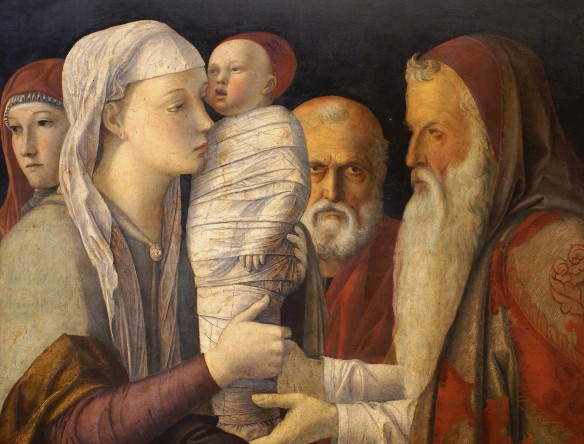
Presentation of Jesus at the Temple (detail), Andrea Mantegna, c. 1455

Today is the Feast of the Presentation of our Lord Jesus Christ in the Temple. It’s a major feast in our calendar but one we observe at Grace only when it falls on a Sunday. It commemorates the events recorded by Luke in today’s gospel reading. Jesus’ parents Mary and Joseph brought him to the temple forty days after his birth to conform to Jewish ritual obligations—the presentation of the first-born to God; and the purification of a woman after giving birth. Continue reading

Of Bibles, Blessings, and Twitter Outrage

On Sunday, this tweet from the National Cathedral appeared in my feed. There was an immediate response from many who found it and the event it was depicting deeply problematic. Conversation about its significance and appropriateness began immediately and unlike so many such twitter controversies, it has not died down 2 days later. NPR picked up the story as well.

I was deeply troubled by the original tweet as it stated the Cathedral was “blessing the official Bible of the Space Force.” There are serious questions here about what this blessing says about the Episcopal Church’s relationship with the United States and its military, some of which I may address on another occasion. What caught my attention however was the phrase “the official Bible of the Space Force.”

I know little about how the Space Force has developed since President Trump announced its creation; in fact, I assumed it was little more than one of those things the President is prone to say that seem to have little basis in reality. Apparently it is a thing. But I had a number of questions. This official Bible was apparently to be used to swear in all commanders. That raises questions about the role of religion, specifically Christianity in the creation of the military hierarchy, and what role, if any, people who aren’t Christian would have in that hierarchy. Are there also “official” Torahs or Qurans for commanders who might be Jewish or Muslim, or for that matter, what provision is made for people who claim no religious affiliation?

While space has been militarized since the beginning of exploration, the creation of a Space Force seems to me to be a qualitative leap beyond what has occurred to this point. I imagined Space Force conquerors claiming planets as US territory following colonization patterns familiar from past centuries, with missionaries coming behind, Christianizing alien races as the Church of England followed the Empire as it colonized the world and Franciscans and Dominicans accompanied Spanish conquistadors.

The NPR article provides a bit of background and walks back the tweet’s inaccuracies but at the same time introduces some other astonishing and troubling details. The Bible was donated by the Museum of the Bible which is itself mired in controversy regarding its questionable acquisition of items and its ideological perspective. And then there is the prayer that was read at its blessing:

“Almighty God, who set the planets in their courses and the stars in space, look with favor, we pray you, upon the commander in chief, the 45th president of this great nation, who looked to the heavens and dared to dream of a safer future for all mankind.”

There are complex issues involved in occasions such as this. The blessing was performed by Bishop Carl Wright, the Episcopal Church’s Suffragan Bishop for the Armed Forces and Federal Ministries. He oversees chaplains in the Armed Forces, Veterans Administration, and federal prisons. It’s important work and I’m grateful for the Episcopal presence in all of those places. I wouldn’t second-guess any action he took, especially considering I have no direct experience in any of them.

At the same time, I think this event and the reaction to it reflect a much more important issue in the life of the Episcopal Church. Since the founding of the US and the Episcopal Church, we have been the quasi-established Church. It’s no accident that we have a “National Cathedral” that is the site of state funerals like that of George H.W. Bush as well as inaugural prayer services. The difference between this event and the widespread fawning among Episcopalians when President Obama attended Inaugural service es at Episcopal churches is more a matter of degree than of kind.

The fundamental question is this. How can we as a church minister in and to institutions that are deeply oppressive, violent, unjust, and militaristic even as we also seek to call them to account? The blessing of a Bible that will be used in a commander’s swearing-in ceremony implicates the Episcopal Church in whatever command decisions he or she might have to make.

As the percentage of Americans who identify themselves as Christian becomes smaller every year, and as the Episcopal Church itself continues to decline in numbers and influence, it will incumbent on us to develop a public witness that is at once faithful to the Good News of Jesus Christ and recognizes the pluralistic reality of the world in which we live.  We must also acknowledge that the people among whom we minister in those institutions are also struggling to negotiate multiple identities of their own and competing claims for their allegiance. While they are doing this, they are also working with people who  are struggling in the same ways and are often coming from very different religious and cultural backgrounds.

What would it be like if the Episcopal Church, instead of reaching back to traditional symbolism and language or adopting models from established churches, explored new religious forms that recognized the complexity of the world in which we live and sought to honor and strengthen the religious commitments, not just of Episcopalians, but of people who reflect the diversity of America’s and the world’s religions?

All of this requires much greater nuance than is possible in 280 characters.