Holy God, Holy and Mighty, Holy Immortal One, Have Mercy on Us

Some prayers in the midst of horrific tragedy.

Grieving Our Lost Children by Walter Brueggeman

We remember today, O God, the slaughter of the holy innocents … Receive, we pray, into the arms of your mercy all innocent victims; and by your great might frustrate the designs of evil tyrants and establish your rule of justice, love, and peace; through Jesus Christ our Lord, who lives and reigns with you, in the unity of the Holy Spirit, one God, for ever and ever. Amen. Collect for Holy Innocents, December 28 BCP

From Rev. Emily Heath (West Dover, VT)

An Article on the Daytime Shelter and Sarah Gillmore

Pat Schneider is effusive in her praise.

From the article:

day-to-day tasks to keep the center running — from greeters to food service to clean-up — are performed by volunteer users of the center. An advisory council of shelter users gives feedback on operations, and a community justice group discusses how to minimize conflicts.

Having a role in running the operation is important, Gillmore told me.

“The idea of someone being able to contribute their skills is so powerful. We’re based on building a sense of empowerment to increase self-worth and make life changes,” she said. By being involved with running the center, as well as participating in support groups and connecting with local service agencies, shelter users make steps toward more stable lives.


Songs of Joy–The Songs of Advent, Part 2: Lectionary Reflections for the Third Sunday of Advent, Year C

This week’s readings are here.

I’m not a big fan of the recent tendency to focus our attention in Advent on one particular theme, so that the Third Sunday of Advent becomes “Joy.” While three of the readings could be construed as joyful or as exhorting joy, I don’t see much joy in the gospel or in the preaching message of John the Baptizer. In fact, if you go back and read the contexts for both the reading from Zephaniah and the canticle from Isaiah 12, you will note that the larger textual context is full of doom and gloom, prophecies of destruction, fears of being invaded and destroyed by larger powers.

Listen to some of Zephaniah’s words:

I will utterly sweep away everything
from the face of the earth, says the Lord.
I will sweep away humans and animals;
I will sweep away the birds of the air
and the fish of the sea.

This week’s reading comes from the very end of the text and is remarkably different in message and tone. Now Israel has been restored; the people are urged to sing, shout, and rejoice. Yahweh, too, sings:

The Lord, your God, is in your midst,
a warrior who gives victory;
he will rejoice over you with gladness,
he will renew you in his love;
he will exult over you with loud singing (Zeph 3:17)

In fact, there’s something of a puzzle here. What reads in the NRSV as “he will renew you in his love,” appears in the Hebrew as “he is silent in his love.” Imagine God struck silent by joy!

The Isaiah song, (Is 9:2-6), is another song of joy, presumably from a similar dire situation as that of Zephaniah, although perhaps a century earlier. Christians have interpreted these words as a prophecy of Jesus Christ but they are backward-looking as well. The imagery of the first few lines recalls Israel’s flight from Egypt and sojourn in the wilderness. The image of God as Savior, stronghold, and defense are all military images, calling to mind that early song of the Hebrew Bible, the Song of Moses, sung after the Israelites passed through the Red Sea:

The Lord is my strength and my might,
and he has become my salvation; (Ex. 15:2)

The next image also returns to the wilderness and the miraculous streams and fountains that came when the people were thirsty. Like the songs I talked about last week, these songs of Advent look backward in history as well as forward. They are songs of remembrance as well as anticipation.

The difficulty we have in feeling or expressing joy often comes from the difficulties in our lives; our personal struggles and pain. Joy is also difficult when we know of others’ suffering or when we think of all the problems facing our nation, community, and world. Both Isaiah and Zephaniah lived in periods of deep national crisis. In both men’s lives, Judah and Jerusalem faced existential threat. Within a decade or two after Zephaniah’s death, Jerusalem itself lay in ruins, its political and religious leadership carried off in exile in Babylon. But in Babylon, hope persevered and the exiles created a religious community and religious texts that survive to the present.

Perhaps these joyous songs of Advent will help us remember God’s mighty acts in history and give us hope that God continues to act in the world around us, bringing deliverance and salvation to a desperate world.

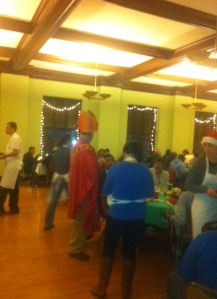
 

Visiting the day center for the first time

Today, I made the long journey around Capitol Square to the new day center that’s been open for two weeks. I probably wouldn’t have done it if I hadn’t had been given a task.

I attended the Annual Meeting of the Wisconsin Council of Churches today in Waunakee. The keynote speaker was Palker Palmer and I will write about what he said in the next couple of days. This post is about something else.

We had lunch–sandwich fixings, soup, and dessert. There was a lot of bread and coldcuts left over and as we were finishing lunch one of the WCC staff members came over to me and asked if we could use the leftovers.

There’s a backstory here. People are bringing food, donations of clothing, and the like to us all of the time. These donations are intended for the men’s shelter that is housed at Grace and operated by Porchlight. Often the donations come when there is no Porchlight staff on the premises and our staff have to deliberate about what to do with the items. We have limited storage space and a lot of groups that use our kitchen and other facilities, so we can’t really accommodate large quantities of donations. But we also don’t want to turn people away when they bring things to us, or tell them to go somewhere else. So when I was asked about the food, I immediately began thinking about all of the issues related to receiving a donation of this sort. After a lengthy pause, I agreed to take the food.

By the time I moved my car to make it easier to move the donated food, I had lit on a solution. The Day Center on E. Washington needs food for the people who use its facility during the day. I knew there would be staff on hand who would tell me immediately if they could use what I brought. And it also gave me a reason to drop in and see how things were going.

So I made my way over to E. Washington Ave. this afternoon with several pounds of turkey, roast beef, and cheese, as well as lots of bread. It’s amazing. There are people in the courtyard, smoking and chatting and when you go in the door, you’re overwhelmed by the number of people in the space, talking, visiting, hanging out. The check-in desk is manned by two volunteers, who this afternoon were probably homeless people. I found Sarah Gillmore in a backroom talking with someone. I asked her about the food, and she immediately accepted it, saying “that’ll be lunch, tomorrow.” She asked if I needed help. I saw someone I knew, called him by name, and asked him to come out to the car to help me. We brought the food into the kitchen, where another volunteer, another guest, was clearly running the kitchen.

Sarah and I chatted briefly. I asked how things were going. It’s obvious that the shelter is filling an important need. I hope that politicians, media, and others will drop by and check it out. I’m sure there will be problems–any time you get that many people in a confined space for a long period of time, there will be conflict. But what struck me was the conviviality, the community that was developing. People greeted me as I came in, engaged me in conversation. They were talking together as well. Sarah seems to have things under control. One of the great things she’s doing is involving guests in the operation of the facility.

Oh, and about those donations? We’ll be directing them to the Day Center and to Feeding the State Street Family. And I hope you will send items that way, too.

The Songs of Advent: A Homily for the 2nd Sunday of Advent, 2012

At the 10:00 service today, we will have our annual service of Advent lessons and carols. If you’ve never attended, it brings together readings from Hebrew Scripture, primarily from the prophets, and the New Testament, to help us focus our attention on some of Advent’s major themes. It is intended to help us prepare for Christmas. The songs of Advent draw on prophetic imagery; they are filled with expectation and hope, they express the promises of Hebrew Scripture that Christians believe are fulfilled in the person of Jesus Christ. Continue reading

A New Era? Changing attitudes and approaches to homelessness in Madison

There seems to be a revolution taking place in Madison and Dane County. Thanks to a number of factors and the efforts of a remarkable group of people, new initiatives are beginning and there is evidence of changing attitudes among our political leadership and wider community. I’m excited to be a witness and in a small way a participant in these changes.

One change, the Warming Center, which finally opened a couple of weeks ago on E. Washington Ave. The first day it opened, 57 people made use of it. It’s a temporary solution with a permanent facility funded by Dane County in the works. I received a plea from Scott McDonnell (chair of the County Board of Supervisors) in which he lists the shelter’s needs. You can download that letter here: McDonnell_letter.

Some of my excitement is due to the work of Tami Miller and her group “Feeding the State Street Family.” The Cap Times recently profiled Miller who began volunteering on her own a couple of years ago. Miller and her group reach out to homeless people where they are instead of expecting homeless people to seek them out. They provide meals, make midnight drop-offs of food and supplies. She is also experimenting with new programs, like a one-on-one mentoring program that may begin as early as January. She and I had a great conversation on Tuesday about how Grace can support her efforts. We also talked about some of the unmet needs in the city and the county.

One impact she and others have had is to shift the approach of the politicians. Mayor Soglin who has come off as very heavy-handed and tone deaf about homelessness over the last months, has been much more conciliatory in the last weeks. And County Executive Joe Parisi, who has made several mis-steps himself, is making similar efforts to reach out. Here’s an article about that.

The focus now from the City of Madison is on figuring out where the gaps in services are. It’s interesting that the 2011 annual report on homelessness in Dane County has finally appeared, just a few weeks before the end of 2012. That document is here: 2011 Annual Report revised

It makes for interesting reading. The statistics come primarily from social service agencies and shelters. It’s interesting to note that for all demographic groups, most people in the shelters were residents of Madison or Dane County before becoming homeless. What it doesn’t seem to track is the number of people who are homeless but don’t use the shelter system. Tami Miller puts that number at 400. On Monday, I talked to a couple of guys who are regulars at our First Monday meal. They sleep outside. One of them said he’ll go in the shelter when it’s really cold, another said he never uses the shelter. When I asked them about it, they brought up the usual issues and complaints I hear. The reality is that the shelter isn’t appropriate for everyone, and with shelter as with almost every other issue facing homeless people, it’s important to develop solutions based on the particular needs of individuals. Of course that takes more financial and human resources, but if the goal is to get someone into a stable living situation, those resources are necessary and produce results.

A video about the plight of homeless teens in Madison is here:

In short, these are interesting and exciting times and I look forward to future developments.

What a Mess!

Mark Lawrence responds to yesterday’s developments. Money quote:

“Quite simply I have not renounced my orders as a deacon, priest or bishop any more than I have abandoned the Church of Jesus Christ — But as I am sure you are aware, the Diocese of South Carolina has canonically and legally disassociated from The Episcopal Church,” Lawrence said in a letter posted on the diocese’s website after the presiding bishop’s announcement. “We took this action long before today’s attempt at renunciation of orders, therein making it superfluous.”

Some circular reasoning here, I think, in that he claims his actions make the declaration of renunciation “superfluous.”

Other commentary on the spiraling crisis. From Mark Harris:

I have sometimes wondered what would have happened if one of the first dioceses to undergo the stress of division had come to the General Convention and petitioned to leave the General Convention, gave the grounds, showed that a large majority of the people and clergy were for it, and made suggestions as to how all could be responsible to the trust or common ownershop concerns. Could General Convention have said, go with our blessings, but know that we will continue in the area where you are to keep and Episcopal Church presence. I don’t know. But no diocese has to my knowledge ever petitioned General Convention on any level to a parting of the ways.  Instead leaders have gone with their followers, called themselves the Diocese and generally ended up in a spitting contest with The Episcopal Church leadership.

From Anthony Clavier:

When it comes to the essential morality of what has happened -I’m not using morality as in sex – few on either side have much to boast about. We’ve hurled insults as readily as we’ve sought to make theological justification for our positions. We look like our political parties. That’s no accident. We live in two worlds and as we spend more time in society and ‘culture’ as we do in the Kingdom: the world seems to triumph.


Is it too late?  It’s never too late. If those who manage the Episcopal Church don’t believe in conscience that they can make room for conscientious dissent, isn’t it their duty to make caring space for dissenters? If those of us who cannot square our consciences with the new canonical provisions, should we not do all we can to respond to any initiatives by the Episcopal Church to give us room.

Update on the Episcopal Church in South Carolina

I had some trouble figuring out what to title this post, since everything, including what to call the various parties involved in the dispute, is being contested.

Whatever.

At least I’m not being as tendentious as the the Episcopal Church’s Office of Public Affairs, which entitled its press release today “Presiding Bishop accepts Lawrence’s renunciation.” It’s not at all clear to me that what Bishop Lawrence did or said in his convention address of November 17 constitutes renunciation of his ordination vows. The Episcopal Cafe story is here.

The article goes on to say that the PB’s actions were fully supported by members of her Council of Advice.

I grant that this is a difficult situation but I fail to see what is being accomplished in these actions or in earlier ones, such as the PB’s “pastoral letter” that read more like a legal document than attempt to listen, mend fences, or pray for reconciliation.

Tobias Haller wonders whether the PB is jumping the gun. He points out that the canons require a written declaration of renunciation:

While I believe that Mark Lawrence has abandoned the communion of The Episcopal Church, I do not think he has renounced his ministry, at least in the manner laid out by Canon III.12.7, which requires a written declaration to the Presiding Bishop expressing a “desire to be removed.”

If there is a way forward, or a Christ-like presence in this controversy, it seems to me the statements of the Diocese of Upper South Carolina are bearing witness to Christ’s reconciling love. Here’s a resolution passed by that Diocese’s Standing Committee on the situation: SC Ltr Res

Bishop Waldo wrote a pastoral letter. In it he writes:

Looking to the future, we do not know how things will unfold across the state. We do not know what individuals and congregations within the Diocese of South Carolina will do. We do not know how the leadership of The Episcopal Church will proceed.

We do know that friendships and relationships across the state will persist. I do know that I will stay in contact with my brother, Mark Lawrence, and those within this diocese who have appreciated and agreed with his theological perspective. I will also stay in contact and dialogue with those who have felt that The Episcopal Church has moved courageously in its theological developments. And, I offer my support to those within the Diocese of South Carolina who wish remain within The Episcopal Church. Both Bishop Mark Lawrence and Presiding Bishop Katherine Jefferts Schori are aware of my offer.

My deepest hope is that in the long-term we, in our brokenness, will steadfastly hold on to the possibility of reconciliation and restoration, even if it takes us a generation. This is precisely the kind of dialogue to which our diocesan strategic visioning process calls us. I will continue to foster such dialogue and to be the bishop of all in this diocese, regardless of where members are on the theological or political continuum.

Therefore we must continue to pray for those whom we love and for those whom we struggle to love, whether they live within or beyond this diocese.

The complete text is here: Advent 2012 – for posting


First Monday: Food, socks, and fun

It’s become a tradition at Grace. The First Monday in December, our regularly scheduled dinner with entertainment for guests of the Drop-In shelter and community, is St. Nick’s Day. We make sure there’s great food; Christmas carols and Holiday songs sung by our Sunday School kids and adult choir and St. Nick himself appears to hand out new warm winter socks for our guests.

The menu was ham, macaroni and cheese, green beans, and cupcakes. Helping us serve were youth from Grace and St. Andrew’s as well as many of our regulars. We planned for 150 but probably had somewhere around 110 or so. It was 64 outside when we began to serve and I suspect many of those who might have joined us if the temps were more seasonal decided to stay outside for the night and forage for food. A couple of pics:

photo(2)photo(1)photo


As always, the guys were very appreciative of both the food and fellowship. Because of the relatively leisurely pace of the evening, there were lots of opportunities to sit down and visit with the guests, hear their stories and make a human connection with some of them. It was especially neat to see the intergenerational interactions and to watch how newcomers to volunteering with us jumped in both to help serve and to take the time to listen to those they were serving.


The Tender Compassion of our God: Lectionary Reflections for Advent 2, Year C

This week’s readings are here.

The Psalm this week comes from Luke’s Gospel (1:68-79). It is one of several songs or hymns that Luke records in his nativity scene (among the others are the Song of Simeon and Mary’s Magnificat). New Testament scholars suppose that Luke was drawing on hymns being sung by early Christians in his community when he wrote the gospel but in their current form they reflect his literary genius and overarching theological concerns.

Although we say, sing, or hear a psalm in every Eucharist, it probably doesn’t dawn on most of us that the Psalter is a hymnal; that when we say the psalms we are joining our voices with those of Christians from the two millennia before us as well as with the Jewish community of today and previous generations.

The Song of Zechariah is replete with the language and imagery of the Hebrew Bible and the Psalms. In fact, like the other Lucan canticles, one can find in Hebrew scripture parallels for almost every word, phrase, or image. But it goes beyond a simple parroting of earlier language and imagery. In its current form, the canticle connects earlier scripture and prophecy with the current moment. The first section refers to David and thus draws our attention to the prophetic books of the Hebrew Bible. The second section refers to Abraham and thus refers us to Torah, the Law. Here we have the Law and the Prophets pointing the way forward to the present moment and the coming of the Messiah. The same thing is true in Luke’s description of Zechariah and Elizabeth which resonates powerfully with both Abraham and Sarah and Elkanah and Hannah. Both were barren couples.

To sing, say, or reflect on this hymn in Advent is to place ourselves in the middle of the season’s expectant hope. Our words echo the words of ancient Hebrews and first-century Jewish Christians. With them, we proclaim our faith in God’s promises; we look forward to our salvation. And we can sing from the position of Zechariah, who with the birth of his son knows that “in the tender compassion of our God, the dawn from on high shalll break upon us.”

One of the miracles of Advent is that for a few brief weeks, all of salvation history, the story of God’s reaching out to us, is collapsed into our lives, into the darkening days of December. Through our prayers and worship, we unite with the voices, the hopes and faith of countless generations, in awaiting the coming of the Savior. God’s tender compassion comes to us as it has to the generations before us and will continue to come for generations to come.

Of course, Luke was writing his gospel decades after the events he was describing. He may have been writing decades after the destruction of the temple in 70 CE (some scholars think Luke was written in the 120s). He, his readers, and the community of Christians among whom he worshiped were singing hymns of hope and faith that were not reflected by the reality in which they lived. The Savior in whom they believed had not materially changed their situation. They were as poor and oppressed as ever. But still they could sing that God had raised up a mighty Savior; promised forgiveness of sins, and guided their feet into the way of peace. And this Sunday, so will we. I pray we believe it.