Be Salt! A Sermon for Proper 21, Year B

September 16, 2012

As many of you know, Grace Church has embarked on a master planning process. Beginning today over the next several months various groups and constituencies will have the opportunity to weigh in about our spaces—what works, what doesn’t work, what needs renovation and enhancement, what should remain pretty much like it is today—All of you will have an opportunity in a few minutes to offer your wisdom and perspective. We hope that everyone here will fill out a survey, whether this is your first visit to Grace or whether you’ve been a member for sixty years. Continue reading

September 26: Lancelot Andrewes “For Holy Communion”

Today is the commemoration of Lancelot Andrewes. Here’s a biography.

FOR HOLY COMMUNION

O LORD, I am not worthy, I am not fit,
that Thou shouldest come under the roof of my soul;
for it is all desolate and ruined;
nor hast Thou in me fitting place to lay Thy head.
But, as Thou didst vouchsafe
to lie in the cavern and manger of brute cattle,
as Thou didst not disdain
to be entertained in the house of Simon the leper;
as Thou didst not disdain that harlot, like me, who was a sinner,
coming to Thee: and touching Thee;
as Thou abhorredst not her polluted and loathsome mouth;
nor the thief upon the cross confessing Thee:

So me too the ruined, wretched, and excessive sinner,
deign to receive to the touch and partaking
of the immaculate, supernatural, lifegiving,
and saving mysteries of Thy all‑holy Body
and Thy precious Blood.

Listen, O Lord, our God, from Thy holy habitation,
and from the glorious throne of Thy kingdom,
and come to sanctify us.

O Thou who sittest on high with the Father,
and art present with us here invisibly;
come Thou to sanctify the gifts which
lie before Thee,
and those in whose behalf, and by whom,
and the things for which,
they are brought near Thee.
And grant to us communion,
unto faith, without shame,
love without: dissimulation,
fulfilment of Thy commandments,
alacrity for every spiritual fruit;
hindrance of all adversity,
healing of soul and body;
that we too, with all Saints,
who have been well‑pleasing to Thee
from the beginning,
may become partakers
of Thy incorrupt and everlasting goods,
which Thou hast prepared, O Lord, for
them that love Thee;
in whom Thou art glorified
for ever and ever.
Lamb of God,
that takest away the sin of the world,
take away the sin of me,
the utter sinner.

–From Lancelot Andrewes, The Devotions of Bishop Andrewes, Vol. I (accessed at the Christian Classics Ethereal Library)

Pray for the selection of the new Archbishop of Canterbury

The Crown Nominations Commission, the group choosing the next Archbishop of Canterbury, is meeting today and tomorrow to select the next head of the Church of England and of the Anglican Communion.

The Church of England has offered this prayer for our use:

Almighty God,
you have given your Holy Spirit to the Church
to lead us into all truth:
bless with the Spirit’s grace and presence
the members of the Crown Nominations Commission.
Keep them steadfast in faith and united in love,
that they may seek your will, manifest your glory
and prepare the way of your kingdom;
through Jesus Christ your Son our Lord.
Amen.

The press release is here.

The meeting brings increasingly speculation on who will be chosen. Adrian Hilton offers his perspective here (he advocates Justin Welby of Durham). John Martin in The Living Church guesses Richard Chartres, Bishop of London. Andrew Brown wrote last week in The Guardian about the alternatives.

From this side of the pond, the whole thing looks rather odd and quaint. In the first place, because of establishment, some members including the chair, are appointed by the Prime Minister. Second, in spite of representation from both bishops and lay people, it’s all quite undemocratic, in a way even less democratic than the Roman Catholic process for electing a pope. Although the ABC is the head of the Anglican Communion, only one member of the commission comes from a church other than the Church of England (Barry Morgan, Archbishop of Wales). Then there’s the fact that one can place bets (currently Richard Dawkins is running 200/1).

But the selection is significant for the Church of England, the worldwide Anglican Communion, and the Episcopal Church. Whoever is chosen will continue to have to deal with issues confronting the CoE–women bishops, same sex marriage, and will have to also deal with the widening rift in the Anglican Communion.

The decision will be announced next week.

Salt is Salt: Lectionary Reflections for Proper 21, Year B

This week’s readings are here.

When I was a kid, salt was salt. It came in a blue cylindrical container with a whimsical picture of a girl holding an umbrella in one hand and the motto, “When it rains, it pours. “Nowadays salt is a matter for connoisseurs. There’s sea salt, gray salt, pink salt. Salt from Brittany, the Himalayas, or Hawaii. But what Jesus says still rings true. If it’s lost its savor, it’s no good. Salt preserves; adds flavor and zest. It can make food tastier but it can also do damage.

In this passage from Mark’s gospel, we see one of the central dilemmas facing our communities of faith, our society, and the world. On the one hand, there are Jesus’ words that seem to downplay differences between communities, interest groups, even nation states: “Whoever is not against us is for us.” On the other hand, there is Jesus’ repeated condemnation of those who would mislead or cause harm. Those who are stumbling blocks (literally, scandal) are destined for hell and damnation.

Jesus invites us to see those outside our communities as fellow travelers and friends. He tells us we need not worry too much about them; their support and encouragement of us, that they offer us a cup of water when we are thirsty, is proof enough of their good intentions and ultimate reward.

But the warning to those who would be stumbling blocks, while clearly directed inwardly at relations within the community of Jesus’ followers, is also a caution to us today, not only to ponder our relationships within our closest communities, but in the larger one as well. When have our actions or statements marginalized others? When have we caused others to stumble? How can we be salt to the communities in which we live, deepening and preserving their flavor, helping disparate ingredients come together to make a marvelous stew?

(I wrote this reflection for a series put together by the Wisconsin Council of Churches that center around the “Seasons of Civility” campaign. More about that here).

An Offering of Angels

Yesterday, Corrie and I toured the Offering of Angels exhibition currently at the Chazen Museum of Art. We were accompanied by Maria Saffiotti Dale, Curator of Paintings, Sculpture, and Decorative Arts at the museum.

It’s well worth a visit, consisting of paintings from the Uffizi Gallery in Florence, most of which are rarely displayed publicly. The paintings are generally tied thematically to the Eucharist and other Biblical and religious subjects, ranging from the Fall to the Resurrection. Most of them date from the sixteenth and seventeenth centuries.

While a number of them are particularly interesting I was drawn to this painting by Cristofano Allori of “Christ being ministered to by the angels.” Allori was a Florentine painter (1577-1621)

The painting’s placement among images of the resurrection, and just after images of the passion, reminded me of Lk 22:43 “Then an angel from heaven appeared to him and gave him strength.” The more likely parallel is with Mt. 4:11 “Then the devil left him, and suddenly angels came and waited on him.” One can see a demon departing to the left in the painting.

What fascinates me more is the Eucharistic imagery in the painting. Some angels are bringing bread and wine to Jesus while others hold a basin in which Jesus is washing his hands. The exhibition catalog suggests this particular theme appears often in monastic institutions during the Catholic Reformation, especially in rooms designated as refectories.
I’m not sure about that whether that explains this particular image. It’s not very large (32cm x 52cm).

That Jesus is washing his hands as angels bring him bread and wine evokes for me the ablutions a priest makes during the Eucharist so the image might be directed at a priest’s devotions and to underscore the role of the priest as mediator of Christ’s presence to the faithful. A quick search of google images returned no other depictions that included Jesus washing his hands and most were much less obviously Eucharistic in focus.

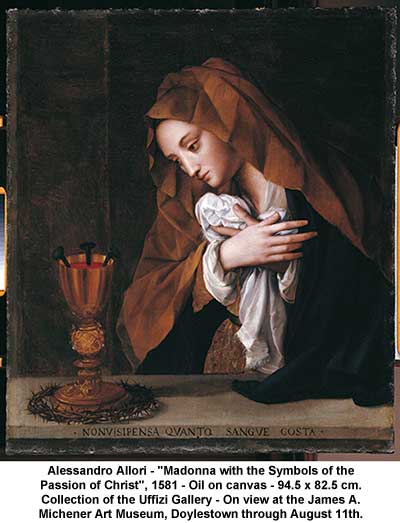
Also in the exhibition are two other paintings with striking Eucharistic imagery. One is an image of the grieving Madonna by Alessandro Allori (1535-1607)

The other is an image of Christ by Jacopo di Chimenti da Empoli (1551-1640), in which blood from the wound in Jesus’ side empties into a chalice:


Is it a fake? More on the “Gospel of Jesus’ Wife”

The New York Times has a follow-up on the sensational announcement this week in which scholars express both excitement and considerable skepticism about Karen King’s discovery. (My previous discussion is here).

Mark Goodacre links to a line-by-line takedown of the text by Francis Watson of Durham University. His summary:

Six of the eight incomplete lines of GJW recto are so closely related to the Coptic GTh,
especially to Sayings 101 and 114, as to make dependence virtually certain. A further line is derived
from Matthew; just one is left unaccounted for. The author has used a “collage” or “patchwork”
compositional technique, and this level of dependence on extant pieces of Coptic text is more plausibly
attributed to a modern author, with limited facility in Coptic, than to an ancient one. Indeed, the GJW
fragment may be designedly incomplete, its lacunae built into it from the outset. It does not seem
possible to fill these lacunae with GTh material contiguous to the fragments cited. The impression of
modernity is reinforced by the case in line 1 of dependence on the line-division of the one surviving
Coptic manuscript, easily accessible in modern printed editions. Unless this impression of modernity is
countered by further investigations and fresh considerations, it seems unlikely that GJW will establish
itself as a “genuine” product of early gospel writing.

An earlier post by Goodacre assembles links to some of those casting doubt on the text’s authenticity.

It turns out there is a documentary in the works.

Radioactive Beer may taste OK

Apparently, the US government tested the effects of nuclear explosions on the quality of beer back in 1955:

Examination made immediately upon recovery showed no observable gross changes in the appearance of the beverages. Immediate taste tests indicated that the beverages, both beer and soft drinks, were still of commercial quality, although there was evidence of a slight flavor change in some of the products exposed at 1270 ft from GZ [Ground Zero]. Those farther away showed no change.

No word on long-term effects of the test on those who drank the radioactive beer. In case you were wondering, bottles survived the blast better than cans. Read it all here.

The Significance of the “Gospel of Jesus’ Wife”

Today, it’s splashed across the headlines. Yesterday, Karen King, Professor at Harvard Divinity School, announced at an international conference in Rome the discovery of a papyrus fragment in which Jesus seems to refer to his wife. Dan Brown must be thrilled.

But let’s take a step back and consider what we’ve got here.

  1. The text itself and its origin. The text came to King from a private source who remains anonymous; there are considerable gaps in the text itself, making a reconstruction of what actually lies on the page quite difficult. There is considerable work that needs to be done to ascertain the fragment’s age, authenticity, and what the text actually says.
  2. it’s written in Coptic, probably dating from the late fourth century (perhaps even later). King posits (based on what she considers “parallels” with the Gospel of Thomas and other texts) that it is a translation of a second-century Greek text. That’s quite a leap.
  3. Is it a gospel? King assigns it to this genre without strong supporting evidence. Jesus does seem to be speaking and the text refers to Mary but is that enough to tell us the larger textual context of the fragment we have?
  4. King did follow correct scholarly norms in announcing the find. She took it to scholars of Coptic and ancient papyri; she wrote an article that she submitted to scholarly review; she announced the find, not in a sensationalistic press conference or National Geographic TV special (as the Gospel of Judas was announced) but at a prestigious international conference; and she has provided scholars with everything they need to make their own judgments.
  5. Most importantly, as King stresses repeatedly, this text in no way proves Jesus was married. It provides no evidence concerning the historical Jesus.

So what does it mean?

If it’s proved authentic–a text dating from the late fourth century (I’m not speculating on whether it actually dates to the 2nd century)–what does it tell us about early Christian belief and practice?

Well, not a lot. That there were groups calling themselves Christian that had interesting and unconventional beliefs about Jesus is not news. By this time, there was a strong tendency toward ascetism in early Christianity that emphasized celibacy and chastity and looked at marriage with a critical eye. In earlier centuries, say the second and early third, there is evidence, cited by King in her draft article, that the debate whether Jesus had a wife was open, and that the belief he had a wife was used as justification for Christians practicing marriage.

Whatever the debates in early Christianity over marriage and celibacy, they provide little guidance for contemporary Christians who seek to follow Jesus. In our very different historical and cultural context, with radically different understandings of sexuality and human personhood, we have to look for moral guidance elsewhere than ambiguous texts from unknown sources.

Did Jesus have a wife?

Karen King of Harvard Divinity School made the announcement today.

From the New York Times:

The faded papyrus fragment is smaller than a business card, with eight lines on one side, in black ink legible under a magnifying glass. Just below the line about Jesus having a wife, the papyrus includes a second provocative clause that purportedly says, “she will be able to be my disciple.”

The press release from HDS might be available here. (h/t David Brakke)

Of course, as the Times piece points out, the fragment is hardly reliable historical evidence for the claim that Jesus was married. Written in Coptic, it dates from several centuries after Jesus’ death and its provenance is uncertain.

Wanna save your life? Lose it! A sermon for Proper 19, Year B

September 16, 2012

  Last week I mentioned the importance of geography in Mark’s gospel. We saw Jesus travel to Tyre, west of his customary stomping grounds in the Galilee. After his visit to Tyre, he traveled in a roundabout fashion, via Sidon, to the Decapolis (the ten cities) which lay east of the sea of Galilee. Again, it was Gentile territory. In today’s gospel, he is on the road again. Now he has moved north of Galilee to the region of Caesarea Philippi. It too was gentile territory, but more importantly perhaps, its name proclaims its significance. Continue reading