The night before the recall

As the day went on today, Capitol Square began to show signs of tomorrow’s election. Once again, media descended. I passed one reporter filing a story from the median on W. Wash. I’m told MSNBC and Fox News are here again, as well. No doubt there are others, but I didn’t walk the square to see. As evening came, car horns played the rhythm of “This is what democracy looks like.

Still, life on the square continued as it does on an early summer evening. It’s First Monday, so we opened our doors to feed shelter guests and community residents. I left early, hoping there would be enough food, because it was obvious that there would be a large number of people dining with us who wouldn’t be staying in the shelter (where numbers have been averaging around 60 since the first of June.

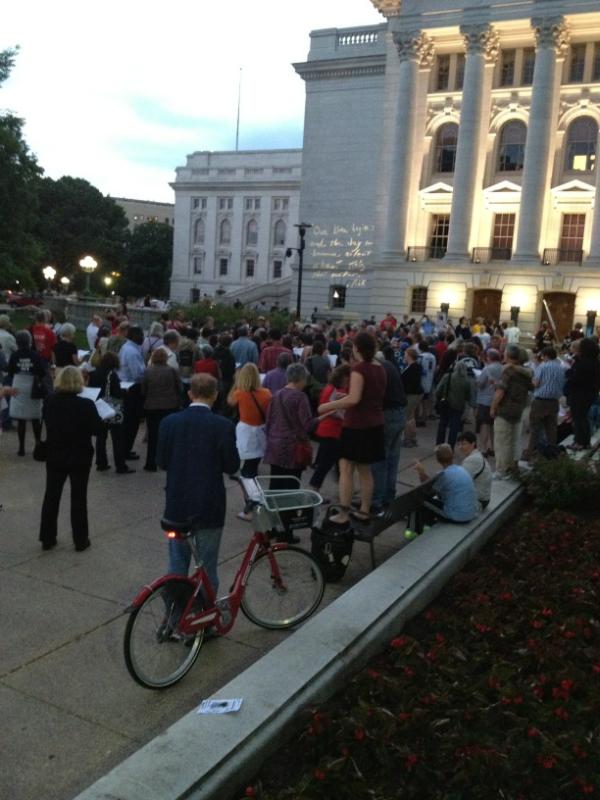
It may have been quiet except for the homeless on our side of the square, but on another corner, things were picking up. Here’s a photo, retweeted by The Daily Page (originally from Judith Davidoff), of the gathering at the King St. entrance:
Who knows what tomorrow will bring? Those I talk with express their concern and anxiety and as I mentioned in my sermon on Sunday, whatever happens tomorrow, we will still need to work together toward the common good (even if some don’t see that as value or goal).

I’m pondering a pastoral response in these days, what to say and do. At this point, besides voting, I suppose the only actions I can take besides voting are to pray and to continue to make Grace Church a sacred presence on the square. We will have noonday prayer tomorrow and Eucharist on Wednesday (both at 12:10 pm) and the church will be open before and after those times for people to come in.

I read as a concluding collect in Sunday’s prayers of the people the following:

Grant, O God, that your holy and life-giving Spirit may so move every human heart [and especially the hearts of the people of this land], that barriers which divide us may crumble, suspicions disappear, and hatreds cease; that our divisions being healed, we may live in justice and peace; through Jesus Christ our Lord.

Amen. (BCP p. 823)

 

Give us a King! Lectionary reflections on Proper 5, Year B (June 10, 2012)

This week’s readings.

I’m not sure what divine irony (or is it the Holy Spirit?) put the Wisconsin Recall election during the week when we will read the story of Israel’s demanding that God give them a king. Our reading from the Hebrew Bible comes from I Samuel 8 and it depicts the deep ambivalence over monarchy that is at the heart of the biblical text.

On the one hand, the problems with direct divine rulership or prophetic leadership are clear. The book of Judges ends with an ominous verse: “In those days there was no king in Israel; all the people did what was right in their own eyes.” Judges depicts a descending cycle of anarchy as the tribes of Israel fail to follow God. Samuel picks up the story. While he is portrayed as a gifted prophet, priest, military leader, and judge, his sons (just as Eli’s sons before him) do not follow in his footsteps. As Samuel ages, problems again come to the fore.

The people’s response is to demand a king, like the nations around them. Ultimately, there will be a ruler and a dynasty that is considered to have divine legitimacy and divine favor (the Davidic monarchy). Later generations will look back on David and Solomon as great and wise rulers, and their reigns as a golden age but at the same time, there will arise in conjunction with the monarchy, the institution of Hebrew prophecy that will call kings and people to justice and to obedience to Torah.

That ambivalence is present in this week’s reading. The demand for kingship is a rejection of divine kingship. Of equal importance are the implications for society of a monarchy:

“These will be the ways of the king who will reign over you: he will take your sons and appoint them to his chariots and to be his horsemen, and to run before his chariots; [and he will appoint for himself commanders of thousands and commanders of fifties, and some to plow his ground and to reap his harvest, and to make his implements of war and the equipment of his chariots. He will take your daughters to be perfumers and cooks and bakers. He will take the best of your fields and vineyards and olive orchards and give them to his courtiers. He will take one-tenth of your grain and of your vineyards and give it to his officers and his courtiers.] He will take your male and female slaves, and the best of your cattle and donkeys, and put them to his work. He will take one-tenth of your flocks, and you shall be his slaves. And in that day you will cry out because of your king, whom you have chosen for yourselves; but the LORD will not answer you in that day.”

One could draw all sorts of lessons from this text for our political situation–both on the state and the national level. What strikes me, however, is the desire for someone to provide easy answers, to solve deep and lasting problems with a sword or legislation. The problems for Israel were deeper than the leadership at the top. Indeed, one could argue that the concluding verse from Judges, is not so much an indictment of political leadership as it is a comment on society as a whole: “all the people did what was right in their own eyes.” In other words, it may be that it was the people’s refusal to follow Torah that was at the heart of the matter.

Will a change in leadership on either the state or national level solve the deep problems that plague our society? Will change (or staying the course, for that matter) lead to greater justice and equity? Are we like the Israelites, who demanded a simple solution to complex problems?


A Sermon for Trinity Sunday, Year B

June 3, 2012

 Corrie and I were driving around southeastern Wisconsin yesterday, and everywhere we went, we saw signs for the upcoming election. Granted, there were many more expressing support for Governor Walker in the countryside and small towns through which we drove than one finds in Madison, but there was evidence of the deep divide throughout our state. In one small town, we saw a yard filled with signs for Walker; right next to it was a house with just as many signs showing support for Barrett. I wonder if those neighbors are on speaking terms. Continue reading

Hilary Mantel’s Bringing up the Bodies

It’s at the top of my reading list. I hope it’s on yours as well. Wolf Hall was brilliant.

Reviews:

An interview with Mantel from Shelf Awareness … and one from NPR

Mantel on Anne Boleyn

Alan Jacobs on Mantel’s Cromwell as a “characteristically late-modern Western man”

The Guardian’s digested read (by John Crace)

An excerpt available from The New York Review of Books

More on the budget

Yesterday afternoon, borrowing a tactic from politicians in Washington to release bad news late on a Friday, TEC produced a line-by-line commentary on the budget for the 2012-2015 triennium. There’s additional material here, including a foreword from the Presiding Bishop and  description of the process that led to the budget itself. The entire document is here:

commentary_on_the_draft_2013-2015_triennial_budget

That story is quite revealing about the dysfunction that led to disaster. Budgeting was put in the hands of a small group. Instead of involving staff, the budget was placed in the hands of the “Executive Council Executive Committee.” There was a survey of select individuals across the church, and from that survey, budget priorities were developed. Then, in advance of the eight-member ECEC meeting, five of the members had a conference call, unknown to the others, where further matters were discussed. I’m not going to say more. You must read Crusty Old Dean’s commentary on the commentary to understand the depths of the dysfunction.  I’ll quote him on the relationship between the Presiding Bishop and the President of the House of Deputies:

Unreal.  The puerile bickering between the PB and the PHOD was bad enough when it was eye-roll worthy; who thought it would be at the core of the struggle to reshape our churchwide structures outside of any democratic process?

He also makes several proposals about what to do:

1)  Adopt something like this budget, and accept that we have dismantled our entire churchwide organization based on not much more than fight between a handful of people over the vision for our churchwide organization, and wind up with Potemkin village for a churchwide organization, where administration and governance are protected by those with a vested interest in them, run by a Politburo in defiance of democratic process.
2)  DEMAND that a TRANSITIONAL BUDGET be adopted for the 2013-2015 to fund more or less our current structures with equal across-the-board cuts.  During this transition budget, allow for a churchwide discussion and consultation.  Find ways to make it happen!  Eliminate the across the Board 3% raises for the triennium.  Postpone the $1 million in additional staff proposed. Make it work somehow.
If not, then walk out and prevent a quorum necessary to pass this.  In the end, if we stand by and do nothing to try to prevent this injustice from moving forward, we forfeit our rightful place as the DFMS and instead accept this dysfunction as normative.  As Leviticus 19 tells us, if we see injustice, “you shall reprove your neighbor, or you will incur guilt yourself.”
People ask me if I’m going to convention. It’s wonderful, they say. I’m not sure Madison is far enough away from Indianapolis to escape infection from the poison that seems to have infested our church.

Batter my heart, three-person’d God

Roz Caveney is blogging about John Donne at The Guardian’s Comment is Free

Part 1

In Part 2 she comments on “Batter my heart, three-person’d God:

Batter my heart, three-person’d God, for you

As yet but knock, breathe, shine, and seek to mend;

That I may rise and stand, o’erthrow me, and bend

Your force to break, blow, burn, and make me new.

I, like an usurp’d town to another due,

Labour to admit you, but oh, to no end;

Reason, your viceroy in me, me should defend,

But is captiv’d, and proves weak or untrue.

Yet dearly I love you, and would be lov’d fain,

But am betroth’d unto your enemy;

Divorce me, untie or break that knot again,

Take me to you, imprison me, for I,

Except you enthrall me, never shall be free,

Nor ever chaste, except you ravish me.

Of course, she tries to find some meaning in Donne “beyond” religious belief (wherever that might be):

That the struggle to determine what we think so often takes place in liminal states, and in paradox and oxymoron. Donne will play games with broken structure, to make a serious point; he will pile up metaphors to talk to us of how faith, how conversion to faith or some other conviction, is a breaking, is like moving into a new state where everything is up for grabs.

Whatever she thinks about the poem, it’s appropriate reading as we prepare for Trinity Sunday.

Gen-Xers less religious

and less Republican.

A new study offers insight into cultural change taking place in our society. We tend to focus on Baby Boomers and on millennials, but change of great significance is occurring among other generational cohorts.

A new study reveals that Gen-Xers (those born between 1965 and 1972) identify themselves as less Christian than they did when they were in college (75% identify as Christian today, 85% did in 1990).

Behind the numbers, 700,000 fewer Catholics among this age group than in 1990, from 33% to 26%, and a growth in those who self-identify as non-religious (up from 11% to 16%).

It’s hard to know what to make of this data, but it does challenge one standard assumption about religious behavior: that there’s a predictable fall-off during college and young adulthood, with a return to the church when older.


Anglicanism for Millennials–Update

A couple of days ago, I posted a query on this blog and to facebook asking about resources designed specifically to introduce Anglicanism and the Episcopal Church to young adults.

I expressed my own frustration with reaching for books that were written twenty or thirty years ago. While volumes like Holmes What is Anglicanism and Sykes and Booty, A Study of Anglicanism are valuable, and I’ve offered them to inquirers, I was hoping to hear about books written in the last few years that reflected the current transformation in culture and religion. Unfortunately, most of the recommendations I received were for classics–C. S. Lewis, Evelyn Underhill, et al, that are wonderful books, accessible, transformational, but I wonder whether they speak to a post-Christian, or “spiritual but not religious” seeker.

The best recommendation came from Susan Brown Snook, who offered Chris Yaw’s Jesus was an Episcopalian (And You Can Be One Too)I’ve ordered multiple copies to give out.

A couple of other recommendations also seem promising, including Full Homely Divinity, which although focused on England and although focused on rural parishes has a great deal of useful info for newcomers and seekers. The blog roll of ratherfondoftheepiscopalchurch.blogspot.com also includes a lot of useful perspectives on Anglicanism and the Episcopal Church.

And then there’s Fr. Matthew presents which I should have thought of immediately.

Any others?