Reflections on Catholics and Episcopalians

James Carroll has written eloquently about his own faith journey and about the history of the Catholic Church in Constantine’s Sword, which I heartily recommend to everyone.  He blogs today about the increasingly right-ward turn of the Roman Catholic hierarchy in the US. His observations are here.

His comments provide a fascinating juxtaposition with a couple of recent encounters I’ve had. One was on Saturday, with someone who came by during our open doors. We talked for a few minutes; he was clearly interested in Grace only for its aesthetics, and left after mentioning he was Roman Catholic and attended Latin Mass.

Another man came by last week and asked if we heard confessions. I made an appointment with him, and we talked this morning. He grew up Catholic, was divorced, and needed to get something off of his chest. I doubt whether he could have faced a Roman Catholic priest in a confessional, but we had a lovely conversation, that ended with me offering him absolution.

In the twenty-first century, people are going to make sense of their spiritual lives from their own perspectives, with the wide variety of resources available to them. Some will be drawn to and accept the rigid, hierarchical, authoritarian approach of traditional Catholicism or fundamentalist Protestantism. Others will search elsewhere.

Another opponent of a church providing services to the homeless sues

In Houston, the Beacon, a ministry of the Episcopal Cathedral, provides lunch and other services to as many as 400 homeless people on Tuesdays, Wednesdays, and Thursdays. A lawyer in an adjacent building doesn’t like the mess, so he has sued, seeking a permanent injunction. It’s not like the Church hasn’t reached out to neighbors. They have an off-duty cop on premises during open hours, and they meet regularly with neighboring businesses. Apparently the lawyer never attended any of those meetings, or communicated directly with the Church. The article is here.

Yes, homelessness is messy. Yes, the sight of homeless people standing around is unattractive. Unfortunately, we live in a society where, for a set of complex reasons, people live on the streets. The answer is not to close facilities, or move them somewhere else, out of sight and out of mind. And above all, the answer is not to prevent the church from doing its mission of feeding the hungry, clothing the naked, and providing shelter to the homeless.

Signs of the Times: Advent 1, Year C

The Signs of the Times

Advent 1, Yr C

November 29, 2009


There were many things that I never got used to in fifteen years of living in the South. Grits, for example. I first tasted grits when I visited Corrie’s parents just after our engagement. There was this mess of off-white something on my breakfast plate the first morning I was there. Politely, I had a spoonful. Tasteless, with the texture of wallpaper paste, I swallowed. It was the last taste of grits I had for many years. I avoided them assiduously, even refusing them vocally in a buffet line in Charleston, leading to a delightful interchange with Natalie Dupree, the doyenne of Southern cooking.

In fact, the list of things about the south I never grew accustomed to is quite long. If pressed, I might be able to come up with a similar list of things I liked. But one of the oddest things was the way Southerners approached, or didn’t approach, winter. As a native Midwesterner, with a dozen years in Massachusetts under my belt; I knew what to do when October came around: You got out the storm windows, you made sure you knew where the snow shovel was, and all of your winter clothes, and coats, and the like. You should have gotten the car winterized. In the south, none of that is necessary.

In the south, in South Carolina, where we lived for the last decade, when November came around, life continued pretty much like it had in the previous months. In fact, often by late October or November, it was actually cool enough that you could enjoy the outdoors after a summer of 90+ degree weather.

The only times people actually gave a thought to what winter might bring were when weather forecasters promised snow or ice. Then, everyone got into high gear, making sure that all of the grocery stores were sold out of bread and milk, long before the first snowflake or ice pellet appeared in the sky.

As a somewhat snobbish northerner, I came to think that the climate had shaped Southern culture and character in negative ways. Not needing the annual discipline of careful preparation for a bitter winter, many Southerners tend to approach all of life with a somewhat lackadaisical, carefree attitude. What are the consequences down the road of some decision we make now? Who cares, we’ll deal with that when the time comes. Don’t worry, be happy.

They may be hardnosed businessmen and women, but if it’s a really nice day, many would be inclined to take it off for a round of golf or a day at the beach. One could call it “flip-flop” culture; the tendency to wear overly casual clothes, summer clothes deep into the winter. Of course, one need only drive down University Avenue once to see flip-flop culture’s advance north—as students everywhere seem to have adopted that mode of footwear.

It’s hard work to get ready for winter. I’m beginning to remember that, even though we are renting. We don’t own a house and have all of those preparations. I did, finally put on the storm doors over the weekend. Hey, don’t criticize me, these were the first two solid, consecutive days off I’ve had since moving here. We’ve got a cord of wood laid in; we’ve been out shopping for new winter coats, winter clothes, boots, and the like. I think we’re ready, but not psychologically.

We think about the hard work of getting ready for Christmas—the shopping, the party planning, the decorating, and we may think that when we come to church, we can leave all of that hard work behind us and enjoy another year’s worth of Advent music and upbeat sermons. But Advent is hard work too. Advent is all about preparation, about getting ready. But it’s about more than that. More than that, it’s also about paying attention.

In today’s gospel, Jesus warns his disciples to be on the lookout. Be on guard, be alert, Jesus cautions his listeners. Today’s reading comes from what scholars call the little apocalypse; a sermon that is common to Matthew, Mark, and Luke, in which Jesus tells his disciples about coming events. It’s called an apocalypse, because it, like the book of revelation and parts of Daniel, including the section we read last Sunday, focus on events that are promised to take place in the near future.

Now there’s a lot I could say about apocalyptic, I once taught a course on the topic, but what’s important for us to understand is that apocalyptic presupposes a cataclysmic end to the world as we know it. It posits an eternal battle between the forces of good and evil, and in the end, a final victory of good over evil. Most scholars argue that in spite of all of the predictions that seem to linger in apocalyptic literature, it’s actually more focused on what has already happening, or what is happening right as the author is writing.

In fact, most of us are probably uncomfortable with apocalyptic language and unless we’ve attended church services regularly over the years, and paid attention to the readings, chances are we’re wondering what this gospel lesson has to do with the coming of Christmas. Where’s the joy? Where’s the party?

In fact, Advent is about two comings. Yes, we look forward to the incarnation, the birth of Jesus Christ in Bethlehem; but of course, when we do that, we are really looking back to events that took place more than two millennia ago. Advent is not just about preparing us for Christmas. It is also about the second coming, the coming of Jesus Christ at the end of the age, an event we all proclaim our faith in every time we recite the Nicene creed.

The symbol we use to mark the first Sunday of Advent, a single candle, is a reminder to us of all that Advent means. We may miss its significance in a well-lighted church, but by itself, one advent candle shines brightly in the darkness. It reminds us of the darkening world in which we live, as the days grow shorter and we near the winter solstice, the shortest day of the year. But it takes effort to notice it; we are easily distracted away from that single candle toward other things.

Jesus warns his disciples about being distracted, and about missing the meaning of the signs they are seeing: “There will be signs in the sun, the moon, and the stars, and on the earth distress among nations confused by the roaring of the sea and the waves. People will faint from fear and foreboding of what is coming upon the world, for the powers of the heavens will be shaken.” On first blush, the language and the imagery may startle us. We may be inclined to dismiss it as nothing more than another example of apocalyptic language that has no place in our lives. Yet the resonances are real, and it may be that by dismissing it as apocalyptic, we lose sight of the real power behind the words.

“Signs in the sun, moon, and stars, nations confused by the roaring of the sea and the waves?” This sounds a great deal like the very world we live in, a world in which we are reminded again and again of the destructive forces of nature, and the extent to which we humans have brought destruction to our world. Our climate is changing; the scarce natural resources from which we live are vanishing at an alarming rate; our food supply is endangered by all manner of threat. But for the most part, we go about our daily lives, oblivious to the future, oblivious to the myriad ways in which our decisions every day contribute to ultimate global catastrophe.

Those problems seem quite distant from us. Instead, we focus on our own concerns, our own lives, and however much we might pay lip service to the world around us, we do everything in our power to keep all those fears, all that uncertainty, all that change as far away from us and our families as possible.

But my brothers and sisters, think about it for a second. Such attitudes fly in the face of the evidence around us. At some point, our personal hopes and expectations are going to meet up against the cold, hard, reality of the world. Try as we might, be it by willful ignorance, by blinding ourselves through entertainment, or relentless consumption, we might try to keep the world at bay. But it has its way of breaking in upon us, reminding us that all our efforts at avoiding pain and suffering will come to nought.

But it still breaks in upon us. The world surprises us at every turn. We have lit one faint candle, a sign of hope in a darkening world. There may be no clearer symbol of the meaning of this season of Advent than to light the advent wreath. In this time of the year, as we move toward the winter solstice and the shortest day of the year, we defy the inevitability of our darkening world by lighting candles each week. We light candles, proclaiming our faith that in spite of the darkening world around us, we look for the coming of the Light of the World.

Our every tendency may be to ignore the suffering in the world around us. There’s nothing we can do about it; the problems seem so great and intractable. Our impulse is to circle the wagons, retreat inside our homes, perhaps even inside of our gated communities and there to live life to the fullest, perhaps assuaging our guilt with an extra donation of money in this season of giving. But our faith does not let us do that.

Think about that candle again. Think about the irrelevance, the meaninglessness of lighting a single candle in the growing darkness of December. How can that dispel the gloom of a winter’s day? Yet we do it, each year. Each year we proclaim our faith in the Light of the World. We proclaim our faith that our redemption is near as we light the candles of the Advent Wreath. A simple, insignificant act like that should give us hope that all of our actions, no matter how small and insignificant may also contribute to the redemption of the world.

new data on foodstamp usage

There’s an article in the NY Times about the enormous increase in the usage of foodstamps. The numbers are startling. For Dane County, 7% of the population relies on food stamps; 15% of children; 51% of African Americans. In other counties I have lived: Greenville County, SC: 12% overall 24% of children; 31% of African Americans. In Elkhart County, IN usage has increased 75% since 2007. The article and the interactive map are here.

I’m reading Mark Winne’s Closing the Food Gap: Resetting the Table in the Land of Plenty. Winne was for many years director of the Hartford Food System in Hartford, CT and describes the many problems associated with the attempts by non-profits to provide food for the food-insecure. I’ll have more to say about this later, but he is critical of the food pantry and food bank system on a number of grounds.

Grace has had a food pantry for thirty years. That’s an achievement, whether it deserves to be celebrated or not is another question. Certainly, we’ve fed a lot of people over those years. But it’s a bandaid, and the fact of the matter is that more people are food-insecure today than ever before, and as Winne and others point out, the food pantry system is constructed in such a way that it makes volunteers feel good, the nonprofits that serve the hungry feel good, and it gives the food producers that provide food for the pantries an outlet for product they don’t want. Winne argues that if all of that volunteer energy were directed toward solving the underlying issues of hunger and poverty, more progress would be made in the long run.

Advent

I have blogged in previous years about the colors of Advent, about some of the fairly new traditions of Advent, including the Advent wreath here.

Traditionally, Advent was a penitential season, much like Lent, hence the use of the same liturgical color, purple, in both seasons. Recent liturgical changes have downplayed its penitential aspect and emphasized the theme of waiting or expectation, as well as being alert.

There’s a profound disconnect between “the holiday season” and Advent, perhaps most apparent in the lectionary readings. One aspect of Advent that remains as true today as ever is that the focus for much of the season is not on the birth of Jesus Christ, but rather on his second coming. Apocalyptic themes predominate. On the first Sunday of Advent, we will hear from Luke’s version of Jesus’ apocalyptic preaching; later, we will hear similar themes from John the Baptist.

The focus on the Second Coming explains the earlier penitential emphasis. But there’s another way of thinking about Advent’s apocalyptic side. The first Sunday of Advent is the Church’s New Year’s Day, the beginning of the liturgical calendar. Advent, first or second, is all about God’s time. We rarely consider the importance of how we think about time. There’s been an enormous cultural transformation in recent years. The move from analog to digital in a way masks the passing of time. We don’t watch the hands of the clock moving across the dial, instead we have the constantly flashing beacon of led displays.

A couple of years ago, one of my colleagues was lecturing about the changes in the early modern period that came to the conception of time, and how people related to it. He began the lecture by asking students to tell him what time their watches read. In fact, only a handful of the eighty students had watches. All the rest kept time by their cellphones.

The Holiday Season, with its bustle of activity–shopping, parties, concerts, and the like–each year makes enormous demands on our time. Advent, which sees God breaking into time, breaking into history, twice; once in Bethlehem, the other at some point in the future, reminds us that even as we are slaves to the time of the season, God operates by a very different clock. Indeed, God exists outside of time, and it should be our goal to view time sub specie aeternitatis.

Biblical surprises

I’m always fascinated when I encounter surprises in the biblical text. Today was one such occasion. As I began preparing for the noon Eucharist, I turned to Lesser Feasts and Fasts. November 25 is the commemoration of James Huntington.

As is often the case, when I encounter a figure with whom I am not familiar, I look for alternatives. Tomorrow being Thanksgiving, I checked out the propers for Thanksgiving in Year C. The gospel was immediately approachable: Matthew 6:25-33 which include those wonderful words: Consider the lilies of the field; they neither toil nor spin…” Given the anxiety I was experiencing, trying to make final preparations for Sunday, after having been out of the office all day yesterday, they were words I needed to hear.

But the lesson from Joel was even more fascinating: “Do not fear, O soil; be glad and rejoice, for the LORD has done great things! Do not fear, you animals of the field, for the pastures of the wilderness are green; the tree bears its fruit, the fig tree and vine give their full yield” (Joel 2:21-22). Remarkable words given the overall attitude toward the land and its non-human inhabitants in the Hebrew Bible.

I had to drive to Whitewater yesterday. As I did, I saw fields that had been harvested, cornfields that remained untouched, and farmers here and there picking corn. Our culture has tended to view the land as something to exploit, but Joel’s words suggest a more difficult and complex relationship. Thanksgiving is traditionally a time to enjoy the fruits of one’s labors, the fruits of harvest. We live in a world that is very much divorced from the struggles of farmers, and their work in the fields. But much of our wealth is created on the backs of the poor, and on the backs of those who toil in fields to harvest vegetables and fruits for our tables. We also benefit from a system that exploits animals horribly. Thanksgiving is a hollow holiday indeed if we do not recognize the sacrifices of others (human beings and animals) to make our table full of food.

On praying for the death of one’s enemies

I alluded in my sermon to the current fad in some right-wing Christian circles for merchandise that sports the following: Psalm 109:8 “May his days be few;
may another seize his position.” There’s been considerable discussion in the press concerning this phenomenon. One interesting take on it comes from Frank Schaeffer. You can see it here:

A former colleague of mine at Furman, Shelly Matthews will soon be publishing a book in which she argues that the “forgiveness” prayers, beginning with Jesus’ words on the cross in the Gospel of Luke (“Father forgive them, for they know not what they do”) and continuing with Stephen’s in Acts, are interpreted in early Christianity as just the opposite.

We often hear that Christianity is a religion of peace (usually contrasting with the violence of Islam), yet the fact of the matter is that Biblical language is very violent and can easily be interpreted as Ps. 109:8 seems to be, as advocating God’s destruction of one’s enemies.

We will be hearing again from apocalyptic texts as we do every Advent. Apocalyptic is predicated on the radical opposition between good and evil and the ultimate, and usually very bloody destruction of the enemies of God.

There is another strand of the biblical tradition. It’s seen in Romans 13, the pseudo-Pauline texts, and in I-II Peter: the urge to pray for those in power, because they have been ordained by God. In the long run, that attitude is hardly more comforting than praying for the destruction of one’s enemies. But in fact it is the position that conservative Christianity maintained up until the present.

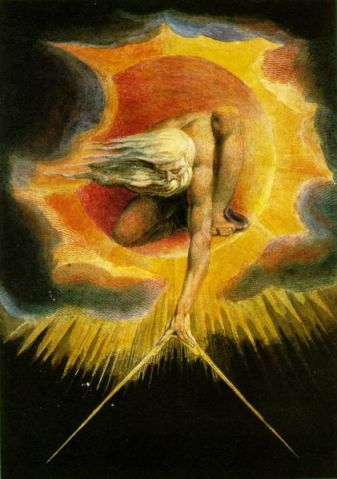
“Ancient of Days”

Here’s the Blake image I referred to in my Sunday sermon

I mentioned that the shafts of light emanating from the fingers are reminiscent of a compass, which calls to mind Milton’s description in Paradise Lost of God creating the universe:

Then stay’d the fervid Wheels, and in his hand
He took the golden Compasses, prepar’d
In God’s Eternal store, to circumscribe
This Universe, and all created things:
One foot he centred and the other turn’d
Round through the vast profundity obscure,
And said, Thus far extend, thus far thy bounds,
This be thy just Circumference, O World. Paradise Lost VII.224-231

The image of the golden compass has itself become quite familiar in contemporary culture, most prominently in Phillip Pullman’s novel of that name, recently made into a movie.

Proper 29, Year B

Christ the King

Last Pentecost, Yr B

November 22, 2009


I’ve long been fascinated by the power of visual images. For some odd reason, that power always comes to mind when I reflect on the texts for the last Sunday of the Church Year, what has come to be known as “Christ the King.” In all three years of the lectionary cycle, the texts we read paint vivid pictures of the kingship of God, and of Jesus Christ. Over the centuries, the rich and evocative biblical imagery of Christ or God ruling in majesty as a king has inspired equally rich and evocative visual images.

The one I’ve been reminded of all week is “Ancient of Days” by William Blake. Blake is one of those historical figures who is a perennial focus of fascination and debate. His religious views were unorthodox; he was a visionary, a visual artist, and a poet. The print depicts a strong man, with white hair and a long, flowing white beard. He seems to be surrounded by, and standing on the sun. He is bent over on one knee, with an arm stretched out. His fingers are splayed in a 90 degree angle and from them emanate two shafts of light, perhaps even a compass, as he creates the universe.

Blake is depicting another visionary’s image. We heard today from the Book of Daniel the description of the “Ancient one… his clothing was white as snow, and the hair of his head like pure wool; his throne was fiery flames, and its wheels were burning fire. A stream of fire issued and flowed out from his presence.”

In fact, the reason we heard these verses read was not so much for the ancient of days, but for what is translated as “one like a human being coming with the clouds of heaven” who was given dominion and glory and kingship. What is translated here as “one like a human being” reads literally in the Aramaic, “the son of man” and of course that title comes to be used in the NT of Jesus Christ. Much of the imagery in Daniel is repeated in the reading from the Book of Revelation.

A copy of Blake’s print leaned against the back of the rood screen up until last week. I don’t know how it got there or why, nor why it was removed, though I suspect its absence has something to do with the bishop’s presence here last Sunday night. Perhaps no one wanted to give him any ideas.

Images like these exercise immense power on our psyches. We are still, even the most sophisticated and intellectual of us, prone to occasionally conjure up images for ourselves of God with white hair and a beard, in a flowing white robe. On the surface such images may seem harmless, but often they can be fraught with danger. If God is an old man with white hair and a beard, then we may be prone in our relationship to God, to act toward God like we might act toward an old man with white hair and a beard.

This is even more true when it comes to other images, like kingship. Even though few of us have ever lived under a monarchy, and what passes for monarchy these days bears little resemblance to ancient monarchies, our hymns, psalms, and liturgy, is full of language of kingship: Today’s psalm reads “The Lord is king, he has girded himself with strength… Mightier than the breakers of the sea, mightier is the Lord who dwells on high.” To think of God as King seems obvious. When we think of God, we think of power and might, a vast distance between ourselves and the deity. We imagine ourselves bowing before him. Of course that’s a gesture full of meaning itself, as we heard last week of the outrage on the right when President Obama bowed to the emperor of Japan.

Both of these images—the ancient of days, and God as king resonate powerfully and seductively. Yet there are dangers when we use such language of God. You may have noted that I used the male pronoun consistently when I spoke of the Ancient of Days and King. I did so deliberately, because both of those images are tied to masculinity. What would you have thought if instead of speaking of God as King, I had begun speaking of God as Queen? No doubt many of you would have been uncomfortable, perhaps some of you would have smirked, even.

The point is that such images are used to say something about God, but in the end, they are inadequate to fully describe God, and it is relatively easy to elevate the image in our mind, to a reality. Thus children often think of God as an old man with a white beard, but as we grow older and mature, we come to see the inadequacy of that image. If we don’t we may in fact fall into the sin of idolatry.

The inadequacy of the image of kingship is glaringly obvious in our gospel passage. Pilate asks Jesus a straightforward question, “Are you the king of the Jews?” Jesus responds finally with those famous words, “my kingship is not of this world.” It’s hard for us to hear these words freshly because of our own history, and indeed our culture’s history, with these concepts. It seems to be a rather obvious and clear distinction between secular and spiritual between political kingship and divine kingship. We tend to blame Pilate, and the Jewish authorities for misunderstanding what Jesus was about. But as we’ve seen this fall while reading through the Gospel of Mark, contemporary notions of messiah-ship were focused on the political, that the Messiah would deliver the Jewish people from the Roman occupation and would restore the fortunes of the Jewish people.

What’s important to recognize is that in the synoptic gospels, in Matthew, Mark, and Luke, when Jesus rejected the notion of the Messiah as a political deliverer, he was not rejecting the political implications of messiah-ship or indeed of divine kingship. If God is Ruler, there can be no secular ruler. And of course in the Roman Empire, by proclaiming the kingdom of God, the reign or rule of God, Jesus was explicitly challenging Roman rule. That’s why there was so much conflict between the Roman empire and Christianity. In Rome, as the notion of the divine emperor developed, there was no room for another ideology that proclaimed a different ruler or emperor.

All of this may seem rather far from our twenty-first century lives, but it’s not. The temptation to equate the nation with God is a persistent human tendency that has profound, long-lasting, and dire consequences.

Nowhere is this more true than in contemporary America, where many Christians view the United States as uniquely ordained, blessed and protected by God. Perhaps it is especially common in the South, where churches advertise a special patriotic service on the Sunday before Memorial Day or the one nearest the 4th of July. Instead of hymns of praise, God Bless America, My Country tis of thee, and the like would be sung. There’s often a pageant, and the promise of a color guard, or military presence in the service.

Now don’t get me wrong. I’m not saying it’s wrong to be patriotic. It isn’t. It’s wrong to allow patriotism to take the place of religious faith or to equate patriotism with faith in Jesus Christ. To do so, is to commit the sin of idolatry and even worse to see one’s enemies then, as enemies of God, as satanic. Apparently, it has gotten so bad in some places that conservative Christians are advocating praying for the death of our president, because to them he so clearly is going against God’s will. They are apparently using a verse from a psalm as sanction for such desires.

What does it mean to think of Christ as King and ruler of all? What does it mean to imagine God reigning in majesty over the universe? These are political images so it is impossible not to draw out political implications from them. Typically when Christians have done so, they have tended to equate the political system in which they find themselves in light of that political imagery. But we live in a democracy, not a monarchy or empire.

There’s a profound irony at the heart of Christ the King Sunday. It is an irony expressed in Jesus’ words, “My Kingdom is not of this world.” Our king Jesus Christ does not ride in majesty, he rides into Jerusalem on a donkey. The purple in which he is clad is a purple that is mocked. The crown he wears is a crown of thorns. He has no palace or throne, but as he said “Foxes have holes, birds of the air have nests, but the Son of Man has nowhere to lay his head.”

Over the centuries, and even in our own day, Christians have defended and legitimized their power, wealth, and oppression of others with the language and imagery of the bible, of Christ reigning in majesty. But as Jesus told his disciples repeatedly in the Gospel of Mark, and as the gospel of Mark has reminded us all these weeks of the fall, “You know that among the Gentiles those whom they recognize as their rulers lord it over them, and their great ones are tyrants over them. 43But it is not so among you; but whoever wishes to become great among you must be your servant, 44and whoever wishes to be first among you must be slave of all. 45For the Son of Man came not to be served but to serve.”

Our ruler is a servant, not a king. His power is the weakness of the cross, not of weapons or armies. His kingdom is not of this world, and if we are his disciples, we should hope and trust in his love, not in the power and might of any government. Thanks be to God.

An interesting article in the NY Times about hunger, wealth and an Episcopal Church

The New York Times published an article about the food pantry at All Saints’ Chicago, which is located in one of Chicago’s wealthiest neighborhoods. The article is here. The author describes something similar to what I’ve noted in the line-up for the homeless shelter here at Grace. Of course the neighbors complain about the pantry attracting “misbegotten souls.” How familiar is that?

Apparently the church was vandalized today, causing considerable damage. That article is here.

I was warned before I arrived in Madison about those who would like the shelter relocated elsewhere, out of sight and out of mind. Some advocates of the shelter refer to such critics as “our enemies.” That’s language I reject. We’re not at war with anyone and I think it’s important to listen to those complaints and to talk with people who voice them. But the fact of the matter is, there would be homeless people on Capitol Square, with or without the presence of a shelter and moving the shelter away from downtown would only make the lives of homeless people more difficult.