More on the protests

From my colleague, David Simmons, Rector of St. Matthias Episcopal Church, in Waukesha, WI on why he participated in the interfaith rally on Tuesday.

Two evangelicals, Brian McLaren and Jim Wallis on the larger issue of Christianity, morality, and budgets.

Wallis writes:

As Sojourners said in the last big budget debate in 2005, “A budget is a moral document.” For a family, church, city, state, or nation, a budget reveals what your fundamental priorities are: who is important and who is not; what is important and what is not. It’s time to bring that slogan back, and build a coalition and campaign around it.

The Role of Religion in the Wisconsin Protests

The significance of Christianity in the actions of Governor Walker and among the protesters continues to be a matter of debate. Diana Butler Bass’s interprets Governor Walker’s actions in light of a talk he gave to Christian businessmen in which he said his motto was “Trust and Obey.” Walker is the son of a Baptist pastor and member of a non-denominationl church. Bass argues that absent the rich moral reasoning traditions of mainstream Christianity, Walker has developed a highly individualistic theology. To use her words:

His spiritual universe is that of 20th century fundamentalism, in its softer evangelical form, a vision that emphasizes “me and Jesus” and personal salvation.

From there, she jumps to a comparison of Walker’s position with that of President Bush whose certainty led the United States into wars in Iraq and Afghanistan. Her complete remarks are here. My guess is, she did what I did. She googled Scott Walker and religion and found this.

I find this analysis unhelpful and misleading. Granted, I’m a relative newcomer to Wisconsin; I live in Madison, which is very different from other parts of the state, and I’ve relocated from South Carolina, where religion (Christianity) does play a prominent role in politics. Plus, I watch relatively little local TV, and get my news and politics (even local) from alternative sources. So, my perspective is quite limited. Still, I haven’t noticed the foregrounding of religious language or religious arguments, either from Walker or from his supporters.

I went back to earlier coverage of Walker’s campaign in Isthmus. In an early piece on him, there was barely a mention of religion. In fact, it seems to me that religion, Christianity, has been a bit player in the drama that is unfolding and that it entered only in the second or third act. For example, last week Dan Schultz wondered where the religious voices were.

I rather doubt that Walker’s refusal to negotiate has anything to do with his religious beliefs or religious certainty. If anything, I would suspect that his religious certainty is a product of his personal and political certainty, not the other way around as Bass would have it.

Updated. Here’s The Washington Post’s Dana Milbank on Walker’s rigidity.

Theological and Faith Perspectives on the Protests in Wisconsin

I’m trying to collect links to blogs and other sites from outside Wisconsin that reflect theologically or religiously on the protests in Madison (and that don’t link back to me). So far, I’ve come up with these:

Here’s the Religion News Service report on the press event yesterday.

A blog post from Stephen Thorngate, former Wisconsin resident and currently Assistant Editor at The Christian Century.

Religion Dispatches has been following developments. Here’s commentary from Gary Laderman, Chair of the Religious Studies Department at Emory. Here’s Julie Ingersoll’s take(Hint: If I have time I will post my reflections on this essay and on the Ingersoll piece; I think they are both deeply flawed).

I want to meet Dan Schultz. He writes for Religion Dispatches, too. At least he’s in Wisconsin. He’s written a couple of things. One points out the relatively slow response by faith communities. He updates that post a couple of days later with info about those who have spoken out.

If you’ve got more, let me know. Yes, I will post thoughtful perspectives that challenge the progressive view.

Ambassadors of Christ–Reflecting on another day of protests

On February 5, Wisconsin came together in a euphoric celebration of the Packers’ victory in the Super Bowl. In bringing back their fourth Lombardi Trophy to Titletown, we anointed a new Savior (Aaron Rogers) and finally laid to rest the ghost of Brett Favre. With a young quarterback and many important players who had been lost to injury, the future looked bright indeed.

The celebration that united all of Wisconsin a little over two weeks ago is not even a distant memory. The spontaneous community created by a major athletic championship has been shattered, deep divisions within our polity have appeared and the promising future of a new Packers dynasty has given way to fear and despair.

The small Midwestern town in which I was raised was profoundly shaped by the order imposed on it by Jefferson’s vision. The square-mile grid of townships, each with a one-room schoolhouse created both civic community and a sense of common purpose. There was relatively little disparity in wealth and what there was could often be blamed on the luck of the draw—the fertility of the land on which a family had homesteaded—or individual effort and talent. To be sure, there was poverty, but most of it was found either among the migrant workers who came each year to harvest vegetable crops, or in the city.

It wasn’t until I went south for the first time to meet my soon-to-be wife’s family that I encountered enormous disparity of wealth in small-town America. I remember vividly visiting one of my father-in-law’s farms and being greeted by the children who lived in the ramshackle house on the property. It seemed more like the Third World than America.

I remember vividly as well the “Poverty Tours” Deacon Steve MacDonald would lead in Greenville. A Vietnam Vet and recovering alcoholic, Steve was an ordained Episcopal deacon and worked for United Ministries. He was an in-your-face advocate for the poor and homeless. He knew where the homeless lived. He also took us to those areas of Greenville where walls divided neighborhoods. On side of the wall were houses that sold for upwards of $1,000,000. On the other side were hovels that lacked central heat, water, and often even electricity.

The Republican Party came to power in the South by using race to divide poor and working class whites from African-Americans, whose economic interests they shared. Politicians in the South continue to play off of division, competing with other states and regions of the country to attract manufacturing and other businesses.

Apart from everything else that is going on, it seems to me that what we are seeing in Wisconsin this week is a similar tactic of division. Instead of bringing people together as a community to come up with solutions and cooperate on solving our state’s problems, Governor Walker and other Republicans are seeking to consolidate power by creating division among our populace. Union members are vilified as freeloaders and undeserving of the wages and benefits they receive from their jobs in the public sector. The code words and rhetoric remind me very much of the language used in an earlier time to attack “welfare queens” and the like.

Among the calls in yesterday’s Interfaith press conference was a vision of shared sacrifice. As religious communities, it is our responsibility to hold up a vision of a common good, in which people of good will come together to solve society’s problems. Whatever our differences—class, race, even political views—we are all created in God’s image. As Christians, we need to do Jesus Christ’s work in the world, breaking down the barriers that divide us, being Christ’s ambassadors, offering reconciliation where others sow division.

This is what religion should look like

The protests continued today. As the Interfaith Press Conference took place on the steps of Grace Church, correctional workers, members of the IBEW, and others marched into the capitol. After representatives from various faith groups spoke about the need for justice and for society to care for the neediest and most vulnerable, many of us walked across to the Capitol as well. Among the speakers were Bishop Miller of the Episcopal Diocese of Milwaukee and Bishop Burnside of the ELCA Synod of Southern Wisconsin.

Here’s what it looked like when we entered the rotunda:

Thanks to Shannon Kelly for the video.

There does seem to be a much more visible and numerous police presence, many of them from out of town communities. That makes things seem a bit more tense on the square, but spirits still seemed high in the Capitol.

We need to continue to hold in our prayers all those involved–the politicians, the protesters, the public sector workers and all in Wisconsin who are concerned for the future of this state and the society that we are building.

Reflections on Day 8

Not as many people on the square today as there were last week, but the weather was awful. Didn’t catch sight of the Daily Show’s John Oliver, who was said to be interviewing people on the square around lunch time.

The response to us opening our doors has been overwhelming. As a gesture it seems to have struck a chord in the community, and to some degree, more widely. There are concerns about security but welcoming people in, giving them space to warm up, reflect, and pray, is being hospitable. There haven’t been all that many people who have taken advantage of our space. Yesterday, for example, when I walked through the sanctuary to check on things, there were three people sitting in pews. They all looked exhausted. Later, a cop used our restroom; when he didn’t come back upstairs after quite some time, we went looking for him. He was relaxing on a couch in the undercroft. He needed a break.

Some might say to open our doors in such a way is to take a political stand on one side or another. To me, it’s being church. Because of our location, anything we do or don’t do, could be interpreted as taking a stand. Keeping the place buttoned up while 30,000 people are protesting outside our doors, sends a powerful message about who and what Grace Church is, just as keeping our doors closed during the Dane County Farmer’s Market (when similar numbers inundate the square) sends an equally profound message.

We did Evening Prayer last night during a rally. Praying, reading scripture, psalms, and canticles while all that is going on is jarring, but a profound experience. I was deeply moved as we said the Magnificat:

He has cast down the mighty from their thrones,
and has lifted up the lowly.
He has filled the hungry with good things,
and the rich he has sent away empty.
He has come to the help of his servant Israel,
for he has remembered his promise of mercy,
The promise he made to our fathers,
to Abraham and his children for ever.

And as we prayed together:

Keep watch, dear Lord, with those who work, or watch, or weep this night, and give your angels charge over those who sleep. Tend the sick, Lord Christ, give rest to the weary, bless the dying, soothe the suffering, pity the afflicted, shield the joyous, and all for your love’s sake. Amen

Wisconsin and South Carolina

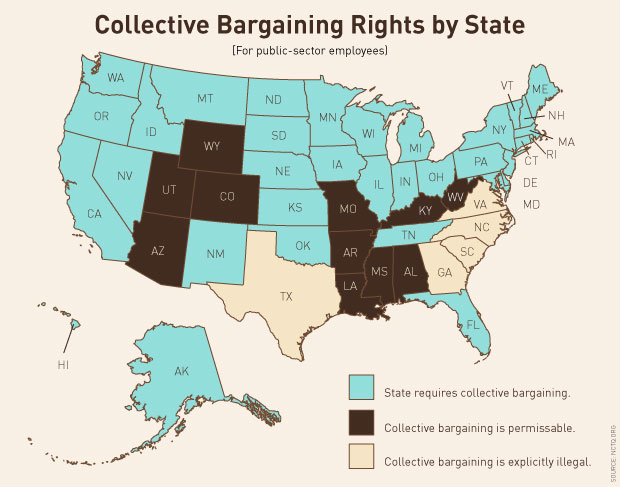
There are a couple of things going around the web that put my move in 2009 from Greenville, SC to Madison, WI in perspective. One of them is somewhat misleading, if memory serves me correctly.

The first is the map that shows states allowing collective bargaining as opposed to those that don’t.

I’m grateful for the map because it confirmed what I had suspected. I recalled that there was some major conflict while we lived there when the state patrol attempted to organize, not even to begin a union, and were shut down.

The other is the statistic related to ACT/SAT scores which a number of sources have correlated to the collective bargaining map. It turns out, South Carolina ranks #50 on that list. This may be misleading because, if memory serves me correctly, the ACT is taken by all South Carolina High School students.

Whether or not the latter is true, what is true is that South Carolina schools are woefully underfunded and teachers underpaid. I was amazed to learn that universal public education didn’t exist in the state until the 1920s; that even then, transportation wasn’t provided. Much of that was due to racism and Jim Crow laws but it also reflected a different vision of the public good than that which was created in the old Northwest Territories by Thomas Jefferson, with the provision for a school in every township.

More surprising still was the revelation that as late as the early 1970s, school buses were driven, not by adults but by high school students who had demonstrated their maturity. Yes, that’s right (at least in Greenville County). I was sitting at a vestry dinner when I learned that. My jaw dropped. I was flabbergasted, but the Greenville County natives were shocked that I found this odd.

I know teachers and other public service workers in South Carolina who work incredibly hard for little pay and little respect. I also know that many of them struggle to make ends meet and struggle to maintain their self-respect. I am in awe of them. I am also in awe of all of those in Wisconsin and throughout the country who work hard to make our nation, our states, and our local communities better places.

One last thing. I can’t imagine protests like the ones taking place in Madison occurring in South Carolina. I remember all too well the vitriol which came about when Furman faculty members protested President Bush’s visit to commencement in 2008. But I hope that what is happening in Madison gives heart to public service workers across the country. You are patriots and we owe all of you a great deal.


Nonviolence

Nonviolence has been very much in the news of late, with the uprisings in Tunisia and Egypt. The New York Times profiles one of the leading theorists of nonviolent direct action, Gene Sharp. I met Gene Sharp back in the 1980s when our non-violent efforts were directed at the proliferation of nuclear weapons and US actions in Central America. Nonviolence has been much on my mind this week, because of the gospel reading for this Sunday:

Jesus said, “You have heard that it was said, `An eye for an eye and a tooth for a tooth.’ But I say to you, Do not resist an evildoer. But if anyone strikes you on the right cheek, turn the other also; and if anyone wants to sue you and take your coat, give your cloak as well; and if anyone forces you to go one mile, go also the second mile. Give to everyone who begs from you, and do not refuse anyone who wants to borrow from you. (Matthew 5:38-42)

While it may seem on the surface that Jesus is advocating complete passivity, that is not the case. The Greek word translated here as “do not resist” could be translated more literally as “stand against.” The actions Jesus mentions, turning the other cheek, giving one’s cloak as well as coat, and going the second mile, are, as MLK and Gandhi pointed out, intended to transform the oppressor.

Here’s an interview with Gene Sharp, author of The Politics of Nonviolent Action. It focuses on events in Egypt and Tunisia, but is interesting in light of ongoing events here in Madison.

Here is the section of questions related to religion:

NS: While watching the coverage, many of us were struck by the images of Muslims and Christians protecting each other while praying. Do you think religion was a significant factor?

GS: Not from anything that I have found so far.

NS: Nonviolence and pacifism have often been historically associated with religions, like Jainism and Christian “peace churches”—

GS: Yes, that’s right.

NS: Is religion at all essential to motivating nonviolent movements, or can the ideas transcend their religious origins?

GS: It’s not even a question anymore. They have transcended religious boundaries. If people come from any particular religious group and are inspired to be nonviolent and to resist—not just to be nonviolent and passive—that’s fine. But don’t claim that they have to believe in a certain religion. Historically, for centuries and even millennia, that has not been true. Nonviolent struggle, as I understand it, is not based on what people believe. It’s what they do.

NS: But don’t cultural differences make some societies more likely to act nonviolently than others? Or is everybody equally equipped to do so, independently of their culture?

GS: Setting culture aside for the moment, not everybody is equally equipped to do anything. But when The Politics of Nonviolent Action was first published in 1973, the famous anthropologist Margaret Mead said in her review that what I was maintaining—without saying so, in so many words—was that this is a cross-cultural phenomenon.

NS: There have certainly been stereotypes suggesting that Muslims couldn’t do something like this, that they can only use violence.

GS: It’s utter nonsense. In the North-West Frontier Province of British India, the Muslim Pashtuns, who had a reputation for great violence, became even braver and more disciplined nonviolent soldiers than the Hindus, according to Gandhi. It’s a very important case. And when my essay “From Dictatorship to Democracy” was published in Indonesia, it carried an introduction by Abdurrahman Wahid, a Muslim leader who later became president.

Interfaith Event at Grace on Tuesday

Details are still being worked out, but an event organized by Madison Urban Ministries will take place at Grace Church beginning at 10:30 AM. I anticipate some sort of prayer vigil in conjunction with the Governor’s scheduled budget speech. Join us this Sunday for services! This week’s lectionary readings certainly speak to what’s happening on the streets outside of Grace.

Bishop Miller’s letter to the Diocese of Milwaukee

A Letter from Bishop Miller to the Diocese of Milwaukee


February 18, 2011


Dear Friends in Christ,

Over the last few days we have witnessed freedom and democracy at work both around the world. I am pleased to report to you that our friends in our former companion diocese of Egypt are safe and that the missionaries of The Episcopal Church serving in Egypt are continuing their ministry in that place. I know you will join me in continuing to hold the people of Egypt and the rest of the Middle East in your prayers.

This past week we have also seen democracy at work in Wisconsin as thousands gathered in Madison in response to the Governor’s Budget Bill. Regardless of our individual positions on the bill before the Legislature and what steps are necessary to build a stronger and better Wisconsin, I believe we can all agree that our baptismal vow to “respect the dignity of every human being” is not served by a majority simply pushing through legislation because they have the votes necessary to do so. As Christians, it is our duty and call to make sure that everyone has a place at the table and every voice has the opportunity to be heard. Respecting the dignity of every human being requires taking the time to have honest and faithful conversation that respects the rights and freedoms of all.

We also are called to speak on behalf of the sick, the poor, the elderly, orphans, widows, and all those who live in the margins of our society. Matthew in his Gospel reminds us that in serving these we are serving the Lord Jesus himself. It would be a sin to balance our state budget on the backs of those who have the least.

As your bishop I ask you to do two things. First, contact your representatives and invite them to true leadership by taking the time to listen to the voices of all and provide a guarantee that the voices of all will be heard on the future. Secondly, pray for elected officials daily, by name. Leading is a difficult task that requires the prayer support of many. I know that I could not lead this diocese without the prayers of each of you.

May God continue to bless us his people that we may be a witness to the world.

Yours in Christ,

The Rt. Rev. Steven A. Miller

Bishop