
Blinded by the Light: Lectionary Reflections for 3 Easter, Year C

This week’s reading from Acts is the story of Paul’s encounter with the Risen Christ on the Road to Damascus (Acts 9:1-6). It’s a story that has come to define Christian experience especially in Evangelical Christianity. It’s not just the importance of conversion but the importance of a dramatic conversion, a complete reversal. John Newton’s “Amazing Grace” describes it in one way, “I once was lost, but now I’m found.” In Evangelicalism, even that can’t describe how dramatic conversion is expected to be, a turnaround from a dissipate life to a life in Christ.

Luke describes Paul’s experience in these terms. There are two versions in Acts, the one in chapter 9 and also a version put in Paul’s mouth in Acts 22:3-16. It is from the former account that the interesting details come: the road to Damascus, the blindness.

Interestingly, Paul also gives accounts of his story. One of the most important is in Galatians 1. There, Paul offers a different account of what happens after the encounter than that given by Luke. More importantly perhaps, he also uses different imagery to understand his experience. For Paul, it’s not a conversion but a call:

But when God, who had set me apart before I was born and called me through his grace, was pleased 16to reveal his Son to me, so that I might proclaim him among the Gentiles (Galatians 1:15-16)

Paul uses language that draws on call narratives of Hebrew prophets. Compare Jeremiah 1:5:

‘Before I formed you in the womb I knew you,
and before you were born I consecrated you;

Paul’s experience as constructed by Luke has shaped Christianity as well as popular culture. Christians have sought to understand and construct their experience to conform to the model of a dramatic conversion and if they’ve never experienced Christ in that way, they wonder whether their faith is truly authentic. And if they’ve never lived a dissolute life, if they’ve been raised in Christianity and consistently attended services, it’s pretty hard to have an evil past from which to convert.

Conversion is real for many people, but it’s not the only, nor even the normative category for thinking about the Christian life. If Paul understood what happened to him as God calling him in a new direction, so can we. There are times when Paul looks back on his past and sees evil but he can also boast about who he was:

If anyone else has reason to be confident in the flesh, I have more: 5circumcised on the eighth day, a member of the people of Israel, of the tribe of Benjamin, a Hebrew born of Hebrews; as to the law, a Pharisee; 6as to zeal, a persecutor of the church; as to righteousness under the law, blameless. (Phil 3:4-6)

This week’s reading, and Paul’s experience, invite us to think about how we understand our own lives in Christ and to explore imagery that helps us name that experience and invites us into deeper relationship with the One who knows us and calls us by name.

(I’ve previously reflected on Paul’s conversion here).
A Sermon for the Fourth Sunday after the Epiphany, Year A

The Foolishness of the Cross
Fourth Sunday after Epiphany
January 30, 2011

I love to bless stuff! I’ve made something of a joke of it over the years. I’ll bless anything. In part, that’s because of the priests I’ve worked with, one of whom always seemed to have an aspergillum near to hand. Aspergillum—if that word is unfamiliar to you, think of it as a “holy water pot.” Around here, I’ve blessed the new freezers and coolers in the food pantry, the youth room space, animals of course, on St. Francis’ Day, and most recently the new dishwasher.

For some, such stuff smacks of superstition or silliness, but it’s not, or only sometimes, and on the surface. Blessing is important, even the blessing of inanimate objects reminds us that they are set aside often, for important uses. Blessing is not a ritual cleaning, or a magical act. To bless things, whether it’s a dishwasher, a dog, or the food before we begin eating, underscore the sacred nature of all of creation and that even ordinary things can be set aside for holy use. Continue reading

Grace in Ordinary Time: A Sermon for Proper 5, 2010

Finally, things are beginning to settle down. We have entered that period of the church year known as Ordinary Time, the weeks after the Feast of Pentecost. We will be in Ordinary Time all the way through November, right up to the beginning of the next church year, which begins on the First Sunday of Advent. Since last December, we have been following, more or less, the life of Jesus from his birth, through his baptism, on to his death and resurrection. With our celebration of his Ascension and Pentecost, when we remember the coming of the Holy Spirit, we turn our attention away from Jesus’ nature, his life and death, and turn toward his teachings and his ministry among the people of the Roman territory of Palestine in the first century.

Continue reading

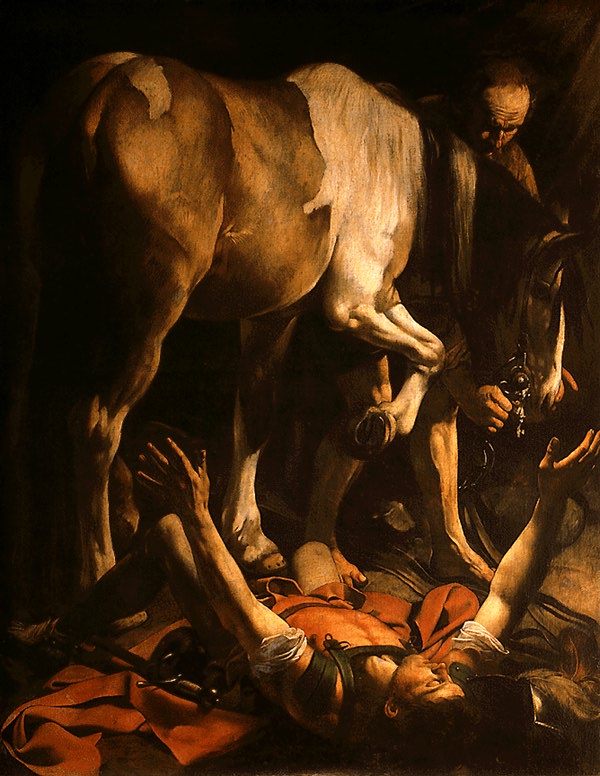
The Conversion of St. Paul (or another excuse for posting a Caravaggio image)

Today is the Conversion of St. Paul. There are at least three versions of this event in the New Testament. The most famous is Acts 9:1-22. From there we have all of the juicy details–Paul’s persecution of the early Christian community, the road to Damascus, his ensuing blindness. Luke gives us another version of the same event in Acts 22:3-16. Paul describes the same event in rather different terms in Galatians 1. Paul’s account describes a different sequence of events following his “conversion,” but more importantly, he doesn’t use language of conversion at all. Instead, Paul writes of being called:

But when God, who had set me apart before I was born and called me through his grace, was pleased 16to reveal his Son to me, so that I might proclaim him among the Gentiles (Galatians 1:15-16)

The notion that Paul’s conversion was a dramatic break from the past is firmly fixed in Christian thought and devotion and there is some legitimacy to it. Paul himself describes a radical break from his past of persecuting Christans. However, in another way, it wasn’t a conversion. He does not see himself “converting” from one religion to another, from Judaism to Christianity.

Still, conversion holds a powerful grip on Christian reflection, and indeed that grip has strengthened over the centuries, especially since the 18th century Evangelical Revival (led by the Wesleys and George Whitefield).

Whatever one thinks of the historicity of Luke’s account, and the utility of viewing the Christian life in terms of conversion, perhaps the most powerful depiction of Luke’s version is that of Caravaggio: