
It might be a vision from God, it might be your stomach growling: A Sermon for 5 Easter, 2019

Today marks the end of the program year for our Christian Formation program. It’s a custom here at Grace that on this day we recognize all those who have worked in our Christian formation program as teachers and as volunteers and to invite the children and youth in the program to participate in our service by serving as ushers, lectors, and Eucharistic ministers. Things are always a bit chaotic on this day, which is not necessarily a bad thing. We experience the full breadth and depth of our congregation—its diversity in ages. And we see concretely how our Christian formation program has grown over the last decade. This year we added a second class during the 10:00 service to accommodate that growth, and next year, we anticipate dividing the older group that meets at 9 into separate classes for middle and high schoolers. Much of the success of the program is due to the energy, passion, and creativity of Pat Werk, and also to all those volunteers whom we will recognize later in the service.

That’s all a sign of growth and change at Grace. While we might welcome such growth, it’s also important to recognize that growth brings with it some challenges. We may not know or recognize everyone who worships with us on Sunday mornings; the presence of children in our services can also make things a little more chaotic, and not just on this Sunday morning. And we are struggling with space. As we consider splitting the youth into two classes, finding space for the second class to meet will require some flexibility and creative thinking.

In the book of Acts, we read the story of the spread of the gospel and the growth in numbers of the followers of Jesus in the first years after Jesus’ crucifixion and resurrection. Luke tells us a story full of drama and excitement but he also records some of the conflict that such growth involved. We see some of that conflict here, in the story of Peter and Cornelius.

Have you ever been in a situation where someone you respected, someone in authority told you to do something you had never done before, something that went against everything you had been taught, would have challenged your very sense of identity, who you were, how you understood yourself, your deepest values? Can you imagine that? How would you respond?

That’s just what happened to Peter. He was staying with Simon the Tanner in Joppa and as he waited for lunch, he had a vision that unsettled him and challenged his very sense of self. A cloth comes down, on it are all sorts of unclean animals. A voice calls to him, “Get up, Peter. Kill and eat.” Peter refuses. The same thing happens three times, and just as the vision comes to an end, messengers sent by Cornelius knock at the door. Peter and some others go with them. Peter preaches to Cornelius’ household, the Holy Spirit comes down on those present, and Peter baptizes them.

We hear the second version of that story, as Peter retells it to the gathered community in Jerusalem after his return from Caesarea. It wasn’t a simple update from Peter to the home office. There was grave concern about what had happened while he was traveling:

Now the apostles and the believers who were in Judea heard that the Gentiles had also accepted the word of God. So when Peter went up to Jerusalem, the circumcised believers criticized him, saying, “Why did you go to uncircumcised men and eat with them?”

In other words, they weren’t bothered that Peter had preached to Gentiles or that he had baptized them. What concerned them was that he had eaten with them. Peter had visited Cornelius, stayed with him for several days, and had eaten at his table. From Luke’s perspective, this all would have been offensive to observant Jews.

Let me take a moment to unpack this. It’s crucial to compare the New Testament accounts with what we know from other sources and in this case, Luke is mis-stating the nature of Jewish practice in the first century. Certainly, observant Jews maintained strict dietary laws—eating only those foods that were clean by biblical standards. That’s what was at stake in the vision Peter had. But the notion that as Luke records a bit earlier (Acts 10:28) “it is unlawful for a Jew to associate with or to visit a Gentile” is wrong. In 1stcentury Palestine, it would have been impossible for Jews not to have had contact with Gentiles. So Luke is depicting Judaism in negative terms here, and also caricaturing the position of Peter’s critics.

Now certainly there were important issues at stake. We will see the conflict again next week as we hear the story of Paul’s visit to Jerusalem and the so-called Jerusalem council. The question whether Gentiles who accepted Jesus as the Messiah needed to be circumcised and to follow Jewish dietary laws was an important one. From the perspective of 21stcentury Americans, it’s hard to understand what was at stake, and to take seriously the concerns around circumcision. We know how the story ended.

But given the resurgence of Anti-Semitism and Anti-Judaism, we must recognize when new testament texts and their authors present Judaism in negative light and provide cover for contemporary anti-semitism. This is one of those places. It’s obvious to us that circumcision and Jewish dietary laws no longer apply and we regard those who wanted to maintain them misguided. They were in a very different place. The relationship between the Jesus movement and Judaism was not defined. The emergence of two religions—Judaism and Christianity—was not at all an obvious development.

But there are other lessons for us here. We should think carefully about the relationship between Judaism and Christianity, the ways in which our sacred texts and Christian history have led to persecution, anti-semitism, and ultimately the Holocaust.

We often look at the story of Acts, the spread of the Gospel, the movement of the Holy Spirit, and the resistance to that from certain parties and interpret our own experiences and the life of the 21stcentury church in light of that narrative. How many times have people said when change is happening in the church, that the Holy Spirit is moving or doing a new thing? When the question is asked that way, the speaker always is advocating that change is good, that the innovation is a faithful adaptation of our faith to new realities.

I’m not so sure. There’s a passage in Deuteronomy that I’ve always found helpful here. The text is addressing the rise of false prophets and raises the question of how to distinguish true from false prophecy. Well, the answer that’s offered isn’t particularly reassuring—basically the advice is to wait and see whether the prophecy comes true. In other words, you can’t really distinguish true and false prophecy until after the fact.

Our congregation is experiencing change. The Episcopal Church is experiencing change, Christianity in America and worldwide is experiencing change. We may be uncomfortable with some of those changes; we may welcome them but as faithful Christians our ultimate task is to discern the work of the spirit, to listen to scripture and tradition, to pay attention to voices on all sides of an issue, and seek God’s wisdom and will in the midst of it, recognizing that our perspective might not be correct in the long run.

And the vision we receive, the voice that tells us, “Get up, kill and eat” may be heaven. It may also be our stomachs growling.


The Disciple named Tabitha: A sermon for the Fourth Sunday of Easter, 2019

When I was a boy, one Wednesday a month, my mother would drop me off at my grandfather’s house to spend the day while she took my grandmother and my sisters to the church to what was called “Sewing.” The women of the church gathered together to work on quilts, comforters, and other sewing projects that would be donated to relief sales or sent to people in need—after natural disasters, for example. I’m not sure when or if the custom ended, if it died out like so many other customs did with our changing culture. Continue reading

Living the Easter story: A Sermon for the Easter Vigil, 2019

A few minutes ago, we baptized Adrian and Roland. If my math is correct, Adrian celebrated his 30thbirthday yesterday; Roland was born on January 15, so he’s just over 3 months old. Adrian has a story he tells about himself, where he came from, who he is. Roland’s story is just beginning and he isn’t able to tell it yet.

But tonight, both of them entered into another story, the story of salvation. We heard some of those highlights in the series of readings from Old Testament, beginning with Creation, the Flood, and the deliverance at the Red Sea. We heard another version of that story in Paul’s description of baptism from the letter to the Romans: Continue reading

Scandal and Glory: A Sermon for Good Friday, 2019

We have heard again the dramatic, heart-breaking story of Jesus’ arrest, trial, and execution as recorded in the Gospel of John. For those of us who know it well, it is a story that grips us with gut-wrenching power. It also may repel us because of the ways it has been interpreted, the ways we’ve internalized the story and meaning of the crucifixion, and in John’s case the unrelenting, offensive anti-Judaism that jumps out at us. Continue reading

Walking, Riding, Dying: A Homily for Palm/Passion Sunday, 2019

How many miles had Jesus walked on his long journey to Jerusalem? Way back in chapter 9, Luke tells us “When the days drew near for him to be taken up, he set his face to go to Jerusalem.” But even before that, he had been walking throughout Galilee. He had walked and along the way he had healed and taught. Now, finally, as he approaches Jerusalem, he instructs his disciples to fetch a donkey so he could ride on it for a bit.

He may have been tired. He may have been full of anxiety and fear about what would happen in Jerusalem, but he didn’t ask for a donkey so that the final leg of his journey would be less taxing. He wanted to ride on a donkey to make a point—to stage a demonstration. It’s a clear reference to Zechariah 9:9: Continue reading

The Disciple who poured out love: A Sermon for Lent 5C, 2019

A few days ago, I had one of those uncomfortable encounters I have from time to time in Madison. I had stopped into Barrique’s for a cup of coffee, and sat down at a table to read through the latest Isthmus edition. There were two well-dressed men at the next table having a conversation. One of them saw me and began to ask me about the shelter. What followed was a fifteen minute rant about the evils of homelessness and the need to construct a shelter somewhere else than downtown. Their brilliant idea was to put it down by the Alliant Center, far away from their places of business and residence downtown, far enough away that they wouldn’t be bothered by homeless people, or presumably by panhandlers because they could not get downtown anymore. Continue reading

A manipulative son? An over-indulgent father? A Sermon for 4 Lent, 2019

How many of you remember watching as your parents let a sibling get away with things they would never have permitted you, or seemed to treat them better, more lovingly than they treated you? How many of you parents have had the experience of loving one child just a little bit more than your other children? Or at work, watching as a co-worker received special, and undeserved treatment while you had to stay late, or failed to get the credit, or the promotion, you deserved? Continue reading

Be merciful as God is merciful: A Sermon for 7 Epiphany, 2019

Who’s your enemy? Take a moment and think about them. Who is it? Why are they your enemy? Is it someone you know, someone who wronged or hurt you deeply? Is your enemy more abstract—do you think of political figures or groups whose ideas and actions offend you? Or is it members of another religious or ethnic group whose hateful rhetoric and violent tactics threaten you? Draw a picture in your mind of the person, real or imagined, whom you passionately and completely hate. Be honest with yourself; there’s someone or some group that you hate…

Jesus said, “I say to you that listen, Love your enemies, do good to those who hate you, bless those who curse you, pray for those who abuse you. If anyone strikes you on the cheek, offer the other also.

Hard words, challenging words. Words that seem so far beyond human possibility that we assume they must be hyperbolic, intended to demonstrate to us once and for all, human incapacity to do the right thing. Or perhaps they are meant only for the perfect few, saints like Francis or figures like the Dalai Lama who seem to be live on a completely different plane of existence than those of us in our busy, messy, complicated lives.

But what if they are meant for us, too?

Remember where we are in Luke’s gospel and what we have already heard. Jesus has come down from the mountain to a level place with his disciples. There was a large crowd pressing in on him, seeking the healing power that came out from. And in the middle of that throng, Jesus lifted his eyes up to his disciples and began to teach. As we saw last week, he began with the beatitudes, a series of blessings pronounced on the poor, the hungry, those in mourning and those being persecuted. Corresponding to that series of blessings was a series of curses: on the rich, the full, those who are laughing, and those who are respected or well-regarded.

Binary oppositions, blessings and curses, reversals of fortune. As I pointed out last week, how we react to these contrasts and reversals very much depends on where we situate ourselves; with which groups we identify.

Now Jesus shifts gears, and the ground under our feet shifts as well. For instead of allowing us to position ourselves comfortably, Jesus’ words strike home uncomfortably, challenging the distinctions we make, upending our assumptions, our attitudes, breaking down the lines we draw between “us” and “them” between those who belong to our group, deserve our love and compassion, and those on the other side of the border, our enemies, outsiders.

I feel the need to come clean with you—these verses: Love your enemy, turn the other cheek profoundly shaped my upbringing and ultimately how I still strive to follow Jesus. I hesitate to bring up my background as a Mennonite publicly because it too quickly becomes little more than a curiosity, something exotic. But these verses and stories interpreting or embodying them have entered the marrow of my bones and shaped my heart and soul. I’ll tell just one of those stories.

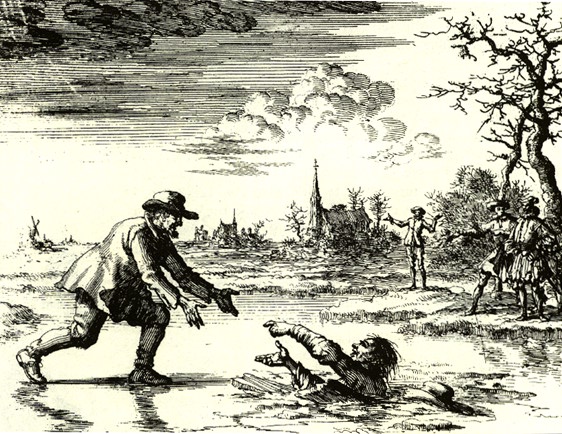
In the 17thcentury, Dutch Mennonites, after gaining toleration and becoming successful merchants, compiled a collection of stories of the men and women who had been killed for their faith in the sixteenth century. Many of the stories are accompanied by engravings. One of them depicts the story of Dirk Willms who had been convicted of heresy for believing and practicing adult rather than infant baptism. On the way to the place of execution, he somehow escaped from the authorities, running for his life. He crossed an ice-covered river, one of his captors in hot pursuit. But the pursuer broke through the ice and was in danger of drowning. Willems could have gone free, he was across the river, but instead, he went back, and helped his captor to safety. It may surprise you to learn that in spite of his heroism, Willems’ execution went on as planned.

It’s a story that strikes us as unbelievable, relating behavior that to us is inexplicable and foolish. It’s no way to live one’s life, no way to survive as an individual, much less as a community, a church, a nation. Whether or not we find Jesus’ words believable, or relevant, or possible, the challenge to love our enemies, turn the cheek, to give one’s shirt as well as one’s coat, to lend expecting nothing in return confronts us with questions of personal worth and value, the relative importance of self and other, and yes, sheer survival.

But these words challenge us in other ways. For those of us with privilege and status, they pierce the armor of our wealth, gender, color. For those of us without, they work very differently. It’s important for us to be conscious of how they have been used and interpreted over the centuries and even today—how they have been used to oppress and to maintain structures of injustice. Even today, how many pastors counsel victims of domestic violence to turn the other cheek and passively accept the blows of their husbands or fathers?

What if, instead of commands, these words are meant to unsettle and de-center us, to move us away from the certainty of our existence and the world we know into a journey toward a new world, where God reign’s and where God’s love is the model for all of our relationships and for all of human community? Jesus came down from the mountain to a level place where he taught a vision of a new world order, coming into existence in the community of his followers. It is a vision of a community with no barriers or boundaries, no distinction between rich and poor, friend and enemy.

As hard as it is for us to imagine, or even to articulate, there is yet one more step to take. When we view these words as commands, we place our behavior on a continuum of obedience: Should I turn the other cheek? Did I turn the other cheek? And if in a particular instant we choose not to, because of fear or threat to life and limb, or simply because our anger overwhelms us, we may judge ourselves and feel shame and guilt for falling short.

Luke, in his compassion and concern for his readers, offers hope and consolation even on such occasions. In Matthew’s version of these sayings, Jesus concludes with the admonition: “Be perfect, as your Father in heaven is perfect.” Luke’s version is quite different, “Be merciful, just as your Father is merciful.”

Using this as a lens by which to read Jesus’ statements offers us a new way of seeing, a new world of possibilities, the reign and realm of God—where the neat calculus of debt and repayment, crime and punishment, eye for an eye no longer is operative. And that’s true not only for the specifics that Jesus talks about but also for us. We need not use this calculus on our own lives and actions. God is merciful and invites us to receive God’s mercy and in turn to offer it to others and to the world.

The instructions which Jesus gives his listeners on the level place are instructions that address our actions towards those who act violently or unjustly against us (love your enemy, turn the other cheek) and address our actions towards those with whom we are already in relationship (if you love those who love you). But the heart of the matter seems to be that whether friend or foe, our actions should not be guided by how others treat us but rather by how God treats us: Be merciful as your Father is merciful.

It may be that we often interpret God’s disposition toward us in terms similar to how we act towards others, loving friends, hating enemies experiencing guilt, expecting punishment when we sin. But God is merciful and forgiving. Receiving God’s mercy and grace gives us the power to share that mercy and grace with others.


The Glory of the Lord revealed in level places: A Sermon for 6 Epiphany, 2019

As we work through the Gospel of Luke this year, we will have a number of opportunities to explore this gospel writer’s unique perspective on Jesus and on the early Christian community. Like Matthew, it’s probable that Luke wrote with a knowledge of the Gospel of Mark and with Matthew he had access to a source that provided much of the material for Jesus’ teachings that appear in both Matthew and Luke, teachings like the ones here, known as the Beatitudes. But each of the gospel writers introduce additional material that is unique to their gospel. In Luke, this includes many of the most familiar and beloved parables—the Good Samaritan, The Prodigal Son, are examples of this other material. Continue reading

Encountering God: A Sermon for the Fifth Sunday after the Epiphany, 2019

I entered the chapel at the monastery of the Society of St. John the Evangelist exhausted by the long day of travel from Madison. I’d had only enough time to drop my things in my room before the evening Eucharist. Stressed, tired, distracted, as I entered the space, I was immediately reminded why I had come here. It’s a remarkable space, perfectly, beautifully designed. You’re suddenly thousands of miles and a thousand years away from Harvard Square in Cambridge. Designed by architect Ralph Adams Cram in the Romanesque style, the walls are stone, with roman arches throughout, lovely stained glass windows dominated by deep blues. Continue reading