
Hooker, Covenant and No-Covenant: Or, the uses and abuses of history

For Anglicans and Episcopalians, the big news this morning wasn’t the election results in the USA but the announcement of a new coalition directed against the Anglican Covenant. Called noanglicancovenant, it has a website, a facebook page, press–at least among bloggers–and its own logo:


Thinking Anglicans announced:

International Campaign Seeks to Stop Anglican Covenant

It wasn’t a coincidence that the announcement came on November 3, the date of the commemoration of Richard Hooker in Anglican calendars:

Susan Russell wrote to members of the Anglican Resistance Movement’s facebook page,

It is no coincidence that today — November 3rd AKA the Feast of Richard Hooker — was chosen to launch an international campagin to oppose the proposed Anglican Covenant.

The new website — No Anglican Covenant: Anglicans for Comprehensive Unity — offers an impressive wealth of resources, background information and context to inform, empower and engage in the process of pushing back on this ill conceived proposal. And I am honored to listed among a truly amazing cloud of witnesses calling our communion to reclaim its foundational value of Anglican comprehensiveness.

Like a wolf in sheep’s clothing, the current proposal is coercion in covenant clothing. Scripture and tradition tell us to value the ideal of Covenant. Reason tells us to reject this proposal lest we throw out the baby of historic Anglican comprehensiveness with the bathwater of hysteric Anglican politics.
Tobias Haller chimed in: Richard Hooker’s Smiling
Don’t misunderstand me. My sympathies lie with the No-Anglican-Covenant group. I think it’s a bad idea on several levels. My problem is with the attempt to bring in Hooker to support it.
The church and the world in the twenty-first century are very different than they were in the 1590s when Hooker wrote The Laws of Ecclesiastical Piety. To appeal to him for support is misguided. Today scholars debate the extent to which Hooker was Reformed in theology and whether he can be seen as the architect of the via media or of what later came to be called Anglicanism.
What is certain is the immediate context in which he wrote The Laws. In 1593, Parliament was debating a series of laws that would increase penalties against Roman Catholics and introduce new restrictions on radical Calvinists. Hooker wrote The Laws in an attempt to convincing wavering members of the House of Commons that the restrictions against the Radical Protestants (later called Puritans) were necessary and legitimate. In other words, Hooker was writing in support of the Crown’s use of coercion to enforce uniformity.
That shouldn’t surprise anyone. The Church of England was the Established Church (it still is, of course) and Elizabeth demanded outward conformity to the Church from her subjects, while famously admitting that she couldn’t “see into men’s souls.”
We can debate Hooker’s contributions to Anglicanism; we can’t debate the fact that he wrote in support of forced outward conformity.

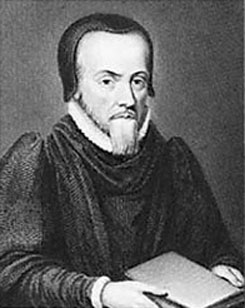
Richard Hooker, 1600

Today we remember Richard Hooker, who died on November 3, 1600. Hookrt is one of the great icons of Anglicanism, although that term was unknown to him, and certain Anglicanism whatever it means today, would be unrecognizable to him.

What established his reputation for later generations is The Laws of Ecclesiastical Polity. Bloggers occasionally like to run contests about books that everyone claims to have read but few people actually have; if there were such a context in the Anglican world, I’m sure The Laws would fare very well. It’s dense reading, in a prose style that is quite alien to modern sensitivities and I can’t imagine there are many people today with the stamina to make it all the way through all five books. Hooker was a man of immense learning and it shows throughout. He draws on patristic sources and on the scholastics, especially, Thomas Aquinas, in making his arguments.

Hooker is credited with originating the “three-legged stool” of Anglicanism, referring to the authority of scripture, tradition, and reason (actually he thinks of the latter more in terms of common sense). The image is not his own, and in his work, the three are not quite equal. Scripture is paramount. Hooker was a Protestant, after all. Reason is used to help elucidate scripture, especially when scripture seems unclear or contradictory. Tradition, too, is largely viewed as an interpreter of scripture.

Hooker’s pre-eminence in later Anglican tradition is largely due to historical developments. As conflict over theology and ecclesiology deepened in the seventeenth century, Hooker’s half-hearted defense of the episcopacy and his moderate Calvinism became weapons in the war against outright Puritanism. Having defended the Elizabethan Settlement, Hooker came to stand for the via media, even as the poles between which the via media balanced shifted dramatically.