
The readings in the daily Eucharistic lectionary for Tuesday in the first week of Advent include Isaiah 11:1-10, the prophet’s vision of the peacable kingdom:
6 The wolf shall live with the lamb,
the leopard shall lie down with the kid,
the calf and the lion and the fatling together,
and a little child shall lead them.
7 The cow and the bear shall graze,
their young shall lie down together;
and the lion shall eat straw like the ox.
It’s one of the most familiar and most beloved images from all of scripture, a beguiling picture of a world at peace with itself, of God’s creatures playing and resting together. For many of us, the most familiar artistic depiction is that by the early American artist, Edward Hicks, who painted 61 different versions. Here is one: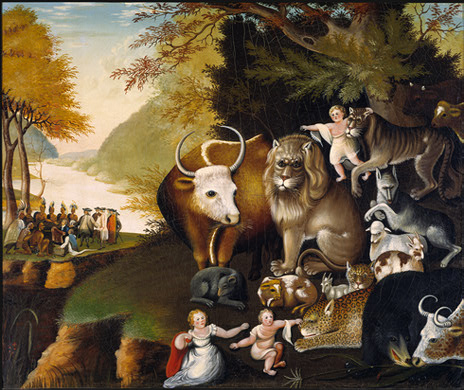 Hicks was a folk artist and the naivete of his style seems well-suited to what might seem to twenty-first century readers, a certain naivete in the vision of the prophet. We live in a world which seems much more in keeping with Thomas Hobbes’ idea of the state of nature in which:
where every man is enemy to every man, the same consequent to the time wherein men live without other security than what their own strength and their own invention shall furnish them withal. In such condition there is no place for industry, because the fruit thereof is uncertain: and consequently no culture of the earth; no navigation, nor use of the commodities that may be imported by sea; no commodious building; no instruments of moving and removing such things as require much force; no knowledge of the face of the earth; no account of time; no arts; no letters; no society; and which is worst of all, continual fear, and danger of violent death; and the life of man, solitary, poor, nasty, brutish, and short.
I don’t know about you, but sometimes I feel like the times in which we live are approaching Hobbes’ state of nature. We are certainly in a world where everyone seems to be at war with everyone else.
Does the prophet’s vision continue to offer hope for us in this season of Advent? Can we imagine a world in which we are remade in God’s image, refashioned as loving and creative persons, and perhaps most importantly living in peacable community with one another? Sometimes I think that vision is so far separated from reality that we can no longer imagine it as a possibility as a vision of our future, rather than the rantings of an eighth-century prophet, or the childish images of a nineteenth-century painter.
The prophet’s vision may no longer hold power over us. But the idea behind that vision cannot be tossed into the dustbin of an abandoned faith and a past time. A human race, no, a world, at peace itself, that idea must continue to shape and empower us. What that world might look like, what our vision of that world might look like, may be different from the prophet’s but it must be beautiful enough to sustain us and to give us hope.
In Advent, in this troubled world and in these troubled times, God waits for us. God waits for us to find our way to that peacable kingdom, where we encounter and embody, God’s love.
 Preaching Grace on the Square