
The Reign of Christ: A sermon for the last Sunday after Pentecost, 2023

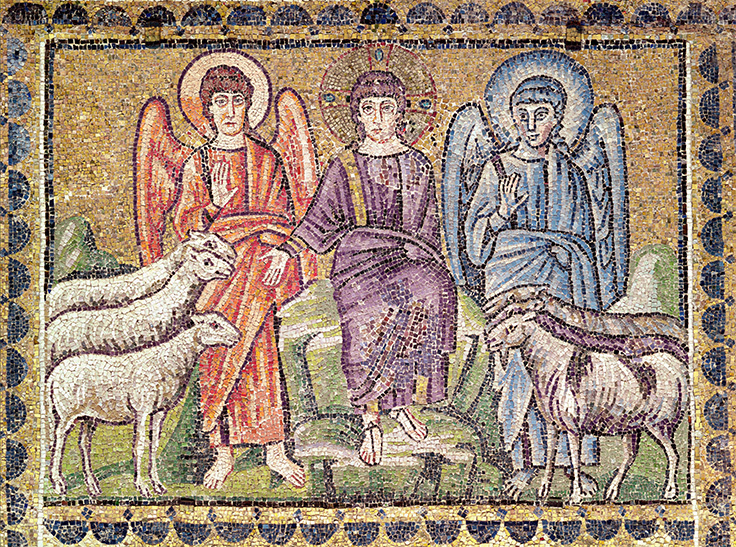
Christ separating the sheep from the goats, San Apollinaire Nuevo, Ravenna, 6th century

Reign of Christ

November 26, 2023

It’s been nearly forty years since I’ve visited Ravenna, Italy but its churches and their mosaics are still alive in my memory. So too is the awe and wonder that they evoked in me then. In the sixth century ce, Ravenna was the western capital of the Byzantine Empire, and the emperors and their families undertook a vast building project to express their power and faith. The mosaics conflate and combine imperial and religious imagery and while their meaning and significance are much debated among art historians and historians of late antiquity, their power, in the sixth century and today, are not.

You can see that imagery on full display on the the cover illustration of today’s service bulletin. What you cannot see is that in addition to looking like a ruler sitting on a throne, Christ in this mosaic is clad in imperial purple, wearing all the trappings and symbolism of a Roman emperor. 

I chose that image because today is the observance of Christ the King, or the Reign of Christ in contemporary parlance, is a 20th century innovation, this mosaic seems to capture perfectly the lectionary choice of Matthew 25:34-46. Christ, reigning in majesty, separating the sheep from the goats. 

Thinking about this image in the context of the parable may help us to encounter the story with new eyes, for it has become something of a favorite for many of us, a way of thinking about our responsibilities as followers of Jesus and to distinguish our sort of Christianity from that of many others—a focus on doing good rather than believing correctly. That interpretation is both comforting and self-gratulatory, and as always with the parables, I want us to experience its strangeness.

One way to do that is to note its context and the parables that precede it. Over the last few weeks, we’ve heard the parable of the wise and foolish bridesmaids, the talents, the wedding banquet. The parable of the wise and foolish bridesmaids concludes with the foolish ones locked out of the banquet hall. The parables of the wedding banquet and the talents end with someone cast into outer darkness, where there is weeping and gnashing of teeth. This one ends similarly with the goats banished to eternal punishment.

After the last two Sunday gospel readings, two parables of judgment and warning about the return of Christ, two parables that make us uncomfortable both in their urgency and in the message of judgment they proclaim, the judgment in this parable seems to support all of our prejudices and values.

In today’s reading, we are inclined, thanks to two thousand years of Christian reflection on this story, to see the separation of sheep and goats into good and evil as obvious, a given. Well, not so fast. In the ancient near east, goats were a prized animal. Their milk and meat were staples. They were not seen as evil—a goat was an acceptable sacrifice in Israelite religion. 

Perhaps more interesting is the fact that it was a common practice to keep goats and sheep together in a single flock. The only time the two animals were separated by the shepherd was on cold nights, when goats needed more protection. In short, in this reading as in the two preceding parables, the separation of sheep and goats into good and evil, is rather arbitrary. 

In fact, that’s something of a theme in Matthew’s gospel, that one can’t distinguish good from evil until the time of judgment—remember the parable of the wheat and the weeds, when “the devil” sowed weeds in a field and the farmer said that at the time of harvest, the wheat and the weeds would be separated and the weeds burned. So there’s something typically Matthean about this whole passage, something that Matthew as a gospel writer is especially interested in. It’s probably a result of something I mentioned a couple of Sundays ago, that a central concern for early Christians that Jesus had not yet returned.

I would like to draw your attention to something else in the text. Jesus is describing what the coming of the Son of Man will be like. First, he uses royal imagery. He will come in glory and sit on his heavenly throne. But immediately, that imagery is combined with another image, that of the shepherd. He will separate the people like a shepherd separates his flocks, the sheep from the goats. 

This image may draw us back to the reading from Ezekiel, where another visionary sees God coming like a shepherd, judging between the fat sheep and the lean sheep, rescuing them from wherever they have been scattered, feeding them, binding up the injured. We might find it odd that these two images—the shepherd and the king—are linked together in the biblical tradition. As the reading from Ezekiel makes clear, one reason for that linkage is the tradition that the founder of the Davidic monarchy—King David, was a shepherd. But for Christians, when shepherd imagery is used of Jesus, it is almost always used to emphasize Jesus’ care for us and his intimate love for us. 

Yet here in Ezekiel, the shepherd is a judge who culls his flocks, separating the fat from the lean sheep. So too in the gospel, the Shepherd King is a Judge who divides the sheep from the goats. In the Ezekiel passage the contrast between the care and tender concern the shepherd shows for the lean sheep and the harsh words with which he judges the fat.

The same is true in the gospel. The king judges harshly, unequivocally between the sheep and the goats. Christ appears to us here as a shepherd-king, but there are two other important images of Christ in the gospel. One is the obvious one. When the king says, inasmuch as you did it to one of the least of these my brothers and sisters, you did it to me, identifies the presence of Christ in the naked, the prisoner, the hungry, the sick. The third image is less obvious. The text begins with a reference to the Son of Man. In Matthew, when Jesus uses that title of himself, it almost always is in reference to his crucifixion. Christ the King is also the Crucified One and the least of these.

We are called to hold these three images together, we might think of them as three facets of a prism that together refract the light. If we ignore one of them, the other two become less brilliant. Emphasizing one over the other is a common temptation for Christians, but the gospel itself warns against it. We might prefer one image over the other. Some might want to encounter Christ only in the face of the poor and hungry; others only in an image of the Crucifixion. There are even those who can conceive of Christ only as the judge who comes on a cloud of thunder and reigns in majesty. 

Each image taken by itself will lead to a distortion of our faith. Those who focus only on the crucifixion will see Jesus only as the one who offers forgiveness for our sins. Those who focus on Christ in Majesty will think only about the second coming and making sure that they are on his right side. Those who focus only on outreach to others turn the Christian message into a social service agency. 

The judge separates sheep from goats, those who reached out to the needy and those who didn’t. The surprising thing here is that all are surprised. Neither group knew that Christ was present in the naked, the stranger or the prisoner. So for those whom the King welcomed into the kingdom, their actions in reaching out to the needy were not a conscious response to Jesus’ teachings or the result of acting out of duty or in order to gain their salvation. Their actions were an unconscious, unknowing part of who they were as Jesus’ disciples.

The same Christ who will come in Majesty to judge the living and the dead; the same Christ who was crucified for our sins; the Christ in whom we proclaim our faith when we recite the creed, that very Christ is present in all of those people—in the prisoner, the naked, the hungry, the stranger, and the sick. To hold these different images together, to confess Christ crucified, risen, reigning in majesty along with recognizing Christ’s presence in the sick, the imprisoned, the hungry and naked is our task as Christians seeking to follow him.
In whom do we see Jesus? A Sermon for Christ the King, 2017

We are at the end of the liturgical year, the end of our reading of the Gospel of Matthew. I find myself reflecting not just on where we’ve come with this gospel but how my reading and preaching of it have been shaped by the challenging times in which we live. Matthew’s underlying theme of an embattled, perhaps persecuted Christian community called to ethical purity and discipleship is an appealing vision for those of us who seek to live out a Christianity shaped by Jesus’ teachings, ministry, and death, rather than the so-called Christianity based on greed, white supremacy, and nationalism that seems ascendant in our day. Continue reading

The imprisonment of John the Baptist, the carceral state and Advent hope: A sermon for Advent 3, Year A, 2016

Today’s readings are here

Most of you know that over the last year, Grace Church has begun to develop a relationship with the Dane County Jail. It began with a visit to Grace last January from Christa Fisher, chaplain to the jail, who preached and talked about her work in an adult forum. The relationship has deepened, as Grace offered to host the ongoing tutoring project and participating in the jail ministry’s winter clothing drive.

The jail ministry has touched me on a personal level. It may have begun, not with my first encounter and conversation with Christa, but even earlier. I don’t know exactly when it was, but I found myself reflecting on the familiar and powerful parable of the sheep and goats in Matthew 25:31-46, you know the one in which the King says:

“I was hungry and you gave me food, I was thirsty and you gave me something to drink, I was a stranger and you welcomed me, I was naked and you gave me clothing, I was sick and you took care of me, I was in prison and you visited me.”

It struck me at the time, for whatever reason, that in all of my life, I had never set foot in a prison, let alone visited or talked with a prisoner. Don’t get me wrong; it’s not like I think I’m going to burn in hell for eternity because I never engaged in prison ministry. Rather, I began to realize that prison ministry, especially in this age of mass incarceration, had simply never been of much interest or concern to me. In fact, I probably didn’t even know where the Dane County Jail for the first 3 or 4 years I lived in Madison; that’s shocking to admit, given it’s only two blocks away.

As part of Grace’s involvement with the work of the Madison Jail Ministry, I have challenged myself to take an active role in supporting the work of the chaplains. Last May, I participated in a tour of the jail that is intended for new employees and volunteers. It was an eye-opening, unforgettable experience. It wasn’t just that parts of the jail, the two top floors of the City County Building that could serve as a movie set for a 1930s era prison. That’s the part of the jail where they repeatedly have difficulties opening cell doors and evacuating inmates during fire drills. It was the demeanor of those who were incarcerated. Their body language and demeanor were those of people without hope, living in despair. They were lonely, abandoned by society, living at the arbitrary whims and actions of their jailors.

By now, we should all be familiar with the statistics, so I won’t belabor them. As Michelle Alexander argued with great passion and eloquence in her book The New Jim Crow, mass incarceration targets African-Americans, especially African-American males disproportionately. It’s not just that an unconscionable number of African-Americans are incarcerated in the US, it’s that they are incarcerated for longer sentences and for crimes for which White Americans walk free.

The racial disparities and hopelessness of mass incarceration are on full display in the Dane County Jail. Many of those in the jail are there for parole violations that can be as minor as having used a computer. What struck me during my tour of the jail was that I hadn’t been anywhere that looked quite like the Dane County jail, or encountered such despair and hopelessness in the eyes and body language of the incarcerated, since my visit to East Germany back in 1980. The Dane County jail, like the former East Germany, is the carceral and surveillance state on full display.

All of this came to mind this week as I read and reflected on our gospel. It’s another episode concerning John the Baptist and the contrast between his demeanor here, in Matthew 11, and in the reading from last week, from Matthew 3, couldn’t be more stark. Last week we saw him railing against the religious and political elites for their corruption, and prophesying that the wrath of God would soon come down upon them. He was courageous, resolute, unworried about the response his preaching might arouse in his opponents.

Now, a few weeks or months later, he is in prison, having crossed Herod one too many times. But Herod isn’t quite sure what to do with him; the gospel of Luke suggests even that Herod kind of liked having John around,, he brought him in for conversations. According to Matthew, Herod wanted to have John executed, but feared how the people might respond.

In any case, now John is in prison. It’s puzzling given what we know about John, that he wonders about Jesus’ identity, that he sends his disciples to Jesus to ask him, “Are you the one who is to come, or are we to wait for another?”

I mean, how could he not know? They are cousins, for crying out loud (at least that’s what Luke tells us). John baptized Jesus. John told everyone that Jesus was the one sent by God, that he, John, was only his messenger. John may even have heard the voice from heaven saying, “This is my Son, my Beloved.” How could he have doubts?

Well, there are a couple of answers to this question. First, there’s the issue of the relationship between Jesus and John the Baptist, and what from the gospels seems to be something of a competition between them, perhaps even a struggle between followers of John and Jesus later, after their deaths, over who was the greater. There’s all sorts of evidence, even in the Book of Acts, that John continued to have a following, and that his followers competed with the followers of Jesus for popularity.

There’s also the fundamental problem for the early Jesus movement that Jesus was baptized by John…

Finally, there’s the little detail that the synoptic gospels, Matthew, Mark, and Luke, agree that Jesus began his public ministry only after John was arrested; that he waited until then to begin preaching publicly and healing people.

So there’s something very interesting going on in the gospels’ depiction of the relationship between Jesus and John the Baptist.

But I don’t think that’s the only reason that John asks this question about Jesus identity from prison. Prison, in the first or the twenty-first century is a place of hopelessness and despair. Too often, it’s a waiting room for death. Think of all of the people on death row across our nation, and think about the decades many of them have been languishing there.

I think John’s question may come out of his hopelessness and despair and I’m not sure Jesus’ response to him, reassured him. Jesus tells John’s disciples, “‘Go and tell John what you hear and see: the blind receive their sight, the lame walk, the lepers are cleansed, the deaf hear, the dead are raised, and the poor have good news brought to them.”

Jesus omits something in that response. When that list of things appears in Isaiah, and when in Luke’s telling, Jesus proclaims those words in his first public sermon in the synagogue in Nazareth, there’s another group mentioned:


‘The Spirit of the Lord is upon me,

because he has anointed me

to bring good news to the poor.

He has sent me to proclaim release to the captives

and recovery of sight to the blind,

to let the oppressed go free,

The blind may see, the lame walk, the poor here the good news, but Jesus makes no mention of prisoners in his response to John’s disciples, no promise of freedom, no freedom for John himself.

John’s doubts and uncertainties were well-founded and it’s an open question whether Jesus’ reply to him did anything to reassure him as he lay in prison and waited for his death.

That should be unsettling for us. It may even raise our doubts and uncertainties. If John couldn’t or didn’t know, and if Jesus’ words offered him no consolation or hope in his particular situation, may our doubts and uncertainties are warranted. Maybe hopelessness, despair, cynicism are appropriate responses in our situation, too. After all, it’s not just John. There is still suffering in the world—the blind, deaf, disabled; and millions upon millions of people who languish in poverty and are food insecure.

So there is cause for despair, cause for doubt, cause for uncertainty. In the midst of all of that, there are also signs of hope—signs of the inbreaking of God’s reign in this dark world. Signs of hope in the work, faith, and spirit of the chaplains at the Dane County jail, signs of hope in the work and witness of our food pantry; signs of hope, signs of God’s inbreaking reign in the coming of Christ in a tiny and distant village in the furthest reaches of the Roman Empire. This Advent, may we look for signs of Christ’s coming and signs of God’s coming reign, in our hearts and in the world around us, and when we see those signs, may we know that Christ is coming, that he is the one for whom we are waiting.


Christ the King and our comfortable assumptions: A Sermon for Christ the King, 2014

Today is the last Sunday of the liturgical year, and for many years it has been known as Christ the King. More recently, the politically correct liturgical police have renamed it “The Reign of Christ” because the imagery and idea of Christ the King has become increasingly problematic in the twentieth and twenty-first centuries. It offends our notions of democracy and egalitarianism; it smacks of violence and militarism; it seems to encourage gender stereotypes. For all of those reasons, and for others, including the image of a crowned Jesus robed in splendor, seated on a throne, judging between the good and evil; for all of these reasons I find the commemoration of Christ the King problematic. Continue reading

Lectionary Reflections for Christ the King Sunday

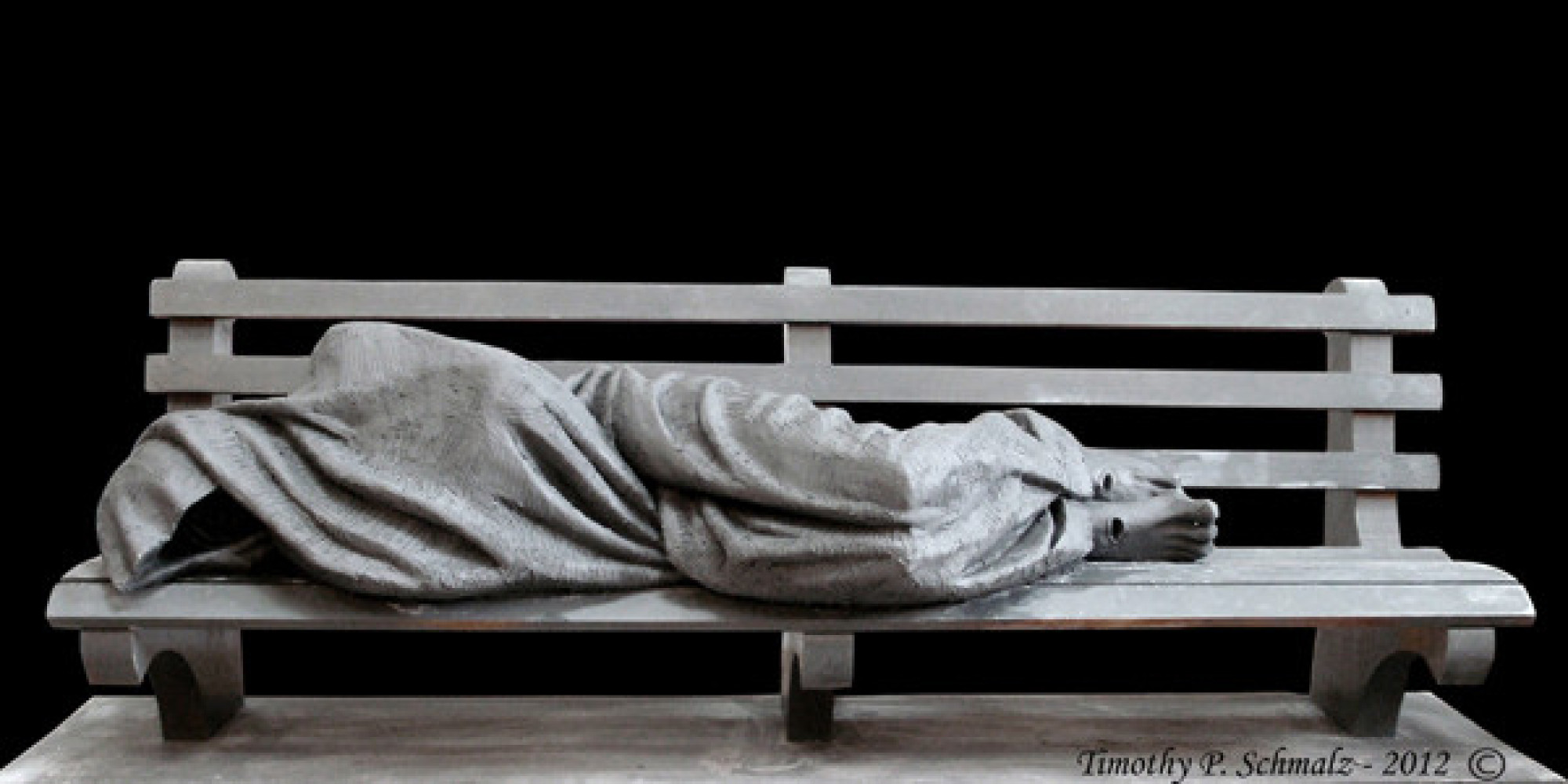
RNS-HOMELESS-JESUS

This Sunday’s texts are available here.

Canadian sculptor Tim Schmaltz has incited controversy with his bronze statue “Jesus the Homeless.” The image gained notoriety when it was rejected by St. Patrick’s Cathedral in New York City and St. Michael’s Cathedral in Toronto. The latter image was installed at the Jesuit School of Theology in Toronto and another cast was purchased and installed at St. Alban’s Episcopal Church in Davidson, NC. The statue depicts a homeless man sleeping on a park bench. His facial features are partially obscured by the blanket that covers him but the marks of crucifixion on his hands and feet clearly identify him as Jesus. After the statue appeared in Davidson, the police were called by a woman who thought it was a real homeless person and others complained that it demeaned the neighborhood. One woman was quoted as saying, “Jesus is not a vagrant; Jesus is not a helpless person who needs our help.” (A story on Huffington Post with images of the statue is here).

This Sunday, the last Sunday of the liturgical year, is Christ the King Sunday, a day when we are encouraged to reflect on the reign of Christ. Often, such reflection takes the form of images of Christ ruling in majesty or coming in triumph. Today’s gospel from Matthew 25, points in a very different direction. We read the familiar parable of sheep, goats, and judgment. For all its familiarity, it continues to challenge us at the core of our existence and at the core of our faith. The king divides sheep and the goats on the basis of how they responded to the deepest human needs: to the hungry and the thirsty, the stranger, the sick, the naked and the prisoner. But when told of their respective fates and the basis for the judgment, sheep and goats answered alike, “Lord, when did we see you hungry or thirsty or naked?”

The Kingship of Christ, the Reign of Christ, is not primarily about recognizing Christ in majesty and triumph. It is about being Christ—in the weakest, lowliest, and most vulnerable of humans; in feeding and clothing, ministering to and being with the stranger, the sick, the friendless. In acts like these, the reign of God is announced and made present. The reign of Christ is proclaimed in a homeless Jesus.