Pondering
Advent 4, Year C
Grace Episcopal Church
December 20, 2009
Finally, we are back to Luke’s narrative of the Christmas story. We’re not quite there, yet. For that we have to wait until Thursday, Christmas Eve; but after weeks of focus on Jesus’ teaching concerning the end times, and on John the Baptizer’s birth and ministry, we are finally into the heart of the story.
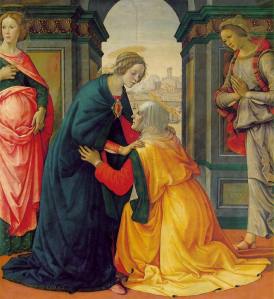
The gospel lection is a brief one and omits, this year, the larger story of what comes before. The angel Gabriel has announced to Mary that she will give birth to the Son of God. After hearing the angel’s words, Mary goes to visit her cousin in the hill country of Judea.
Mary’s song, the Magnificat, has been running through my head all of Advent. That’s not new. If I reflect back to past years, I soon realize that the words she sings in response to her visit to Elizabeth are a recurrent theme for me this time of year. They provide something of a framework for my personal meditation on the season. Partly it’s been running through my mind because of the choir’s marvelous performance of Biebl’s magnificat at lessons and carols on the two weeks ago.
Some of us have been reading and talking about Marcus Borg and Dominic Crossan’s book The First Christmas. In it, these two prominent biblical scholars take a close look at the stories of the birth of Jesus, the nativity stories in Matthew and Luke, and try to look for the larger meaning behind each author’s version of the events surrounding Jesus’ birth. For Matthew and Luke tell very different stories—different in details major and minor. We tend to overlook those differences and combine the two stories into a single whole. Thus, our crèche, our nativity scene has wise men and shepherds, though Matthew has wise men and Luke shepherds. It is also a stable, as in Luke’s gospel, while Matthew refers to Jesus’ birthplace as a house.
These differences are important, not so much for trying to nail down what really happened—we can’t know that from the distance of two thousand years, but rather, what the gospel writers, Luke and Matthew were trying to say about the birth of Jesus. Luke’s version is probably even more familiar to us than Matthew. The central episode in the story, the trip to Bethlehem by Mary and Joseph, Jesus’ birth in a stable, the visit of the shepherds, is what we think of when we think of Christmas.
But Luke is not interested only in telling the story of Jesus’ birth. He is interested in putting that story into a larger context, or perhaps it would be better to say contexts, for there are several larger issues at stake. First of all, there is the Roman Empire. Luke takes great care repeatedly to place his story in the story of the empire, something he does by repeating at several points, the name of the ruling emperor, and other Roman officials. He is going to contrast, throughout his gospel and into the book of Acts, the military might of the Roman Empire with the kingdom of God that Jesus preaches.
The other important context for Luke is Judaism. Like Matthew, Luke is interested in tying the story he is relating with larger Jewish history and biblical narrative. Where Matthew does this by linking events in Jesus’ birth with quotations from scripture, Luke does it by using motifs from scripture in his story. The barren woman, for example, appears again and again in Hebrew scripture: Sarah, Abraham’s wife, like Elizabeth, the mother of John, was long past child-bearing age. Hannah, too, whose story we heard some weeks ago, was barren and prayed to God to give her a son. Her prayers were eventually answered and she gave birth to Samuel.
The song Mary sings in response to Elizabeth’s words is itself a reformulation of Hannah’s song. The connections between past and present are deep and strong. When Mary sings, “My soul magnifies the lord,” she goes on to mention God’s mighty acts in saving God’s people:
He has shown the strength of his arm, *
he has scattered the proud in their conceit.
He has cast down the mighty from their thrones, *
and has lifted up the lowly.
He has filled the hungry with good things, *
and the rich he has sent away empty.
These are not single actions of God, they are the way God acts in history; the force of the Greek is to make these things aspects or characteristics of God. In other words, this is the kind of God that God is. It is in God’s nature to do these things.
Luke stresses this in another way. Here, for a moment, all of our attention focuses on these two women—Mary and Elizabeth. Our tradition has so overwhelmed the story that it is hard for us to recapture what Luke had in mind. Elizabeth’s words “Blessed are you among women and blessed is the fruit of your womb” have been memorized by millions, perhaps billions of Catholics over the centuries and the Magnificat itself has been a part of Christian worship for centuries. When we think of Mary, we think of those images of her as the theotokos, “the bearer of God” or the eternal virgin, sitting in heaven beside her son. Those of us who visited the Chazen with Maria two weeks ago, or heard Tom’s talk last week have all of those medieval, renaissance, and baroque images of Mary fresh in our memories. She has long been a focus of Christian devotion and piety.
None of that is what Luke intended. When he turned his focus to these two women, he was turning away from the obvious political and imperial history that was his context. It wasn’t simply a change in subject matter. The contrast between the powerful men he names, and the centers of power, his focus on Bethlehem and on these two women was meant to highlight the contrast between the way of empire, the way of the world, and the way of Jesus Christ.
In these last few days before Christmas, when our attention is directed at all of the final preparations we need to make—the shopping, cooking, last-minute decorations, and for many of us travels, too, the world of a peasant girl, two thousand years ago, awaiting the birth of her child, and her cousin’s child, seem remote and unimportant. The clash of empires depicted by Luke seems far-fetched at best. We don’t want to think too long and hard about what it all means, because that might distract us away from what’s really important—the holiday that is only a few days away.
But Luke encourages us to contemplate a God who acts in history in a certain way and acts with a certain kind of people:
he has scattered the proud in their conceit.
He has cast down the mighty from their thrones, *
and has lifted up the lowly.
Our understanding of God may not be able to comprehend this notion of reversal, turning the world upside-down. We are apt to want to reinterpret these words spiritually, to think that what Mary meant, what God does is uplift those who are depressed and humble the proud. But these are to be taken quite literally as well as spiritually.
For that is just what God did in the incarnation. God took what was lowly, a poor peasant woman from Nazareth, and through her made Godself incarnate. God took ordinary human flesh, a body just like ours, and became one of us.
This may be so hard for us to understand because Luke describes a world so very different than ours. One reason we have turned Christmas into an extravagance of cuteness and kitsch is because we cannot get our heads around the notion that God comes into the world in just this way.
Can we really, sincerely, sing with Mary the words of the Magnificat today? Does the God she praises look and act in any way like the God we worship? I’ve been thinking about the Drop-in Shelter a good bit the past few weeks. I suppose it’s been more in my consciousness in part because the weather has turned colder. But I’ll also admit that I’m more aware of it because with the switch to winter hours in November, I’m much more likely to encounter the guys waiting in line at the door when I leave the office at the end of the day.
I see the men and I think about the magnificat and the God of the Bible who intervenes on behalf of the powerless, the homeless, hungry and poor, the God whom Mary praises, and I wonder what connection there is between that God and the God we worship here. Of course they are the same God, but have we so remade God in our image that we cannot hear the force of Mary’s song? Have we so created a God who comforts us, that we cannot experience a God who unsettles us, who scatters the proud and casts down the mighty?
On Christmas Eve, we will gather here again, to listen to the story from Luke of the birth of Jesus Christ. We will sing the familiar carols, we will celebrate with joy; many of us will be coming from, or going to lavish parties among friends and family. All the while, on the opposite side of the courtyard, the guests in the shelter will do what they do every night, wait for a warm meal, a warm bed, a place to rest their tired feet.
Mary’s song challenges us to experience and imagine a God who acts on behalf of just those men standing in line at the shelter. Mary’s song challenges us to consider what our responsibility to them is in this season and around the year. Grace is justly proud that it gives a home to the drop-in shelter. Many of you, like me, come here in part of that presence. But being a landlord is not enough. As we think about a God who acts in, and among the poor and the oppressed, as we worship a God who becomes incarnate in a stable in Bethlehem, we must seek to make that God present, not only in the bread and wine of the Eucharist, but also in the line of men waiting to enter the shelter on a cold winter’s night, and everywhere else that the poor, downtrodden, and hungry congregate.


 Preaching Grace on the Square