
Dust, Ashes, and God’s steadfast love: A Homily for Ash Wednesday, 2019

I have been surrounded by death the last few months. There was the death of my mother before Christmas, and two funerals at Grace in recent weeks. Yesterday morning, I visited someone in hospice care and we talked about death as I prayed and read Psalms with her. After that visit, I came to the church and burnt the dried palms from last year’s Palm Sunday and prepared the ashes that I will use to mark the sign of the cross on our foreheads and say, “Remember that you are dust, and to dust you shall return.”

This is now my tenth Ash Wednesday at Grace and I’m increasingly conscious of those people whose foreheads I daubed with ash and said, “Remember that you are dust…” and who in the years since, I’ve said while committing their remains to their final resting place, “Ashes to ashes, dust to dust.” Of all the intimate and powerful acts I perform as a priest, there may be none so intimate or powerful as what I do today, for as I say, “Remember that you are dust and to dust you shall return…” I am saying it as much to myself as to you.

In our culture, we do almost everything we can to avoid talking about, thinking about, or being near, death. We don’t even use the word—someone has passed, they don’t die. We go to extraordinary lengths to avoid looking old, spending billions on cosmetic surgery to look young. We are so averse to speaking about death that we’ve invented a word, “cremains” so we don’t have to confront the reality of ashes.

But then we come hear and have our foreheads smudged with ashes and hear the words, “Remember that you are dust, and to dust you shall return.”

To face our mortality with honesty and admitting our vulnerability is no easy thing. But it is an important first step in the work we need to do. Lent is a season of repentance and spiritual discipline. But to ask God’s forgiveness, to receive God’s forgiveness requires that we first admit who we are, acknowledge our sin and brokenness, open our selves and our hearts to God’s redemptive and forgiving grace.

We see that in Psalm 51, which we will recite together later. It’s a psalm of repentance but as the psalmist acknowledges his sinfulness and prays to God for forgiveness, there’s a moment when the tone changes:

Make me hear of joy and gladness, *
that the body you have broken may rejoice.


It is only through such confession, and honesty about oneself, that one can fully experience the joy of God’s forgiveness.

There’s another image that haunts me each Ash Wednesday, a verse from the Joel reading, “Between the vestibule and the altar let the priests, the ministers of the Lord, weep.” My attention was first drawn to it years ago by Tom Davis, a priest who has himself now entered the larger life, as we were preparing for services at St. James, Greenville.

The image of priests weeping between the vestibule and altar, or as we might say, between the sacristy and the altar haunts me because it evokes a moment of intense repentance and it goes against the priestly decorum we display and that is expected of us. In the larger passage, the prophet Joel is talking about an imminent catastrophe, a natural disaster, a plague of locusts that has come upon the land and destroyed the crops. Interestingly, he does not attribute this natural disaster to punishment for the evil of the people. He offers no explanation for the coming destruction.

But he does offer hope: “Return to the Lord…”

The prophet continues:

Return to the Lord, your God,
for he is gracious and merciful,

slow to anger, and abounding in steadfast love,
and relents from punishing.

As we confront our mortality this day, as we remember that we are dust and to dust we shall return, as we confess our sins, and acknowledge our brokenness, as we weep between the vestibule and the altar, may our broken bodies and spirits be filled with the joy of God’s forgiveness, and know the immeasurable power of God’s loving grace.


Another Poem for Lent: Affliction by George Herbert

Affliction

by George Herbert

My thoughts are all a case of knives,
Wounding my heart
With scattered smart;
As wat’ring-pots give flowers their lives.
Nothing their fury can control,
While they do wound and prick my soul.

All my attendants are at strife
Quitting their place
Unto my face:
Nothing performs the task of life:
The elements are let loose to fight,
And while I live, try out their right.

Oh help, my God! let not their plot
Kill them and me,
And also Thee,
Who art my life: dissolve the knot,
As the sun scatters by his light
All the rebellions of the night.

Then shall those powers which work for grief,
Enter Thy pay,
And day by day
Labour Thy praise and my relief:
With care and courage building me,
Till I reach heav’n, and much more, Thee.

Can we see Jesus? Do we see Jesus? A Sermon for the Fifth Sunday in Lent, 2018

We are at a turning point. Lent is drawing to a close; those of you who have been following Lent Madness are watching as the tension builds and the saintly competition comes to an end. If you’ve given up something for the season, you are probably counting the days to Easter and the end of your fast. Here in the office at Grace, we are preparing for Holy Week as you can tell from the notices in the service bulletin.

As we were reciting and chanting the verses from Psalm 51 this morning, I was reminded that we had said this same psalm on Ash Wednesday, after the imposition of the ashes. Then, I and you were hoping for a Holy Lent, a time when we might deepen our relationship with God in Christ, experience repentance and forgiveness of our sins and grow spiritually. Now, as Lent draws to a close, those verses remind me of all the ways my actions and discipline in Lent have fallen short of what I had hoped for, another missed opportunity. I am grateful again, and continuously, for God’s mercy and grace. Continue reading

Poetry for Ash Wednesday: “Lent” by George Herbert

Welcome dear feast of Lent: who loves not thee,
He loves not Temperance, or Authority,
But is composed of passion.
The Scriptures bid us fast; the Church says, now:
Give to your Mother, what you would allow
To every Corporation.

*  *  *

It ‘s true, we cannot reach Christ’s fortieth day;
Yet to go part of that religious way,
Is better than to rest:
We cannot reach our Savior’s purity;
Yet are bid, Be holy ev’n as he.
In both let ‘s do our best.

Who goes in the way which Christ has gone,
Is much more sure to meet with him, than one
Who travels the by-ways:
Perhaps my God, though he be far before,
May turn, and take me by the hand, and more
May strengthen my decays.

Yet Lord instruct us to improve our fast
By starving sin and taking such repast
As may our faults control:
That ev’ry man may revel at his door,
Not in his parlor; banqueting the poor,
And among those his soul.

Walking the Stations of the Cross in Downtown Madison, April 7, 2017

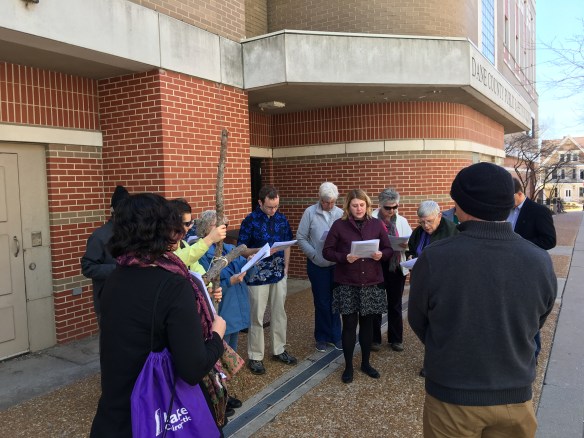
At the entrance of the Dane County Jail

This is the fourth (I think) year we’ve walked the Stations of the Cross in Downtown Madison. It’s a strange, uncomfortable experience in that for me, I’m walking streets I walk nearly every day as I go to and from work or grab lunch or run errands. This year, as in past years, I encountered familiar faces as I walked, among them two elected officials of county and city government.

This year, in addition to the usual distractions of city traffic and people going about their business, we had to compete with construction on Capitol Square and with the Solidarity Singers, who seemed to be a larger group than they had been in recent weeks.

To be honest, I wasn’t really looking forward to today’s event. For whatever reason, my spiritual focus has been elsewhere, and my energy diverted to other matters. If it hadn’t concluded at Grace, I doubt whether I would have participated.

I was surprised how quickly I was caught up in the experience. It wasn’t just the familiar stations, and the meditations that connected Jesus’ suffering with the suffering on the streets of Madison. It was also about making Christ’s suffering present on these streets, at the door of the Dane County Jail, opposite the Wisconsin Veterans’ Museum, and at the steps of Grace where a homeless person died in the winter of 2014, and where so many homeless people have sought refuge over the last thirty years, and hungry people have been fed.

We do so much to protect ourselves from the knowledge and experience of human suffering on the streets of our city. The homeless and panhandlers are harassed and shoved out of sight. The inhumanity of the Dane County Jail is at its worst several stories above the room in the City County building where Madison’s Common Council and the Dane County Board of Supervisors deliberate.

To walk the way of the cross in Downtown Madison is to bear witness to the blood on our streets and in our city. It is also to see in that suffering and pain, the suffering and pain of Jesus Christ.

Today I realized that our little Stations of the Cross, walked as we’ve done it every year on the Friday before Palm Sunday, has become an essential part of my preparation for the drama of Holy Week.


For background on the devotion of the Stations of the Cross and how we do it here in Madison, follow this link.

A White Lent

1. Now quit your care
And anxious fear and worry;
For schemes are vain
And fretting brings no gain.
To prayer, to prayer!
Bells call and clash and hurry,
In Lent the bells do cry
‘Come buy, come buy,
Come buy with love the love most high!’

2. Lent comes in the spring,
And spring is pied with brightness;
The sweetest flowers,
Keen winds, and sun, and showers,
Their health do bring
To make Lent’s chastened whiteness;
For life to men brings light
And might, and might,
And might to those whose hearts are right.

3. To bow the head
In sackcloth and in ashes,
Or rend the soul,
Such grief is not Lent’s goal;
But to be led
To where God’s glory flashes,
His beauty to come nigh,
To fly, to fly,
To fly where truth and light do lie.

4. For is not this
The fast that I have chosen? –
The prophet spoke –
To shatter every yoke,
Of wickedness
The grievous bands to loosen,
Oppression put to flight,
To fight, to fight,
To fight till every wrong’s set right.

5. For righteousness
And peace will show their faces
To those who feed
The hungry in their need,
And wrongs redress,
Who build the old waste places,
And in the darkness shine.
Divine, divine,
Divine it is when all combine!

6. Then shall your light
Break forth as doth the morning;
Your health shall spring,
The friends you make shall bring
God’s glory bright,
Your way through life adorning
And love shall be the prize.
Arise, arise,
Arise! and make a paradise!

A Lenten carol written by Percy Dearmer. I’m grateful to Thinking Anglicans for drawing my attention to it. It’s lovely because of its quite joyful evocation of the beauty of springtime. And it is powerful in shifting the focus of Lent away from personal piety toward works of justice. I’ve borrowed the text from A Clerk of Oxford


Hens and Foxes: A Sermon for the Second Sunday in Lent, 2016


I don’t think anyone would deny that the general mood in our nation is particularly troubling. No matter what one’s political preferences might be, most of us, left or right, feel as if the country, our state, our culture is out of our control, that big money and political operatives are running the show and care little for the lives of ordinary people. It’s not just that we can’t seem to come together to solve intractable problems; it’s that the whole system is rigged for the 1% and their money and influence make it impossible for the rest of us—we end up fighting over an ever-smaller piece of the pie while the wealthy and powerful gorge themselves. Continue reading

I will draw all people to myself: A Sermon for the Fifth Sunday in Lent, 2015

I don’t know if you’ve noticed that all of our crosses and crucifixes are veiled in purple. They have been since Ash Wednesday. Next week on Palm Sunday, the color of the veils will change to red, and then on Good Friday, they’ll be veiled in black. You may wonder why we do it, especially when Lent is a season when we ought to be focusing on the cross. It’s an old tradition, dating back to the Middle Ages, and probably has its roots in penitential practice. In some places, for example, there was a custom of placing a veil between the altar and the people during Lent. So you can think of it as a reminder, like the fact that we don’t sing or say alleluia during the liturgy, that we’re in a season of penitence, that we’re prevented, by our own weaknesses and sins, from deep relationship with Jesus Christ. But let’s be honest. The real reason we at Grace veil the cross is because “we’ve always done it that way.” Continue reading

The Wilderness of Lent: A Sermon for the First Sunday in Lent, 2015

Of all the things we do liturgically, I sometimes think that the Season of Lent presents us in the twenty-first century with the greatest distance from our contemporary world. Lent is a season of repentance and self-examination that flies in the face of our consumerist culture and values. Lent challenges us to focus, when what we want is distraction. Lent is somber when we want to be happy. Lent invites us to self-denial and fasting when we crave self-indulgence. Continue reading

Forty for 40: A Literary Reader for Lent

A remarkable collection of readings for the forty days of Lent. I think I’ve found one of my lenten disciplines!

Compiled by Nick Ripatrazone who writes:

Lent is the most literary season of the liturgical year. The Lenten narrative is marked by violence, suffering, anticipation, and finally, joy. Jesus Christ’s 40 days of fasting in the desert are the spiritual and dramatic origin for the season that begins on Ash Wednesday and ends on Holy Saturday.

There are some old familiar pieces here and many that I don’t know and look forward to exploring.