
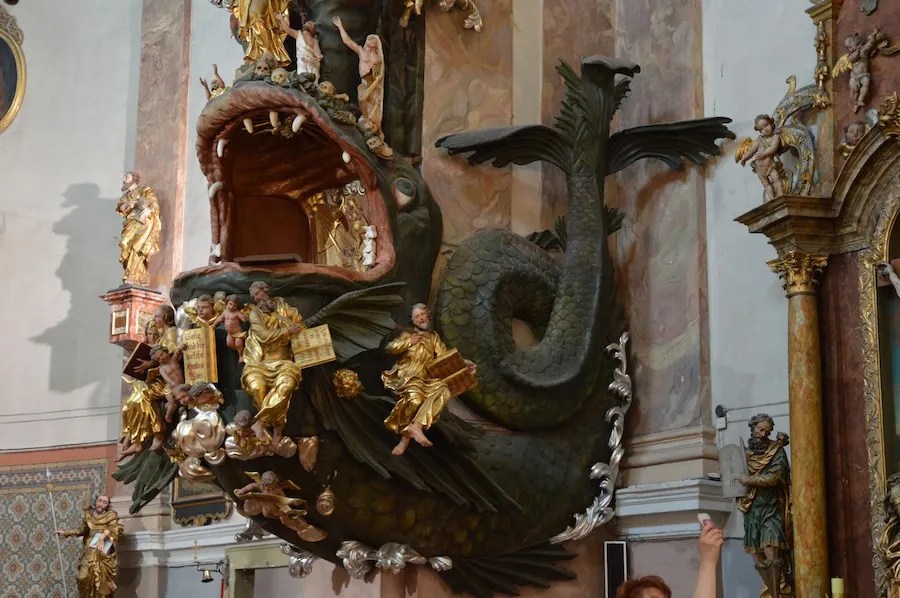
It’s one of those great ironies, and perhaps an indictment of the 3-year lectionary cycle, that the Book of Jonah gets so little love in the Sunday Eucharistic lectionary. I mean, if you ever went to Sunday School as a kid, if you had a story bible, if you know anything about the Old Testament, and even if you don’t, you’ve heard something about Jonah and the whale. It’s a great story, full of drama, big fish, and lots of humor. But we will only hear from it once in the three-year lectionary, this reading of a smattering of verses from chapter 3 (the same chapter comes up as an alternative reading in year A).
I get it; I get the discomfort. I had figured out the problems with a literal, historical reading of Jonah when I was a young boy. Whales can’t ingest humans; people can’t survive for three days in a whale’s belly; a whale couldn’t get from the Mediterranean to the Persian Gulf to spew Jonah out, and on and on. One commentator remarked that of all the details in the story of Jonah, that he was eaten by a whale is the most plausible. But it’s a great story!
The cultural and theological significance of it go far beyond the story’s detail. Look at that image on the front cover of a pulpit in the shape of a whale. What must it be like to preach from such a thing? It certainly would enhance one’s sense of responsibility, of obligation and authority and it draws attention both the brevity of the sermon Jonah preached (six words in English, five in Hebrew) and the amazing response to that sermon by the people (and cattle) of Nineveh.
On Friday, I had a conversation with some clergy friends that detoured into talking about preaching and about what we expect our sermons to do. Oddly enough, none of us brought up Jonah’s example as a sermon either to emulate, or to expect that level of response from one’s congregation.
Well, let’s dig in a bit.
For if there’s anything unlikely, unbelievable, it’s the effect of Jonah’s preaching. The text says that Nineveh was a large city; it was a three-day’s walk from one end to the other, and that when Jonah arrived, he walked a day into it, and there preached his message of doom and destruction. That’s all it took. One lone voice, six simple words in Hebrew. Just this, coming from a foreigner, and the whole city, man and beast, put on sackcloth and ashes, and repented of their wickedness. It could happen, I suppose.
What comes next is equally surprising. Having prophesied doom and destruction, Jonah leaves the city, finds a hill overlooking it, and settles in to watch the carnage. God provides him with a bush that grows up to give Jonah shade from the hot sun, a turn of events that made Jonah quite happy, but the next day, God caused a worm to kill the bush so that it withered and Jonah got sunburnt. He also got angry.
If you were Jonah, how would you respond to this development? One would think he would be pleased with himself, proud of the effects of his preaching. But no. He complains to God, saying that the reason he didn’t want to go in the first place was because he knew this would happen. He knew God was a gracious God, full of mercy, slow to anger, and abounding in steadfast love, ready to relent. In other words, if Jonah was going to prophesy doom and destruction, he wanted to see it happen.
So what should we make of all this? A prophet who doesn’t want to be a prophet, certainly doesn’t want to be a successful prophet and resists his call. On that level, we can understand the story all to well. We can imagine resisting the tug of duty and responsibility, turning away from what we know we ought to do. We can even imagine, most of us, sensing God calling us in a certain direction, calling us to deeper commitment, to a richer spiritual life, and turning away.
That’s all easy to imagine, and in that sense, Jonah represents us, everyman. But there’s more to the story than just Jonah. Besides Jonah and God, there’s another actor, or set of actors in the story, and that is Nineveh itself. Now, Nineveh was the heart of the Assyrian empire, one of the great empires of the ancient near east, and one of the most brutal. It was Assyria that had destroyed the northern kingdom of Israel in the 8th century bce. Nineveh was the evil empire. Its power dwarfed all of its neighbors, including the kingdom of Judah. That makes Jonah’s resistance to God’s call all the more understandable, even if that’s not the excuse Jonah gave himself.
In the end, the book of Jonah is not primarily about Jonah. It is about God. It is a story of God’s love, mercy, steadfast love. It is about proclaiming not just God’s displeasure and threatening destruction, it is about knowing who God is, and proclaiming that message of love, mercy, and steadfast love.
When God rebukes Jonah at the end of the story, God points out that if Jonah was concerned about a bush, how much more should God be concerned about the city of Nineveh with its more than 120,000 inhabitants, and also animals. This is a story about the universalizing of God’s love and mercy. Jonah, and the original readers of this text, were being challenged to expand their notion of God and of God’s love. For all God’s love and concern for the Jewish people in the post-exilic period, the Hebrew Bible and the book of Jonah, bear witness to a growing understanding that God is God of all creation, the God of all humanity and God’s love and mercy extends to all humans, even to one’s enemies.
I wonder how many of us are like Jonah, so hardened in our attitudes, so critical of those with whom we disagree, that what we really want is to see them destroyed by God’s wrath, embarrassment in the media, or humiliating political defeat? We proclaim God’s judgment on our opponents but do we ever consider what might happen if they changed their minds, if they repented of the actions that we regard as sinful, evil, oppressive and unjust?
Are we like Jonah, who having delivered our prophetic message in the most self-righteous of language and attitude, are now sitting above the city, waiting for its destruction? Or can we imagine that God might accept the repentance and show mercy?
And that’s the message for us as well. Like Jonah, that is what God is calling us to, as individuals and as a congregation. The God who is calling us is not a God of wrath and destruction, no matter how much some Christians in our culture would have us and everyone else believe it. The God who calls us is unimaginable in the extent of the love, mercy, and patience God has. It is that God we have experienced ourselves in the forgiveness of our sins. It is that God we are called to share with a world that knows hate and fear and violence. It is that message, a message we know for ourselves, that we need to bring to those around us. And we need to proclaim it throughout the our community and the world. Wherever there is animosity and hate, whatever enemies we fear, God’s steadfast love and mercy is present even there, even among them. God is reaching out, seeking the lost, extending God’s love to the unloved, the hated, the reviled, whether they live on the other side of the world, or right next door.
 Preaching Grace on the Square