
Winter is getting closer, so that means the debate over homelessness is ramping up again

So the county has proposed a day shelter for Madison’s eastside, a site picked apparently out of the blue and with no input from the neighborhood. Mayor Soglin is outraged because the city wasn’t consulted and is having none of it. What frustrates me is that we’ve come down to the last minute again. Here it is early October and there are no definite plans in place for providing day shelter in the winter. No doubt the powers that be are hoping the problem will just go away and that when the library reopens next year, the seasonal fuss will die down.

Soglin is convinced that Madison is a magnet for homeless people from across the region:

“I have made it clear that the city of Madison does not have the resources or the responsibility to take care of Dane County’s and Wisconsin’s homeless population,” Soglin wrote.

Has he noticed that it is a magnet for people with homes as well? For students and young adults?

In fact, on Sunday I met a homeless man who asked me if I could make some copies of his resume. He is in Madison because he came here from a small town elsewhere in the state, not in hopes of mooching off of Madison’s largesse, but because he’s looking for work. The unemployment rate is much lower here than elsewhere in the state, lower than most of the small towns that dot the countryside.

The debate over a day center is not about providing a hang-out. It is about basic human needs–providing shelter from inclement weather–and about providing services as efficiently as possible. Rather than forcing people to traipse across the city lugging their possessions while they search for food, laundry facilities, a shower, as well as a job, a day center would put most of those services in a single place and staff it with human service professionals who could help people negotiate the labyrinthine bureaucracy of city, county, state, and federal services.

Madison.com coverage of the day center controversy is available here.

Chris Rickert writes here about Mayor Soglin’s position.

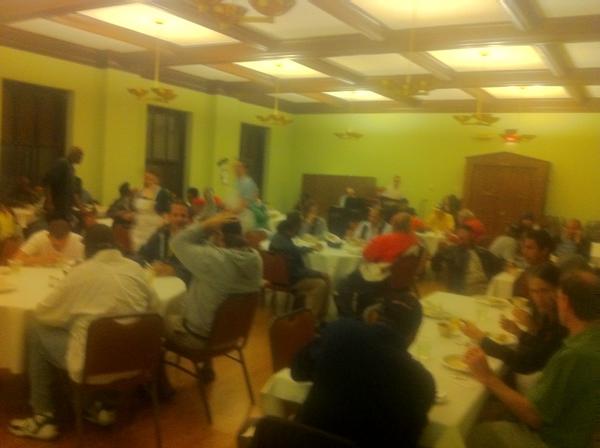
Meanwhile, we fed about 100 people last night at First Monday: meatloaf, potatoes, green beans, ice cream. Music ranged from Leonard Cohen to Opera and was very well received. There were men and women, including one family who enjoyed our hospitality:
Homelessness in Madison–The Future of Occupy Madison

It’s been a while since I’ve blogged about homelessness. Two statistics, one is somewhat anecdotal, the other backed up by a survey. First, Porchlight reports that they saw higher numbers in the men’s shelter this winter than ever before. There were more than 150 guests many nights, which meant men sleeping on the floors of the overflow shelters, with nothing but a blanket. This, in spite of the fact that we had one of the mildest winters on record.

In addition, the current vacancy rate for rentals in Dane County is around 2%, down from 6% in 2006. Why are there homeless people? For one reason, there’s nowhere for them to go. The recession has seen a drop in home ownership, foreclosures, and the like. People who once owned homes or in a better economy might be purchasing one, are renting, putting pressure on the rental market, which means landlords can raise rents.

But there’s been an interesting development. In spite of the huge numbers of people in shelters, and the large numbers being turned away, Occupy Madison, which has been present on a vacant property on East Washington Avenue for the last six months, has become a center for homeless activism and empowerment. They approached the city about finding a new site for their tent city; testified before City Council, and have raised the issue of homelessness in a new way in this city. We’ll see what happens.

The mainstream media’s coverage can be followed here. Pat Schneider’s blog post is here.

Brenda Konkel has been following the story closely, and has offered insight into the mayor’s and alders’ perspectives. She reports on the testimony of Occupy Madison participants before the Common Council as well as other material.

The reality is that the issue is much larger than any one thing. People become homeless for all kinds of reasons–unemployment, substance abuse, family situations, crime, medical conditions–and helping people to regain stability requires intensive support from many sources and directions. The men’s Drop-In Shelter is just that, a temporary place to stay for men who are on the streets. It’s not transitional housing; it can’t provide the intensive services necessary to help men find solutions to their situations.

Just in the last couple of weeks, I’ve talked to guys who came to the shelter directly from prison, from hospitals, or because their family situation had deteriorated to such a degree that the street was a better place for them. Some of them were working, at least part time, some of them were in school; all of them wanted a little help to get them out of their immediate situation into something better. I have also heard time and again, from various sources, that one of the problems of the drop-in shelter is that it doesn’t provide the kind of community necessary to help people get out of their situations.

I’ve not visited the current site of Occupy Madison (I did when they were located closer to the square, earlier last Fall). But from the testimony to Common Council, it sounds like what has developed there is something of a community, a network of support that can sustain people in their current situation. The city, and social service providers, should find ways to support this community and help it thrive.