Thursday in Holy Week

Is not this, then, why Jesus give us some very specific things to do in order to “re-member” our dark past into his future of love, to re-educate even the flesh beyond the distortions of competition and conquest? And so, before he goes out into the dark to confront his own unspeakable pain and agony and loneliness, the authentic marks of his humanity, Jesus first opens the door to the mystery of how transformed memory and love can, in him, coincide with perfection; how, through the love commandment that he gives us, and the special act of memory he demands of us in foot-washing and bread and wine, we may find our way back into the vineyard of love that we have repeatedly despoiled but long to re-enter.

–Sarah Coakley (more here)


Wednesday in Holy Week

If betrayal is so deep a part of human sin, and so profoundly entangled also with the story of love and salvation, then it cannot actually be betrayal per se that must be repressed or obliterated in the Passion. Rather, what is held up to us is the amazing possibility that even betraying, as well as being betrayed, can become part of the terrible stuff of being “handed over” to the full and deepest meaning of Christian love. God can make love, excessive love, even out of human betrayal. On this view Judas’s tragedy was that – unlike Peter – he despaired of that possibility; he could not conceive of that excessive sort of forgiveness.

–Sarah Coakley (more here)

Tuesday in Holy Week

We now stand in this lush fragrance of the ointment that reminds us again of the original vineyard of love: we step forward hesitantly, wondering what it will mean. We bring all our own excessive, broken, damaged and lost loves and we see anew, and with wonder, that Jesus accepts them; and not only accepts them but makes of them the necessary stuff of the opening of his Passion. Only Good Friday will show that, rightly understood, such excessive gift is not marginalized as “feminine,” nor is it an invitation to abuse or be abused, nor even a misplaced form of idolatry, but rather a “deeper magic” beyond all human calculation, a divine rationality beyond all human reason. But for now we leave our own hopeless and excessive gifts of love, like wasted nard, at Jesus’s feet, and wait for the unfolding of his new meaning. Amen.

–Sarah Coakley (more here)

Monday in Holy Week

Think of this entry into Holy Week, then, as an invitation: perhaps not to a mere drama after all, but to a Passion to end all dramas; not to a story of justice and deserts, but to a story of divine love so exquisite as to exceed and upturn all justice as we know it; not to a theological conundrum to be solved, but to a dangerous and life-threatening journey: a journey of pain, death, discovery and new Life. This is a journey that can only be undergone, and our undergoing it can only start with a profound lament for our ongoing resistance and aversion to its strange meaning.

From a meditation by Sarah Coakley. Read it all here.

Love, Cynicism, and the Cross: A Sermon for Palm Sunday, 2014

Palm Sunday is an experience of liturgical whiplash. We begin with joy, celebration, with loud hosannas and singing, “All Glory, Laud, and Honor.” But the mood shifts as we enter the nave and sing Ride On! Ride on in majesty.” It’s a hymn that begins with the Triumphal Entry but ends with a foreshadowing of the cross:

In lowly pomp, ride on to die

Bow thy meek head to mortal pain

In the same way our own emotions and participation shift, too, from praise and joy to condemnation as we shout with the crowd in Jerusalem, “Crucify him! Crucify him!” Continue reading

Some words from Auden for Holy Week

“Just as we were all, potentially, in Adam when he fell, so we were all, potentially, in Jerusalem on that first Good Friday before there was an Easter, a Pentecost, a Christian, or a Church. It seems to me worth while asking ourselves who we should have been and what we should have been doing. None of us, I’m certain, will imagine himself as one of the Disciples, cowering in an agony of spiritual despair and physical terror. Very few of us are big wheels enough to see ourselves as Pilate, or good churchmen enough to see ourselves as a member of the Sanhedrin. In my most optimistic mood I see myself as a Hellenized Jew from Alexandria visiting an intellectual friend. We are walking along, engaged in philosophical argument. Our path takes us past the base of Golgotha. Looking up, we see an all-too-familiar sight — three crosses surrounded by a jeering crowd. Frowning with prim distaste, I say, “It’s disgusting the way the mob enjoy such things. Why can’t the authorities execute criminals humanely and in private by giving them hemlock to drink, as they did with Socrates?” Then, averting my eyes from the disagreeable spectacle, I resume our fascinating discussion about the nature of the True, the Good, and the Beautiful.” W. H. Auden, in A Certain World: A Commonplace Book

Source: Alan Jacobs

Love was His meaning: A Homily for Good Friday, 2013

Is there any symbol more ubiquitous in our culture than the cross? We see it everywhere. Although the crosses here in the church are veiled, we can detect their outlines behind the veils. We wear them on pendants around our necks; we see it in ads; some even have crosses tattooed on their bodies. Most of the time, when we see a cross, we don’t give it another thought. It may not even have religious significance for the one who wears it as jewelry. Continue reading

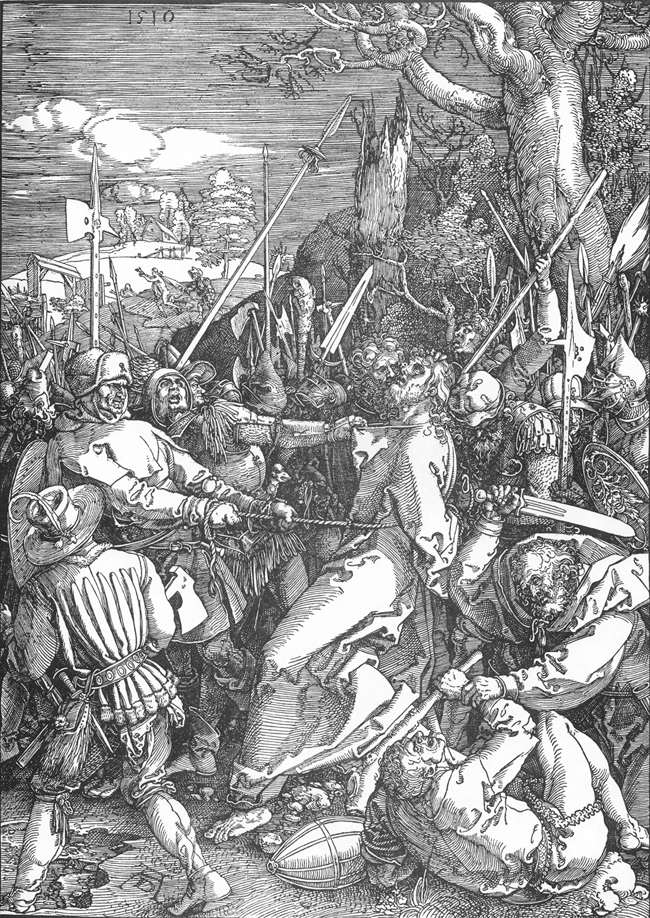
Maundy Thursday

10largepAlbrecht Dürer, Christ taken Captive (The Large Passion)

The Collect

Almghty Father, whose dear Son, on the night before he suffered, instituted the Sacrament of his Body and Blood: Mercifully grant that we may receive it thankfully in remembrance of Jesus Christ our Lord, who in these holy mysteries gives us a pledge of eternal life; and who now lives and reigns with you and the Holy Spirit, one God, for ever and ever. Amen.

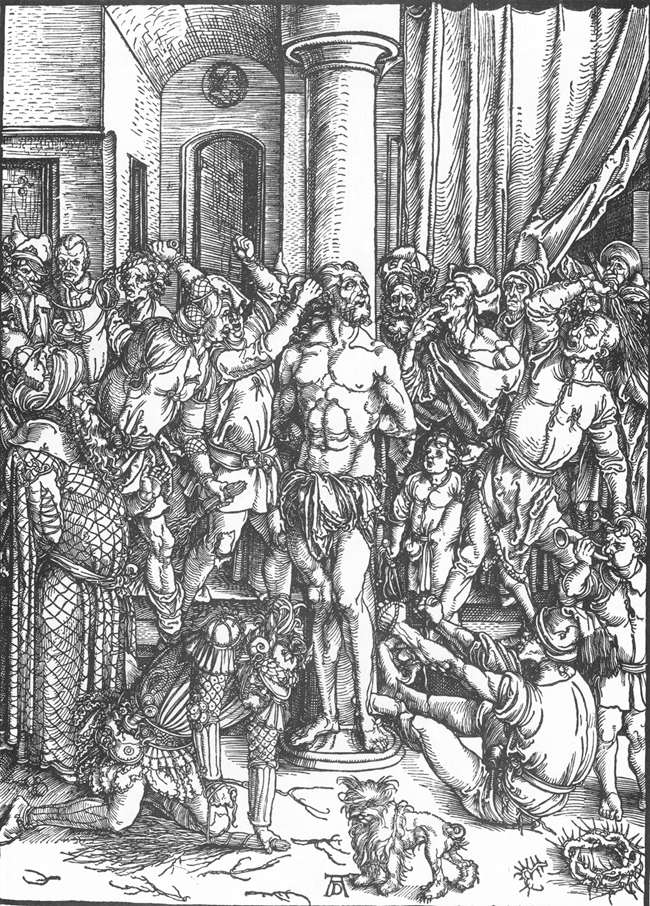
Wednesday in Holy Week

03largepAlbrecht Dürer, The Flagellation of Christ (The Large Passion)

The Collect

Lord God, whose blessed Son our Savior gave his body to be whipped and his face to be spit upon: Give us grace to accept joyfully the sufferings of the present time, confident of the glory that shall be revealed; through Jesus Christ your Son our Lord, who lives and reigns with you and the Holy Spirit, one God, for ever and ever. Amen.

Tuesday in Holy Week

04largepAlbrecht Dürer, Ecce homo (from the Large Passion)

The Collect.

O God, by the passion of your blessed Son you made an instrument of shameful death to be for us the means of life: Grant us so to glory in the cross of Christ, that we may gladly suffer shame and loss for the sake of your Son our Savior Jesus Christ; who lives and reigns with you and the Holy Spirit, one God, for ever and ever. Amen.