
April 17, 2025
A memory has been running through my mind these last few days as I’ve thought about Maundy Thursday. I grew up Mennonite, which was then, and likely remains a profoundly non-liturgical tradition. When I was a member, we celebrated communion only twice a year but our observance of communion always included footwashing. It was a ritual central to Mennonite identity in that era; so central in fact that one of the Mennonite colleges had as its logo an image of a basin and towel. The idea of service to others, Jesus’ commandment to imitate his actions, and to love others as he loved his disciples, were core values among Mennonites during the 50s and 60s.
But what I’ve been thinking about is not the act of footwashing itself, as practiced among the Mennonites of my childhood. Rather, I’ve been remembering other aspects of the ritual, specifically the fact that our footwashing was accompanied by hymns. I recall my dad, who was a musician and often led music in the church, leading out in hymns as we watched each other’s feet,–although they were sung from memory and without accompaniment by musical instrument. Truth be told, while I vividly remember singing, I cannot for the life of me remember the specific hymns we sang.
Perhaps the reason I’ve been reminded of that memory is because it is the one thing that our service tonight shares with the traditions of my childhood, even though our singing during footwashing had been planned in advance and will be accompanied by the organ, thankfully.
Footwashing is an intimate, deeply moving, powerful ritual and for us on Maundy Thursday, it is only one of several such powerful moments in our liturgy. I remember also the first Episcopal Maundy Thursday service I attended, and the wave of emotion that overcame me as I watched for the first time in my life the Stripping of the Altar. It evokes in so many ways the stripping of a body, of Christ’s body, for burial, and as I cleanse the altar later this evening, in near darkness, my gestures will mimic the scourging that Jesus suffered at the hands of his persecutors and executioners.
Our watching is accompanied by growing apprehension as the ritual acts remind us of the events that follow. Some of them we will remember viscerally as our bodies move through traces of Gethsemane, Golgotha, and the tomb. As we move, our emotions build—the grief and despair, the guilt and shame. Our daily lives seem to be suspended, interrupted, as our attention focuses on the drama of Christ’s passion. But even as we know what tomorrow brings—Good Friday and crucifixion, let us linger for another moment or two, here on Maundy Thursday and with the Last Supper.
“Having loved his own who were in the world, he loved them to the end.” This brief sentence, the beginning of our gospel reading tonight, is an introduction not just to the events that follow immediately—the last supper and footwashing, but to everything else that we commemorate in the coming days, Christ’s arrest and trial, his execution and death, and yes, his resurrection. All of that, all of what will happen, what we dread will happen, is an expression of Christ’s love for his disciples and for us. But while we may want to move on to the bigger parts of the story; it all begins here. Friends gathered around a table, and a humble, intimate act of footwashing.
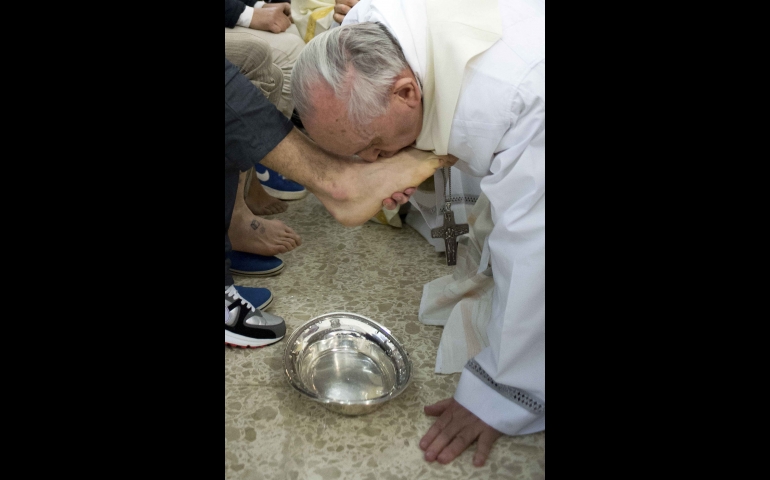
We see Peter’s response—his revulsion and unwillingness to allow Jesus to serve him in this way, to kneel before him. Less obvious from the text we heard, the footwashing takes place before Judas’ departure. So Jesus knelt down before the one who would betray him as he knelt before the other disciples. Perhaps that’s the most radical, least imaginable moment in the whole story.
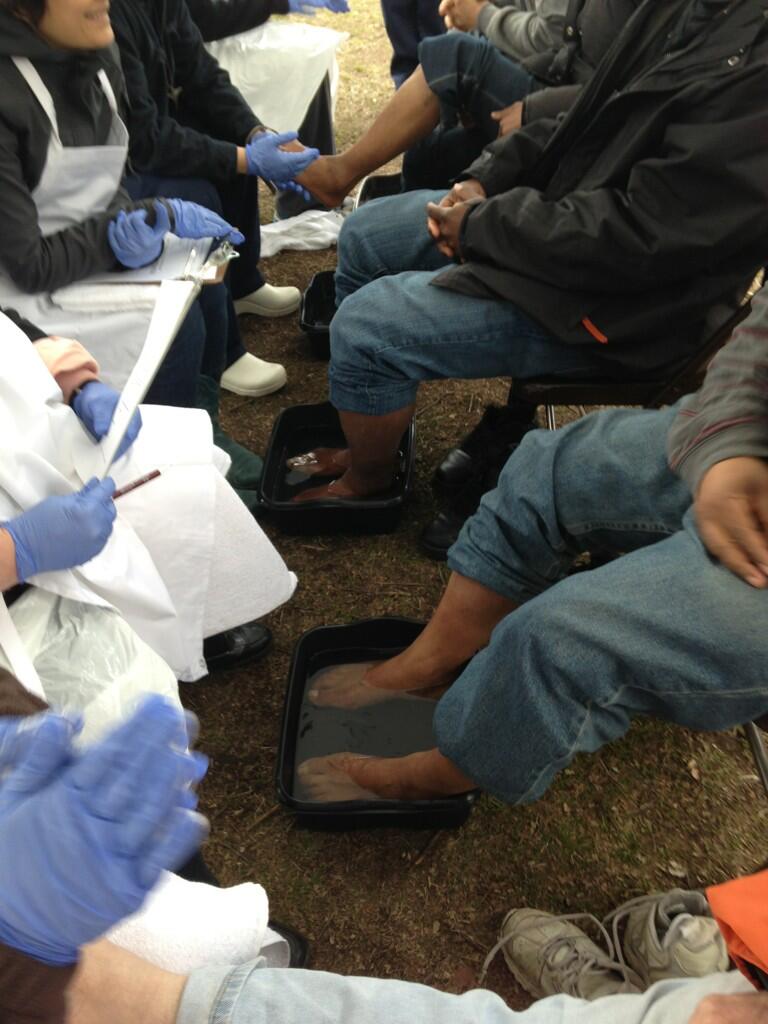
It’s a shocking act—in the first century as in the twenty-first. Peter’s response to it might be the same as ours, to imagine our teacher, our leader, the Son of God, kneeling down girding himself with a towel, and washing our feet. It makes us uncomfortable to do it ourselves, unaccustomed as we are to such acts of intimate service. Yet all around us people do such things—take intimate care of their loved ones who are unable to care for themselves. And many others do it for people they don’t love—because it’s their job, often ill-paid, thankless.
But Jesus joins them in their labor and toil, washing the dust and dirt from the feet of his friends—an intimate, revolutionary act that presages everything else to come, and demonstrates, wordlessly, what it means to love his own to the end. It’s a concrete demonstration of his self-giving love; the emptying himself of his identity to become the lowest of servants, performing menial tasks, unworthy of a king, let alone of a God.
In our world, where power and dominance are demonstrated in acts large and small, forcing submission, demanding obedience, where bullying is the norm, for Jesus to fall to his knees in humility and service, upends our assumptions and shatters our expectations.
But more than that, Jesus invites us to join him on our knees, in service and love to others. This act of humble service combined with the meal at which it takes place, is the constitutive act of a new beloved community brought together in shared commitment to following Jesus. Forged by love, shaped by love, the community gathered at table together, shares in Christ’s body and blood, becomes Christ’s body, knit together by love.
In these days of turmoil and suffering, as we watch our nation and world collapse, and we lose our moorings in the rubble and chaos of institutions and ideals, the acts we remember tonight, the rituals tonight bind us together with Christ in that new community. And what we do here may serve as example and witness to our neighbors and to the world—evidence of a faith in a Christ who comes as one to love and serve in humility, not to dominate and oppress.
 Preaching Grace on the Square