The St. Francis house brouhaha

I’ve had several inquiries from parishioners about what’s happening with St. Francis House, the Episcopal Chaplaincy at UW Madison, and decided it was time to offer my perspective. I’ve been a member of the board since early 2010. When I joined, discussions about the future of the chaplaincy were well underway. The chaplaincy had been funded by an endowment that over the last decade or more has been depleted in order to meet expenses. The building itself is in need of several hundred thousand dollars of deferred maintenance. Clearly, we were approaching a crisis.

At the end of its visioning process, the board concluded that the chaplaincy’s physical presence on UW’s campus was of vital importance and that we should do whatever we could to ensure that presence. We are also convinced of the importance of college chaplaincy to the future of the Episcopal Church. Such programs have served as the incubator for the church’s future leadership, and St. Francis House is no exception. We believe Anglicanism is a unique and powerful witness to the Christian faith that resonates with young people in an academic setting.

The chaplaincy’s greatest asset is its property, located on the heart of UW Madison’s campus. A number of options for moving forward were considered, including some sort of joint-venture development with our Lutheran neighbors. After exploring the possibility of an outright sale of the property, the board decided to move forward with a public/private partnership with a private developer. The plan is to demolish the 1964 chapel, move the historic building to the corner of the lot, and build an L-shaped student apartment complex on the remainder of the property. This portion of the property would return to the property tax rolls, and income from the project would place the Episcopal Chaplaincy on firm financial ground.

There has been lively debate on the board about the importance of having a physical presence on campus; in the end, the option to sell the property seemed shortsighted. It is also the case that an outright sale would not generate enough income to pay for the sort of chaplaincy envisioned by the board.

Bishop Miller wrote a letter on May 15 that captures the board’s reasoning and also speaks eloquently to the importance of campus ministry. He wrote:

Strengthening Campus ministry and the funding for it has been one of my priorities as bishop because it was through the Episcopal Ministry at Michigan State University I discovered The Episcopal Church and found a spiritual home. Over the last few years I have worked with our chaplains, the St. Francis House Board, and our diocesan convention to strengthen and restore this ministry. Each week a faithful community gathers for prayer, fellowship, and study at our home at 1001 University Avenue. Over the past eight years the ministry at St. Francis House has produced some great future leaders of our church including one candidate for ordination, and two others who are now exploring the possibility of ordained ministry while serving as missioner of the Episcopal Service Corps.

The full letter is here: bishopsletter.

The City Planning Commission rejected the proposal at its meeting this week. There has been vocal opposition from our neighbors at Luther Memorial Church. It is unfortunate that this conflict has arisen. Bishop Miller, the board, and the developers have worked hard to assuage any concerns our neighbors might have. In the end, however, our primary obligation is  to strengthen the mission and ministry of the Episcopal Chaplaincy at UW.

Who knows what will happen next but the board remains committed to this project and the promise it holds for empowering Episcopal campus ministry in the coming decades.

For background reading here are relevant articles from the Madison State Journal

On the Visitation of a Bishop

One of the fun things for me about having a doctorate in the History of Christianity and being an Episcopal priest is musing over the historical background of particular customs or even canons. Bishop Miller’s visit to Grace has been the occasion for some not-so-serious reflection on the history of Episcopal visitations.

The visitation was introduced in the late middle ages as an effort at reform. First targeting monastic houses, reform-minded bishops and church organizations began visitations of parishes as well. One of the early, and most famous, visitations was that of Electoral Saxony (Luther’s home) in 1528. Eventually, the requirement for regular visitations was enshrined for Roman Catholics at the Council of Trent. When I was working on my doctorate, visitation records were all the rage. Visitors (not bishops, but state or church bureaucrats) would go to all of the parishes and inquire about the religious life and faith of the community, asking as well about the priest or minister. From these records, we gain insight into the level of religious commitment, religious practice, and other things like magic, witchcraft, heresy, and clerical malfeasance. The visitors often had a set of very detailed questions to ask, and they also demanded that people do things like say the 10 Commandments or creed.

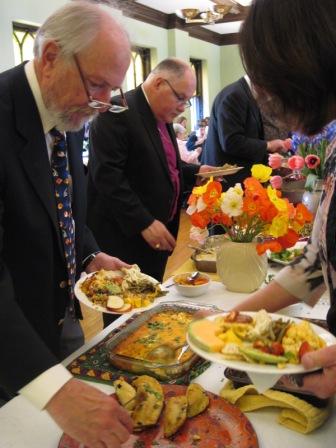
In the Episcopal Church, the Bishop’s visit is usually the occasion for confirmation. Such was the case for us, but unlike visitors of yore, Bishop Miller did not query confirmands on their catechism (good thing!). After confirmation, as is the custom in many places, we had a reception. Here are some photos:

Thy table now is spread

The Bishop and the Senior Warden analyzing the situation

There was music as well:

From the children:

And from Los Soles:

In addition to celebrating the confirmands and all of our mothers, we belatedly celebrated the Rev. Pat Size’s ministry among us. She retired at the end of 2010.

Mary Ray Worley gives Pat a scrapbook of her ministry with the Hispanic community

Participants or Spectators? Consumers or producers?

Bishop Miller made his biennial visitation to Grace Church yesterday. In his sermon, he referred to a college course he once took on the history of sport in America. The professor’s thesis was that Americans’ involvement in sports was the movement from participation to being fans. He compared that to the church and proclaimed that Christianity is not a spectator sport.

I found a connection between his sermon and a blog entry that asked whether worshipers are consumers or producers. The author began with music–the difference between consuming (turning on the radio, listening to one’s ipod) and producing, whether as a musician or as a songwriter. She then turns to worship, asking whether we perceive worship leaders (clergy, choir, professionals) as producers, and those who sit in the pew as consumers of worship. She concludes that to some degree the notion of the lay consumer of worship is an accurate representation:

It’s true that we consume the Word which is given to us, something we did not produce ourselves.  But as we chew and swallow and ponder what we freely receive, we do go out to produce, to create, to produce fruit, to create community, to do justice and to love kindness.

One could have deepened the comparison by pointing out that people’s “consumption” of music has changed since the nineteenth century, with the selling of sheet music giving way to the selling of recordings, and the important value that educated, cultured persons could play an instrument, or that popular entertainment for many among the poorer classes, was self-created. In these cases, music also created community.

The problem with the consumer/producer model is not just that tends towards passivity; it also tends towards isolation. I think that’s true of much of worship as well, even in the Anglican tradition.

Opening our Doors: An update

As we have for the past two weeks, Grace Church will continue to open its doors this week for all who seek a place of prayer, warmth, and respite on Capitol Square. Thanks to parishioners who have agreed to serve as hosts on Monday and Tuesday. If you’re in the square drop by Grace to warm up and say hello. We’d love to meet you.

We’ve been struggling throughout the last two weeks to keep up with events and most of the time we’ve been reacting; dealing with situations after they’ve already begun to develop. We don’t know what’s going to happen this week, but we’ve been overwhelmed by the positive response to our efforts to extend our hospitality.

We know how difficult a time this is for many people. It’s been difficult for us, as well. Addressing the situation on the ground while we are also trying to go about the regular work of the church–finalizing budgets, preparing service bulletins, trying to get everything organized for Shrove Tuesday, Ash Wednesday, and Lent. Well, we’ve been overwhelmed.

I’m grateful to our staff who have been gracious in their flexibility; grateful to to parishioners who didn’t say anything about the dirty floors of the nave today, and have been supportive of our efforts to reach out in these past weeks.

I’m also deeply appreciative to the leadership of Bishop Steven Miller and my clergy colleagues who have offered their support and prayers.

Keep praying for us, for all of us in Madison’s Capitol Square, across the country and the world who are seeking to speak out for justice in the name of God.

This is what Religion looks like, Part 3

Video of Bishop Miller at the rally today:

. Thanks to Shannon Kelly.

I didn’t see Bishop Miller today. I was in Grace as the clergy assembled and my guess is he was either outside the church or couldn’t make it through the crowd.

One amusing note: clergy and protesters behave like everyone else when they enter a church. They crowd the back and leave the front half of the church completely empty.

Bishop Miller’s letter to the Diocese of Milwaukee

A Letter from Bishop Miller to the Diocese of Milwaukee


February 18, 2011


Dear Friends in Christ,

Over the last few days we have witnessed freedom and democracy at work both around the world. I am pleased to report to you that our friends in our former companion diocese of Egypt are safe and that the missionaries of The Episcopal Church serving in Egypt are continuing their ministry in that place. I know you will join me in continuing to hold the people of Egypt and the rest of the Middle East in your prayers.

This past week we have also seen democracy at work in Wisconsin as thousands gathered in Madison in response to the Governor’s Budget Bill. Regardless of our individual positions on the bill before the Legislature and what steps are necessary to build a stronger and better Wisconsin, I believe we can all agree that our baptismal vow to “respect the dignity of every human being” is not served by a majority simply pushing through legislation because they have the votes necessary to do so. As Christians, it is our duty and call to make sure that everyone has a place at the table and every voice has the opportunity to be heard. Respecting the dignity of every human being requires taking the time to have honest and faithful conversation that respects the rights and freedoms of all.

We also are called to speak on behalf of the sick, the poor, the elderly, orphans, widows, and all those who live in the margins of our society. Matthew in his Gospel reminds us that in serving these we are serving the Lord Jesus himself. It would be a sin to balance our state budget on the backs of those who have the least.

As your bishop I ask you to do two things. First, contact your representatives and invite them to true leadership by taking the time to listen to the voices of all and provide a guarantee that the voices of all will be heard on the future. Secondly, pray for elected officials daily, by name. Leading is a difficult task that requires the prayer support of many. I know that I could not lead this diocese without the prayers of each of you.

May God continue to bless us his people that we may be a witness to the world.

Yours in Christ,

The Rt. Rev. Steven A. Miller

Bishop