
Advent Resources 2012

The Presiding Bishop’s message for Advent.

A good word for the world in Advent:

Too often I’m left feeling shamed and abandoned by the church in this season, because I’m a human being like the ones I hear derided from the pulpit. I may not line up at 12 midnight on Black Friday, but I do get all caught up in commercialism and I am needy and I do want things and I do feel pressure to spend and I am certainly no Virgin Mary in Advent, rapt in pregnant contemplation in the quiet candlelight of my room during these four weeks. And if I, being a committed religious professional and all, feel shamed and condemned by anti-consumerist, world-deriding sermons, I can only imagine how it feels to a secular person who wanders into the pews to be told with divine authority that their secularity has rendered them unfit for Christmas.

Daily Meditations for and by college students and young adults

The Advent Conspiracy

is an effort to refocus our attention on the season, not to ignore the commercialism but to seek in it the deeper meaning of Christ’s coming. How to plot your own Advent Conspiracy has more:

Advent Conspiracy is about giving presence, which is often more costly and more meaningful than material presents. The movement is generating hundreds of powerful stories and creative gift ideas, many of which can be found at AdventConspiracy.org. Holder mentions just a few examples: The son who gave his father a pound of coffee beans with the stipulation that the father can only enjoy the beans when he’s with his son, who wants to hear his voice and get reacquainted. The dad who gave his daughter two blank journals—one for him to fill, and the other for her as she headed off to college; they would exchange the journals the next Christmas. And the 84-year-old woman on a fixed income who made donations to a charity in the names of her family.

Sharon Ely Pearson has compiled a list of online Advent Calendars and some background info.

Her list includes:

  • The Institute for Christian Formation (Cincinnati, OH) has devised a calendar for 2013: Year of Grace (December 2, 2012 – January 13, 2013) that includes activities and resources for each day.
  • Trinity Wall Street‘s offers a new calendar every year – What are you waiting for?
  • A variety of calendars in English and Spanish from Living Simply.
  • An Advent Devotional Calendar for downloading from Thomas Mousin of Massachusetts.
  • Paperless Christmas from the UK in 2011 is still lots of fun!
  • Busted Halo has a more off-tradition calendar.
  • Loyola Press offers an online calendar or downloadable version for children and families.
  • Praying in Color offers templates in which to create your own Advent calendar.
  • The Society of St. John the Evangelist (Cambridge, MA) has offered a daily mediation via Pinterest.

Living Compass, offers a free daily meditation booklet for Advent. You can download it here. Its goal is:

The goal of these days of Advent are not just to get our homes decorated and the shopping done, it is to help us prepare our whole selves, our hearts, souls, strength and mind for the gift God so freely gives us: God’s Love as revealed in Jesus. It is a gift that might get overlooked if we aren’t prepared to receive Christ.
On preaching to oneself in Advent

Yesterday was one of those difficult days in ministry. I was tired and frazzled. A funeral last Friday was followed by the usual Saturday and Sunday events and business. Sunday afternoon, I sat by the bedside of a dying parishioner, praying and reading Psalms as I listened to her labored breathing. Monday morning, I received word that she had died, so there was another funeral to plan this week. Monday also was our regularly scheduled vestry meeting. All of that meant I woke on Tuesday after little sleep, knowing that the day would be long, busy, and exhausting.

By the time I arrived at church yesterday, it was already full of activity. Members of the altar guild were decorating the nave for Christmas and full of questions about upcoming services, including the funeral. There were bulletins to prepare and questions from staff, lay leaders, and others about Christmas Eve and Christmas Day services. In the middle of all that, I paused for an hour to talk with family members and plan the Thursday funeral service. Then there was a staff meeting, and a walk-through of Christmas Eve with the thurifer.

I was physically and spiritually exhausted as I welcomed people to our evening Eucharist and began the service. But something miraculous happened, at least for me. As I spoke about the gospel for Tuesday in 4 Advent (Luke 1:26-38–the same gospel that we read on Sunday), I realized that the words I was saying were addressed not primarily to the congregation gathered there. They were addressed to me. I spoke about all that had been going on in my life the past few days, all that had been going on the world around us, and the difficulties many of us face in this season. Christmas is meant to be a time of joy and celebration, but for many it is a time of great stress, sadness, even conflict. It is often difficult to be open to God’s presence in such times, to welcome the coming of God into our midst.

As I was speaking, I sensed that all of the day’s–the week’s–stresses were leaving me and my heart was making room for God. As I looked at the faces in the congregation, it seemed as if something similar was happening to some of them. I left my burdens at the altar, received Christ in the bread and wine, and received strength for the journey. The words I preached changed me. I’m told from time to time that a sermon of mine has had a powerful impact on a hearer. This is the first time in my memory, that a sermon of mine has had such an impact on me.

Today, there is more bustle at church with workmen in the nave, arrangements concerning the funeral, pastoral appointments in the afternoon. But today, at least for a bit, I am prepared for the coming of Christ.


Perplexed and Pondering: A Sermon for the Fourth Sunday in Advent, Year B

December 18, 2011

Today is the fourth Sunday of Advent and our attention turns to the story of the birth of Jesus. Our attention turns to Mary. As you know Christians have speculated for nearly two thousand years about Mary. Why Mary? In answer to that question, elaborate theologies and doctrine have developed to explain what set Mary apart, why God chose her as the woman who would give birth to Jesus Christ. The irony is that as important as the question why Mary has been for two thousand years of the Christian tradition, it’s not a question Luke, the gospel writer who tells us the most about her, is interested in. Continue reading

Lectionary Reflections, Advent 4, Year B: Occupy Bethlehem?

This week’s readings.

Our readings bring us ever closer to the coming of Christ, and it is easy for our attention to focus on Mary this week, with the story of the Annunciation as the gospel reading and the Magnificat as an option for the Psalm. But we shouldn’t let our expectation of Christmas divert our attention from the other readings. In particular, the reading from 2 Samuel is fascinating on its own, and meaningful too in its lectionary context, with God’s promise to David that “your throne shall be established forever.”

The passage from 2 Samuel occurs just after David has gained control of the monarchy and has begun the building projects that every victorious ruler undertakes–to demonstrate their power and symbolize their reign. David has built a “house of cedar” for himself, and gets the idea to build a temple for Yahweh. Nathan the prophet supports him in this effort, saying “The Lord is with you.”

Apparently Nathan wasn’t paying attention, because Yahweh speaks directly to David, asking him where he got this bright idea and whether Yahweh had ever asked to have a temple built. In fact, the Hebrew suggests that Yahweh has walked alongside and with the Israelites. For all of the effort in 1 and 2 Samuel to offer a defense of David’s rise to power and of his monarchy, there remains in the text considerable antagonism toward monarchy in general. This seems to be one example of that.

The lectionary editors no doubt wanted to focus our attention on the promise that David’s house would last forever and that his throne would be established forever, a prophecy of the coming of the Messiah. But there’s another connection between this reading and our other texts. Yahweh tells David that “I took you from the pasture, from following the sheep to be prince over my people Israel; and I have been with you wherever you went, and have cut off all your enemies from before you; and I will make for you a great name.” In the Magnificat, Mary sings:

He has shown the strength of his arm, *
he has scattered the proud in their conceit.
He has cast down the mighty from their thrones, *
and has lifted up the lowly.
He has filled the hungry with good things, *
and the rich he has sent away empty.
He has come to the help of his servant Israel, *
for he has remembered his promise of mercy,
The promise he made to our fathers, *
to Abraham and his children for ever.

Just as Yahweh lifted up the lowly David and made him king, Mary sings that God casts down the mighty from their thrones and sends the rich away empty. There’s a connection here, not just the genealogical connection with David that Matthew and Luke want to emphasize. We are invited to compare the rule of David, perhaps the rule of Rome, too, with the rule, the reign of God, and the coming of the Messiah. To put our hopes in the power and justice of human rulers and institutions is to hope falsely, for 1 Kings goes on to describe how Solomon, the wisest of all kings, oppressed the people. His son Rehoboam promised to do even worse, a promise that was met with rebellion and led to the division of the Northern and Southern monarchies.

As Advent nears its end, this season in which we prepare for the coming of Jesus Christ and reflect on his coming to us in Christmas and in the Second Coming, we do well to remember that God’s power is greater than that of any human agency or institution, and that Mary’s song praises a God who upends power relationships, reverses the status of rich and poor, and feeds the hungry. These latter are especially important to keep in mind with all the news of Occupy Wall Street, the 99%, and Republican efforts to lower taxes on the wealthiest of our citizens.

Lectionary Reflections on Advent 3, Year B

This week’s lectionary readings.

The contrast between the presentation of John the Baptizer in Mark and the Gospel of John’s portrayal of him is striking. For one thing, in the fourth gospel, John doesn’t actually baptize Jesus. In addition, Jesus begins his public ministry before John’s arrest. There are other differences, too.

In this week’s gospel reading, we learn about who John is not. He is a witness, or testifier to Jesus Christ, but when asked who he is, whether he is the Messiah, or a prophet, or Elijah, he replies, “I am not.” Later in chapter 1, when John sees Jesus, he points to him and says twice, “Behold the Lamb of God.”

The gospel writer is concerned to heighten the difference between John the Baptizer and Jesus, to make clear that John is less important, but by writing in this way, he presents us with questions that, in a sense, we struggle with as Christians. Who is Jesus Christ? For all of the doctrinal formulations that attempted to fix and define Jesus Christ’s identity for all time, the question of who he is, for us as individuals and for our congregations presses itself on us.

How do we experience Jesus Christ? How does he come to us? How do we encounter him in our lives and in our world? We are often tempted, just like those who defined the doctrines of Jesus Christ’s nature, to fit him into a certain philosophical or theological framework. We are tempted, like those who asked John who he was, to try to fit our experience of Jesus Christ into certain pre-defined categories or terms. That’s the case all of the time, but it may be particularly true in this season, when we look for Jesus Christ’s coming in a manger in Bethlehem, and ignore other ways in which Jesus Christ comes to us.

The Gospel of John consistently asks, “Who is Jesus Christ?” As often as not, those who ask Jesus the question, “who are you?” have questions asked back of them, or experience Jesus shattering the categories they use to ask him.

Who is Jesus Christ? To ask that question in Advent is to invite two very different, and in some ways contradictory responses. He is the babe who is born in Bethlehem, but he is also to one who will come to usher in a new age. Those two answers force us to open ourselves up to contradictory and unsettling ways in which Jesus Christ comes to us. To be open to his coming, however it is he chooses to come, is one of the disciplines of Advent.

The Messianic Banquet–Reflections on Wednesday in the first week of Advent

The readings for today from the daily eucharistic lectionary:

Isaiah 25:6-10a
Psalm 23
Matthew 15:29-37

All three scriptures feature meals. The gospel story is Matthew’s account of the feeding of the five thousand. Psalm 23 includes the line, “you spread a table for me in the presence of those who trouble me.” The Isaiah passage begins:

On this mountain the Lord of hosts will make for all peoples
a feast of rich food, a feast of well-matured wines,
of rich food filled with marrow, of well-matured wines strained clear.

The messianic banquet is one of the predominant images for Jewish reflection about the messianic age in the decades leading up to Jesus. Drawing on rich biblical imagery, the Dead Sea Scrolls and other sources express a hope that the age to come will include a bountiful feast of rich foods and wines. That image was picked up and expanded in early Christianity. One need only think of the importance of table fellowship in Jesus’ ministry, the numerous times we see him feasting (and the criticism of his and his disciples’ actions). But in the gospels, Jesus also brings about the messianic feast. In the gospel for today, Jesus creates more than enough food from sparse resources, so that everyone goes away satisfied. In John’s gospel, Jesus makes wine out of water after the part had already been going on for quite some time.

At the Last Supper, in language echoed by the gospels’ accounts of the feeding miracles, Jesus takes bread and wine, gives thanks, and gives it to his disciples. The Eucharist is a foretaste of the heavenly banquet.

Advent is a time when we think not only about Jesus’ first coming, but also about his Second Coming, and the idea of a messianic banquet remains a powerful image in Christian reflection. The Isaiah text is one of the suggestions for Hebrew Bible readings in the BCP Burial Service liturgies, and rightly so. It evokes the rich memories of our own celebratory meals, and looks forward to an even greater celebration in the age to come.

Our holidays are full of celebrations, parties, meals like Thanksgiving Day and Christmas Day when tables groan from all the food on them. We seldom make the connections between those meals, the Eucharistic feast, and the messianic banquet, but we should. The meals we share together as families and friends are icons of the meal we share when we share Christ’s body and blood.

They are not for ourselves alone to enjoy. For our joy to be complete, our invitation must be shared with all of humanity, our table extended to include who hunger and thirst.

The Peacable Kingdom–Tuesday in the First Week of Advent

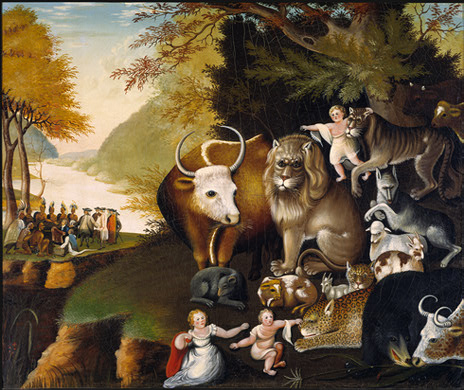
The readings in the daily Eucharistic lectionary for Tuesday in the first week of Advent include Isaiah 11:1-10, the prophet’s vision of the peacable kingdom:

6 The wolf shall live with the lamb,
the leopard shall lie down with the kid,
the calf and the lion and the fatling together,
and a little child shall lead them.
7 The cow and the bear shall graze,
their young shall lie down together;
and the lion shall eat straw like the ox.

It’s one of the most familiar and most beloved images from all of scripture, a beguiling picture of a world at peace with itself, of God’s creatures playing and resting together. For many of us, the most familiar artistic depiction is that by the early American artist, Edward Hicks, who painted 61 different versions. Here is one: Hicks was a folk artist and the naivete of his style seems well-suited to what might seem to twenty-first century readers, a certain naivete in the vision of the prophet. We live in a world which seems much more in keeping with Thomas Hobbes’ idea of the state of nature in which:

where every man is enemy to every man, the same consequent to the time wherein men live without other security than what their own strength and their own invention shall furnish them withal. In such condition there is no place for industry, because the fruit thereof is uncertain: and consequently no culture of the earth; no navigation, nor use of the commodities that may be imported by sea; no commodious building; no instruments of moving and removing such things as require much force; no knowledge of the face of the earth; no account of time; no arts; no letters; no society; and which is worst of all, continual fear, and danger of violent death; and the life of man, solitary, poor, nasty, brutish, and short.

I don’t know about you, but sometimes I feel like the times in which we live are approaching Hobbes’ state of nature. We are certainly in a world where everyone seems to be at war with everyone else.

Does the prophet’s vision continue to offer hope for us in this season of Advent? Can we imagine a world in which we are remade in God’s image, refashioned as loving and creative persons, and perhaps most importantly living in peacable community with one another? Sometimes I think that vision is so far separated from reality that we can no longer imagine it as a possibility as a vision of our future, rather than the rantings of an eighth-century prophet, or the childish images of a nineteenth-century painter.

The prophet’s vision may no longer hold power over us. But the idea behind that vision cannot be tossed into the dustbin of an abandoned faith and a past time. A human race, no, a world, at peace itself, that idea must continue to shape and empower us. What that world might look like, what our vision of that world might look like, may be different from the prophet’s but it must be beautiful enough to sustain us and to give us hope.

In Advent, in this troubled world and in these troubled times, God waits for us. God waits for us to find our way to that peacable kingdom, where we encounter and embody, God’s love.

Looking for signs of Christ’s Coming: A Sermon for Advent 1, Year B

November 27, 2011

 Apparently, Harold Camping has given up. He’s retired, quit preaching, and quit setting dates for the second coming. You remember Harold Camping. He’s the guy who predicted the world would end on May 21. His followers bought advertising all over the place, hyped it up, and stoked a media frenzy. When May 22 dawned, Camping regrouped, said that he had got his calculations wrong, and said, no the real date was October 21. After that, he threw in the towel. He has decided that whatever God was telling him, and is continuing to tell him, he will no longer announce to the world that date of Jesus’ return. Continue reading

Advent

It is very remarkable that we face the thought that God is coming, so calmly, whereas previously peoples trembled at the day of God, whereas the world fell into trembling when Jesus Christ walked over the earth. That is why it is so strange when we see the marks of God in the world so often together with the marks of human suffering, with the marks of the cross on Golgotha. We have become so* accustomed to the idea of divine love and of God’s coming at Christmas that we no longer feel the shiver of fear that God’s coming should arouse in us. We are indifferent to the message, taking only the pleasant and agreeable out of it and forgetting the serious aspect, that the God of the world draws near to the people of our little earth and lays claim to us. The coming of God is truly not only glad tidings, but first of all frightening news for everyone who has a conscience. Dietrich Bonhoeffer, “The Coming of Jesus in our Midst”

From a sermon Bonhoeffer preached on the First Sunday of Advent, 1928, in Barcelona; from The Living Pulpit