
Antony the Great

Today is the commemoration of Antony the Great in our liturgical calendar. Here’s a homily I prepared on him a couple of years ago:
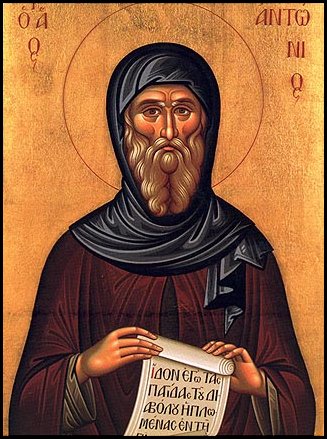
Antony is one of those saints who has been a fixture in the liturgical calendar for centuries. And rightly so.  Antony is one of the most important figures in the birth of monasticism. Antony lived in the third and fourth centuries. We’re not exactly sure of his dates, but the best guess is that he lived from 250 to 350 or thereabouts. He lived in Egypt, was the child of wealthy Christian parents, and after their death, while he was still a young man, he heard the gospel for today read and decided that was what he wanted to do. He put his sister in a convent, gave away his money, and went off into the desert to seek intimacy with God. Over the years, he moved further and further away from civilization, but wherever he went, he was pursued by curiosity seekers and by would-be disciples. Occasionally he would return to the city. We know that when he was a very old man, he went to Alexandria, which was the Egyptian metropolis, and the leading center of Christianity in the region, at least twice, and conferred there with bishops.

The flight from the city into the wilderness was not unique to Christianity in Antony’s day. Wealthy people had begun to abandon the city for the countryside, where they could live in leisurely quiet. Poor people fled the city to seek food, shelter, and protection. What set monasticism apart was the certainty that the city was an evil place, that the wilderness was more suited to the pursuit of God.

This tension between city and wilderness is deeply ingrained in our own culture and in the cultures that gave rise to the biblical writings. It’s been a very long time since we in America saw urban life as the ideal.. We may not prefer the wilderness to the city, but we certainly tend to distrust the city, and all that it represents. Longer ago, the distrust of the city and even the town ran much deeper. When I was a boy, my mother read the books of Laura Ingalls Wilder to my sisters and me. If you remember them, you remember that Pa was always on the move further west, further into the wilderness; as soon as he could see the smoke from a neighbor’s chimney, he was ready to find somewhere new to live.

Antony did much the same, and indeed throughout the Middle Ages, monks settled in the wilderness, in places as remote as possible. There’s something of an irony here, however, for wherever monks went, laypeople quickly followed them. Antony’s biographer, Athanasius, said of Antony that “he made the desert a city.” By that he meant two things; first: Antony and the monastic ideal were so popular that perhaps thousands followed him into the desert; second, that in their communities, the monks created a new kind of city, focused on the worship of God.

The wilderness also plays a role in the story of Jesus. Jesus was baptized by John, who lived in the wilderness, dressed in camel’s hair, and ate locusts and wild honey. People came out into the wilderness to see him. He seems to have been something of a curiosity, but the encounter with John changed people’s lives. In the weeks to come, we will hear of Jesus’ own journey into the wilderness, where he will be tempted by Satan.That encounter with Satan in the wilderness seems to be a turning point. It comes immediately after his baptism, and after the baptism, Jesus returns to Galilee and begins his public ministry.

Usually when we think of the image of wilderness, we think of wasteland, of danger and violence. In the language of spirituality or religious life, the wilderness is often used as a metaphor for a period of intense struggle, or perhaps a feeling of alienation from God. For Antony and the other Egyptian monks, the wilderness or desert was not a place of alienation from God. Rather, it was a place that enabled intimacy with God. Stripped bare of everything but the essentials, the monk could focus only on what really mattered—his or her relationship with God.

Compared to Antony, of course, our lives are much more complex. The idea of throwing it all away for the opportunity to focus on one’s relationship with God may seem appealing occasionally, but few of us would ever act on that impulse. We all have those times in our lives when it seems as if we are in a desert, when the old way of doing things, our lives and lifestyles, seem difficult or meaningless. Sometimes, in those deserts, we seem to be all alone, abandoned even by God. That feeling of abandonment was not foreign even to those monks and nuns of the early centuries of Christianity. They left behind stories of their struggles with temptations and their struggles to deepen their relationships with God. Antony’s example reminds us that even there, in the wilderness, God is present.

Antony’s life and lifestyle may seem completely alien, perhaps even bizarre to us. Few of us would ever contemplate, at least for more than a moment, throwing everything away in our pursuit of God. That’s exactly what he did, and we might wonder about the impact of that decision on those around him—on his sister who he put in a convent. But his example is also a lesson that we respond to the call of God in very different ways. Today’s gospel led Antony into the wilderness. The very same words of Jesus, nearly 1000 years later, spurred St. Francis to begin a very different form of the religious life, focused on poverty, on preaching, and reaching out to those in need. The question for us is how do we respond, authentically and passionately, to the call of Jesus today?
Come and See: A Sermon for the Second Sunday after Epiphany, Year A

John the Baptizer, John the Baptist, did not baptize Jesus. Not according to the Gospel of John at least. Oh, everything else about the story is pretty much the same. John and Jesus meet. A few verses before today’s gospel, John asserts Jesus’ superiority to him. We heard John say that he saw the Holy Spirit come like a dove and remain on Jesus; he heard a voice from heaven identifying Jesus to him. So, everything is there except what we most expect to see—the baptism.

There are important reasons for this. As I used to ask my students when we talked about the story of Jesus’ baptism in the gospels, “Why is Jesus’ baptism by John such a problem for the gospel writers?” There are at least two reasons for this. First, according to the gospels, John’s baptism was a baptism for the forgiveness of sins and Christian theology asserts that Jesus didn’t commit any. Second, who is more powerful in the ritual of baptism, the baptizer or the baptizee? Well, if the latter is a squirming two-year old, perhaps she is, but otherwise, and ecclesiastically, of course, it’s the one doing the baptizing.

John’s very different version of the encounter of Jesus and John the Baptist is intended to reveal to the reader something quite different and quite new. John, the gospel writer, uses the story of the encounter of Jesus and John the Baptizer to tell us something important about who Jesus is. The season of Epiphany is somewhat like a prism. Each Sunday we see a different facet of Christ revealed to us; each week, the light of Christ is reflected back to us in slightly different ways. In today’s gospel, John sees clearly who Jesus is, identifying him as “the Lamb of God who takes away the sin of the world.” He sees the Holy Spirit like a dove. He seems to know that Jesus is the Son of God, and even seems to point that out to two his disciples.

I would like to draw your attention to this interchange between Jesus and these two disciples of John the Baptist. Again, the gospel writer takes what on the surface is a very simple story of Jesus calling the disciples and reshapes it for his own purposes, to tell us something about who Jesus is, and how we ought to respond to him. Unlike the story of the disciples’ call in the Synoptics where Jesus initiates the relationship, here there is a completely different dynamic. John the Baptist draws his disciples’ attention to Jesus, by pointing him out and saying, “Here is the Lamb of God.” Then they leave John and follow Jesus. Jesus asks them, “What are you looking for?” And they respond oddly, by asking “Where are you staying?” To that question, Jesus answers, “Come and see.”

“Where are you staying?” What kind of question is that? What might the disciples learn about Jesus by staying with him for the day? To understand what’s going on we need to put this question, and the event itself, in the context of John’s gospel. Staying… to use the traditional language of the Authorized Version, to abide… is one of those themes that is repeated throughout the gospel. In fact, we heard the theme sounded already in John’s testimony about Jesus. When he reports that he saw the Holy Spirit come down like a dove, he says that “it remained on him.” In today’s gospel the words is used at least four times in quick succession. Much later in the gospel, in the lengthy farewell discourse that John puts in Jesus’ mouth at the Last Supper, he says, “Abide in me as I abide in you.”

The call of the disciples in John may be unlike the call of the disciples in the other gospels. It may be strange and puzzling. In the reading from Isaiah, we are presented with another story of a call, one that is much more in keeping with our assumptions about call: “The Lord called me before I was born, while I was in my mother’s womb he named me.” ‘

We tend to think of call as something dramatic—something like the story Luke tells about Paul on the road to Damascus. Sometimes it is of course, some times we know like a bolt from the blue what is going on. But sometimes, often, call is something quite different, something subtle that emerges over a long time, something that becomes clear only as we live and grow and mature.

I know from my own call that the process can be long and frustrating. We want clarity in our lives but often, things are “clear as mud” as one of my teachers used to say. But call to ordination is not the only call. All of us, lay people as well as clergy, are called by God. We are called to be the people God means us to be, we are called into deeper relationship with Jesus Christ. We are also called as a community, to be God’s people in this place.

In today’s gospel, we hear a very different understanding of call than the certainty of the bolt of lightning. There is a powerful dynamic that John describes. First, John the Baptist identifies Jesus to the disciples—the Lamb of God. Then, for whatever reason, they leave John and follow Jesus. I’ve always wondered what John the Baptist’s reaction was to that? He points somebody out to two of his followers, and immediately they go off and leave him. Then Jesus notices them, and asks, not “what do you want?” but “what are you looking for?” They address him as Rabbi, teacher, a title of honor and authority, and tell him that they want to hang out with him for the day.

After that, Andrew goes to his brother Simon, and tells him that they’ve found the Messiah. By abiding with him, by staying with Jesus for the day, let’s use our language, by hanging out with him, they find out who he is. What do they learn? How do they learn it? The gospel doesn’t tell us. There’s not a hint of what Jesus might have done or said that day. And to ask those questions is to miss the gospel’s point. What’s most important about Jesus is not what he said or did, it is who he is and was. That we can only learn by hanging out with him.

When’s the last time you did something like that? Nothing more than be with a friend, a relative, a spouse or partner for the day, with no agenda, with nothing planned? Can you remember doing it? It’s something I used to do years ago, when I was in my twenties with college friends or friends from grad school—pretty much just wasting time, perhaps drinking a few beers and listening to music, telling stories, you know what I’m talking about, being with someone. Occasionally Corrie and I do something of the same, sit around the house all afternoon or evening, listening to music, talking about things, but most of the time, she or I or both of us have tasks that we need to be taking care of and that take us away from being fully present to each other.

Now I don’t know what Jesus did with those disciples that day, but my guess is that they pretty much just hung out together, and in doing so, they began to experience and know who Jesus was. They learned so much in fact that at the end of the day, Andrew tells his brother that they had found the Messiah.

Yesterday, we had our vestry retreat. For six or seven hours, we met together, ate, talked about all manner of things related to Grace Church, and we worshiped together. We got some work done. We made some plans for the coming year, discussed weighty matters like finances and stewardship. But we also got to know each other a lot better, developed relationships with one another and as a group.

To build those relationships is one of the primary goals of any such day-long experience. It’s important in the life of a vestry. It’s also of crucial importance in the life of a congregation. Our lives today are fragmentary, filled with random encounters with people we’ve never met before, with people whose names we don’t even know. I was reading something this week by a commentator who observed that as he got to know the names of the people who worked in the stores he shopped, he began to enter into their lives, as they did in his. To be the body of Christ means creating the kind of community in which we abide with one another, we develop deeper relationships across generations and across the divide of class and race.

Jesus bids us, “Come and see.” That is an offer to enter into ever-deepening relationships with one another. It is also an offer to enter into an ever-deepening relationship with Christ,  a relationship that depends not on whether, or how much we believe. It depends, rather, on our being willing to abide with him, to stay a while and learn who he is. It is an offer not of easy answers, but an offer of a journey into the heart of our faith, into the heart of ourselves where we will encounter Christ, already abiding in us.

Baptism of Blood

On Saturday, Diana Butler Bass posted an essay in response to the shootings in Tucson. She began by arguing that clergy needed to speak out on the events. Her question was “But who will speak for the soul?” It was a good question and challenged me as I was trying to rewrite my sermon in light of the day’s events.

But the last couple of paragraphs troubled me. Last Sunday was “The Baptism of our Lord” and the gospel reading was Matthew’s story of Jesus’ Baptism by John. As she sought to make a connection between the day’s events and the gospel, she contrasted two types of baptism, the baptism of water which is redemptive and life-giving and the baptism of blood. To illustrate the importance of the latter symbol in American religious history, she quoted Episcopal Bishop Stephen Elliott of Georgia, saying in 1862, “All nations which come into existence . . . must be born amid the storm of revolution and must win their way to a place in history through the baptism of blood.”

At the time, I prepared a blog post that was critical of this move. I thought better of it and deleted it before posting. I’ve continued to think about it, and I continue to be troubled by it. The baptism of (or by) blood has a long history in the Christian tradition, going back to the early church, where martyrdom was understood to be a baptism of blood. In Catholicism to this day, an unbaptized person, who makes a confession of faith in Jesus Christ, and is martyred, is saved by that confession and by the baptism of blood without water baptism.

Then I came across this enlightening post by Daniel W. Crofts on The New York Times. Croft wrote about the lead-up to the Civil War. His column is about a speech on January 12, 1861, by William Henry Seward, New York Senator, and soon to join the Lincoln administration. In that speech, he sought compromise in order to avoid what seemed like imminent war. While many were critical, abolitionist (and Quaker) John Greenleaf Whittier wrote:

If, without damage to the sacred cause
Of Freedom and the safeguard of its laws —
If, without yielding that for which alone
We prize the Union, thou canst save it now
From a baptism of blood, upon thy brow
A wreath whose flowers no earthly soil have known,
Woven of the beatitudes, shall rest,
And the peacemaker be forever blest!

What did Whittier mean by using this imagery?

The rhetoric of both North and South was filled with violent religious imagery, including “baptism of blood.” One need only think of The Battle Hymn of the Republic. It didn’t end with the Civil War. Such imagery returns with every war as we have seen in the last nine years. It’s not unique to America, either. I’m sure one can find similar language in the rhetoric of German pastors during World War I and World War II, or English pastors in the same wars, or ….

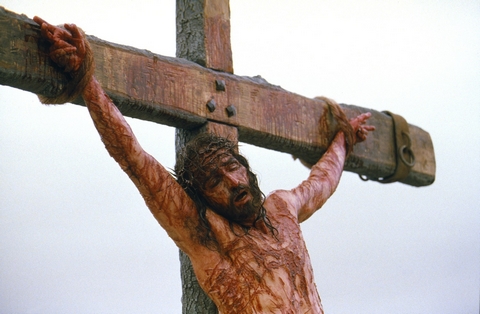
Bass is absolutely correct to see a preoccupation with blood in American religiosity. As I child, I sang “There’s power in the blood.” It may be especially prevalent in the South. Sometimes, it’s rather amusing like the fountain that used to be outside the mansion of a mega-church pastor in Spartanburg, SC. At night, the fountain’s water was bathed with red light, to remind passers-by of “the fountain filled with blood. But it’s not just the South. Think of Mel Gibson’s gory spectacle, The Passion of the Christ.


In spite of the excesses, it’s important to remember that the notion of “baptism of blood” can be, and often has been, life-giving and redemptive, especially for those Christians facing persecution. That it has been and is perverted is hardly surprising.

Reaching for the sacred when there is no holy ground

The memorial service in Tuscon was fascinating, moving and disturbing at the same time. Set in a gymnasium at the University of Arizona, it began as a combination pep rally and marketing effort for the University, as the University President tried to cast the institution as a locus of community, healing and hope. Those in attendance did what spectators at basketball games do. They applauded the team, whooped and hollered. As at all sporting events, the university provided t-shirts.

At first, the turn to scripture, Hebrew and Christian, was jarring, but as President Obama began speaking, he wove a tapestry of scripture, reflections on the lives of the dead and wounded that helped all of us think in new ways about the tragedy and about the future of our nation. His prepared remarks are available here. His words made the place, and the service itself, sacred.

Better scholars than I will be able to place this event in the context of the continuing evolution of civil religion in America. There’s been a great deal of discussion over the last few days about the decline of political rhetoric. All of that may be true. But it seems to me that President Obama was able to give a speech that placed the events in the historical context of the United States and to offer a trajectory of hope.


Blood Libel

It’s not often that concepts from Medieval or Early Modern history enter contemporary political discourse, but “blood libel” did today. The term refers to the myth that Jews ritually murdered Christians, especially children, and especially at Passover. The first example is from twelfth-century England, where the accusation was made after a young boy, William of Norwich, went missing and was later found dead. He became the object of religious devotion. The story eventually found its way into Canterbury Tales.

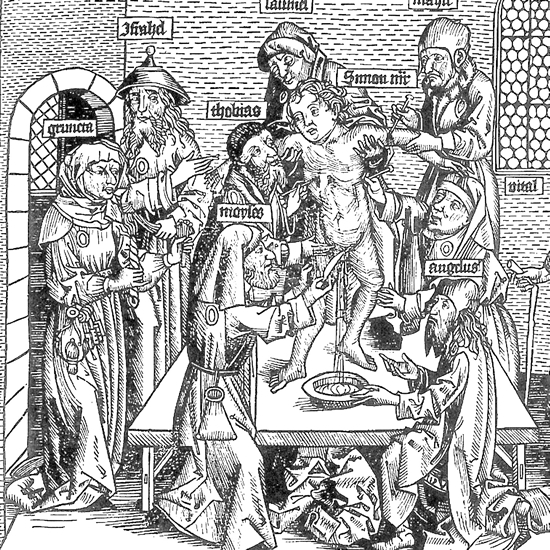
The Blood Libel had a long history after that. Among the most famous was Simon of Trent, in 1475. R. Po Chia Hsia wrote a book-length study placing this event in the larger historical and religious context. The Myth of Ritual Murder is worth reading.

There have been several discussions of the historical meaning of the term in today’s media.  Salon provides background, including quotes from Hsia.

Here’s a contemporary woodcut of Simon of Trent:

The Blood Libel persisted long after trials ended around 1600 (they were repeatedly denounced by both secular and religious authorities in Europe). In fact, there was an accusation in New York state in the early twentieth century.

While completely baseless, the myth of the Blood Libel points to the depths of Christian anti-Judaism, and later to Antisemitism. And it continues to resonate.

Reading a little Aelred of Rievaulx

Tomorrow is his commemoration. Here’s what I wrote last year. Aelred (1132-167) was an English Cistercian Abbot during the golden age of the Cistercian order. He is noted for his writings on friendship and love, but today  I reread part of his pastoral prayer. He prays to Jesus Christ on behalf of the monks under his care:

My understanding and speaking, my leisure, my activity my doing and thinking, my good and ill fortune, life and death, health and sickness–let absolutely all that I am, experience, feel and understand be employed and expended for them, for whom you yourself did not scorn to expend your very life. And so I pray you teach your servant, Lord, teach me by your Holy Spirit how I may spend my substance for them. Grant, Lord, by your grace, that I may bear patiently with their frailty, sympathize kindly and support with tact. Let your Spirit teach me to console the sad, strengthen the faint-hearted, raise the fallen; to be weak with the weak, indignant with the scandalized and to become all things to all men, that I may win them all.

His prayer is a powerful reminder to all of us with the cure of souls, of the importance of praying on behalf of those in our care. He prays for their material needs, but also for their spiritual needs:

pour your Holy Spirit into their hearts that he may keep them in unity of spirit and the bond of peace, chaste in body and humble of mind. May he himself be with them when they pray and inspire the prayers it pleases you to grant. May the same Spirit abide in those who meditate, so that, enlightened by him, they come to know you and fix in their memory the God whom they invoke in their distress and look to in time of doubt. May that kind comforter be swift to succour those who struggle with temptation and sustain them in the trials and tribulations of this life.

These quotations are from The Cistercian World: Monastic Writings of the Twelfth Century (Penguin Classics), translated and edited by Pauline Matarasso.

It’s January 10, the commemoration of William Laud

I said my piece last year on this date, so instead of rehashing that, I will point readers to Affirming Laudianism.

Its primary aims are:

  • The wearing of copes at the Holy Communion;
  • The application of Laudian frontals to Altars;
  • The use of silver candle sticks and incense at divine worship, in accordance with the principles of The Parson’s Handbook;
  • Bowing at the Holy name and during the Gloria Patri

Laudable, I’m sure.

Re-reading Genesis

Jane Williams is publishing a series of essays on the book of Genesis in The Guardian. So far four have appeared. They are available here. In a few short paragraphs, she captures much of the historical and literary context, as well as some of the important theological themes. Worth paying attention to. She’s the wife of Rowan Williams, by the way.

My Son, My Beloved–A Sermon for the Baptism of Our Lord, January 9, 2011


The horrific shootings in Arizona of Congresswoman Giffords, Judge Roll and the others shocked and dismayed me, as I’m sure it did you. How did we get to this point? The anger and rhetoric have finally boiled over in this country, so that in addition to having economic and other problems that are seemingly intractable, we have a culture, a media and political environment that have devolved into violence.

I don’t know about you, but I am almost in despair. When I look out at our nation, our culture, and our world, I see nothing hopeful. I only see increasing conflict over fewer resources and a national, no, a worldwide leadership, fiddling while the Titanic sinks. For a preacher at a time like this, the question of what to say, or rather, of what the good news is, becomes both urgent and perplexing.

We are at the second Sunday of New Year’s. We should still be enjoying ourselves, looking forward to the NFL playoffs, ready to root for a Packer victory. The New Year is supposed to usher in a time of new hope and new possibility. We make New Year’s resolutions that we hope will help us change behaviors. We promise to exercise and eat right, to learn something new, or to treat those we love in new ways. Of course, usually, within a few weeks or months, if we’re lucky, often within a few hours or days, we’ve broken those resolutions and are back in our old habits.

Perhaps instead of all of that, it’s time for a season of national soul-searching; a time to reflect on what binds us together as Americans and as human beings, instead of focusing as we tend to, on what divides us. Perhaps as Christians, it’s time for us to take stock of ourselves as well, and ponder how we might foster understanding and good will, being instruments of God’s peace.

In the lectionary, the cycle of readings that we follow from week to week on Sunday mornings, today is always “the baptism of our Lord,” the Sunday when we hear the story of Jesus’ baptism by John. It’s one of the more abrupt transitions in our liturgical cycle, because after twelve days of Christmas, two weeks during which we sing Christmas carols, reflect on the incarnation, and focus on Jesus’ birth, we suddenly jump ahead thirty years, to his adulthood. The intervening years are passed over in silence by Matthew and Luke, the only two gospels to say anything about Jesus’ birth. At least Luke tells one story about Jesus’ childhood, his visit to the temple with his parents when he was twelve. Matthew omits even that.

Jesus’ baptism by John is one of the key events in the gospels’ narrative of Jesus’ life. In the synoptic gospels of Matthew, Mark, and Luke, it stands as the beginning moment of Jesus’ public life. Matthew takes it a step further, though, because this is the first moment in his gospel that we see Jesus acting. So for him to come to John, seeking baptism, is saying something important for Matthew.

We can be certain that Jesus’ baptism by John constituted something of a problem for early Christianity. We can be certain that it is one of those things that was common knowledge, and also that it was something of an embarrassment. In fact, although mentioned by all four gospels, it receives little discussion elsewhere in the New Testament. Peter’s reference to it in today’s reading from Acts is one of the very few times it is mentioned other than in the gospels.

More than an embarrassment, the story of Jesus’ baptism was an opportunity for each gospel writer to reflect on the meaning of the event. It’s a good question—why does Jesus need to be baptized? As they sought to answer it, they filled out the story with theological content. Matthew does this in several ways. For one thing, he tells the story in such a way to lead his readers back to the Hebrew Bible, to the lesson from Isaiah that we heard today. The voice from heaven that says, “This is my son, the beloved, in whom I am well pleased, alludes to the words that open Isaiah 42 “Here is my servant, whom I uphold, my chosen, in whom my soul delights. I have put my spirit upon him…”

There is another important theme in Matthew’s version of the baptism. In the conversation between Jesus and John, after John asks the question we ask, “why do you come to me to be baptized?” Jesus responds, “Let it be so now; for it is proper for us in this way to fulfill all righteousness.” So Matthew connects Jesus’ baptism to righteousness. It’s one of those biblical words we don’t use very often any more, and we don’t really know what it means. We probably have some idea that it has to do with God and being good, but more than that is a question.

Righteousness is an important and rich concept in the biblical traditions, in both the Hebrew Bible and the New Testament. The Greek word includes connotations of uprightness, correctness, justice, innocence, and redemption. Matthew has used the word earlier in the gospel. When describing Joseph’s reaction to learning that Mary was pregnant Matthew writes, “but being a righteous man, and unwilling to expose her to public disgrace, Joseph planned to dismiss her quietly. Here, it would seem that Matthew wants to underscore Joseph’s behavior, that he is a good Jew who knows what Torah, the Law demands in such cases.

In the gospel we read next Sunday, the term righteousness appears again. In the beatitudes, Jesus says, “Blessed are those who hunger and thirst after righteousness, for they will be filled. Righteousness is not simply a matter of internal disposition, being in right relationship with God; it is also about bringing one’s actions in accordance with those internal dispositions. Thus to be righteous is to behave as one thinks or believes.

Jesus was baptized by John to fulfill all righteousness. It wasn’t a necessary act, in that he needed to be baptized—to be purified and cleansed him of his sins. But it was an act that put him in line with who he was and who he was meant to be. And it was an act that the gospels tell us, confirmed who he was. The voice from heaven said, “This is my son, the beloved, with whom I am well pleased.”

I wonder about the two characters in this story. John the Baptizer, who didn’t understand what he was doing, but knew that what he was doing, baptizing Jesus, didn’t make any sense. Did he also know that soon after baptizing Jesus, he would be arrested and ultimately killed for speaking out against the power of Herod? I wonder, too, about Jesus. In Mark’s version of the story, it seems that the voice from heaven speaks only to him, telling him that he is the son of God, the beloved. In Matthew, the voice says different words, speaks to the audience, but did Jesus know, could he have known what would happen?

For us, baptism is little more than a cute ritual. I doubt many of us believe that without baptism, we are condemned to hell, or the limbo of the un-baptized. We don’t think it matters much; we certainly don’t believe it is a matter of eternal life and death. I’m not going to try to disabuse you of that notion if you hold it, but I do think it is a matter of great import.

In Jesus’ baptism, he and others learned something about him. There was a miraculous voice that identified him. It told him, and those around him, who he was. It’s a powerful statement, isn’t it? It’s a statement we hear when we are baptized, but do we ever really believe it?

When Presiding Bishop Katharine Jefforts Schori came to the diocese last October, she met with clergy. During her time with us, she asked us to reflect on that statement that came from heaven. She asked us to repeat it to ourselves, to reflect on what it means for us, “You are my child, my beloved.”

Those words that came from heaven to Jesus at his baptism come to us at ours. A priest speaks them, not some heavenly voice, but they are true, no matter their origin. In baptism, we become God’s children; we are God’s beloved.

They are words with which many of us might struggle at times. We hear, from so many directions, a very different message. Sometimes, it comes from parents or loved ones. Sometimes the message was drilled into us decades ago, by parents long dead. Sometimes, the message is immediate; the wounds it makes still fresh, as in the case of the bullying that often goes on in our schools.

To know that we are God’s beloved in these circumstances, when all around us says otherwise is hard enough. But it’s not enough. As Jesus did in so many ways, as Jesus said repeatedly, we also need to share that message with others, to love them as God loves us. And yes, to love even our enemy, and our neighbor. I don’t know what this year has in store for our nation, our community, or for Grace Church. But it is my hope and prayer that Grace can be a beacon of hope and an agent of reconciliation in this dark and troubled time.


Lord, make us instruments of our peace

Lord, make us instruments of your peace.
Where there is hatred, let us sow love.
Where there is injury, pardon.
Where there is doubt, faith.
Where there is despair, hope.
Where there is darkness, light.
Where there is sadness, joy.
O Divine Master,
grant that we may not so much seek to be consoled, as to console;
to be understood, as to understand;
to be loved, as to love.
For it is in giving that we receive.
It is in pardoning that we are pardoned,
and it is in dying that we are born to Eternal Life.
–a prayer attributed to St. Francis (though unattested before the twentieth century)