First Mondays at Grace–June

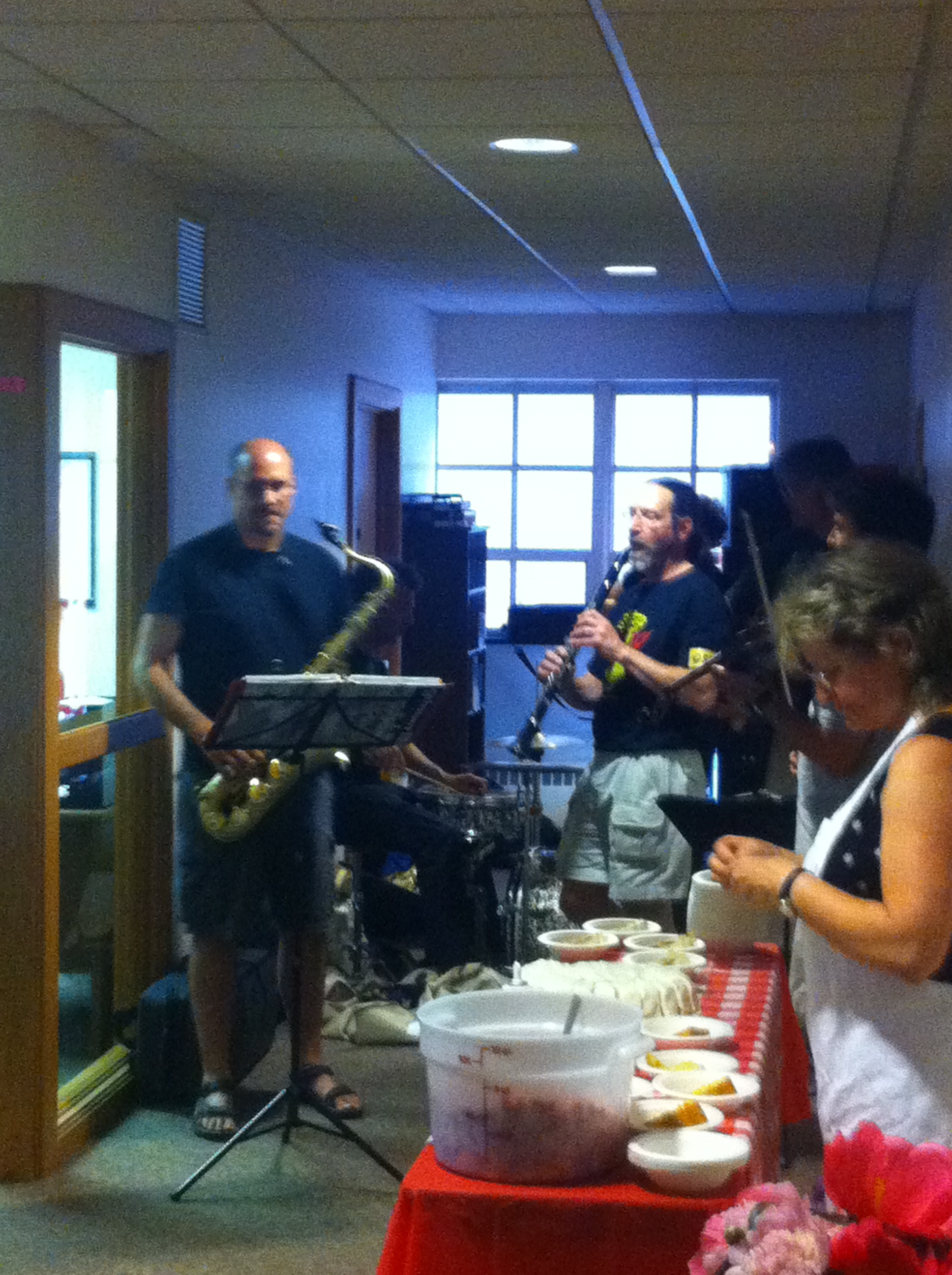
It was over 90 outside; in the kitchen it was probably 20 degrees warmer. We improvised, serving our guests in the air-conditioned reception area. The music was provided by Yid Vicious.

The menu was ham, macaroni and cheese, and coleslaw. For dessert, wedding  cake or pound cake with strawberries. Here are photos:

The numbers were small last night; perhaps many of our usual guests took advantage of the free food offered in Walkerville (apparently shelter numbers have been quite low the past few nights).

You will be witnesses–The Seventh Sunday after Easter

June 5, 2011

 This has been one of those weeks where being a priest seems a whole lot like being a victim of whiplash. Four parishioners are dealing with the deaths of parents, either in the last week, or in the past few weeks, and chance encounters with them, or planned meetings became occasions for making room for the presence of God in the midst of grief. Someone else is dealing with an unexpected diagnosis of cancer but uncertainty as well until there are further tests. And one of the children in our parish is looking forward to hospitalization and possible pacemaker surgery. For all of these people, and their loved ones, the world they knew no longer exists—they are entering uncharted territory. Continue reading

The calm before the storm?

Here’s what was going on at Grace this morning during the Farmer’s Market. Members of the Camerata String Quartet played to pitch for the upcoming Bach Dancing and Dynamite Society (if you’re in Madison, their season is not to be missed).

Here is a photo:

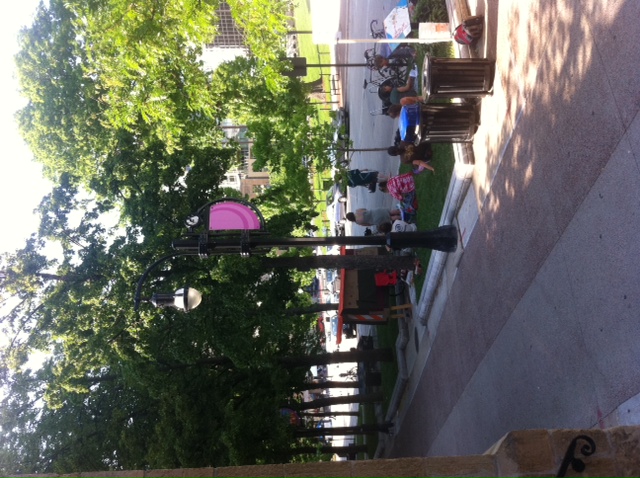
We’ll see what the sidewalk outside our doors looks like tomorrow.

Oh, and by the way, apparently the city of Madison does value a church as much as an empty storefront; it turns out both of the other locations where 24-hour tents are permitted are in front of vacant commercial space.

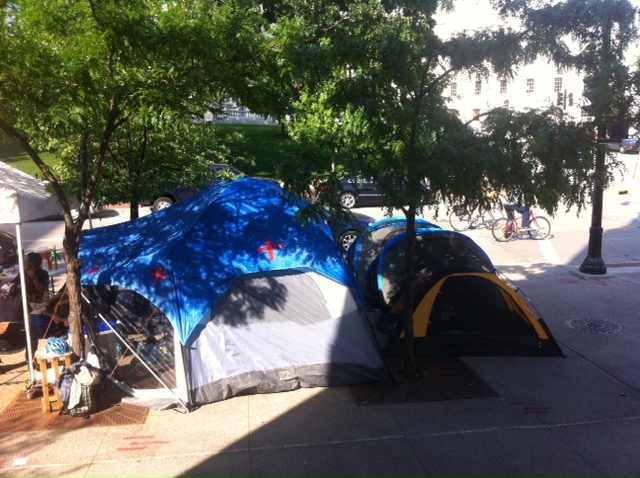
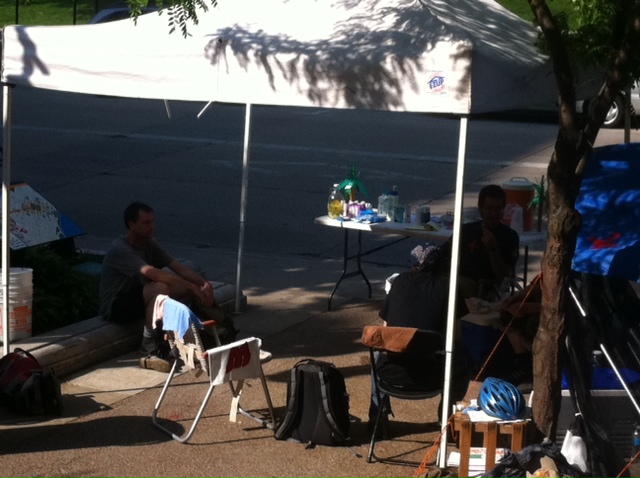
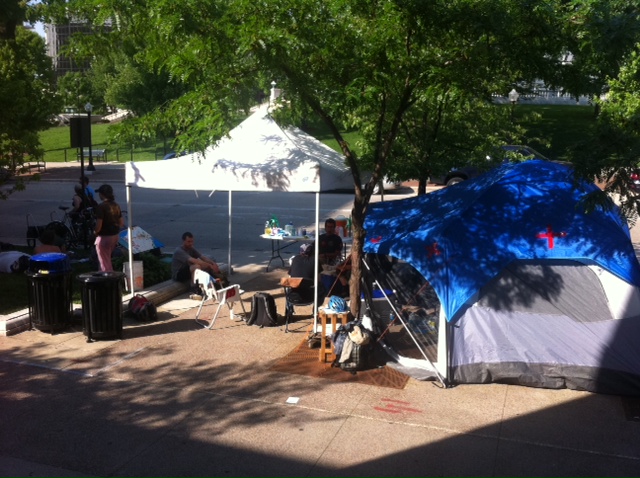
A hearty welcome to our new neighbors

Here’s what we know now:

-Overnight tent camping areas:  They were allowed three areas where they could set up 24-hour tents:  On N. Carroll St. in front of Grace Church; in front of 14 W. Mifflin (they will try to keep to unoccupied storefront) and in front of 2 E. Mifflin St.  All tents must be attended at all times.

There are other details as well. Hopefully the disruption to us will be minimal. We shall see. I would make a comment about Grace being equivalent in the city’s understanding to an unoccupied storefront, but the third location, 2 E. Mifflin, is a multi-story office building.

I’m looking forward to meeting our new neighbors, inviting them to services, and to volunteer in their free time at our food pantry.


Walkerville is a go, with restrictions

Word is coming out that the permit for Walkerville has been approved, but there are restrictions. For one thing, tents will be allowed only overnight (from 9:00 pm-7:00 am, with an earlier departure on Saturday to accommodate the Farmers’ Market). There are other restrictions related to the placement of food, medical supplies, and information. Although the permit was approved, an additional campground permit will be required.

I’m disappointed in these results–disappointed for the city, for downtown residents and businesses, and for the ministry and mission of Grace Church. We’ve been placed in a very difficult position by the organizers of the protest, who didn’t take the time or deem it necessary to discuss their plans with us or with the others who would be most affected by it. We opened our doors to the protesters repeatedly in February and March and occasionally our hospitality was abused.

Surprise, surprise! Just when things seemed to be easing up

I posted last night about my relief that Mayor Soglin had cancelled the August Ride the Drive event. Then I woke up this morning to news about Walkerville, a proposed tent city, that, you guessed would be pitched right outside the doors of Grace Church beginning Saturday. I received emails from parishioners expressing their concern and talked to our neighbor business owners who are concerned about the impact on their livelihoods.

I made phone calls and sent emails to various elected officials and city bureaucrats. We’ll see what happens. Again, as I’ve said before; it’s not that I’m opposed to the protests. As one businessman said in frustration, “I’m a Democrat!” This is the same issue for me as it is with the marathon or Ride the Drive. Organizers of such events pay little attention to the effects of their events on those who live and work in their midst. Yes, such events may bring business, but they also create enormous inconvenience. For example, I doubt very much whether many of our elderly members will want to make their way to church through a gauntlet of protestors. I should think regular conversations about such matters would go a long way to allaying concerns and even give rise to accommodation or compromise. That the organizers of the event didn’t bother to communicate with us before I began expressing my concern is troubling indeed.


It’s summer in the city: No parking, no access, nobody in church

Getting to church on Sunday was an adventure. We knew that we would not have access to the parking spaces in our alley because of the Madison Marathon. I decided to take the bus. It became clear to me after a lengthy detour through the UW hospitals and several calls to the dispatcher, that the bus driver wasn’t clear on how she would get over to the eastside of Madison. When she came to a stop, forced by the advancing marathoners, I asked to be let out. It was the corner of Marion St. and W. Johnson. I too had to deal with the marathon course, but by the time I made it to W. Washington, the vast majority of runners had passed me and I was able to pick my way through the stragglers.

Attendance was awful, about a third of what we usually get on a Sunday. Most people didn’t try to make it, and those who did arrived quite late. It was the second of three consecutive Sundays on which parts of Capitol Sq. would be closed. This coming Sunday, June 5, is “Ride the Drive.” Street closures, parades, art fairs, are all part of the price of being located on the Square, but all of that means that our worshiping community shrinks on such occasions. But as one parishioner said to me, he felt rather sheepish complaining about a few blocks’ walk to church when he thought of what Christians in previous centuries had to do to worship together, and what they suffered for the faith.

On one level, such difficulties are another sign of the peripheral role played in culture by religion. We are not consulted about street closures or asked whether we are inconvenienced. Some years and with some events, it is impossible to learn before the day of the event itself, whether or how we will be impacted.

So I received the news that Madison’s new mayor, Paul Soglin, has cancelled the second “Ride the Drive” event with mixed feelings. I’m all for getting people downtown, especially on a Sunday, and I am eager to think creatively about how we might engage people who have come for such events. But at the same time, they create enormous inconvenience for many of our members, especially the elderly, who need to park in close proximity to the church, and are in special need of the relationships and human contact that they find in church each week.

My issue is not with the events themselves, but with the organizers who do not seem interested in how those who live, work, and worship in the downtown might be affected by their events, and especially the cumulative effect on morale and quality of life of week after week filled with such activities.



The Search for the Historical Adam

Now that the dust has settled over universal salvation, it seems Evangelicals are going to war over “the historical Adam.” Here’s Christianity Today’s cover story on the matter. It seems faculty at Calvin College are under investigation for having publicly questioned whether Adam ever existed; scholars elsewhere have lost their jobs. For those of us on the outside, the question whether Adam and Eve once lived and were the progenitors of all of humanity may seem a bit silly. The scientific evidence is clear–the human genome is virtually identical with the genome of Chimpanzees and it seems that we are descended from a community of at least several thousand hominids, not two.

But it’s not just the historical (and scientific) accuracy of Genesis at stake. If Adam never existed then Pauline theology is in trouble, and if Pauline theology goes, then what remains of the whole Reformed edifice? If Adam never existed, then humans didn’t inherit sin from him, and our shared fallenness can’t be redeemed, needn’t be redeemed by Jesus Christ

Much of the work trying to flesh out the theological implications of contemporary science for Evangelicalism is followed on the BioLogos website, founded by Francis Collins. Their take on this controversy is here:  http://biologos.org/blog/biologos-and-the-june-2011-christianity-today-cover-story/.

We might be tempted to laugh at this controversy, just as many of us laughed at the Rapture theology of Harold Camping, but there are significant implications for traditional theology and to the extent that contemporary Christian theology, and churches, like the Episcopal Church, claim continuity with the past, there are implications for us as well.

One of the reasons I am so fascinated by scientific advances in the understanding human beings, especially neuroscience, is that it challenges traditional notions of human nature-the body/soul dichotomy, for example. It is incumbent on us to develop a robust theology that remains faithful to the tradition, but also takes into account these scientific discoveries. If we can’t make our imagery and symbolism meaningful for the twenty-first century, we will no longer be able to help people orient themselves in the world and in their own lives. We will sound like we are speaking in a foreign language, describing a fantasy world.

Authenticity and post-modern Christianity–but don’t expect me to get tattoos

Last week, I posted a link to an article that quoted Bishop Greg Rickel of the Episcopal Diocese of Olympia, in which he likened the church in the twenty-first century to a base camp–not an end point on a journey, but a staging area. It’s an image I like because it captures what I’ve been encountering in Madison. People come to church for all sorts of reasons; we may see them for only a single service, perhaps a year or two if we’re lucky, then they are off on the next stage of their journey. Often their temporary stay is dictated by other realities–school or job change–but often it is because of life changes. And the latter is particularly new. Wade Clark Roof and other sociologists of religion saw such trends in American religion in the 90s–people participating in organized religion for a few years and then withdrawing.

Rickel has a great deal to say in another interview about what it’s like to be bishop in post-Christian America (i.e., the Pacific Northwest) after serving parishes in the South and Southwest. He also has interesting things to say about the importance of authenticity, good holy discourse and conversation, and good music. The interview is here.

Among the things he has to say about young adults:

I sense the younger generations looking for a fun place, yes, energy, good conversation, deep reflection about serious issues, but also a place where diversity of thought is honored and where they learn the life skills to keep that greater conversation going in their lives. In the midst of all of that they know the power of mystery, and don’t necessarily want a place of answers, but more a place of reflection, meditation, silence. True engagement, instead of the veneer of much of our religion, would be the more subtle but short way of saying it.

Bishop Rickel blogs here.

If authenticity is what matters, check out this profile of Nadia Bolz-Weber.

Bolz-Weber said her church is “anti-excellence and pro-participation.”

They sing the hymns a cappella rather than rely on a choir, organist or band. They divvy up the readings. They create their own artwork.

“We don’t do anything really well,” she said, “but we do it together.”

Bolz-Weber blogs here.