First Monday in July

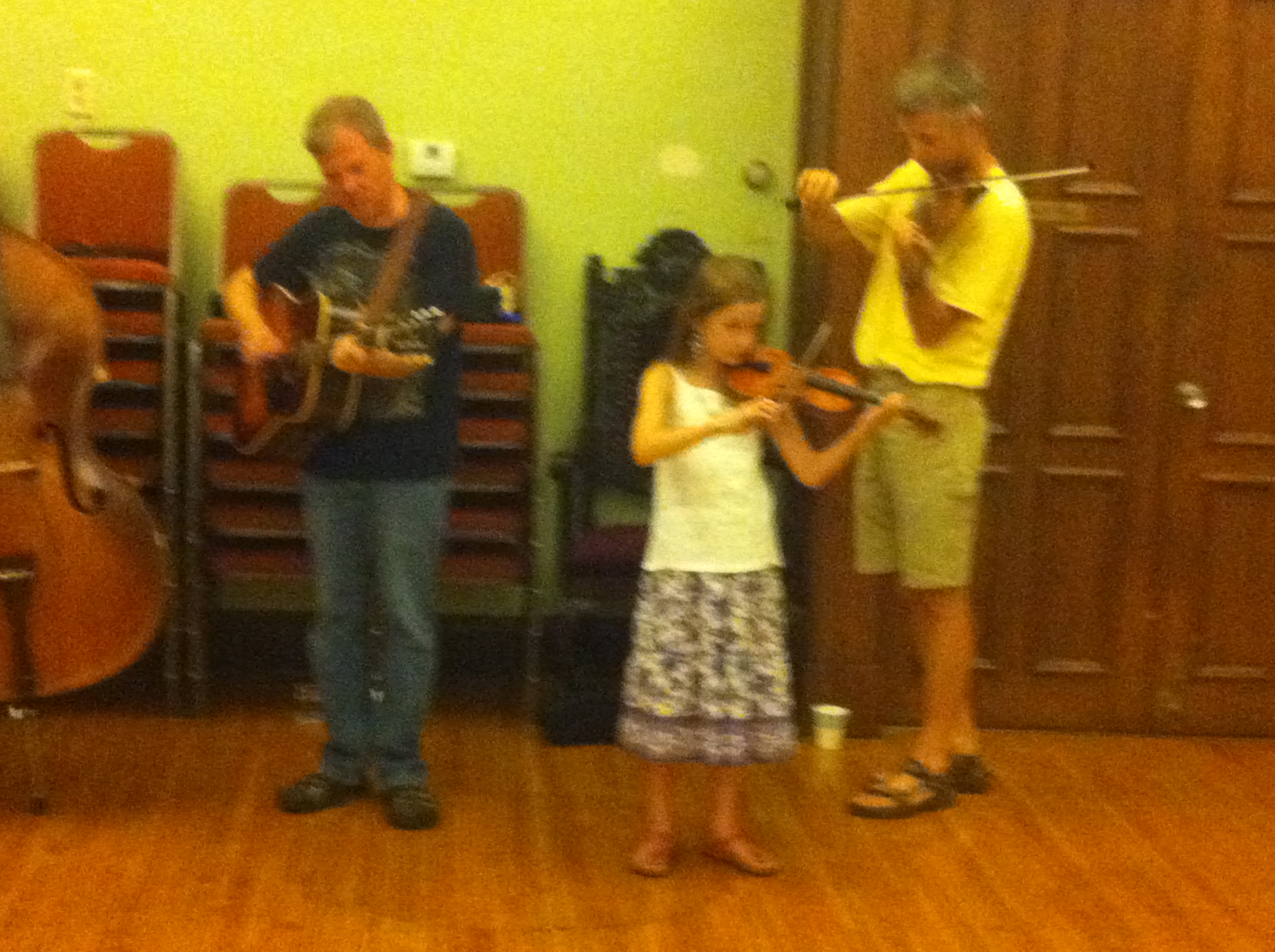
In July, our First Monday fell on the 4th. We entertained about 70 guests with bluegrass music, brats, sauerkraut, and poundcake with ice cream. Thanks to all of our volunteers, and to the vendors. The brats and buns came from Mad Dog’s Eatery on N. Henry St.; the sauerkraut came from Porchlight Products, and the ice cream was from Sassy Cow Creamery.

Thanks to everyone who helped out and those who were willing to volunteer but weren’t needed. See you next month!

Here are pictures:

For I do not do what I want: A sermon for the Third Sunday after Pentecost (Proper 9, Year A

Proper 9, Yr A

July 3, 2011

There’s a guy who comes by the church to see me on a regular basis; well, there are several guys, but I’m thinking of one in particular. He’s clearly an operator. He’s not really homeless, at least, not all of the time. For a few months I’ll see him regularly in the lineup or at the monthly meal, then when his 90 days runs out, he makes himself scarce—except to come by and see me. He always wants a bus ticket to Milwaukee, but there’s always a story involved. It’s never the same story, though. After the second time, I told him that I could only help him once every six months—that was a rule we had back in South Carolina, and it worked pretty well to keep the most annoying people at bay. So the six months came up this past week, and sure enough, he came back by the church, looking for money for a bus ticket to go to Milwaukee. We missed each other, but next time he comes by, I’ll tell him, he’s been to Milwaukee more often in the last two years, than I have, and that’s only if you count the trips I’ve paid for. Continue reading

More on Terence Malick’s “Tree of Life”

From The Guardian, an interview with Brad Pitt, and Michael Newton’s review.

It is a very rare talent to be able to show with equal power both the free places for which we yearn and the compromise and wickedness that makes their freedom impossible to achieve. At his best, Malick lets us share his humane, unironic and compassionate vision. He presents life as caught between a fragile innocence and an encroaching darkness.


One way to respond to the demonization of political opponents

I took a phone call from a reporter for a Madison media outlet a couple of weeks ago. He had recently returned to Madison after several years abroad and was shocked by the breakdown of community in Madison since he had left. Because of the developments in state government and the protests, deep fissures have arisen in Madison. Debate has given way to name-calling, and as he put it, everything seems black or white. I could do no more than concur with his assessment, having experienced myself that any attempt at nuance is often perceived as betrayal or attack.

For this, both sides share responsibility. The effects on our civic life will be felt for a very long time and our community may never be the same. But in the midst of this polarized and polarizing situation, there are signs of an alternative.

During the height of the protest, talk show hosts and others were quick to spew forth epithets. When one radio personality called police and firefighters who were protesting, “lousy, rotten people,” who used violence and intimidation, Lt. Laura Laurenzi of the Madison Fire Department challenged her to provide video proof of such behavior, or to make a substantial donation to a local charity. No proof was forthcoming.

Lt. Laurenzi wanted to make something good out of this, so she challenged members of Firefighters Local 311 to make a donation and promised that she would match their generosity. The firefighters donated $1000 to Porchlight. In return, Lt. Laurenzi wrote a check for $1000 to Grace’s Food Pantry. Her donation will help purchase food and other supplies for people suffering during these difficult economic times.

Lt. Laurenzi did something quite interesting. She demanded that her opponent examine the language she used; she attempted to open up a conversation with her opponent, and she demanded that she be treated as a human being. That her opponent didn’t respond is not suprising. What is surprising is that Lt. Laurenzi made something good out of a dehumanizing situation.

As the dust has settled on the budget, and the protests have diminished, we are left in a community and in a state that seems to be at war with itself. The hard work of reconciliation lies ahead. I wonder who will take the lead.

Technology, life, and faith: Some links

It seems there are always those who contemplate the effects of new technologies (and now, social media) on our lives and our faiths.

We could begin with the Amish, who make careful, and what to outsiders seem arbitrary and irrational, decisions about technology.

Then there’s Johann Hari pleading for real books against the distractions of ebooks and the internet.

Someone asks what sort of Christians does contemporary worship create.

Jason Byassee encounters texting while teaching a Sunday School class and wonders how leaders should deal with the presence of smartphones and the like in church services or other meetings.

James Martin comments on the use of the web by Catholic organizations.

And Elizabeth Drescher identifies elements of the Digital Reformation. Based on the results of a Pew survey, she observes:

While participation in digital social networks does not cause participation in religious groups, digital social engagement parallels local religious engagement. Where these two paths intersect would seem to be a particularly fruitful locale for socio-spiritual encounter.


Religious Institutions and the Property-tax exemption

The property-tax exemption for religious institutions has been in the news of late. In Wisconsin, the legislature passed a measure that revoked the exemption granted to Presbyterian House at the University of Wisconsin for the student rental complex they constructed several years ago. Gov. Walker vetoed the measure. St. Francis House, the Episcopal Chaplaincy at UW is also proposing a housing development on its site, although plans there are for the project to return to the property tax rolls. From the comments on these stories, it’s clear that the property tax exemption strikes raw nerves.

Meanwhile, city officials in Palmer, Massachusetts, have asked several non-profits, from the Chamber of Commerce, to churches, to make payments to the city in lieu of taxes (this idea is not new; Harvard University has been making substantial payments to the cities of Cambridge and Boston for many years).

Matt Yglesias has posted on this issue. He argues that:

Urban land is a scarce commodity, and structures are valuable fixed assets. If you tax land and structures that are operated as homes and business, but don’t tax land and structures that are operated as churches, you end up with more land being used for churches and less being used for homes and businesses than would otherwise be the case.

This is silly. Take Grace Church for example. Grace is on the National Register of Historical Places; it is also landmarked by the city. As such, the property has no value except to members of Grace Church. If we were to abandon the property, as so many churches have been abandoned in America’s cities due to population shifts and declining attendance, the property would probably remain vacant. No other church would purchase it. The space is ill-suited for the needs of contemporary worship: there’s no parking, the space is not airconditioned, and barely handicapped accessible. No other other entity would be interested in it, either, except a themed restaurant-nightclub, perhaps.

At the same time, we provide valuable services to the city and the community: housing a homeless shelter that would be incredibly difficult to relocate, a food pantry, space for AA and other community meetings. Yglesias himself often argues about the importance of balance in urban planning, and we offer that as well, a courtyard garden that is much appreciated by local residents and tourists, a beautiful space that beckons even non-churchgoers who sense the sacred when they enter it.

I suspect that at some point in the future, the property tax exemption will be challenged, if not in Madison, the home of the Freedom from Religion Foundation, then in another part of the country. When that happens, some religious institutions will be forced to close their doors, and my guess would be that many of the endangered congregations would be located in old buildings in towns and cities that are already struggling to make ends meet, impoverishing the cultural and historical landscape of our communities.

The two walked on together: A Sermon for the Second Sunday after Pentecost

Proper 8 Year A
June 26, 2011

On Friday, I saw Terence Malick’s “Tree of Life.” Malick is a filmmaker whose every work is mined for its meaning and significance. In almost 40 years as a director, he has completed only five films. “Tree of Life” won the Palme d’Or at Cannes this year. It is a sprawling, beautiful, incomprehensible film that asks its viewers to ponder life’s meaning. It begins with a verse from Job: “Where were you when I laid the foundations of the world?” It is the first line of God’s response to the case Job has constructed against God, a case based on Job’s righteousness, and his suffering.

The central event in the “Tree of Life” is the death at nineteen years old of one of three brothers. We assume he was killed in Viet Nam, although there is nothing other than the mid 60s dress and décor that leads to such a conclusion. But that death continues to resonate, presumably with his parents, but also with his elder brother, who recalls their childhood, and the little torments a boy inflicts on a younger brother.

Continue reading

Treasures of Heaven

Eamon Duffy on relics, occasioned by an exhibition at the British Museum.

some of the central themes of the British Museum‘s magnificent new exhibition. St Hugh’s startling behaviour reflected these themes: the universal medieval belief that relics, the fragmented bodies of the saints, were charged with holiness and power, worth journeying great distances to see; the prestige which ownership of such relics brought (the Burgundian abbey of Vézelay was a rival claimant to Mary Magdalene’s relics); ambiguity over whether the power of the relic could be tapped through its appearance – concealed in this instance by its silken cover – or by brute physical contact with its sanctified matter; the comparison between the holiness of the relics of the saints, and the holiness of the body and blood of Christ in the Mass; and finally the lengths to which some would go to secure even tiny fragments of the relic for their own church or community.