Rick Perry, Michele Bachmann, Dominionism, and the pundits

Julie Ingersoll defends the coverage of Dominionism by herself and others here. Douglas Groothuis, of Denver Seminary, challenges the media’s narrative concerning Bachmann’s relationship to Dominionism.

Meanwhile, outgoing NYTimes editor Bill Keller wrote a piece in the Sunday Times Magazine in which he calls for close scrutiny of the religious beliefs of candidates. The list of questions is here. Pascal-Emanuel Gobry’s takedown of Keller is well-worth the read.

And it’s rather unfortunate that in a piece advocating questioning of presidential candidates’ concerning their religious belief and practice, Rick Santorum was identified originally as an Evangelical, not a Roman Catholic.

Islamophobia

The full report can be found through links here. But the summary itself is chilling.

The report’s authors write:

This report shines a light on the Islamophobia network of so-called experts, academics, institutions, grassroots organizations, media outlets, and donors who manufacture, produce, distribute, and mainstream an irrational fear of Islam and Muslims. Let us learn the proper lesson from the past, and rise above fear-mongering to public awareness, acceptance, and respect for our fellow Americans. In doing so, let us prevent hatred from infecting and endangering our country again.

The defend their use of the term Islamophobia in this way:

We define it as an exaggerated fear, hatred, and hostility toward Islam and Muslims that is perpetuated by negative stereotypes resulting in bias, discrimination, and the marginalization and exclusion of Muslims from America’s social, political, and civic life.

They conclude:

It is our view that in order to safeguard our national security and uphold America’s core values, we must return to a fact-based civil discourse regarding the challenges we face as a nation and world. This discourse must be frank and honest, but also consistent with American values of religious liberty, equal justice under the law, and respect for pluralism.

Well put!

Other perspectives at Religion Dispatches.

Atheism–more links

A brilliant essay by James Wood on atheism and belief.

Just as evangelical Christianity is characterised by scriptural literalism and an uncomplicated belief in a “personal God”, so the New Atheism often seems engaged only in doing battle with scriptural literalism; but the only way to combat such literalism is with rival literalism. The God of the New Atheism and the God of religious fundamentalism turn out to be remarkably similar entities. This God, the God worth fighting against, is the God we grew up with as children (and soon grew out of, or stopped believing in): this God created the world, controls our destinies, sits up somewhere in heaven, loves us, sometimes punishes us, and is ready to intervene to perform miracles. He promises goodies in heaven for the devout, and horrors for the damned. Since militant atheism interprets religious faith, again on the evangelical or Islamist model, as blind – a blind leap of faith that hurls the believer into an infinite idiocy – so no understanding or even interest can be extended to why or how people believe the religious narratives they follow, and how often those narratives are invaded by doubt, reversal, interruption and banality.

That should come as no surprise to anyone who has watched or read “Hitchkins.” But I think Wood is also on to something when he says:

Part of the weakness of current theological warfare is that it is premised on stable, lifelong belief – each side congealed into its rival (but weirdly symmetrical) creeds. Likewise, in contemporary politics, the worst crime you can apparently commit is to change your mind. Yet people’s beliefs are often not stable, and are fluctuating. We are all flip-floppers.

Atheist Adam Lee ponders why the numbers of non-believers is rising and postulates:

What all this means is that the rise of atheism as a political force is an effect, rather than a cause, of the churches’ hard right turn towards fundamentalism. I admit that this conclusion is a little damaging to my ego. I’d love to say that we atheists did it all ourselves; I’d love to be able to say that our dazzling wit and slashing rhetorical attacks are persuading people to abandon organized religion in droves. But the truth is that the churches’ wounds are largely self-inflicted. By obstinately clinging to prejudices that the rest of society is moving beyond, they’re in the process of making themselves irrelevant.

After an appearance on a Fox News program, Blair Scott, of American Atheists, Inc., was subjected to more than 8,000 death threats.

James F. McGrath asked, “Are Atheists just like liberal religious believers?” He points out that:

When atheists point out errors, historical issues and stories that defy belief or moral acceptance in the Bible, for the most part that information (when it is accurate) derives from the scholarship pioneered and for the most part carried out by liberal religious believers. Liberal Christians have been denouncing much of popular piety as superstition long before atheists, advocating pioneering, expanding and embracing scientific understanding even when this infringed on what was traditionally considered God’s turf.

McGrath would do well to ponder Wood’s analysis in the essay pointed to above.

Some links on food, ethics, and religion

Brian McLaren writes about a pray-in at a Publix in Florida, supporting the rights of and improved working conditions for, migrant farm workers: We’re connected by what we eat . – Brian McLaren.

In a similar vein, Steve Ells, founder of Chipotle, talks about their Food with Integrity program (all of their pork is raised sustainably, for one thing):

If you look at the last nine years since introducing Food with Integrity ingredients and having to make modest price adjustments along the way, during that time, we had double digit same store growth, year after year, while bringing these quality store ingredients. So yes, I think it’s something that customers are starting to want more, and I think the demand is going to go up as they continue to understand the ramifications of not having a sustainable food supply. Not only on the taste of our food but also on our health.

In a similar vein, Mark Bittman argues that the cost differential between conventionally-raised and organic or sustainable production would vanish if subsidies were removed and the cost to the environment included.

The Other Journal continues to post conversations about food.

Stephen Webb’s essay, “Against the Gourmands: In praise of fast food as a form of fasting” is a lengthy attack on those who seek religious meaning in what and how we eat. It begins provocatively: “Food is fuel in much the same way that wood is fuel,” and goes on to take potshots at Babette’s Feast and William Cavanaugh.

Of course food is fuel, but it is also so much more. Cavanaugh’s response is here. He points out that

Webb denies that food is sacramental and subscribes to a kind of dualism in which, as he says, “fine dining is to the tongue and nose what a sexual orgy is to other bodily organs. In both cases, sensations have to be carefully paced and systematically parsed if satiation is to be postponed.” We can agree that overindulgence of the senses is certainly problematic, but I don’t have the same qualms about a sacramental view of food or the world in general. In principle, at least, it is entirely scriptural to see all creation as an icon of God and a potential window to God’s grace. Gluttony is a sin; Webb is surely right to say that Christians should not elevate the self-indulgent aesthetic appreciation of fine cuisine into a virtue. Just as surely, however, there is a distinction to be made between a properly sacramental point of view and an idolatrous one that simply collapses the divine into the material.

Perhaps even more importantly, Cavanaugh offers a scathing rebuttal to Webb’s conflation of the gourmand with social justice and concludes:

If Christians are attentive to our economic practices, we can help to create eucharistic spaces on earth that prefigure the fullness of the Babette’s feast that God has prepared for us. This does not mean gluttony. Insofar as Webb’s essay warns us against self-righteousness and self-indulgence, it is a salutary piece. Insofar as Webb encourages us to disregard the theological import of our practices of consumption, he is out to lunch.

Sam Rocha is somewhat more sympathetic to Webb than Cavanaugh but his criticism is much the same:

Webb’s tortured conservatism aside, his biggest mistake is to try to speak of food without recourse to the phenomenological experience of food and eating. (Babette’s Feast and fried catfish both immediately come to mind.) And what about the body? Surely we are not cars that run on fuel, surely our bodies are not combustion engines. For Webb, there is little difference. He invokes platitude after platitude about this thing called “food” to the point of making the laughable claim that, since the only non-utilitarian meal is the Eucharist, we might as well eat McDonald’s the rest of the time.

Help! The internet is killing Christianity!

According to Josh McDowell, who in case you’ve never heard the name, is a Christian apologist guru, especially popular (or used to be) among young evangelicals. I would occasionally have students bring his books to my office hours in their attempt to defend themselves from my apostasy.

In any case, McDowell sees the Internet’s growth and egalitarianism as undermining authority and orthodoxy. Apparently McDowell gave a talk to that effect:

His talk, titled “Unshakeable Truth, Relevant Faith,” had detailed a certain uncomfortable fact in anticipation of the question: that young Christians in America are rejecting Christian fundamentalism—and doctrinaire concepts such as absolute truth and biblical infallibility—in droves. Why is faith in God being supplanted, earlier and earlier, by relativism, secularism and skepticism? McDowell’s answer was simple: the Internet.

So the Internet joins that long list of other cultural innovations (the printing press, dancing, the automobile, movies, radio, television) that will destroy the faith of our youth.

It’s not just conservative Protestants who are attuned to epochal changes in attitudes toward religion. In fact, McDowell is behind the curve. In fact, it’s not the internet that’s the problem anymore. It’s the iphone:

Anyone who today works with or near young people cannot fail to see this: for members of the present generation, the smartphone has become an amulet. It is a sacred object to be held and caressed and constantly attended to. Previous generations fell in love with their cars or became addicted to TV, but this one elevates devotion to material objects to an altogether different level. In the guise of exercising freedom, its members engage in a form of idolatry. Small wonder that aficionados of Apple’s iPhone call it the Jesus Phone.


Be not afraid of evangelicals

Lisa Miller brings some necessary perspective to Progressives’ bashing of Perry, Bachmann, and “Dominionism.”

Among her arguments, the “dominionism” that has received so much attention is relatively unknown among conservative Christians, that Evangelicals have not united between a single candidate, and that “Christian conservatives are not more militant than ever.”

But the most trenchant piece of her essay is her observation that for many on the left, anyone who confesses faith in Jesus Christ and identifies themselves as Evangelical, is bent on political hegemony in the US.

There have been responses to Miller’s essay. Here’s one from Peter Montgomery on Religion Dispatches.

In the midst of the name-calling back and forth is this thoughtful piece by David Sessions on Patrol. Sessions writes:

Here’s the reality: Dominionism as a term or a school of thought is virtually unknown even to conservative evangelicals of the type who adore Bachmann and Palin. There is no widely-agreed-upon definition of what constitutes “dominionism”; it is used describe everything from garden-variety religious right (“soft dominionism”) to the insane, totalitarian Christianism of Rushdoony (“hard dominionism”). It is difficult to overstate how fringe it is in its purest forms, how tiny the number of people who are aware of and embrace its arguments.

Sessions goes on to say that, yes, many Evangelical Christians believe that America is a Christian nation and that a return to traditional values is necessary. Moreover,

But, and this is the most important thing, most of their political concerns arise organically from their relatively orthodox Christian views, and have nothing to do with ideological movements like dominionism . Far fewer evangelicals are the red-meat voting machines than certain members of the media imagine. And most of them, even if they have a revisionist, whitewashed, Christianized understanding of the American founding, still accept that they live in a multicultural nation that is not and will never be a theocracy.

Well said.


All those jokes about earthquake damage? Here’s the reality

Facebook was full of lame jokes about damage yesterday. The most popular seems to have been the photo with a lawn chair turned on its side.

The reality is rather more sobering. Significant damage to the National Cathedral.

Here’s a taste of the damage:

All of the photos are here. As someone who spends a great deal of time and energy caring for a historic building, I shudder to think about the cost of restoration.

Many commentators observed that Twitter and Facebook were the means by which people learned of the earthquake. The speed with which the news (and the jokes) circulated meant that the information we received was unfiltered and the real impact unknown. I should think it’s important to pause and reflect before passing judgment on events–whether it’s a natural disaster like an earthquake or the rapidly-evolving scene in Libya.

Here’s a link to the National Cathedral’s website.

Here’s the story from the Episcopal News Service.

Reflections on Madison Pride and GSE–Gay Straight Episcopalians

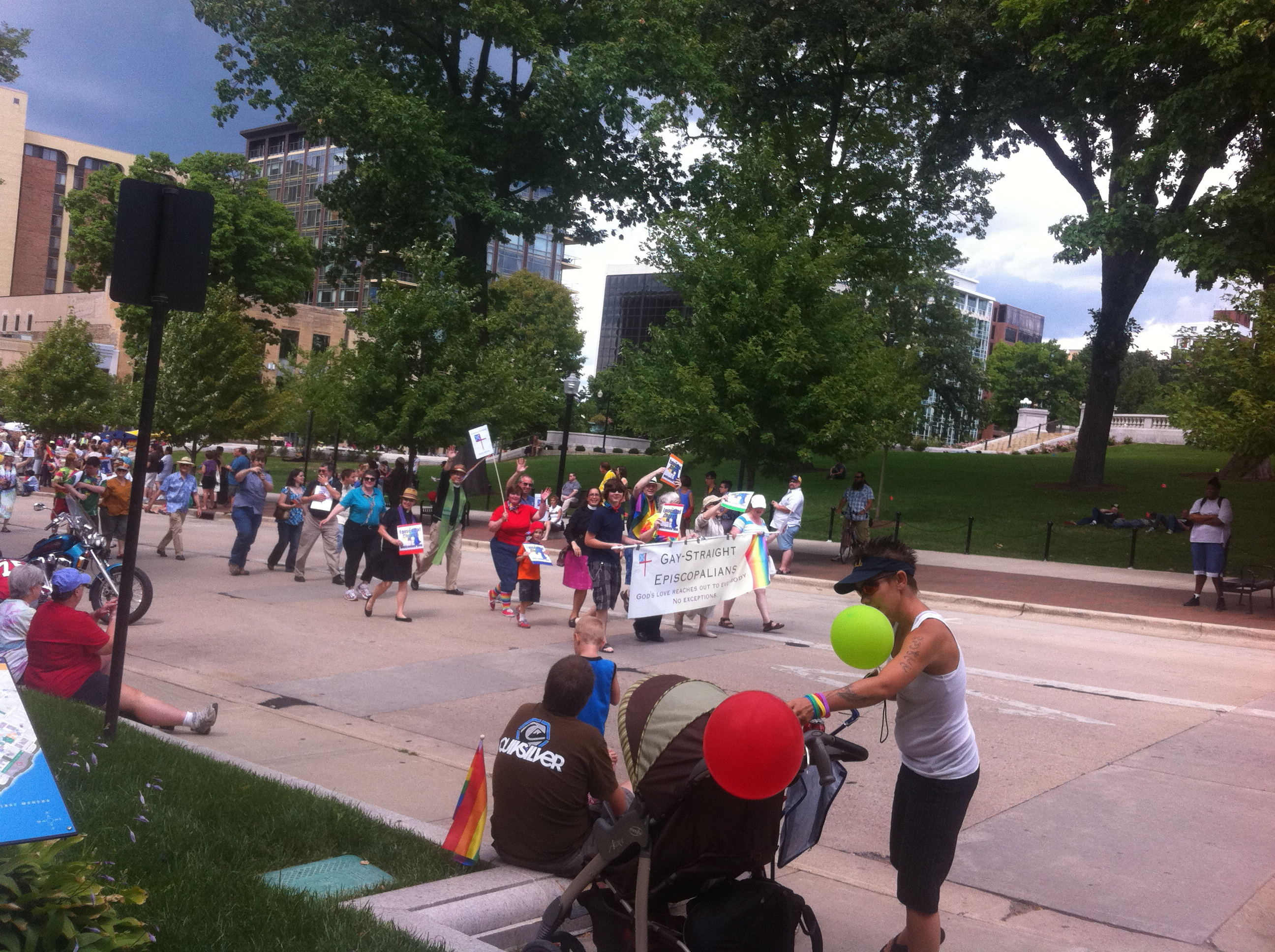
It was great to see so many religious communities marching in the parade. I noticed UCC churches, Unitarian Universalists, Quakers, and First Methodist all with contingents in addition to the group of Episcopalians. When Christianity is so often depicted in our culture and media as only consisting of the religious right, it’s important to bear witness that there are other voices, even if they are often drowned out. Members of our group who marched talked about the support they received along the way and the gratitude that many expressed.

That is not to say the voices of Conservative Christianity were silent yesterday. There were a couple of protesters with signs quoting verses like “The wages of sin is death.” They succeeded in angering those who were here for the parade. When I walked by, one protester was in a heated argument with a bystander.

For all the good it can do, religion can also do great harm. In our society one of the segments most hurt by the religious community are LGBT people. I was reminded of that earlier in the week when I had a conversation with a young woman who came to our midweek service. She had never been to services at Grace before but said she had been meaning to come for quite some time. The first question she asked after we exchanged names was about our stance on welcoming LGBT’s. I immediately mentioned the parade and Eucharist that were scheduled for yesterday, and she was delighted. She also shared that the last time she attended services at a church, the preacher launched into a tirade about sexuality and she walked out.

It is for people like her that we walked in the parade, celebrated the Eucharist, and need to say often, explicitly, and loudly that we welcome everyone to our services and into our congregations.

Gay Straight Episcopalians at the Madison Pride Parade

Thanks to some initial organizational efforts by Michael Ramsey-Mulshof, the Madison rectors, and a team of lay people, a group began talking about ways of making Madison’s parishes more inclusive and supportive of LGBT people, and especially of LGBT teens. The group chose Gay Straight Episcopalians as its name, and decided to “go public” at the Madison Pride Parade today. At the end of the parade, while others were attending a rally just a block away, 30-40 of us, marchers and supporters gathered at Grace for a Eucharist. It was a wonderful experience. Here are pictures of GSE marchers:


I remember two years ago, coming out of church early Sunday afternoon and encountering the Pride Parade. It was my third Sunday at Grace and I was surprised that there was no visible Episcopalian presence among the marchers. Thanks to all those who organized and those who marched in witness to our inclusivity.