
Images of St. Francis

Today is the Feast of St. Francis, when we remember one of the most beloved, and important, figures in the Christian tradition.

Here’s Giotto’s rendering of St. Francis receiving the stigmata:

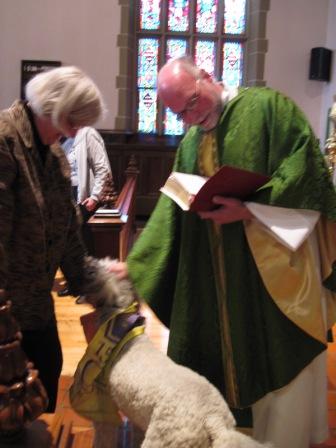
Our images of St. Francis tend be associated with the Blessing of the Animals:

a photo from Sunday that I didn’t post:
Last night, during “First Monday,” I reflected on St. Francis as well. Although he wasn’t mentioned by anyone, or perhaps even thought of (by anyone but me), we were doing the sort of ministry Francis did, among people with whom Francis ministered.

While he preached to birds and tamed wolves, and even rebuilt churches, Francis was most known for his work among the destitute, the poor, the hungry, and the sick. Although the order he founded quickly became powerful and made its home in universities and other cultural centers, Franciscans also tended the sick and dying.

Our feeding of shelter guests and community last night is one way in which we at Grace seek to serve Christ in all persons, to feed the hungry, clothe the naked, and the like. Last night, we were joined by others in the community, some who have become regular volunteers, others who were there for the first time. Among this latter group were members of the Madison Mennonite Church. The band last night was “Off the Porch.”

Here are other images of Franciscan ministry:
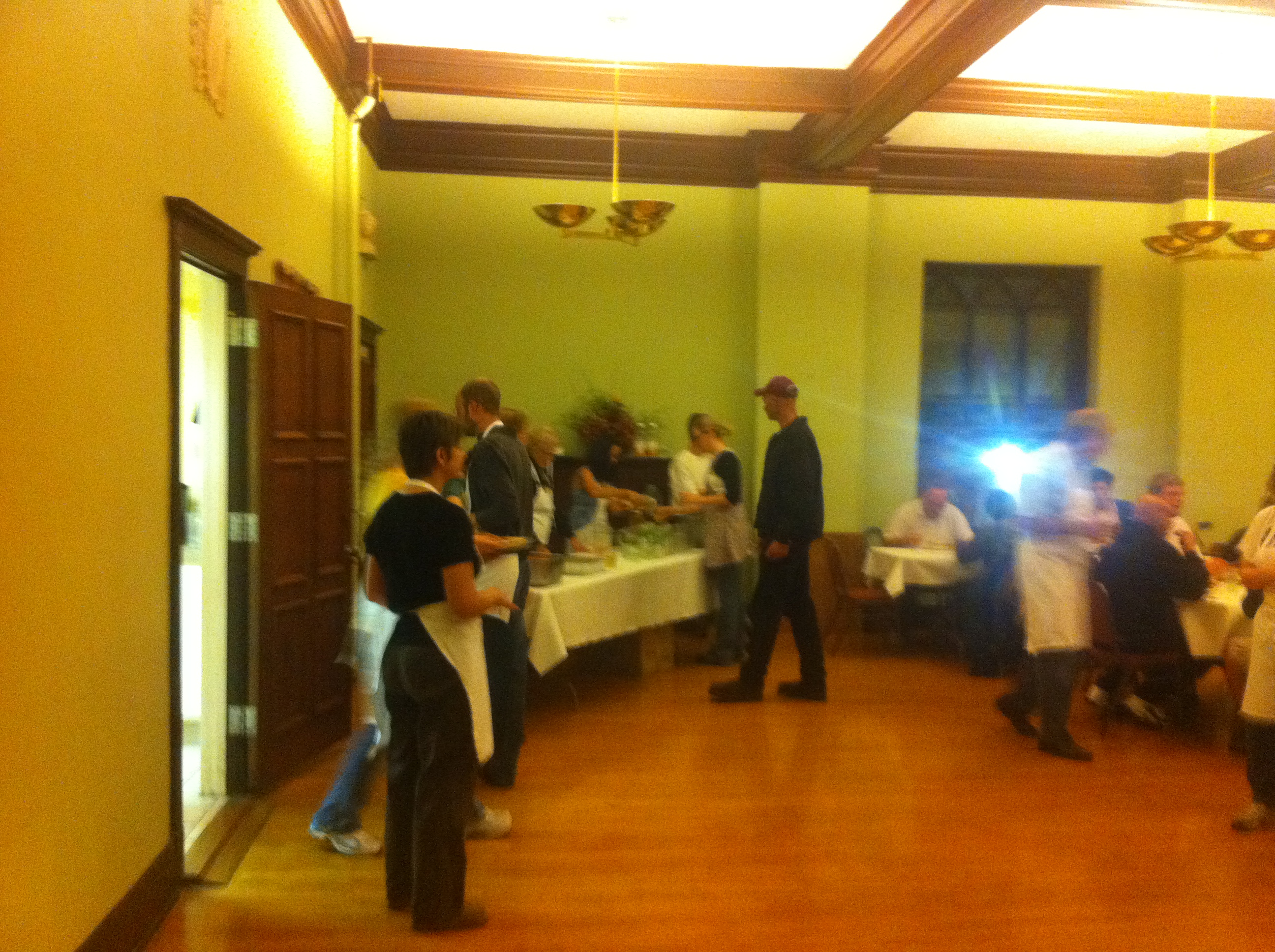
The meal had a very different feel, for some reason. Several regular volunteers remarked on the guests’ behavior. We often have brusque, difficult, or demanding guests. Last night, they were friendly, incredibly appreciative, and many lingered long after they had eaten, chatting with friends or volunteers, and listening to the music. It also seemed to me that there was a demographic shift–the percentage of African-Americans seemed lower than in past months, and many of the men looked “middle-class,” by which I mean one could have expected to see them working retail, or in a bank. It was all very odd. Whatever their history, tonight they were here, for a meal, most of them for a bed as well. And for a half-hour or so, they could enjoy some great food, great music, and wonderful hospitality. The spirit of St. Francis was present as well.

Of course, one can’t extrapolate from a single evening. It’s only a snapshot taken on a relatively warm night in early fall.

Thanks to everyone who came, everyone who volunteered, and especially to Metcalfe’s, who helped with the food.


Forgiveness in Action

October 2 was the fifth anniversary of the shocking killings at an Amish schoolhouse in Lancaster County, PA. It wasn’t only the violence that shocked the community and the nation; it was also the immediate response to the shooter’s family by the Amish community. Five years later, those acts of forgiveness continue to inspire.

Here’s a story about the mother of the shooter, who now visits a paralyzed survivor on a weekly basis.

An article from a Mennonite publication on a recent conference that looked back on the event and sought to draw some larger lessons. Don Kraybill, sociologist called the way in which the Amish drew together to help the Roberts family “a moral barnraising.”

It’s a remarkable story, made more remarkable by the almost immediate response by the Amish community to the tragedy. Within hours, Amish neighbors were in the homes of Roberts’ parents, offering them prayers, consolation, and love. The human propensity is to lash out violently when such violence is done; and often the desire for revenge persists indefinitely. But here, healing has taken place; new relationships have been forged, and new hope as well.

There may be few better examples in our culture of people putting the words of Jesus into action.

Update on homelessness in Madison

Pat Schneider of the Capital Times continues to pursue this story. As I’ve mentioned before, with the imminent closure of the Central Library for renovations and continuing closure of the Capitol basement, there is great concern about where homeless people will go during the day this winter.

Schneider interviewed Steve Schooler, Executive Director of Porchlight, which runs the Drop-in Shelter housed at Grace and other downtown churches. In initial meetings with other service providers, churches, and the downtown business community, stop-gap measures were identified, but as Schneider and Schooler point out, there are large gaps in potential coverage, especially on the weekends. Schneider’s most recent article is here.  For a depressing perspective on attitudes toward homeless people, read the comments thread.

I’ve previously discussed this issue here and here.

Walker Percy, Bourbon, and the Holy Ghost | First Things

Ruminations on the spiritual power of bourbon, from Walker Percy, nonetheless: Walker Percy, Bourbon, and the Holy Ghost | First Things.

To return to more earthly spirits, bourbon is for Percy a way to be for a moment in the evening. Why might one take an evening cocktail? Baser reasons are: an addiction to alcohol, or the desire to appear sophisticated. Better reasons, according to Percy, are the aesthetic experience of the drink itself—the appearance, the aroma, the taste, the cheering effect of (moderate) ethanol on the brain. Another reason is that a drink incarnates the evening; it marks the shift from the active workday to a reflective time at home. One simply must choose a way to be at a five o’clock on a Wednesday evening. Instead surrendering to TV, Percy recommended making a proper southern julep. I prefer my bourbon as an old-fashioned, a drink that reflects the colors of an autumn day. “Love God and do what you will,” Saint Augustine advised. This presumes that you have allowed God’s grace to order you to love properly, and you have taken proper note of your own God-given gifts and dispositions. Then, praise God, and be.

Walker’s original essay can be read here.


St. Francis of Assisi–An otherwordly falling in love

Tomorrow, Grace will have a Blessing of the Animals at our 10:00 service. It is one way in which we honor St. Francis of Assisi, whose feast day is October 4. St. Francis is fondly remembered for his love of creation and especially of animals, but he was much more than that. Here is an excerpt from a reflection on America’s “In all Things” blog:

The story of Francis encountering the San Damiano crucifix wonderfully illustrates what the great Jesuit theologian and philosopher Bernard Lonergan called “the Law of the Cross.” What was that?

When Lonergan pondered our salvation, he rejected the idea that the Father causes it through any act of external intrusion into history.   For Lonergan salvation isn’t something God accomplishes without our cooperation. God certainly doesn’t declare our alienation to be at an end because we’ve killed the Son. On the contrary, God saves us through our being drawn by love into the cross of Christ. The knowledge of the Son’s gift upon the cross compels our conversion, because it calls us to love. Lonergan defined conversion as “otherworldly falling in love.”

We’re meant to look upon Jesus, as Francis did in that Umbrian chapel, and fall in love. And having fallen in love, as any lover knows, the entire world is changed.

The entire post, written by Terrance W. Klein, is available here.

“Concealed Carry” and the Love of Christ

Among the bills passed by Wisconsin’s legislature and signed into law by Governor Walker, is one permitting “concealed carry” of handguns. It will go into effect in November and has caused consternation in many quarters. Churches and other property owners are permitted to put up signs that state weapons are forbidden to ensure that law-abiding citizens carrying guns will not bring them onto premises. Grace Church already has a published policy (in our employee handbook) that forbids weapons on church property.

There is considerable discussion about how churches should respond. The Wisconsin Council of Churches has produced material to help churches decide and the Convention of the Episcopal Diocese of Milwaukee will debate a  resolution that recommends forbidding weapons on all property owned by, or held in trust for, the Diocese (which would include all churches and rectories): concealedcarryresolution

There was lively debate about the resolution at yesterday’s clergy day. I am opposed to the law and to any law that increases the possibility of violence in our community. However, I am also mindful of my own experience. When we were living in Tennessee back in the 1990s, I remember the first time I noticed the sign forbidding weapons on the entry doors of the Chattanooga airport. I was relieved to know that weapons were prohibited in the airport (this was years before 9-11) but suddenly I realized the sign meant that people carrying concealed weapons were out on the streets, in stores and restaurants, and the like. Tennessee was then, and undoubtedly remains, a violent state. While we lived there, several local county courthouses were bombed with dynamite by disgruntled citizens.

Signs forbidding weapons in churches remind us that churches are sanctuaries, places of peace, and link us to the long history of churches providing safe havens for people threatened by violence. At the same time, such signs prominently displayed can arouse fear and suspicion.

As churches, we are to offer a message of love and hope, not fear and the question for me is whether chilling signs with handguns prominently displayed that inevitably remind us of the violence inherent in our society, proclaim the love of Christ.

More on Stacy Sauls’ Proposal

I’m intrigued by the conversation about Bishop Sauls’ proposal to shift money from administration and governance toward ministry and mission. It’s an important conversation and has aroused considerable interest and emotion. Many seem to perceive it as an attack on the laity, particularly on lay governance, in the form of General Convention.

The reality is, things must change. Sauls’ presentation focuses on the financial realities confronting the church. They are real and potentially of enormous impact. But there are other realities, too. The Episcopal Cafe, in the midst of these postings about structural change within the denomination, found time to link to a study  that highlights the structural changes taking place in our society and in the religious life of Americans. The full study is available here: Decade of Change Final_0

The Episcopal Lead quotes:

“There is an overall decline in the numbers of faithful in the pews. Median weekly attendance in American congregations was 130 in 2000 and had dropped to 108 by 2010 . . . More disconcerting is the erosion in spiritual vitality. In 2005 about 43% of congregations reported high spiritual vitality and 5 years later this has dropped to 28%. This is paralleled by a decline in financial health in congregations…”

The conversation within the Episcopal Church may be driven by finances. It ought to be driven by this reality, the increase of those who identify themselves as non-religious and the very different ways in which younger cohorts relate to religious institutions than their elders did.

The burning question ought to be: How do we create vital spiritual communities that proclaim the good news of Jesus Christ in this environment? There are thousands of people who are asking this question and experimenting with possibilities both in our denomination throughout American Christianity. It ought to be our top priority as well. If we can’t adapt to this new reality, no amount of restructuring will matter. Nor should it.

Here’s is Bishop Sauls’ slideshow: Sauls’ presentation.

Here’s a link to the text.

The pushback has begun. Jim Naughton’s is publishing a series of posts examining the proposal. The first, examines “the political context.” It is here. It seems there is outcry that the leadership of General Convention were not consulted  and there is perception that this may be a powerplay from the House of Bishops to reduce the involvement of laity in governance. The second asks about mission. The third explores other ways of reducing overhead, including merging dioceses and rethinking national church headquarters in Manhattan.

A follow-up article from Episcopal News Service is here.

Mark Harris’ continuing commentary is here.

The Antichrist is back in the news!

First, an oped in the New York Times.

For some evangelicals, President Obama is troubling. The specious theories about his place of birth, his internationalist tendencies, his measured support for Israel and his Nobel Peace Prize fit their long-held expectations about the Antichrist. So does his commitment to expanding the reach of government in areas like health care.

As if to prove Sutton’s point, a heckler calls President Obama the antichrist: http://youtu.be/9cP-FTX5tVg

A review of Richard Landes’ new book on secular apocalypticism:

Despite the lack of subtlety in his treatment of Islam, Landes’ arguments are convincing: that by diminishing the milennialist influence, viewing it through a narrow Enlightenment-centric lens, or ignoring it altogether, the “bats” overlook a dangerous historical force; and second, that we need to better understand how such ideas shift from the fringes to the center. Above all, Heaven on Earth convinces the reader that secular movements are often far more religious than we tend to acknowledge.