
Lectionary Reflections on Advent 3, Year B

This week’s lectionary readings.

The contrast between the presentation of John the Baptizer in Mark and the Gospel of John’s portrayal of him is striking. For one thing, in the fourth gospel, John doesn’t actually baptize Jesus. In addition, Jesus begins his public ministry before John’s arrest. There are other differences, too.

In this week’s gospel reading, we learn about who John is not. He is a witness, or testifier to Jesus Christ, but when asked who he is, whether he is the Messiah, or a prophet, or Elijah, he replies, “I am not.” Later in chapter 1, when John sees Jesus, he points to him and says twice, “Behold the Lamb of God.”

The gospel writer is concerned to heighten the difference between John the Baptizer and Jesus, to make clear that John is less important, but by writing in this way, he presents us with questions that, in a sense, we struggle with as Christians. Who is Jesus Christ? For all of the doctrinal formulations that attempted to fix and define Jesus Christ’s identity for all time, the question of who he is, for us as individuals and for our congregations presses itself on us.

How do we experience Jesus Christ? How does he come to us? How do we encounter him in our lives and in our world? We are often tempted, just like those who defined the doctrines of Jesus Christ’s nature, to fit him into a certain philosophical or theological framework. We are tempted, like those who asked John who he was, to try to fit our experience of Jesus Christ into certain pre-defined categories or terms. That’s the case all of the time, but it may be particularly true in this season, when we look for Jesus Christ’s coming in a manger in Bethlehem, and ignore other ways in which Jesus Christ comes to us.

The Gospel of John consistently asks, “Who is Jesus Christ?” As often as not, those who ask Jesus the question, “who are you?” have questions asked back of them, or experience Jesus shattering the categories they use to ask him.

Who is Jesus Christ? To ask that question in Advent is to invite two very different, and in some ways contradictory responses. He is the babe who is born in Bethlehem, but he is also to one who will come to usher in a new age. Those two answers force us to open ourselves up to contradictory and unsettling ways in which Jesus Christ comes to us. To be open to his coming, however it is he chooses to come, is one of the disciplines of Advent.
Art, neuroscience, and religion

Alva Noe has a thoughtful essay on “Art and the Limits of Neuroscience” on the Opinionator.

He criticizes the field of neuroaesthetics:

Semir Zeki, a neuroscientist at University College London, likes to say that art is governed by the laws of the brain. It is brains, he says, that see art and it is brains that make art. Champions of the new brain-based approach to art sometimes think of themselves as fighting a battle with scholars in the humanities who may lack the courage (in the words of the art historian John Onians) to acknowledge the ways in which biology constrains cultural activity. Strikingly, it hasn’t been much of a battle. Students of culture, like so many of us, seem all too glad to join in the general enthusiasm for neural approaches to just about everything.

There’s a deeper criticism here. Noe attacks the view, held from Descartes on, that there is in us something “that thinks and feels and that we are that thing.” For Descartes, it was the soul; for neuroscientists, it is the brain. Noe counters:

What we do know is that a healthy brain is necessary for normal mental life, and indeed, for any life at all. But of course much else is necessary for mental life. We need roughly normal bodies and a roughly normal environment. We also need the presence and availability of other people if we are to have anything like the sorts of lives that we know and value. So we really ought to say that it is the normally embodied, environmentally- and socially-situated human animal that thinks, feels, decides and is conscious. But once we say this, it would be simpler, and more accurate, to allow that it is people, not their brains, who think and feel and decide. It is people, not their brains, that make and enjoy art. You are not your brain, you are a living human being.

Finally,

Far from its being the case that we can apply neuroscience as an intellectual ready-made to understand art, it may be that art, by disclosing the ways in which human experience in general is something we enact together, in exchange, may provide new resources for shaping a more plausible, more empirically rigorous, account of our human nature.

What Noe says about art, could be said, mutatis mutandi, about religion. While I am deeply interested in what researchers studying the brain can tell us about religious experience, I think that, as Noe says, we are people, embodied, engaged in a web of relationships, in a context larger than our brain. Our attempt to make sense of ourselves and our world is more than mental activity; it involves our entire being.

Rod Dreher, who is a bit over the top for me, says something along the same lines in a brief comment on Bellah’s Religion in Human Evolution (h/t Andrew Sullivan):

If you read Bellah’s book, “Religion in Human Evolution,” you understand why ritual is more important than theology. No doubt that ritual completely disconnected from theology is empty. But humans never outgrow the deep need for ritual. It’s built into the biological fabric of our being. You mess with that, you’re messing with things you ought not touch.

Beginnings Matter: A Sermon for the Second Sunday in Advent, Year B

December 4, 2011

Beginnings matter. Memorable beginnings can make all the difference. “Call me Ishmael.” What novel is that from? “It was the best of times; it was the worst of times.” Recognize that? “It was a dark and stormy night,” the first sentence of a novel by Bulwer-Lytton, a nineteenth century English novelist, made famous by Charles Schulz in the comic strip Peanuts. That sentence is so famous that there is now a contest each year for the best worst opening of a novel.

If novels aren’t your thing, what about movies? Are there any opening shots in movies that are fixed in your memory, or even fixed in our cultural consciousness? For people of a certain age, perhaps the opening sequence of 2001: A Space Odyssey, or perhaps Star Wars. Long, long ago, in a galaxy far far away. Continue reading

Scorsese to direct “Silence”

Hugo has movie critics praising Scorsese again and making lists of his greatest films. Here’s Salon’s list. I’m not going to comment on the merits of this particular list, although, how anyone can place Raging Bull below #1 is beyond me. I was a huge fan of Scorsese for many years and often tried to see his films on opening day. Some time after Casino I began to lose interest, but I am eager to see Hugo.

So after reading the list on Salon, I went poking around on imdb.com and was thrilled to see that Scorsese’s long-promised film adaptation of Shusako Endo’s Silence is on the schedule with a release date of 2013. It’s a brilliant novel dealing with one of the most fascinating and tragic episodes in the history of Christianity. Daniel-Day Lewis is slated to play one of the leads.

I can’t wait to see it!

Covenant, Schmovenant

Back in the news with an Advent letter from the Archbishop of Canterbury to the Primates and Moderators. After talking about his travels, especially in Africa, he turns again to the matter of the Anglican Covenant, and the letter turns into another plea for its adoption. In his efforts to convince those opposed as well as the uncertain of the merits of this documents, Williams’ arguments become more shrill and less convincing.

Tobias Haller is on the case here and here. Haller quotes Williams’ plea that the covenant is needed to provide a united front in our conversations with other religious bodies, especially the Roman Catholic and Orthodox. Curiously, Haller does not include in his quotation what I consider the most telling, sentence from that section:

“if the moratoria are ignored and the Covenant suspected, what are the means by which we maintain some theological coherence as a Communion and some personal respect and understanding as a fellowship of people seeking to serve Christ?

Theological coherence? Anglican theological coherence? What can Williams possibly mean when his own Church of England is so deeply divided between Evangelicals on one end of the continuum and Anglo-Catholics on the other. Those differences are not chiefly about liturgy. They are about theology. One of the great blessings of Anglicanism is the space it has provided over the centuries for theological difference–for different approaches and perspectives, for those of a more Protestant, even Calvinist bent, and those who find in the Catholic theological tradition rich resources for faith and life.

In fact, the Covenant aims not at theological coherence, but at limiting the provinces’ expressions of what they think the gospel means in their particular contexts.

Andrew Gerns points out that the Archbishops’ travels and interactions with Anglicans in other countries succeeded in the absence of a Covenant, that there can be communion without covenant.

There have been more developments concerning the Covenant. In Canada, the House of Bishops has discussed it again. Archbishop Fred Hiltz expressed his reservations about the punitive measures in Article IV:

My personal concern is what happens when the direction you move in is not in accordance with the standards of the communion. You’re out. It does not end on a note of restoration or hope, so I say it falls short of the Gospel


So why not allow some experimentation with restructuring?

There’s been considerable debate in the Episcopal Church over the past few months about restructuring the church. The problems are clear. We can’t financially sustain the current structure of national church offices, provinces, dioceses, and parishes as they are currently conceived, and it’s not clear that the current structure, even if it were well-grounded financially, serves the current mission needs of the church.

So what to do? Bishop Sauls has offered his proposal, about which I’ve already made comment. Others have also weighed in. Currently, my friend Crusty Old Dean is putting forth a very thoughtful and provocative set of proposals: part I, part II, part III, part IV (I knew him before he ascended the heights of academe). I urge everyone interested in the future direction of the church to read carefully what he is proposing.

At the same time, in the Diocese of South Carolina, a certain restructuring is already taking place. Bishop Mark Lawrence recently issued quit-claim deeds to the parishes in the diocese, essentially granting them property rights to parish property (which canonically is owned by or held in trust by, the diocese). This move has aroused considerable anxiety and outrage among “institutional” (most of whom are progressive) Episcopalians. Mark Harris comments on developments here and here.

I find this response quite interesting. Given that the diocese as an institution is a relic of an earlier age, that the ownership of property is one of the most contentious (and expensive) issues in the conflicts within the church, I wonder what the harm is with making this change? It may go against the constitution and canons, but perhaps they ought to be changed, and indeed, Bishop Lawrence may be right that the current understanding is something of an innovation. Why use the heavy cudgel of authority and constitution to force compliance or membership, when we might all be better served going our separate ways.

One of the chief arguments in favor of restructuring is to allow more horizontal relationships across diocesan and provincial boundaries. Might there be a way that people who share theological perspectives might found solace, strength, and comfort, by creating bonds with like-minded people across the church, at the same time remaining under the umbrella of the Episcopal Church? In a sense, that’s what earlier efforts at providing alternative episcopal oversight to parishes that struggled with their bishop’s perspective were meant to do. No, it’s not a perfect solution. But the question may finally come down to whether the only things that unite us as a denomination are property and the Church Pension Fund.


The Messianic Banquet–Reflections on Wednesday in the first week of Advent

The readings for today from the daily eucharistic lectionary:

Isaiah 25:6-10a
Psalm 23
Matthew 15:29-37

All three scriptures feature meals. The gospel story is Matthew’s account of the feeding of the five thousand. Psalm 23 includes the line, “you spread a table for me in the presence of those who trouble me.” The Isaiah passage begins:

On this mountain the Lord of hosts will make for all peoples
a feast of rich food, a feast of well-matured wines,
of rich food filled with marrow, of well-matured wines strained clear.

The messianic banquet is one of the predominant images for Jewish reflection about the messianic age in the decades leading up to Jesus. Drawing on rich biblical imagery, the Dead Sea Scrolls and other sources express a hope that the age to come will include a bountiful feast of rich foods and wines. That image was picked up and expanded in early Christianity. One need only think of the importance of table fellowship in Jesus’ ministry, the numerous times we see him feasting (and the criticism of his and his disciples’ actions). But in the gospels, Jesus also brings about the messianic feast. In the gospel for today, Jesus creates more than enough food from sparse resources, so that everyone goes away satisfied. In John’s gospel, Jesus makes wine out of water after the part had already been going on for quite some time.

At the Last Supper, in language echoed by the gospels’ accounts of the feeding miracles, Jesus takes bread and wine, gives thanks, and gives it to his disciples. The Eucharist is a foretaste of the heavenly banquet.

Advent is a time when we think not only about Jesus’ first coming, but also about his Second Coming, and the idea of a messianic banquet remains a powerful image in Christian reflection. The Isaiah text is one of the suggestions for Hebrew Bible readings in the BCP Burial Service liturgies, and rightly so. It evokes the rich memories of our own celebratory meals, and looks forward to an even greater celebration in the age to come.

Our holidays are full of celebrations, parties, meals like Thanksgiving Day and Christmas Day when tables groan from all the food on them. We seldom make the connections between those meals, the Eucharistic feast, and the messianic banquet, but we should. The meals we share together as families and friends are icons of the meal we share when we share Christ’s body and blood.

They are not for ourselves alone to enjoy. For our joy to be complete, our invitation must be shared with all of humanity, our table extended to include who hunger and thirst.

The Peacable Kingdom–Tuesday in the First Week of Advent

The readings in the daily Eucharistic lectionary for Tuesday in the first week of Advent include Isaiah 11:1-10, the prophet’s vision of the peacable kingdom:

6 The wolf shall live with the lamb,
the leopard shall lie down with the kid,
the calf and the lion and the fatling together,
and a little child shall lead them.
7 The cow and the bear shall graze,
their young shall lie down together;
and the lion shall eat straw like the ox.

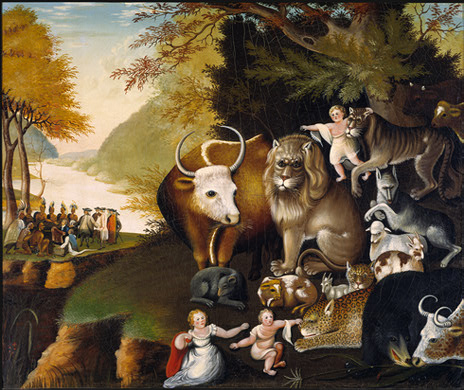
It’s one of the most familiar and most beloved images from all of scripture, a beguiling picture of a world at peace with itself, of God’s creatures playing and resting together. For many of us, the most familiar artistic depiction is that by the early American artist, Edward Hicks, who painted 61 different versions. Here is one: Hicks was a folk artist and the naivete of his style seems well-suited to what might seem to twenty-first century readers, a certain naivete in the vision of the prophet. We live in a world which seems much more in keeping with Thomas Hobbes’ idea of the state of nature in which:

where every man is enemy to every man, the same consequent to the time wherein men live without other security than what their own strength and their own invention shall furnish them withal. In such condition there is no place for industry, because the fruit thereof is uncertain: and consequently no culture of the earth; no navigation, nor use of the commodities that may be imported by sea; no commodious building; no instruments of moving and removing such things as require much force; no knowledge of the face of the earth; no account of time; no arts; no letters; no society; and which is worst of all, continual fear, and danger of violent death; and the life of man, solitary, poor, nasty, brutish, and short.

I don’t know about you, but sometimes I feel like the times in which we live are approaching Hobbes’ state of nature. We are certainly in a world where everyone seems to be at war with everyone else.

Does the prophet’s vision continue to offer hope for us in this season of Advent? Can we imagine a world in which we are remade in God’s image, refashioned as loving and creative persons, and perhaps most importantly living in peacable community with one another? Sometimes I think that vision is so far separated from reality that we can no longer imagine it as a possibility as a vision of our future, rather than the rantings of an eighth-century prophet, or the childish images of a nineteenth-century painter.

The prophet’s vision may no longer hold power over us. But the idea behind that vision cannot be tossed into the dustbin of an abandoned faith and a past time. A human race, no, a world, at peace itself, that idea must continue to shape and empower us. What that world might look like, what our vision of that world might look like, may be different from the prophet’s but it must be beautiful enough to sustain us and to give us hope.

In Advent, in this troubled world and in these troubled times, God waits for us. God waits for us to find our way to that peacable kingdom, where we encounter and embody, God’s love.

The Good News Begins in the Wilderness: Lectionary Reflections for Advent 2, Year A

This week’s readings.

I love the beginning of Mark’s gospel. It’s simple and clear and nevertheless raises many questions: “The beginning of the good news of Jesus Christ, Son of God.” Now, I suppose professional commentators would tell us that Mark 1:1 is really just a title or introduction to the work as a whole (I don’t know, I didn’t check), but what always strikes me about this verse is the audacity of the gospel writer in beginning this way, and the abrupt transition from v. 1 to the story of John the Baptizer.

Mark doesn’t give us the biographical details that Matthew and Luke provide; he doesn’t give the theological background that John does. He simply begins, inviting us to ask questions: What is the good news? Who is this Jesus Christ? Those are the questions we will ask throughout the gospel, and the questions that will remain at its end, because the ending is as abrupt as the beginning.

This year, as I reflect on the juxtaposition of Isaiah 40 and Mark 1, I’m intrigued by the role of the wilderness. The story of the good news Jesus Christ begins in the wilderness (with John the Baptizer) just as the prophet proclaims the way of the Lord in the wilderness. In the Isaiah passage, written from exile in Babylon, the promise of comfort to a ruined and desolate Jerusalem comes by way of a procession through a wilderness that is made hospitable and a journey made easy.

The idea of wilderness captures our imagination even if we rarely directly experience such places. The desert of the ancient Near East was a foreboding place, threatening existence with its sparse food and water. It was a barren place, a place of exile and a place where civilization and culture were absent. Still it beckoned to those who lived in cities and towns; it could offer refuge for those on the run, and it could be a place of innovation. The crowds came to hear John in the wilderness, perhaps as a curiosity, but also, likely, because many believed religious truth could be found there.

In later centuries, Christians would go repeatedly into the wilderness in their search for God. The monastic movement began with the flight to the desert of Anthony the Great and ever since, monastic communities have sought and found God in the desert, far away from culture and civilization.

Our lives often seem to us to be deserts or wildernesses, places of loneliness and barrenness, places where we cannot find nourishment. And they can be that. But as scripture and great spiritual teachers tell us, deserts can be places where we encounter God, where we can hear the good news of Jesus Christ.

Sometimes it is only when our lives are stripped bare of all essentials, when we are left completely alone in a dry and barren place, that we can encounter and experience God. Sometimes though, even when we are in those places–at our wits’ end–we seem abandoned even by God. Sometimes the promise of comfort rings hollow and meaningless.

In those times, being open to the possibility of God’s presence can be difficult, even almost impossible. The desert can be both forbidding and beautiful and our perspective can allow us to experience something new and powerfully creative in what might seem, from a different angle, nothing at all.

Advent invites us to explore and experience in new ways the wildernesses and deserts in our lives. It invites us to look for good news and comfort in difficult and forbidding places and invites us to rejoice that God is coming to make things new. And that means, even our lives!