Lectionary Reflections, Advent 4, Year B: Occupy Bethlehem?

This week’s readings.

Our readings bring us ever closer to the coming of Christ, and it is easy for our attention to focus on Mary this week, with the story of the Annunciation as the gospel reading and the Magnificat as an option for the Psalm. But we shouldn’t let our expectation of Christmas divert our attention from the other readings. In particular, the reading from 2 Samuel is fascinating on its own, and meaningful too in its lectionary context, with God’s promise to David that “your throne shall be established forever.”

The passage from 2 Samuel occurs just after David has gained control of the monarchy and has begun the building projects that every victorious ruler undertakes–to demonstrate their power and symbolize their reign. David has built a “house of cedar” for himself, and gets the idea to build a temple for Yahweh. Nathan the prophet supports him in this effort, saying “The Lord is with you.”

Apparently Nathan wasn’t paying attention, because Yahweh speaks directly to David, asking him where he got this bright idea and whether Yahweh had ever asked to have a temple built. In fact, the Hebrew suggests that Yahweh has walked alongside and with the Israelites. For all of the effort in 1 and 2 Samuel to offer a defense of David’s rise to power and of his monarchy, there remains in the text considerable antagonism toward monarchy in general. This seems to be one example of that.

The lectionary editors no doubt wanted to focus our attention on the promise that David’s house would last forever and that his throne would be established forever, a prophecy of the coming of the Messiah. But there’s another connection between this reading and our other texts. Yahweh tells David that “I took you from the pasture, from following the sheep to be prince over my people Israel; and I have been with you wherever you went, and have cut off all your enemies from before you; and I will make for you a great name.” In the Magnificat, Mary sings:

He has shown the strength of his arm, *
he has scattered the proud in their conceit.
He has cast down the mighty from their thrones, *
and has lifted up the lowly.
He has filled the hungry with good things, *
and the rich he has sent away empty.
He has come to the help of his servant Israel, *
for he has remembered his promise of mercy,
The promise he made to our fathers, *
to Abraham and his children for ever.

Just as Yahweh lifted up the lowly David and made him king, Mary sings that God casts down the mighty from their thrones and sends the rich away empty. There’s a connection here, not just the genealogical connection with David that Matthew and Luke want to emphasize. We are invited to compare the rule of David, perhaps the rule of Rome, too, with the rule, the reign of God, and the coming of the Messiah. To put our hopes in the power and justice of human rulers and institutions is to hope falsely, for 1 Kings goes on to describe how Solomon, the wisest of all kings, oppressed the people. His son Rehoboam promised to do even worse, a promise that was met with rebellion and led to the division of the Northern and Southern monarchies.

As Advent nears its end, this season in which we prepare for the coming of Jesus Christ and reflect on his coming to us in Christmas and in the Second Coming, we do well to remember that God’s power is greater than that of any human agency or institution, and that Mary’s song praises a God who upends power relationships, reverses the status of rich and poor, and feeds the hungry. These latter are especially important to keep in mind with all the news of Occupy Wall Street, the 99%, and Republican efforts to lower taxes on the wealthiest of our citizens.

The sad decline of the war on Christmas

I went to the Capitol today. It was kind of eerie, because I hadn’t entered it since the protests last February, when it was occupied by thousands, and a group of interfaith clergy made their way from the steps of Grace to the rotunda to show our solidarity.

It was much quieter today. The Christmas tree (before this year, it was a Holiday tree) is beautiful. I was on a mission, looking for the nativity scene put up by a conservative Christian organization that wanted to witness to the “true meaning of Christmas.” It took me a while to find the display, on the second floor of the rotunda. But there it was, as were a couple of signs proclaiming loudly the Christian faith, and near them, the remains of last week’s interfaith display–posters from UW’s Lubar Institute and from a group of Hindus. Here’s the article from Madison.com

No doubt those who erected the creche are convinced that they are making a profound and valiant witness to the truth of Christianity in the face of a secular onslaught. In fact, they have done little more than attract notice from the Freedom from Religion folks, who are always looking for a good fight.

Here are photos:

here's the infamous nativity scene

here’s the accompanying message

No sign yet of the display from Freedom from Religion.

Meanwhile, sophisticated Christians are laughing about the youtube video of a Christian choir singing about Merry Christmas: http://www.youtube.com/watch?v=TWrrvQ_3-40&feature=share

The second verse features the following lines:

If you don’t see Merry Christmas in the window,

No, you don’t go in that store …

It’s the one and only reason

we celebrate the season,

wishing love to all and peace upon the earth

But not, apparently, to retailers.

As I was greeting people after the service yesterday, one parishioner said, Merry Christmas, to me, and then apologized, saying she wasn’t sure anymore what she could say. I pointed out to her that in the liturgical calendar, the season of Christmas begins only on December 24, so technically, one shouldn’t say “Merry Christmas” until then. And then I laughed.

The Hinduization of death? Please, give me a break!

An article in the New York Times today about the growing appeal of cremation in the US quotes Stephen Prothero of BU:

“America is becoming Hinduized in this way,” said Stephen Prothero, a professor of religion at Boston University and the author of “Purified by Fire: A History of Cremation in America.” “We’re increasingly seeing the human as essentially spiritual and gradually giving up on the Judeo-Christian idea of the person in the afterlife.”

He might want to talk to some people involved in caring for those facing decisions about burial. Yes, it’s economic. When I served in Greenville, I could tell people that cremations done by the South Carolina Cremation Society cost $600, as opposed to whatever funeral homes were charging. To choose cremation in those circumstances is not about the resurrection of the body, it is about stewardship. For people who no longer have close ties to particular places, to think about tying their bodies, and the emotions of their loved ones, to a particular place in a cemetery seems inappropriate, especially when they may never return there.

We have a columbarium at Grace where the ashes of former members and members’ loved ones can be inurned. It is a symbol of the community of the faithful that extends beyond death and the grave and includes us all in the great cloud of witnesses.

Yes, there is a transformation in Americans’ attitudes toward the body and how one treats a body at death, but whether that has anything to do with an changing understanding of what constitutes a human person seems to me very much debatable. My father, for example, donated his body to the Medical College of Ohio, not because he didn’t believe in the resurrection of the body, but because he considered his body something that might be of use to society. He died in sure and certain hope of the resurrection, confident that if his body could be raised, so too could his ashes.

A decision like this is often one of the most difficult an individual, or the surviving loved ones have to make. Of course, economics plays a role, so do many other factors, including our transient society, and personal experiences related to places other than cemeteries. I think the choice of cremation has as much to do with the American funeral industry as it has to do with changes in the understanding of the bodily resurrection. And it doesn’t take more than a glance to experience the radically different spiritual experience of a typical cemetery with a beautiful place like the memorial garden at St. James Episcopal Church in Greenville, SC.

All are welcome here!

I really don’t want to use news about other denominations as marketing for my own church, but living in Madison, it’s hard not to want to take advantage of developments in the Roman Catholic Church. Now, Bishop Morlino has recommended that a hymn entitled “All are Welcome” is not appropriate for use in the Mass. Here’s Doug Erickson’s article on Madison.com. Apparently, Bishop Morlino believes that all are not welcome at the Lord’s table.

I’ve toyed over the years with several marketing strategies for disaffected Catholics: “The Episcopal Church: All of the liturgy, none of the guilt” is one. OK, yes, that was a joke. The national church has had a slogan “The Episcopal Church welcomes you.” Perhaps we need to be even more clear in our message, at least in Madison: “The Episcopal Church: All are welcome here!”

And we mean it, whether you’re Episcopalian, or Roman Catholic, or just seeking!


Hugo

As I mentioned in a previous post, I’m a huge fan of Martin Scorsese. I saw Hugo this afternoon and I’m still processing it. The difficulty is not so much the movie itself; it’s beautiful, well-made, and a delightful paean to the power of imagination, dreams, and film. The puzzle for me is fitting it into Scorsese’s oeuvre.

First, if you’ve not seen it, some other reviews:

There’s a moment in the film when Hugo, the young orphan who lives in the train station and is trying to repair the automaton because he believes his dead father will deliver a message from beyond the grave, and because as a boy on his own he is seeking to end his loneliness in the company of this magical creation, talks about his place in the universe. He imagines it as a giant machine. Just as machines have no unnecessary or superfluous parts, so too the universe. He must have a place in it.

The film, on one level, offers praise of technology. But it is technology that has the power to bring our dreams to life. There is Georges Mulies himself who begins as a magician, creates an automaton that can write, and when he encounters the movies of the Lumieres brothers, imagines the power of film.

On another level, the film is a hymn to technology, to the power of technology to transport us from the lives we live into an imagined world, limited only by our imaginations. Scorsese plays off the power of film, using the story of the first viewers of the Lumieres brothers movie of a train entering a station, an experience so powerful that the first audience flinched and ducked as they feared the train hitting them. We see the train again, entering the station in Hugo’s dreams, then again, when Hugo tries to rescue the automaton from the tracks.

We see the power of imagined worlds–Scorsese’s, Hugo’s, the world of the first film-makers, and the world of books. The latter comes to life as Hugo and his friend Isabelle look at a history of movies and see pictures in a book come to life.

We see the possibility of a different world, a possibility opened up by the power of art, and love. But we also see technology. The mechanisms of clockworks dominate the film, mechanisms that make a toy wind-up mouse run across a store counter, the mechanisms that make clocks tick, automata do their magic, and movie cameras create the new worlds. Scorsese seems to be saying that this technology can create dreams, bring our dreams to life, and help us find our place in the universe. But as he looks back at the history of film, he also is calling for the importance of the preservation of its past, and the power of that old technology, and old dreams, to transport us as well. He seems to be saying, even as he makes superb use of the most modern of technology, that the vision of the first film-makers is as powerful as his own. It’s a beguiling vision.

But I’m still thinking about what he is saying about technology, even as he makes use of it. Reviewers like Roger Ebert have made a great deal of his use of 3D. I’m going to confess that this is the first 3D film I’ve ever seen. I found it curious. As a neophyte, my first exposure was not to Hugo but to the trailers that were shown first, a series of animated movies that were advertised and visually, in 3D seemed over the top and over-stimulating. Hugo was quite different. The 3D seemed to add a dimension (duh), to add depth, rather than force itself on the viewer. But I wonder what it added, other than another level of special effect to a technological marvel.

In the end, I suppose Hugo is another example of Scorsese’s love of film. He has been a leader in the preservation of of film history. In addition, it reminds of the care he takes in creating a vision of a different world for his audience. Whether it was The Age of Innocence or Casino, Scorsese draws us into the world he creates and invites us to imagine that world.

It’s also a remarkable confession of faith–to assert, as Hugo does, that everyone has a place in this universe is a remarkable statement of faith.

I’ve finally found a reason to become a Packers fan

Aaron Rogers quotes St. Francis of Assisi:

“I feel like my stance and my desire has always been to follow a quote from St. Francis of Assisi, who said, ‘Preach the gospel at all times. If necessary, use words.’

Yes, I’ve got an issue with the ostentatious and “in-your-face” display of Christianity. It always puts me in mind of a student I had in my first term teaching Intro to the Bible at Furman. The year was 1999. The kid was completely, 100% secular, a fish out of water at Furman. When we were talking about the Sermon on the Mount, he raised his hand and asked about Matthew 6:5-6

5 ‘And whenever you pray, do not be like the hypocrites; for they love to stand and pray in the synagogues and at the street corners, so that they may be seen by others. Truly I tell you, they have received their reward. 6But whenever you pray, go into your room and shut the door and pray to your Father who is in secret; and your Father who sees in secret will reward you.

Specifically, he wondered why kids did the “meet me around the flagpole” thing. I don’t know if it’s still popular, but back then, in the first weeks of public school in the fall, there was a designated time when “Christians” would gather together to pray. He found it very alienating and obviously not in keeping with Jesus’ words. To watch  Tim Tebow, or for that matter, any other athlete, pray after a touchdown, may be equally alienating to non-Christians.


So how’s that restructuring working out, Chuck?

For those of us who are Episco-geeks, news this week of a divorce between the Anglican Church of Rwanda and the Anglican Mission in America (AMiA) is like the Rose Bowl for Wisconsin Badger fans–we’re lovin’ it!

But for those who aren’t, here’s a bit of explanation, and I’m doing it off the top of my head, so chances are I’ll get some details wrong, but probably not the overall gist.

The issue of the ordination of gays and lesbians has been around for quite some time. Conservatives bristled at the prospect, even before Gene Robinson’s election as Bishop of New Hampshire. Chuck Murphy was Rector of a large parish, All Saints’ Pawley’s Island. From encounters with members, children who grew up there, and seminarians who came out of that parish, it was clear to me that All Saints’ commitment to Anglicanism was tenuous at best (My wife once had a student who was raised there ask her what the Book of Common Prayer was).

Murphy retired and at some point was ordained Bishop by the Archbishop of Rwanda, who was deeply opposed to developments in the Episcopal Church. The AMiA developed something of a parallel structure to the Episcopal Church, attracting some conservative parishes and planting congregations in various places, hoping to pick off disgruntled conservative Episcopalians (this was especially true in South Carolina).

Now, it seems, Murphy and the AMiA have run into conflict with the Anglican Church of Rwanda. Apparently, they are no longer connected. Murphy was called out for insubordination and the like and has gone his separate way. The story can be followed in various places, including Episcopal Cafe.

It may be that as George Conger puts it, “It’s just a sad, sad case all around,” Conger said. “There are no doctrinal or theological issues. It’s not about women priests or homosexuality or race. It’s entirely about egos.”

Here’s an article from Christianity Today on the break.

Apparently, they will be seeking a “council of archbishops” who will provide them with some sort of concrete link to the Anglican Communion. We’ll see how that works out.

I put “restructuring” in the title of this blog post, because this division is really about restructuring. Murphy and others, including those American clergy who sought episcopal ordination in the Anglican Church of Nigeria, or the Southern Cone, or Uganda, were (and in many cases, still are) attempting a radical restructuring of Anglicanism in North America. But as the AMiA example, demonstrates, restructuring is a difficult thing.

On one level, I have no problem with people seeking out like-minded people in other countries to help build institutions and to provide some legitimacy. I thought it somewhat odd, and particularly in the case of Rwanda, which, when Murphy was ordained Bishop, was only a few years after the genocide and had enormous issues of its own to deal with. I always thought that the Americans were exploiting a church, and a nation, that was weak and vulnerable. I also found it ironic, even tragic, that Southern descendants of slaveowners, and parishes created by slaveowners, were  looking to Africans for authority. In other words, I thought it all a mess.

But now, it seems, we see what it really is all about, and once more, the loser is the Church of Jesus Christ. I hope that whatever conversations occur in the Episcopal Church about restructuring develop in more productive directions. May God have mercy on all of us.


Ambrose of Milan, December 7

Today is the commemoration of Ambrose of Milan. I had this to say about him last year. With a nod to the season, here is one of his hymns:

1. Redeemer of the nations, come;
Virgin’s Son, here make Thy home!
Marvel now, O heaven and earth,
That the Lord chose such a birth.

2. Not by human flesh and blood;
By the Spirit of our God
Was the Word of God made flesh,
Woman’s offspring, pure and fresh.

3. Wondrous birth! O wondrous Child
Of the virgin undefiled!
Though by all the world disowned,
Still to be in heaven enthroned.

4. From the Father forth He came
And returneth to the same,
Captive leading death and hell
High the song of triumph swell!

5. Thou, the Father’s only Son,
Hast over sin the victory won.
Boundless shall Thy kingdom be;
When shall we its glories see?

6. Brightly doth Thy manger shine,
Glorious is its light divine.
Let not sin overcloud this light;
Ever be our faith thus bright.

7. Praise to God the Father sing,
Praise to God the Son, our King,
Praise to God the Spirit be
Ever and eternally.

Here’s one version of it: http://youtu.be/amkzPGSf-y4


Milton’s Paradise Lost

Jessica Martin, in The Guardian, has begun a series examing Paradise Lost. It’s well-timed given the promised release of a movie based on Books V and VI of the great English epic.

Here’s part 1, part 2. Other parts to follow.

Here’s Martin on Milton’s choice of epic as his genre:

And so Milton folds together two stories focused on different heroes, placing them in balance. On one side, and opening the poem, the defeated figure of Satan following a first great fall, his fall from heaven. Corrupted by overweening ambition, morally tormented, subtle and charming, Satan presents like a melange of the best villains of the stage-plays of Milton’s youth; but his strand of the story follows the epic tradition.

To him belongs the journeys, the politics, the battles, a growing insupportable self-knowledge that will, eventually, diminish him to almost nothing. He travels to encounter and corrupt his opposite numbers, the counter-heroes Adam and Eve – united where he is solitary, ignorant where he is knowing, happy where he is miserable. Their meeting will result in the poem’s second and very different fall, raising Adam and Eve separately and for different reasons to tragic stature. Out of its disaster, as out of Troy’s burning, we see them at the beginning of an odyssey. Their final “wandering steps and slow” will walk them out of the poem and into history, an untold journey leading humanity – eventually, eventually – into the embrace of a lost beloved.

I’ve probably blogged about this before, but looking back on my teaching career, one of the great gifts I received was teaching for most of my fifteen years in an interdisciplinary humanities program, and in almost every year, in a term that had us reading at least some of Paradise Lost. I hadn’t read it before beginning to teach and learning from my colleagues at Sewanee and Furman, and growing to love Milton’s language and genius, is one of the great gifts I’ve received.

It’s probably time to read it again. It’s been almost four years.

First Monday, December 5, 2011

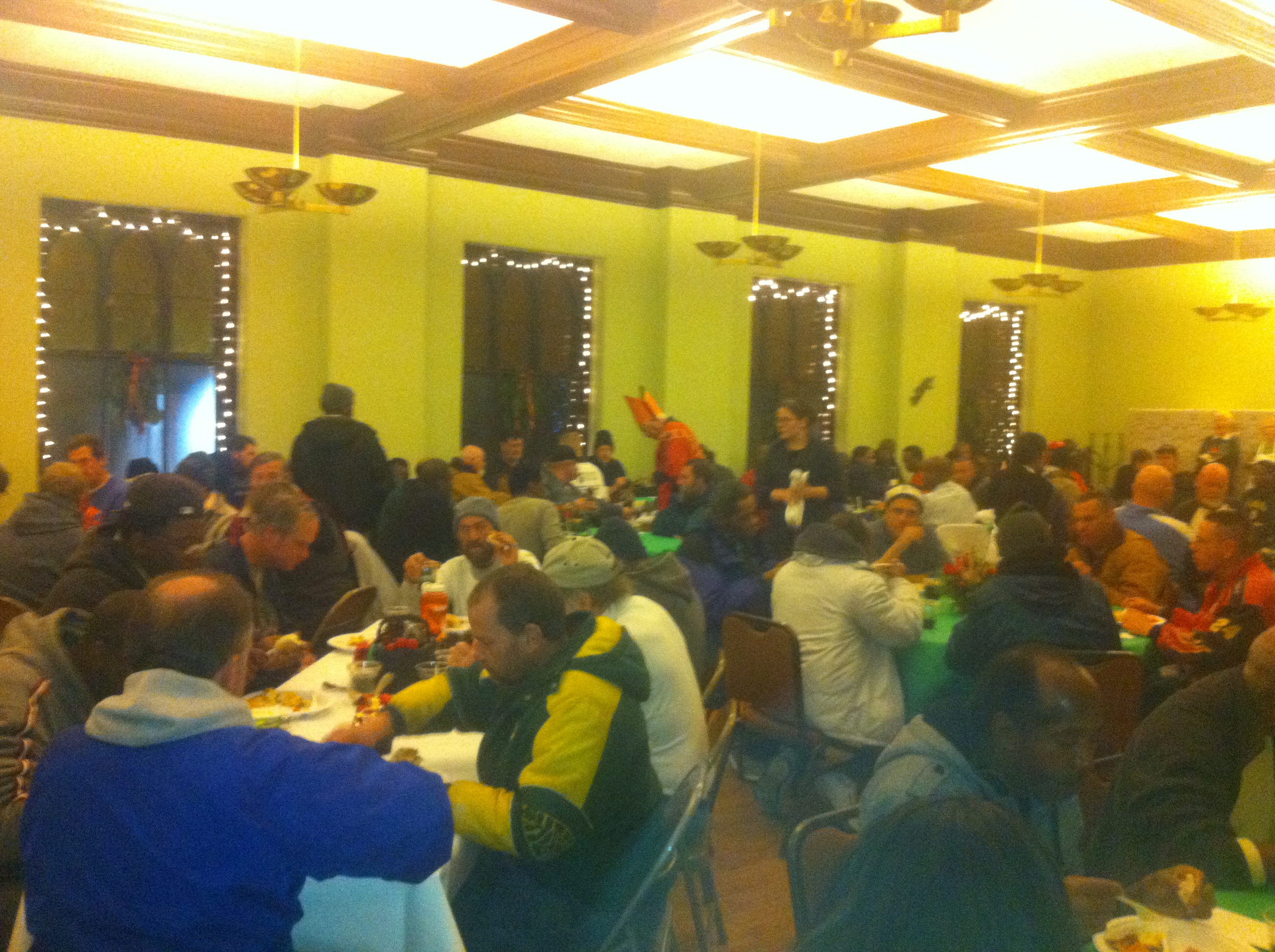
Tonight was First Monday. As tomorrow is St. Nicholas Day, we had a visit from St. Nick himself. He distributed winter socks to our guests, who were treated to a hearty meal of ham, macaroni and cheese, carrots, and cake. We fed more than 150 people and along with our regular group of volunteers, we had several first-timers who enjoyed themselves and said they would be back to help again.

The music was provided by the children of Grace Church, and by our adult choir, who sang a variety of holiday music, Christmas carols and holiday favorites like Frosty the Snowman.

One of our volunteers remarked to me at the end of the evening that the guests were incredibly appreciative of the food and our hospitality. It’s an incredible amount of work, especially the preparation, but it’s also very rewarding. It’s also eye-opening to be reminded of the diversity of homelessness, even among our overwhelming male population.

A couple of pictures: