My next-door neighbor loves decorating for Christmas. Last year, he was out in the middle of a snow storm in the dark, stringing up lights. This year, he began earlier, the weekend after Thanksgiving. But he didn’t stop then. He has continued to fill the trees and shrubs in front of his house with strands of light. Some of them are tasteful, like the wreath and garland bedecked with white lights over his garage door. Others are less so. Among the latter, a dozen or so red-lit candy canes that appeared last weekend. He is exuberant in his decoration. His joy for the season is on display for all to see, every night. Continue reading
No room at the inn, Madison style
As we were leaving church this evening after the early service, we encountered a homeless man, lying in a fetal position, on the sidewalk in front of the church. Released from the hospital a couple of hours earlier, cops had dropped him off here because of the men’s shelter. Unfortunately, he couldn’t walk the twenty yards to the shelter entrance and shelter staff were not going to come out to help him. We called 911 and EMT’s transported him back to the hospital but as they left, they told me that he would probably be back on the street in an hour or so.
He’s not the first person discharged from a hospital to end up at the shelter later the same day. It happens regularly.
The fault in this does not lie with the hospital, or the police, or the shelter staff. The fault lies with all of us, with a society that turns its back on the most vulnerable.
Occupy Trinity Church, Part III
The debate goes on and on. Apparently the actions by #OWS over the weekend, the interventions by Bishop Sisk and Presiding Bishop Jefforts Schori, and the arrest of Bishop Packard have aroused passions. One only need read the comments thread on Jim Naughton’s Episcopal Cafe article to see that things have gotten interesting.
Naughton referred to “An extremely insightful essay” written by Tom Beaudoin at America in which he ponders the theological meaning of private property when it comes to churches:
I think we have a very important theological matter before us when Occupy, through its religious-leader allies, is saying to Trinity Wall Street: We in Occupy — as a multifaith, interreligious, spiritually pluralistic movement that is also and equally a nonreligious, secular movement — can better meet your mission as a Christian church in this particular time, and this particular place, with negligible negative financial impact (Trinity is a verywealthy community), and with a rare and time-sensitive influence, by using this particular private property to host the next stage of Occupy Wall Street, and let’s meet to talk about the liability issues and any other concerns you have, let’s have that dialogue starting immediately, but in principle we have a substantial theological point worthy of your consideration.
The presumption in this theological claim, which I think is correct, is that no Christian church is – on the very terms of its theological existence – permitted to fall back on the mere invocation of “private property” without also a theological conversation about the spiritual significance of what that concept means and how it is being used.
There are several interesting issues in this statement. The first has to do with how “private property” relates to the property of an Episcopal parish, which as we all know to well by now, is held in trust by the parish for the diocese, and by the diocese for the national church. It may be different in Trinity’s case because of its unique history with an immense land grant coming from Queen Anne in 1715. Nonetheless, even here there is a question of “who owns the property.”
But aside from that question, there is the question of “private property” itself and that is probably what Beaudoin is getting at. I used to enjoy telling my students that “God is not a capitalist.” No matter how hard conservative Christians try to spin scripture, to derive capitalism, or even the notion of private property from Hebrew or Christian scriptures takes considerable finesse and exegetical hijinks. In Hebrew Scripture, in fact, there is no sense of private property at all. The land is owned by Yahweh, distributed to the people, given a sabbatical every seventh year, and in the fiftieth year, the Jubilee, whatever land was alienated from its original inhabitants, for debt or sale, or whatever, is returned to its original occupants.
But the question is not what private property may or may not have meant in scripture. Beaudoin is challenging the use of “private property” as Trinity’s defense against the use of its property by #OWS. And here I think he is doing some theological legerdemain. For in fact, what he is arguing is not that #OWS is challenging Trinity’s claim to private property, but rather their mission. Read this carefully:
We in Occupy — as a multifaith, interreligious, spiritually pluralistic movement that is also and equally a nonreligious, secular movement — can better meet your mission as a Christian church in this particular time, and this particular place,
In other words #OWS, or Beaudoin’s articulation of it, is not challenging Trinity’s defense of its private property, but of its mission. And this is a different thing. I haven’t read Trinity’s mission statement, and I don’t think that matters much. Trinity has enormous wealth and has done enormous good across the world with that wealth. My guess is that all of those in #OWS would be supportive of Trinity’s work in Africa and elsewhere. But it also has a mission to its particular context and that is Wall Street. Among its members and among its lay leadership are people from all walks of life, including investment bankers and CEOs of banks and financial firms, yes, the 1%.
There is a great deal of discussion about how Jesus would respond to #OWS. Well, in fact, the gospels are quite clear. Jesus ate with tax collectors and sinners, and tax collectors were probably the first-century equivalent of the 1%.
My hackles are raised whenever anyone, someone on the outside, whether lay or clergy, attempts to define the mission of a congregation, church, or even denomination. It is the height of arrogance to do so. Mission should be contextual and reflect the life of the congregation. It may be appropriate to ask questions about that mission, to invite an expansion of that mission, but to say that an outside group “can better meet your mission” is nothing more than hubris.

On preaching to oneself in Advent
Yesterday was one of those difficult days in ministry. I was tired and frazzled. A funeral last Friday was followed by the usual Saturday and Sunday events and business. Sunday afternoon, I sat by the bedside of a dying parishioner, praying and reading Psalms as I listened to her labored breathing. Monday morning, I received word that she had died, so there was another funeral to plan this week. Monday also was our regularly scheduled vestry meeting. All of that meant I woke on Tuesday after little sleep, knowing that the day would be long, busy, and exhausting.
By the time I arrived at church yesterday, it was already full of activity. Members of the altar guild were decorating the nave for Christmas and full of questions about upcoming services, including the funeral. There were bulletins to prepare and questions from staff, lay leaders, and others about Christmas Eve and Christmas Day services. In the middle of all that, I paused for an hour to talk with family members and plan the Thursday funeral service. Then there was a staff meeting, and a walk-through of Christmas Eve with the thurifer.
I was physically and spiritually exhausted as I welcomed people to our evening Eucharist and began the service. But something miraculous happened, at least for me. As I spoke about the gospel for Tuesday in 4 Advent (Luke 1:26-38–the same gospel that we read on Sunday), I realized that the words I was saying were addressed not primarily to the congregation gathered there. They were addressed to me. I spoke about all that had been going on in my life the past few days, all that had been going on the world around us, and the difficulties many of us face in this season. Christmas is meant to be a time of joy and celebration, but for many it is a time of great stress, sadness, even conflict. It is often difficult to be open to God’s presence in such times, to welcome the coming of God into our midst.
As I was speaking, I sensed that all of the day’s–the week’s–stresses were leaving me and my heart was making room for God. As I looked at the faces in the congregation, it seemed as if something similar was happening to some of them. I left my burdens at the altar, received Christ in the bread and wine, and received strength for the journey. The words I preached changed me. I’m told from time to time that a sermon of mine has had a powerful impact on a hearer. This is the first time in my memory, that a sermon of mine has had such an impact on me.
Today, there is more bustle at church with workmen in the nave, arrangements concerning the funeral, pastoral appointments in the afternoon. But today, at least for a bit, I am prepared for the coming of Christ.
A moving article about homeless ministry at one of our neighbor churches
Pat Schneider writes on Madison.com about the program at Bethel Lutheran Church.
Today is National Homeless Persons’ Memorial Day. Madison’s observation of this event begins at 4:00 pm on Capitol Square at the corner of E. Main and S. Pinckney.
Occupy Trinity Church, continued
Ta-Nehisi Coates gets it right:
From what I can tell, Trinity (which had been supportive of Occupy) has committed the sin of owning a lot of land in downtown Manhattan. This just seems like really small-ball–a concern for the activist one percent.
More here.
Perplexed and Pondering: A Sermon for the Fourth Sunday in Advent, Year B
December 18, 2011
Today is the fourth Sunday of Advent and our attention turns to the story of the birth of Jesus. Our attention turns to Mary. As you know Christians have speculated for nearly two thousand years about Mary. Why Mary? In answer to that question, elaborate theologies and doctrine have developed to explain what set Mary apart, why God chose her as the woman who would give birth to Jesus Christ. The irony is that as important as the question why Mary has been for two thousand years of the Christian tradition, it’s not a question Luke, the gospel writer who tells us the most about her, is interested in. Continue reading
Occupy Trinity Church
This isn’t going to end well, and once again, the hierarchy of the Episcopal Church is not acquitting itself particularly well.
I’ve blogged about the relationship between Trinity and the Occupy Wall Street protestors before. Things have only gotten more tense in the last month. There was actually something of a moment of grace last week, when retired Bishop George Packer and his wife, accompanied by the Rector of Trinity and his wife, visited the OWS encampment. After conversation, many of the protestors attended services at Trinity. Read about it here.
Unfortunately, that was only a temporary break in the growing tension. On Friday, Bishop of New York Mark Sisk and Presiding Bishop Katharine Jefforts Schori weighed in, urging the protestors to abandon their demands that Trinity allow them use of a portion of Duarte Square for their encampment.
These events brought front page coverage in The New York Times and increasing debate among Episcopalians about the controversy. Elisabeth Drescher offers her perspective here.
Today, Bishop Packard, who has been advocating more loudly on behalf of the protestors, was arrested for entering the disputed area of Duarte Square.
As Drescher points out in her essay:
Trinity Wall Street and the Episcopal Church are, it seems, trying to maintain a delicate balance in their approach to Occupy Wall Street, and their consistent ministry to participants in the movement is laudable. Their active chaplaincy, preaching, and material support has been a powerful reminder of the moral role that churches and other religious groups continue to play even as institutional religion becomes more and more irrelevant in everyday life. Indeed, Trinity Wall Street and many other Episcopal Churchcommunities, have made clear that “being church” is much more than maintaining a building where fewer and fewer people gather to worship for an hour or so on Sundays. They have illustrated the Christian understanding of the call of the faithful to be Christ’s body in the world throughout the Occupy protests, and this has made me proud to be an Episcopalian.
Unfortunately, with the responses from Sisk and Jefforts Schori, as well as the ongoing response from Trinity, the Episcopal Church seems once again to be coming down on the side of the powers that be. For Trinity, that might not be surprising given the amount of real estate they own in the area. I also know well how difficult it is to maintain program, ministry, and perspective in the midst of ongoing protests, so I am not unsympathetic with the position Trinity’s leadership finds itself in. But I believe there ought to be some room for compromise, some creative response to the situation that would begin to shape a vision of what church might be in the twenty-first century.
I find it especially troubling that all those goes on as I prepare a sermon on Mary, and reflect on her words in the Magnificat:
he has scattered the proud in their conceit.
He has cast down the mighty from their thrones,
and has lifted up the lowly.
He has filled the hungry with good things,
and the rich he has sent away empty.
Bishop Packard’s blog is probably well-worth following.
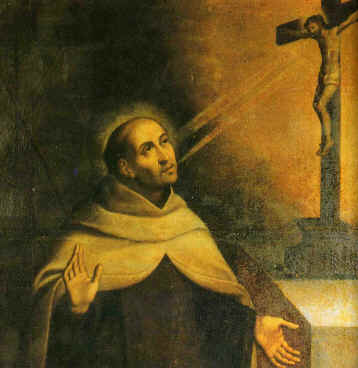
St. John of the Cross, December 14
Today is the commemoration of the great Spanish mystic, St. John of the Cross. My blog post from last year is here.
As a complement to last year’s quotation from “The Dark Night of the Soul,” a few stanzas from “The Spiritual Canticle:”
SONG OF THE SOUL AND THE BRIDEGROOM
I
THE BRIDE
Where have You hidden Yourself,
And abandoned me in my groaning, O my Beloved?
You have fled like the hart,
Having wounded me.
I ran after You, crying; but You were gone.
II
O shepherds, you who go
Through the sheepcots up the hill,
If you shall see Him
Whom I love the most,
Tell Him I languish, suffer, and die.
III
In search of my Love
I will go over mountains and strands;
I will gather no flowers,
I will fear no wild beasts;
And pass by the mighty and the frontiers.
IV
O groves and thickets
Planted by the hand of the Beloved;
O verdant meads
Enameled with flowers,
Tell me, has He passed by you?
V
ANSWER OF THE CREATURES
A thousand graces diffusing
He passed through the groves in haste,
And merely regarding them
As He passed
Clothed them with His beauty.
VI
THE BRIDE
Oh! who can heal me?
Give me at once Yourself,
Send me no more
A messenger
Who cannot tell me what I wish.
VII
All they who serve are telling me
Of Your unnumbered graces;
And all wound me more and more,
And something leaves me dying,
I know not what, of which they are darkly speaking.
VIII
But how you persevere, O life,
Not living where you live;
The arrows bring death
Which you receive
From your conceptions of the Beloved.
Eucharistic whiplash–I love being a priest
Today was one of those days that nothing prepares you for. I woke up exhausted, feeling I hadn’t had a wink of sleep, and knowing that it was going to be one of those days. After the usual round of emails, that included a delightful surprise (more about that later), I made my way for the annual rector’s obligatory Christmas Eucharist for the Rector’s Guild. This is an organization that was founded decades ago, by a rector who was hoping to encourage women of the parish to support particular projects that he thought were worthy. Over time, it has become primarily a social organization and its membership is largely rather elderly.
I attended the meeting today and celebrated Eucharist for the some twenty-five women who were in attendance. I neglected to bring the pile of service booklets that were on my desk, so when I arrived, I decided that it would make most sense to celebrate a Rite I Eucharist. As I said to the ladies in attendance, most of them knew the responses, and then I quipped, if they didn’t know the responses in Rite I, they probably shouldn’t belong to the Guild. Indeed, the responses were loud and clear, and when I announced we would be doing Rite I, there were exclamations of joy.
I had a delightful time, connecting with some folks I rarely see, and enjoying being with a group of women in a context I rarely have the opportunity to be in.
This evening was a very different celebration of the Eucharist. I decided, very last minute, to try a Celtic Eucharist during Advent, choosing Tuesdays, because it seemed the best night, given other activities at Grace. Tonight was a revelation. The numbers weren’t particularly large, but given the minimal publicity, to have 13 in attendance is something of a feat. But more remarkable were the demographics. Of the 13, six were young adults and/or relative newcomers. They had heard about it only from our internal publicity. Since I’ve been at Grace, we’ve attempted a number of things on weeknights in Advent and Lent–Evening Prayer, Eucharist, book studies, but tonight’s turn-out was by far the largest for anything we’ve done on our own.
Of course there’s a certain amount of curiosity, but I think trying something new is worth the effort. I’m especially encouraged by the presence of young adults and am hopeful that when the Episcopal Campus Ministry moves to Grace in the New Year, we may find new ways of reaching out to students and young adults in our neighborhood.
It might also be that a straight Rite I service could be as appealing to people as the Celtic Eucharist we’ve been doing this Advent.
Let’s try it and see!